An angler’s year testing rods, riversides and patience

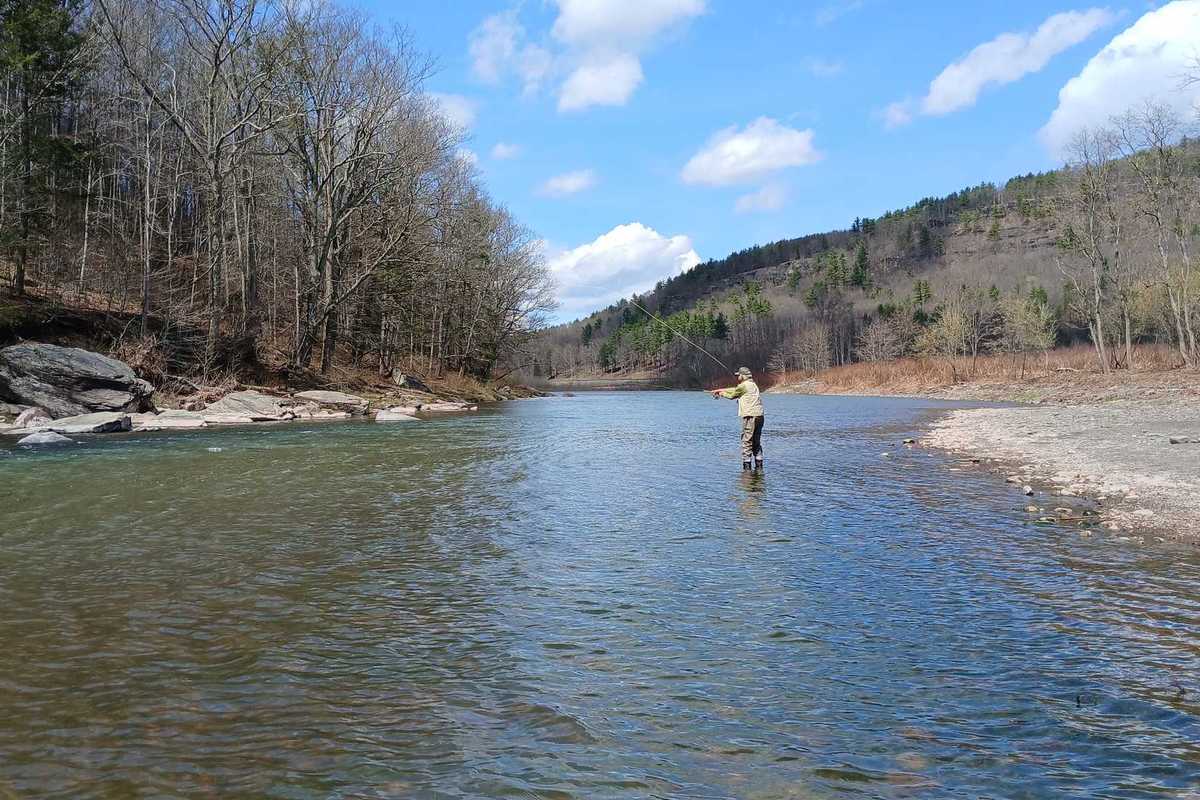
Gary Dodson casting at dawn on the Salmon River in Pulaski, New York in late April. It was cold but it sure looked nice.
Patrick L. Sullivan

Gary Dodson casting at dawn on the Salmon River in Pulaski, New York in late April. It was cold but it sure looked nice.
I was very optimistic as winter loosened its grip in the early part of 2025. I had a couple new rods to play with, my rotator cuff problem on my casting arm was resolved in a satisfactory manner, and I joined a private fishing club in the Catskills and was looking forward to exploring new water.
Some of the exploring and trying new things with new rods happened, but a lot of it did not. I blame Nature.
(Listening to anglers complain about the weather is as tedious as it gets, so feel free to skip the next bit.)
Just for laughs I plotted out the Housatonic flow from April 1 to Nov. 22 on the United States Geological Survey website. What I got back was an inverse bell curve, with high flows at the extremes and a long period of very low flows in between.
Amazingly, this corresponds to the rain, or lack thereof, between April 1 and Nov. 22. It’s just science.
So, looking back at the Tangled archives and my own hastily scribbled journal notes, I see that I started out when the snow and ice were still on the ground on the Blackberry in North Canaan and Macedonia Brook in Kent.
I do remember trying out a short rod, 6-feet 10-inches, from Zen Tenkara. I used it with two-fly rigs, including weighted flies, which should not work in theory, but it did in practice. The biggest problem was when a guy in the parking lot asked me what it was. I said, “It’s a Hachi” and the guy said, “Gesundheit.”
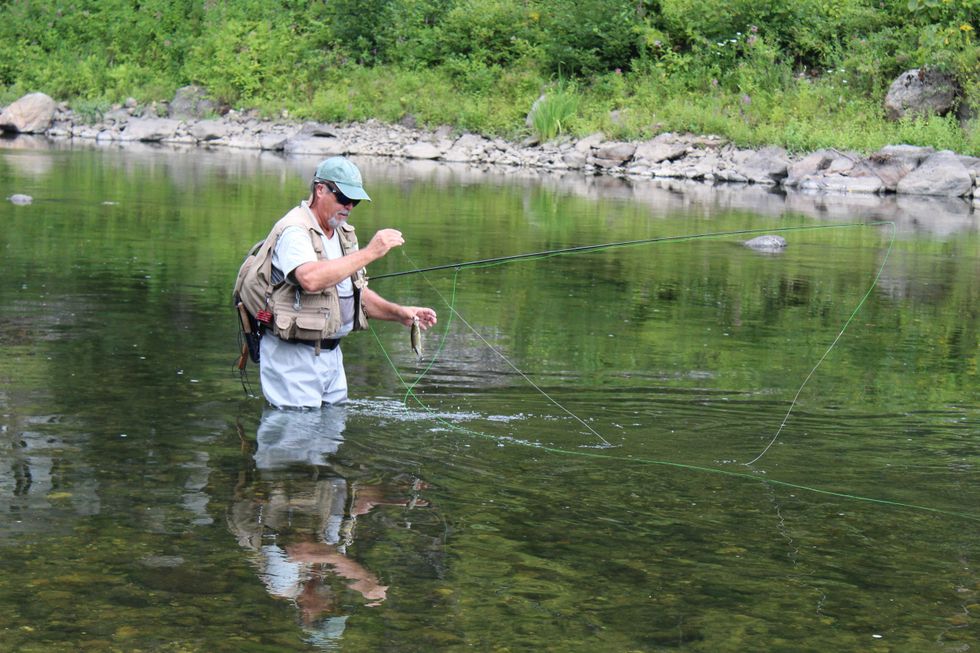
I had an interesting encounter with a couple of DEEP guys who were putting some brown trout fry in the Blackberry, since they had them to spare and were wondering what would happen. I suggested that they would get eaten up fairly quickly by the adult trout and they agreed but did it anyway.
The private water was a bust. There’s no other way to put it. I got there three times all year, and by the beginning of July the drought had settled in and the stream was nothing but a trickle.
I’m going to reup because I enjoyed meeting my fellow club members and the nice landowners who allow us to barge around their properties This year I’m going to hit it often and hard in May and June, circumstances allowing.
My Catskill fishing buddy Gary Dodson has got the big fish bug bad. We went back to Pulaski in late April and I caught a steelhead using a decadent and depraved method called “plugging.” I’m glad to have done it once and feel zero need to do it again.
I’ve had an 11-foot-4 weight switch rod kicking around for a few years. I never knew how to rig it up. In the two-handed rod world, the line weight designation means diddly. It’s all about grains and different tips and all this stuff that I just don’t want to learn.
Since Gary was already down in that rabbit hole I just gave him the rod, a big inexpensive Redington reel and asked him to get the appropriate lines and tips and set it up for me. Which he did, for about $150.
And I got to deploy it on the water precisely once in September before…
My right hip got the Gang Gong from the medical profession.
Yep. By the time this is published, I will have had my new right hip for about a month.
At this rate I’m going to be about 40% after-market parts.
So the entire autumn fishing routine, normally a happy and productive time, was shot to hell. My hip worked just enough to let me know that the kind of aggressive and active fishing I like to do was out of the question.
So apart from fiddling around in a half-hearted way with the fall stockies on the Blackberry in October, I spent the fall and early winter sitting around watching YouTube fish videos and plotting and scheming for all the excellent fishing adventures I will have with my new right hip.
Members of the North East Town Board discuss proposed zoning code revisions during a meeting at North East Town Hall in Millerton on Monday, Jan. 19.
MILLERTON — The North East Town Board on Monday, Jan. 19, adopted a series of detailed revisions to its proposed zoning code overhaul, incorporating feedback from county and local agencies as well as public comments.
Zoning Review Commission Chair Edie Greenwood and the town’s zoning consultant, Will Agresta, participated in the meeting as board members reviewed comments submitted by Dutchess County Planning, the North East Planning Board, the town’s Conservation Advisory Council, and residents who spoke or submitted written remarks during the initial public hearing on Jan. 8.
Board members addressed the comments line by line, approving changes that Greenwood described as largely technical in nature, including revisions to definitions that did not align with state regulations and clarifications intended to improve readability and consistency.
Greenwood said a red-line draft showing the approved changes alongside the original text will be prepared.
Among the more substantive revisions was the decision to impose an overall size cap on accessory dwelling units. The board voted to limit ADUs to a maximum of 1,200 square feet and specified that they must be accessed from an existing driveway on the property. Board members also discussed adding language to clarify how ownership through an LLC or trust would comply with the requirement that the property owner reside in the principal dwelling.
The board also approved allowing retail businesses and restaurants in the so-called Irondale District, a small commercial area encompassing seven parcels along Route 22 near Winchell Mountain Road and Irondale Road.
Other changes included:
– Replacing the term “farm” with “farm operation” for consistency with state law.
— Revising drive-through regulations to allow additional lanes for banks.
— Tying requirements for landscaped islands in parking lots to the size of the lot.
— Adding expiration dates for site plan approvals.
— Removing references to “cage-type poultry farms.”
— Requiring 10% of parking spaces in lots with 30 or more spaces to be “EV-ready,” meaning the necessary infrastructure must be installed, but not necessarily a charger itself.
— Standardizing safety and maintenance requirements across all parking regulations.
— Clarifying that parking structures may be built above or below grade.
— Allowing farm machinery sales and rentals.
Greenwood told The News she expects the red-line draft to be completed and submitted before the end of next week. The Town Board is set to continue the public hearing on the proposed zoning changes on Tuesday, Feb. 3, at 7 p.m. at North East Town Hall.
The following excerpts from The Millerton News were compiled by Kathleen Spahn and Rhiannon Leo-Jameson of the North East-Millerton Library.
January 24, 1935
About Millerton
Mayor and Mrs. William J. Brewer and Mr. and Mrs. Miles Jenks left on Monday for a month’s vacation in Florida.
Mr. Roy Ganung and daughter, Jane, spent Tuesday afternoon In Poughkeepsie.
Jean Silvernale is confined to home by illness.
Miss Blanche Bates is spending several weeks at the home of her brother, Edward Bates, at Pittsfield, Mass.
George Wooding of Thornewood spent Sunday at the home of his sister, Mrs. Harry Card.
Mr. and Mrs. Lewis Decker and family moved to Lakeville on Sunday.
January 22, 1976
Snowmobiles Tresspassing[sic], Officer Says
Trespassing and riding on public roads are the major offenses committed by area snowmobilers this winter, New York State Conservation Officer Harry Wheeler stated this week.
He asserted that a number of snowmobile riders have been sighted traveling on public roads and soaring across private property without permission, both illegal acts.
January 18, 2001
Local Homes Added to Historic Register
COLEMAN STATION — Three houses in the town of North East were recently added to the National Register of Historic Places.
The Oliver Barrett House, the Dakin-Coleman Farm and the Thomas Wheeler Farm, all located in the Coleman Station area, were selected by the New York state Office of Parks, Recreation and Historic Preservation to be listed individually on the register, though the entire Coleman Station Valley was considered for the recognition in 1993.
Millerton Sees Some Business Changes; Shops Move, Expand
MILLERTON- Two stores on Main Street in Millerton have interior changes in the works.
Leslie Hoss Flood has recently relocated her Amenia-based store to the basement of the Millerton Antiques Center. Ms. Flood’s shop had been in Amenia for about 15 years, where, in addition to selling used and antique furniture, Ms. Flood also ran an upholstery shop.
After removing several partitions and installing new lights, the basement store looks entirely new. Ms. Flood is pleased with the space, which offers more room in which to showcase her wares. She is also taking advantage of the additional area by creating a separate reupholstery room and a section to display in-stock fabrics.
Pasta-At-Large Expands
After acquiring the empty space, owner Sofia Okołowicz has expanded her business to provide “a little more elbow room inside.”
The front portion has been open since late November and, in recent days, Ms. Okolowicz has removed a wall and had electricity installed in the new area.
The college-age generation is grappling with inflation, increasing housing prices, climate change, and now mass corporate layoffs. In a world where geopolitical turmoil is increasing, the ground beneath their feet is shifting. Many believe their future is bleak.
My nephew, Joey, just got married. His wife lives with her parents, and he lives with his. While he makes good money as a pharmacy manager at a national chain drugstore, neither he nor his wife can afford even a down payment on a house in Long Island. They are moving in with the wife’s parents. Joey’s sister is also married with two children. They also live with their parents. Welcome to the American dream turned nightmare for almost 70 million young Americans.
The typical age range of Gen Z is 1997 to 2012. They are the demographic cohort succeeding Millennials and preceding Generation Alpha. They are the most racially and ethnically diverse generation in America, with 48% being non-white.
Almost all of this generation is highly active on social media. Almost 60% are planning to pursue a college education. They are just as likely to identify as Republicans, Democrats, or Independents. As such, the present populist upheaval the U.S. is undergoing takes an inordinate toll on them. It may be why 91% of Gen Zers report experiencing symptoms of stress and anxiety.
While Wall Street opened the year celebrating the promise of a bright future, thanks to AI. Opinion leaders predict that artificial intelligence, robots, and space, among other technological breakthroughs, will dramatically reshape the way the world works. For college grads, all they see is a no-fire, no-hire labor market where unemployment among workers ages 20 to 24 continues to rise. It is now to 5.3% and even worse for those younger than that.
The National Association of Colleges and Employers predict the entry-level hiring crisis will worsen this year, rating job prospects as poor or at best fair. At a recent gathering of employers at the Yale School of Management, 66% admitted they planned to cut jobs or freeze hiring.
With an economy that is expected to grow by 3% in 2026, one would have expected the opposite reaction, but then you would not be reckoning with the impact of artificial intelligence on the job market. Potential employers are concerned and uncertain about how AI might reshape the workforce over the next few years, and rightfully so.
Most analysts believe that many white-collar positions, especially at the entry level, will be replaced by technological advancement. Underscoring that concern, many corporate giants, including Amazon, UPS, Target, and Google, announced layoffs affecting more than 60,000 jobs. And to many, that is just the tip of the iceberg.
Faced with taking fast-food jobs at minimum wage and lacking work experience in their hoped-for professions, 3 in 5 Gen Z workers are looking elsewhere for a job with some kind of reasonable future. Almost half of these young workers believe the blue-collar jobs may offer better long-term security than corporate work in the technology fields. The top sectors pursued by Gen Z include plumbing, automotive repair, construction, and electrical work.
I happen to agree with that belief, but unfortunately, Gen Z applicants face the same barrier to entry in their white-collar arena—lack of experience. Many job applicants, regardless of industry, are now required to have at least 3 years of experience and up to 5 years before being considered.
The lure of six-figure salaries in the blue-collar area is attracting more Gen Zs to vocational schools. However, what many conveniently forget is that earning that kind of take-home pay requires years of experience, a substantial investment in personal tools and equipment, and serious wear and tear on the body.
As I write this, in the next room, a 65-year-old builder I’ll call Scott, who is going in for his second knee replacement next month, is building another room in our condo. Assisting him is a young GenZer. There is a constant stream of chatter as Scott talks through his drywalling process. His helper listens intently. They seem eager to learn and ask questions as they work. He did the same when he placed the struts and erected the wall.
For several years, Scott has been involved in a local high school program that teaches vocational school grads his business, while they gain on-the-job experience and a paycheck. Scott and others like him are providing a solution one day at a time. He is one answer to the dilemma facing this struggling generation. This country needs more Scotts to hire and teach a young workforce in need.
Next week, I will highlight one area where many Gen Xers have found an alternative to home ownership. It holds risks but doesn’t cost an arm and a leg to get involved.
Bill Schmick is a founding partner of Onota Partners, Inc., in the Berkshires.Bill’s forecasts and opinions are purely his own and do not necessarily represent the views of Onota Partners, Inc. (OPI).