Tarantula rain calls for Tenkara rods

Tarantula rain calls for Tenkara rods

Enough theory, time to get wet. Anglers took a shot at smallmouth bass in the Housatonic River during a Trout Unlimited event Saturday, Aug. 3

Patrick L. Sullivan

We are in unequivocal bass mode at the moment, although the recent tarantula rain has brought up the flow of the little blue lines to the extent it might be worth a go.

What is tarantula rain, you ask?

Years ago, the checkout clerk at the old Grand Union in Millerton was performing a soliloquy while ringing up purchases. There was no other employee so all of us in line had no choice but to listen.

The gist was the clerk had attended some kind of motor sports event and a thunderstorm blew up suddenly, forcing a stampede. The woman was indignant that the management had not foreseen this and provided cover for the spectators to get out of what she called “the tarantula rain.”

I am 99% sure this was a malaprop and she meant “torrential.” But I retain a nagging suspicion that she was describing a supernatural spider event.

Skipping lightly over this incident of yore, the first couple of spins around the warm water lake where I am spending August yielded a pickerel, a couple of juvenile smallies, some juvenile largemouth, and one Mongo-type lunker.

I am pleased to say that the lunker was landed using a Tenkara rod, which means no reel and a great deal of uncertainty.
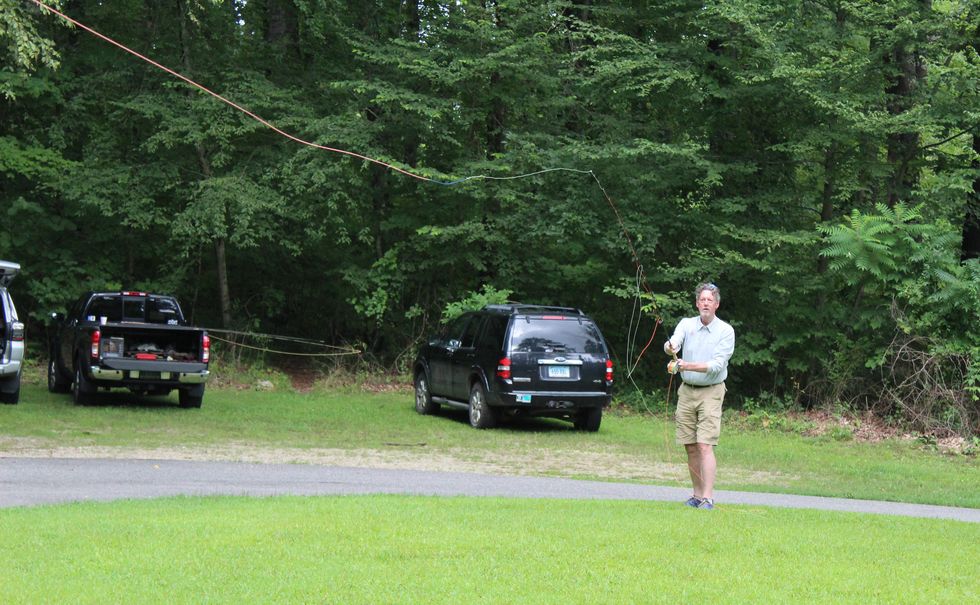
Tom Carter practiced his two-handed casting at the Trout Unlimited picnic Saturday, Aug. 3. Patrick L. Sullivan

On Saturday, Aug. 3, the Northwest Connecticut and Naugatuck-Pomperaug Trout Unlimited chapters, plus the Housatonic Fly Fishermen's Association, held a “Burgers and Bass” event at Housatonic Meadows State Park.

It was hard to get a head count as people kept drifting off to wet a line, but I’d say about 25 anglers turned up.

Jerry Jahn and Peter Chuang were on hand to teach us about casting two-handed rods. This was simultaneously enlightening and bewildering.

The enlightenment came from actually seeing it done, and realizing it’s not as difficult as one might imagine (or fear).

The bewilderment came when Jahn, in response to a simple question about the material used to link one piece of fly line to another, gave this reporter the fishing data equivalent of tarantula rain.

After a solid half hour of Knowledge I slithered away and ran a few streamers and poppers through the choppy water upstream of where the picnic was held. A couple of dinker smallmouth were willing to play a little, but it was one of those overcast, baking summer days when I can just feel the harmful UV rays bypassing the sunscreen and going to work on my cells.

So I cheesed it and headed back up to the bass lake, where everyone was settling in for another bout of thunderstorms, with a 1% chance of furry arachnids.
Latest News

'We need more daycare' — rural parents say

Dutchess County Legislator Chris Drago addresses the crowd at the end of a discussion on challenges facing parents and child care providers in rural northeast Dutchess County on Wednesday, Feb. 25. Drago hosted the forum to collect feedback from local stakeholders ahead of an expected $20 million in state funding to establish a universal childcare program in the county.

Photo by Nathan Miller

PINE PLAINS — Parents and child care leaders gathered Wednesday, Feb. 25, to discuss concerns about early child care access and affordability in the rural northeast corner of Dutchess County.

County legislator Chris Drago, who represents the towns of North East, Pine Plains, Stanford, Milan and Red Hook, hosted the event at the Stissing Center on Church Street to seek community feedback following news about a proposed pilot program that would expand funding for child care, particularly for children under three, in Dutchess County.

Keep ReadingShow less

Classifieds - February 26, 2026

Classifieds - February 26, 2026

Help Wanted

PART-TIME CARE-GIVER NEEDED: possibly LIVE-IN. Bright private STUDIO on 10 acres. Queen Bed, En-Suite Bathroom, Kitchenette & Garage. SHARON 407-620-7777.

The Salisbury Association’s Land Trust seeks part-time Land Steward: Responsibilities include monitoring easements and preserves, filing monitoring reports, documenting and reporting violations or encroachments, and recruiting and supervising volunteer monitors. The Steward will also execute preserve and trail stewardship according to Management Plans and manage contractor activity. Up to 10 hours per week, compensation commensurate with experience. Further details and requirements are available on request. To apply: Send cover letter, resume, and references to info@salisburyassociation.org. The Salisbury Association is an equal opportunity employer.

Keep ReadingShow less
google preferred source

Want more of our stories on Google? Click here to make us a Preferred Source.

To save birds, plant for caterpillars

Fireweed attracts the fabulous hummingbird sphinx moth.

Photo provided by Wild Seed Project

You must figure that, as rough as the cold weather has been for us, it’s worse for wildlife. Here, by the banks of the Housatonic, flocks of dark-eyed juncos, song sparrows, tufted titmice and black-capped chickadees have taken up residence in the boxwood — presumably because of its proximity to the breakfast bar. I no longer have a bird feeder after bears destroyed two versions and simply throw chili-flavored birdseed onto the snow twice a day. The tiny creatures from the boxwood are joined by blue jays, cardinals and a solitary flicker.

These birds will soon enough be nesting, and their babies will require a nonstop diet of caterpillars. This source of soft-bodied protein makes up more than 90 percent of native bird chicks’ diets, with each clutch consuming between 6,000 and 9,000 caterpillars before they fledge. That means we need a lot of caterpillars if we want our bird population to survive.

Keep ReadingShow less
Stephanie Haboush Plunkett and the home for American illustration

Stephanie Haboush Plunkett

L. Tomaino
"The field of illustration is very close to my heart"
— Stephanie Plunkett

For more than three decades, Stephanie Haboush Plunkett has worked to elevate illustration as a serious art form. As chief curator and Rockwell Center director at the Norman Rockwell Museum in Stockbridge, Massachusetts, she has helped bring national and international attention to an art form long dismissed as merely commercial.

Her commitment to illustration is deeply personal. Plunkett grew up watching her father, Joseph Haboush, an illustrator and graphic designer, work late into the night in his home studio creating art and hand-lettered logos for package designs, toys and licensed-character products for the Walt Disney Co. and other clients.

Keep ReadingShow less
Free film screening and talk on end-of-life care
‘Come See Me in the Good Light’ is nominated for best documentary at this year’s Academy Awards.
Provided

Craig Davis, co-founder and board chair of East Mountain House, an end-of-life care facility in Lakeville, will sponsor a March 5 screening of the documentary “Come See Me in the Good Light” at The Moviehouse in Millerton, followed by a discussion with attendees.

The film, which is nominated for best documentary at this year’s Academy Awards, follows the poet Andrea Gibson and their partner Megan Falley as they are suddenly and unimaginably forced to navigate a terminal illness. The free screening invites audiences to gather not just for a film but for reflection on mortality, healing, connection and the ways communities support one another through difficult life transitions.

Keep ReadingShow less
google preferred source

Want more of our stories on Google? Click here to make us a Preferred Source.

google preferred source

Want more of our stories on Google? Click here to make us a Preferred Source.