Stir-crazy angler takes first trip of new year

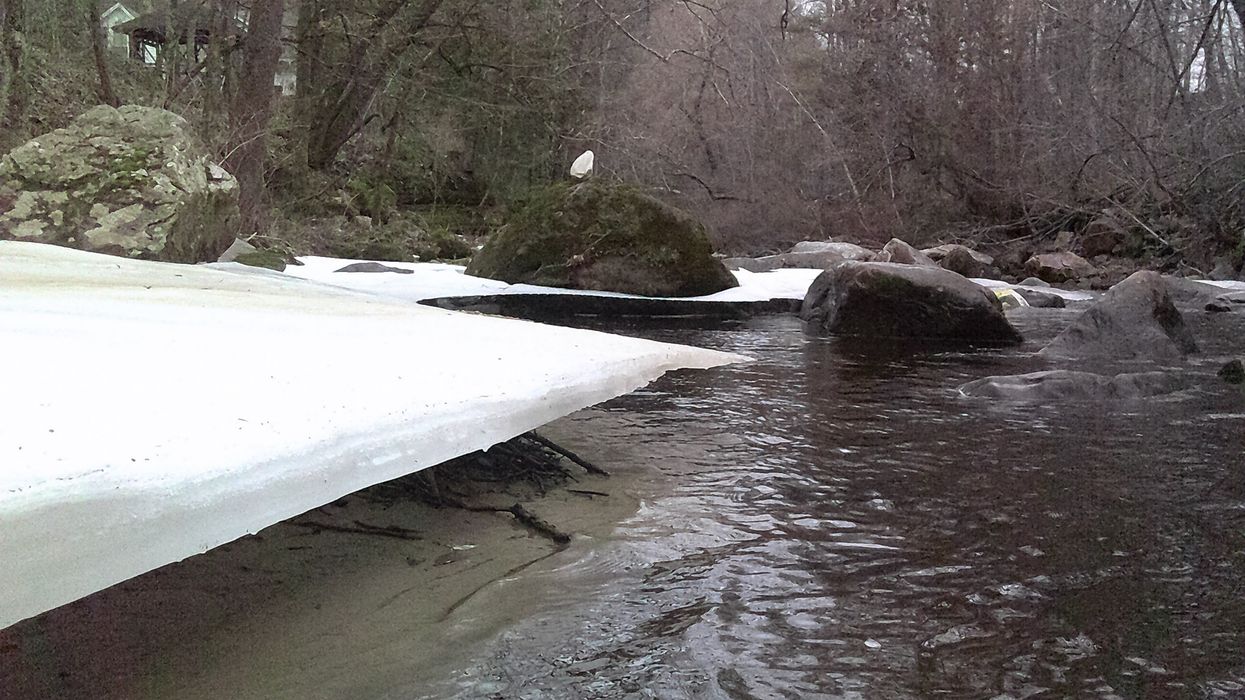
Shelf ice on the Blackberry River last week. Do not stand on shelf ice. It's a great way to get hurt.
Patrick L. Sullivan

Shelf ice on the Blackberry River last week. Do not stand on shelf ice. It's a great way to get hurt.
I’ve got a bad case of the Shack Nasties.
With a slight change in the weather I ventured out Wednesday and Thursday, March 5 and 6.
First I scouted a couple of little blue lines. No good. Still too much ice and snow for solid footing.
Since I am nursing a rotator cuff injury and my right pinky toe still aches from when I cleverly slammed it into the furniture two months ago, I am not in the mood for adventurous wading.
That left the Blackberry.
At one spot the shelf ice was still in effect. It was theoretically fishable but I kept going to Beckley Furnace, where the big pool beneath the dam was clear.
I pounded it hard, starting with junk flies such as squirmy worms and brightly-colored mops.
Then I got cute with a double-nymph rig: a little black stone on a dropper and a Bread and Butter nymph with a tungsten head on point to drag the whole thing down into the depths.
I managed two bumps. One could have been a hangup but I’m counting it as a bump.
Downstream below the second, smaller dam the shelf ice presented serious challenges.
There’s really only one way to get rid of shelf ice besides waiting for it to melt.
That is to stand on it and break it.
This is an excellent way to break up shelf ice.
It is also an excellent way to sprain or break an ankle.
Maybe it’s old age creeping up on me, but somehow I am not inclined to take the chance.
Imagine really banging yourself up mere weeks before fishing starts in earnest, and then sitting sullenly in a dark room watching old Filipino horror movies as the broken or sprained element heals while outside trout are merrily gobbling up bugs after the long winter.
Thursday I went further afield. Furnace Brook in Cornwall, always an early season favorite, was roaring after the inch-plus of rain we got Wednesday night.
That left Macedonia Brook in Kent, which was actually fishable above the waterfall.
I probed that for a couple hours with a Tenkara rod and a series of darkish nymphs that could be mistaken for an early black stonefly.
Or just something to eat. I doubt any holdover trout in there are all that picky about the menu.
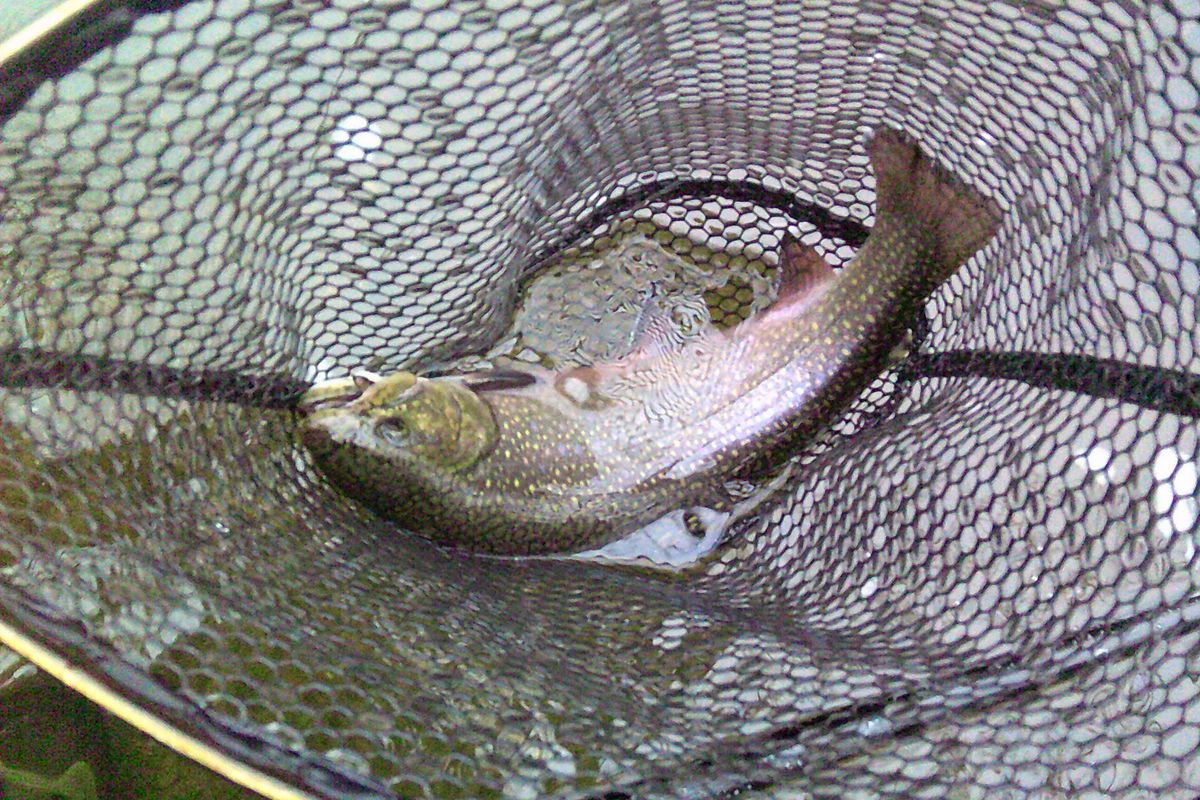
I managed to tickle precisely one small brown trout.
In fact I messed with that little guy for about an hour.
It went like this:
Cast. Drift into strike zone. Lift out before fly gets stuck in brush buildup. Watch bemusedly as little brown trout pecks at nymph on the way up.
Cast three or four more times with no result. Sit on rock. Ponder the infinite. Consider changing fly. Conclude it makes no difference. Watch passenger car slither around on muddy dirt road.
After 10 minutes of this, drift nymph into strike zone and miss fish again. Sit back down on boulder…
Standard operating procedure in these cases is to say, “Oh well. At least it was nice to get out.”
This is baloney. It was cold and windy and nobody with any sense would go out and stand in cold water just for the sake of getting out of the house.
But…
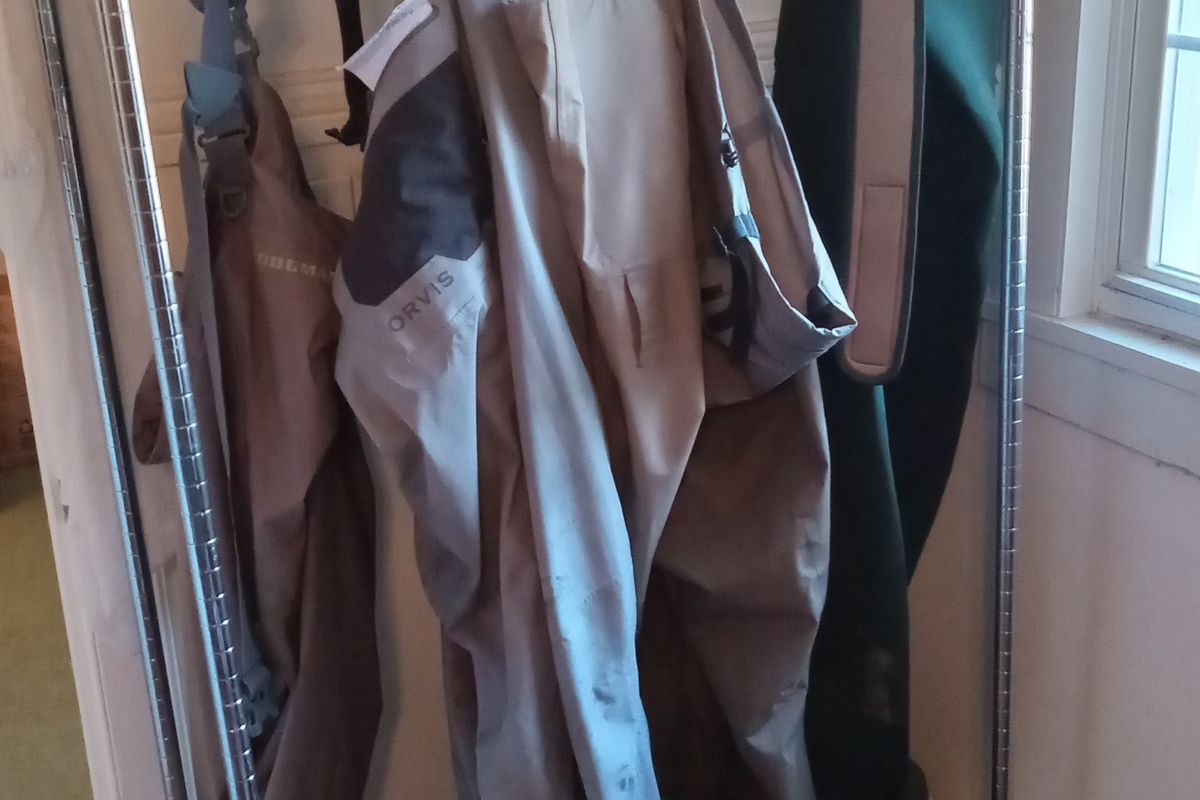
I didn’t injure myself. My waders didn’t leak. I was wondering if I could get an orthotic insert into the wader boot without problems. I could.
I didn’t break or lose any equipment other than a black conehead Wooly Bugger, size 8, which was claimed by the tree that is sticking into the Beckley pool.
And I didn’t get stuck in the mud on the seriously gooey Macedonia State Park road.
So this initial salvo of the 2025 campaign goes in the win column.
Nathan Miller
Pine Plains Councilwoman Jeanine Sisco displays a photograph of flashing lights used to alert drivers to pedestrians in crosswalks in Millerton during a public forum at Pine Plains Town Hall on Tuesday, March 3. Sisco outlined plans to repair sidewalks and install two new crosswalks in downtown Pine Plains as a first phase in sidewalk repairs across the town.
PINE PLAINS — Town Board members unveiled plans for sidewalk renovations in downtown Pine Plains as they prepare to apply for a federal grant to fund the first phase of the project.
Councilwoman Jeanine Sisco described the first phase of the sidewalk project at a public forum at Pine Plains Town Hall on Tuesday, March 3.
The first phase calls for repairing sidewalks along Church Street and Main Street and the crosswalks where those streets meet. Two new crosswalks are planned — one on Church Street at the intersection with Academy Street and another on Main Street that will connect the sidewalk on the east side of the street to the Pine Plains Free Library and Community Center.
Town Board members said they intend to apply for a Transportation Alternatives Program grant. The federal funds are administered through the New York State Department of Transportation to finance projects that promote walkability and lessen dependence on cars in a community. The application deadline is March 12, 2026.
Discussion at the public forum centered around crosswalk safety and the inclusion of flashing yellow lights on signposts for pedestrians to activate when they cross. Sisco said it's unclear whether flashing lights will be required at the crosswalks.
She showed pictures of crosswalks in Pleasant Valley, New York, across Route 44, that do not have flashing lights, which she said indicated the lights may not be required in Pine Plains. Sisco also showed pictures of the crosswalks in downtown Millerton that feature lights that would be similar to installations in Pine Plains if required.
Residents were divided on the issue, with opponents raising aesthetic concerns and supporters citing research that flashing lights improve driver awareness and safety at crosswalks.
Pine Plains resident Torey Soracco said she opposed flashing lights at the crosswalks and questioned prior Town Board statements that indicated the lights may be required under grant stipulations.
Soracco asked about the lights' effectiveness, and whether alternative safety measures had been considered. She supported a police presence at the crosswalks to deter unsafe driving.
"I want to make sure we're doing the best way we can," Soracco said. "We already know a way to do that. The fastest way is to give people tickets."
Michael Stabile, who serves as Chair of the Pine Plains Planning Board, spoke in support of flashing lights. He said Federal Highway Administration (FHWA) studies show flashing lights at crosswalks improve driver awareness.
The lights, officially known as "rectangular rapid flashing beacons," reduce pedestrian crashes by up to 47% according to data from the FHWA. Figures on the FHWA's website also state that driver yield rates increase up to 98% at crosswalks with flashing lights.
"I worry about putting sidewalks in that don't have enough safety features," Stabile said.
Sisco said town officials are budgeting for flashing lights in the event they are required, but current plans are to avoid the lights if possible.
Town Supervisor Brian Walsh laid out the timeline of the project. He said the grant process and design work for the first phase would likely take the rest of this year and continue through 2027. He added that the current timeline indicates the first phase of repairs will be complete in late 2028.
After that first phase, Walsh said the project would expand outward from the town center to repair damaged sidewalks and install new paths.
Those plans have not been laid out yet, with no clear timeline given at the public forum. Board members acknowledged the project will be a lengthy process.
D.H. Callahan
Contemporary chamber musicians, HUB, performing at The Clark.
Northwestern Massachusetts may sometimes feel remote, but last weekend it felt like the center of the contemporary art world.
Within 15 miles of each other, MASS MoCA in North Adams and the Clark Art Institute in Williamstown showcased not only their renowned historic collections, but an impressive range of living artists pushing boundaries in technology, identity and sound.
MASS MoCA is known for its 20th-century holdings spread throughout a sprawling complex of industrial brick buildings. Installations by Sol LeWitt and James Turrell have permanent homes there. Just down the road in Williamstown, the Clark features masterworks by Winslow Homer, Frederic Remington, John Singer Sargent and Claude Monet.
But what visitors might not immediately associate with those established names is how deeply both institutions invest in art happening right now.
On Saturday afternoon, a panel of young artists discussed their relationships with art, identity and technology as part of MASS MoCA’s “Technologies of Relation” exhibition, which opened that evening. The artists represented a broad range of cultural backgrounds, drawing on ancestry while exploring the future of art and technology.
The work itself ran the gamut: wax relief paintings, stained glass, interactive video and sculptural installations. One immersive piece automated the traditional Armenian practice of reading fortunes from coffee grounds. Particularly striking were Roopa Vasudevan’s hand-drawn QR codes and Taeyoon Choi’s large-scale weavings of binary code.
Opening the same night was Zora J. Murff’s “RACE/HUSTLE.” Through photographs, paintings and installations, Murff explores the wide-ranging and sometimes violent implications of being Black in America today. Each piece — whether confronting the rise of white supremacy or examining stereotypes imposed on Black communities — carries razor-sharp visual commentary designed to unsettle.

On Sunday, the Clark continued the contemporary thread. A small exhibition of work by Raffaella della Olga, titled “Typescript,” features intricate patterns created using a typewriter on varied paper surfaces. The effect seems almost impossible until viewers watch a video of della Olga loading her typewriter with 140-grit sandpaper and typing in a hypnotic rhythm. Though the typewriter is considered obsolete technology, she continues to find new applications for it, completing some of the works in recent months.
Next door in the Clark auditorium, HUB New Music performed works written specifically for its unusual instrumentation: violin, cello, clarinet and flute. While that combination may not stand out to casual listeners, relatively little classical repertoire exists for it. The ensemble regularly commissions composers to expand the possibilities.
The results were striking. From the opening notes of Francisco del Pino’s “Passacaglia,” the quartet’s command and layered repetition pulled unexpected emotion from the audience.
After three pieces came the world premiere of Daniel Wohl’s “Mirage,” a roughly 25-minute work accompanied by digital blips, static and electronic textures evoking radio transmissions and UFO lore. Hearing four virtuoso musicians extract entirely new sounds from traditional instruments echoed the weekend’s larger theme: old tools made new again.
Like della Olga’s typewriter, Vasudevan’s QR codes or Murff’s charged imagery, the performances demonstrated that contemporary art often grows from familiar materials — reimagined.
The old masters will always draw visitors to these institutions. But when living artists command equal attention, this quiet corner of the Berkshires feels less like the middle of nowhere and more like a creative epicenter.
D.H. Callahan is a voice actor, creative director and trail steward. He lives with his artist wife in West Cornwall, Connecticut.

Want more of our stories on Google? Click here to make us a Preferred Source.
Aly Morrissey
Francesca Donner, founder and editor of The Persistent. Subscribe at thepersistent.com.
Francesca Donner pours a cup of tea in the cozy library of Troutbeck’s Manor House in Amenia, likely a habit she picked up during her formative years in the United Kingdom. Flanked by old books and a roaring fire, Donner feels at home in the quiet room, where she spends much of her time working as founder, editor and CEO of The Persistent, a journalism platform created to amplify women’s voices.
Although her parents are American and she spent her earliest years in New York City and Litchfield County — even attending Washington Montessori School as a preschooler — Donner moved to England at around five years old and completed most of her education there. Her accent still bears the imprint of what she describes as a traditional English schooling.
Today, she and her family call Sharon, Connecticut, home. While she still travels frequently to Manhattan, she embraces the contrast between city and countryside.
“For me, it’s all about the contrast,” she said, adding that she is friendly and curious about people here in a way that doesn’t feel natural in the city. “I want to know who you are, what you do, and why you’re here. You end up meeting these really interesting people.”
As a longtime editor in newsrooms like The Wall Street Journal, The New York Times and Forbes, Donner said she began to notice something unsettling about how stories were framed, and whose voices were missing.
“It’s just the way news is done,” she said. “It’s the DNA of what we deem newsworthy and important in mainstream media.”
The problem, she explained, isn’t that women aren’t covered at all. It’s that when women are covered, it’s often in a stereotyped way. Women are frequently framed through familiar narratives – the gender pay gap, unpaid labor, caregiving – important issues that persist, she said, but are often treated as repetitive or secondary. Meanwhile, the stories deemed front-page worthy tend to revolve around power, economics, war and politics — and men.
“If we don’t make a deliberate effort to cover women, women won’t be covered,” Donner said.
The issue isn’t unique to any outlet, she stressed. “It’s just the way news is done.”
But that DNA — who gets quoted and whose experiences are centered — has consequences.
And for Donner, that realization demanded a response.
Enter The Persistent.
Founded in 2024, The Persistent was built around what Donner calls a simple but deliberate premise.
“Women don’t get covered in the same way men get covered,” she said.
The goal isn’t to exclude men or create a siloed “women’s section.” Instead, Donner said, it’s about correcting an imbalance by putting women at the center of the story.
Describing the approach as a reframe, this means expanding who is quoted as an expert. It means spotlighting women in business, politics, culture and global affairs. It also means examining major news stories through a lens that mainstream outlets often overlook.
“What we can add,” she said of The Persistent, “is perspective.”
Now approaching its second year — a milestone that will be celebrated next month — the publication operates with an all-women team of writers, editors and illustrators based across the world. The team meets regularly over Google Meet.
“They’re awesome,” Donner said of the editorial meetings. Some of her staff are mothers, some are not. All bring lived experiences to the table. Donner has intentionally created a newsroom culture that balances rigor with support.
“If your writing doesn’t measure up, I’m going to tell you,” she said plainly. “But it’s not a battle. It’s a partnership.”
Beyond publishing stories that matter, Donner wants contributors to be seen.
“I don’t just want people to read the story and forget who wrote it,” she said. “We can do a lot better if we amplify each other.”
As a woman, Donner rejects the idea that success is finite. She wants everyone to have a slice of the pie.
“Just make the pie bigger,” she said. “Bring more seats to the table. Make it richer.”
Donner credits her “mum” for articulating what would become her professional identity.
“You are what you can’t help doing,” her mother used to say.
Today, without hesitation, Donner said she can’t help being an editor.“My identity as an editor is very strong,” she said. Editing, she explained, is less about correcting typos and more about building and shaping ideas.
“Sometimes I imagine this physical movement of cracking something open,” she gestured.
That instinct traces back to childhood. She recalls sitting in a classroom around age 10, listening to a classmate read a short story aloud. For Donner, that moment crystallized something fundamental.
“Someone else’s words made me just sit up straight in my chair and think, wow, that is so good.”
Today, whether she’s in a historic manor house in Amenia or on a Google Meet with her team across the globe, that instinct remains the same: crack the story open, elevate the unheard voice and reframe the narrative.
Natalia Zukerman
On March 7, Berkshire Opera Festival will bring “Winterreise” to Studio E at Tanglewood’s Linde Center for Music and Learning, with baritone Jarrett Porter and BOF Artistic Director and pianist Brian Garman performing Franz Schubert’s haunting 24-song setting of poems by Wilhelm Müller.
A rejected lover. A frozen landscape. A mind unraveling in real time. Nearly 200 years after its premiere, “Winterreise” remains unnervingly current in its psychological portrait of isolation, heartbreak and existential drift.
Porter, praised by Opera News for his “imposing baritone” and “manifest honesty,” has built his career on major European opera stages, including Oper Frankfurt. But recital work, he says, is closest to his heart.
“I love to recital. If I were to pick my career, I would be doing some opera and mostly recital,” he said. “I think there can be difficulty with grabbing an audience in a recital, but this is one of the greatest pieces to do so because it is so psychological, so powerful, so universally moving.”
Unlike opera, there are no sets in a recital, no costumes or lighting cues to lean on. “The singer with no sets or costumes is left to create a kind of one-man show,” Porter said. His solution is internal. “The way that I process learning something like this and having the responsibility to hold an audience without set or costumes or lights or props is to stage it in my mind. Each song has an identity.”
Schubert’s writing, Porter insists, needs no adornment. “Schubert does an amazing job at setting the scene, and for me, you don’t need anything else. I feel like anything added to it would be almost subtracting. I’d rather just see the singer and the pianist the way that Schubert intended it to be.”
At the center of “Winterreise” is the wanderer, an unnamed figure moving through snow and memory after a failed love affair. For Porter, the character is both specific and universal. “There’s so much ambiguity in the piece,” he said. “We don’t know all of the answers in the first song. We don’t really know who this person is. There are tidbits of information dropped throughout each song. And I think the tendency is to put a narrative on that and to try to connect the dots rather than embracing what it is. The ambiguity is actually where the beauty is.”
That ambiguity extends to the cycle’s ending and the encounter with the eerie hurdy-gurdy player in “Der Leiermann.” Does the protagonist die? “I think one could make that argument,” Porter said. But he resists a neat conclusion. “Death is right in front of him. Death is actually the most peaceful answer to his problem and it’s not given to him. There’s something more, a deeper level.”
Rather than a literal death scene, Porter sees a reckoning. “For me, he’s not granted the easy way out. He has to sort of come to terms with being nothing and having no real skill as a songster or a poet or a wanderer.” The winter landscape, he suggests, mirrors the psyche: “The winter is sort of the mirror of his heart.”
In shaping the emotional arc across all 24 songs, Porter leans into uncertainty rather than resolution. “What I relate to in this piece is that in life, you don’t know what’s going to happen. And you don’t know the next day. Even in tragedy—especially in tragedy—there’s so much question.”
Porter performed Gounod’s “Faust” at BOF in 2024 with Garman conducting but this will be the first time the two will be collaborating with Garman at his instrument. “I love making music with Brian,” said Porter. “I’m a huge fan of his musicianship. I think we’re sort of bitten by the same bug that Schubert is, and so I was super honored that he asked me to do this with him.”
For tickets, visit berkshireoperafestival.org
Sally Haver
Christine Gevert, artistic director, brings together international and local musicians for a season of rare works.
Crescendo, the Lakeville-based nonprofit specializing in early and rarely performed classical music, will close its 22nd season with a slate of spring concerts featuring international performers, local musicians and works by pioneering composers from the Baroque era to the 20th century.
Christine Gevert, the organization’s artistic director, has gathered international vocal and instrumental talent, blending it with local voices to provide Berkshire audiences with rare musical treats.
“The biggest event of this part of our season is our April 25 and 26 concerts, with the US premiere of ‘A Jewish Cantata’ and the iconic ‘Misa a Buenos Aires,’” said Gevert. “The composer, an internationally renowned musician, will come and share the podium with me.”
Among the other season highlights are concerts showcasing the works of two trailblazing female musical innovators, Francesca Caccini, the early Baroque composer, poet and singer; and Wanda Landowska, the 20th-century virtuoso who single-handedly brought the harpsichord back from obscurity. Also not to be missed is the May 30 concert, Bach’s Motets in Concert, featuring all six of Johann Sebastian Bach’s surviving motets, sung by four eight-part double choruses and accompanied by period instruments, widely considered the pinnacle of Baroque choral music.
For a schedule of concerts and tickets, visit crescendomusic.org

Want more of our stories on Google? Click here to make us a Preferred Source.

Want more of our stories on Google? Click here to make us a Preferred Source.