Thank you!
Your support is sustaining the future of local news in our communities.

SNAP delays prompt response from area food access advocates

SNAP delays prompt response from area food access advocates

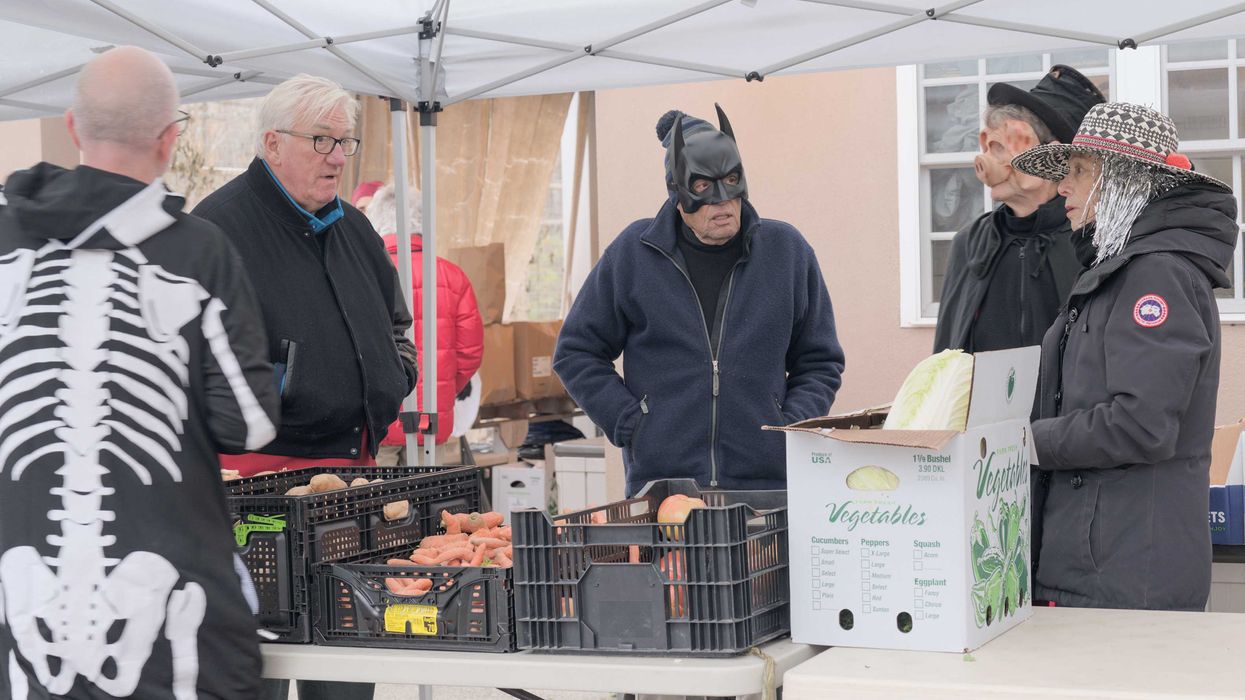
Volunteers at St. Thomas Episcopal Church’s Food of Life Pantry donned masks and costumes to celebrate Halloween while distributing meals on Friday, Oct. 31, at the church on Leedsville Road in Amenia. The pantry regularly serves more than 600 people every week.

Nathan Miller

The federal government shutdown has delayed SNAP benefits payouts nationwide, prompting New York State and Dutchess County governments to distribute millions of dollars in aid to food banks and pantries.

Dutchess County Executive Sue Serino announced on Friday, Oct. 31, that $1.5 million in reserve emergency funds would be distributed to food pantries across the county. The county plans to distribute $150,000 per week for 10 weeks to pantries across Dutchess.

The Supplemental Nutritional Assistance Program — commonly referred to as SNAP or food stamps — has never faced a delay in benefit payouts in its modern history.

Volunteers at the Food of Life Pantry — run by Amenia’s St. Thomas Episcopal Church and Charlie Paley of Sharon — said they expect the freeze in SNAP disbursements to strain a community that is already under stress.

Jim Wright, warden of the St. Thomas Episcopal Church, said keeping the food pantry stocked has become more difficult as free and reduced-price food from the Albany-based Food Bank of New York is increasingly scarce. He added that ongoing cuts to funding and staffing at the U.S. Department of Agriculture have only exacerbated the problem.

That scarcity has pushed the pantry to lean harder on other organizations such as the Tenmile Farm Foundation in Dover Plains, which Wright said has delivered 24,758 pounds of fruits and vegetables to the pantry this growing season.

“What’s been happening since late January is that there’s been less and less food that’s either free or lower price,” Wright said. “So many of our partners have stepped up.”

The Tenmile Farm Foundation is part of a network of like-minded organizations in the Tri-corner region of New York, Connecticut and Massachusetts that collaborate to promote access to nutritious, locally-produced food at an accessible price or for free.

The North East Community Center’s Food Programs Director Jordan Schmidt heads up the network — officially known as the Tri Corner Nutrition Security Coalition — as part of her role in charge of the community center’s food pantry and outreach programs.

Among the coalition’s partners is Tri-Corner F.E.E.D., which offers an alternative to traditional pantries. Linda and James Quella of Sharon, Connecticut, formed the organization and opened a market in Millerton that sells locally-produced groceries at subsidized prices.

Blake Myers, manager of the Tri-Corner F.E.E.D. Market on South Center Street in Millerton, collaborates with the coalition. She said the coalition has been closely monitoring local residents’ access to food, allowing its member farms, pantries and nonprofits to quickly redirect supplies when needs arise.

Tri-Corner F.E.E.D. operates a market with tiered pricing. Customers can sign up to buy groceries either at full price, at a 30% discount or at a 60% discount depending on their need.

Myers echoed Food of Life volunteers’ concerns about the community’s increasing dependence on local food pantries.

She said food pantries are supposed to be a resource in emergencies. “What’s happened is that they are now a regular resource that people need in order to feed their families,” Myers said. “This case of the SNAP benefits being cut is an emergency emergency, because there’s already so many families that are barely scraping by.”

The Rev. AJ Stack of St. Thomas Episcopal Church in Amenia said the most effective way to support the Food of Life pantry is through cash donations. “We can purchase things at much lower prices elsewhere,” Stack explained, adding that every dollar goes further when the pantry buys in bulk from its suppliers.

Myers offered a similar perspective when it comes to supporting Tri-Corner F.E.E.D. She told The News that customers with the means can best assist the nonprofit by purchasing items at full price — providing revenue that helps fund the market’s mission to offer affordable food to those in need.

“All of our shoppers here are by word of mouth,” Myers said. “Which is really important to me, because I wanted the experience to be something that people wanted to return to and feel comfortable.”
Latest News

Authorities end search for missing former Dover Town Supervisor

Ryan Courtien disappeared from his Waldo Road home in Wingdale on Sunday morning, July 12. Authorities concluded the search of the landscape surrounding his home after four days of scouring the woods at 4 p.m. Wednesday, July 15.

Photo by Lucia Iandolo

DOVER PLAINS — The search for former Dover Town Supervisor Ryan Courtien has concluded after four days of scouring the area surrounding his Wingdale home, but authorities say the investigation is ongoing.

New York State Police announced the end of the search for the 49-year-old Wingdale resident and current Dover Planning Board chair at roughly 4:45 p.m. Wednesday, July 15. Courtien disappeared from the yard in front of his Waldo Road home in Wingdale shortly after leaving the house at 9:30 a.m. Sunday, July 12, to work in his yard.

Keep ReadingShow less
Millerton dressmaker forged path as early businesswoman
Mary Kisselbrack, left, and her husband, George.
Provided

If you’ve driven down Main Street in Millerton, you’ve passed the former home and shop of one of the village’s earliest female entrepreneurs. At a time when most businesses were owned by men, Mary Kisselbrack made a name for herself in the late 1800s as a well-respected milliner and dressmaker.

On April 11, 1891, train conductor George Kisselbrack purchased a 124-by-232-foot vacant lot at 54 Main St. and hired locally renowned builders Beers and Trafford to design what would become their home and Mary’s business.

Keep ReadingShow less
Wastewater project coming to fruition after decades of debate

Millerton’s business community will soon see the completion of a public wastewater system, addressing what local officials and business owners have called a major constraint on commercial development in the community for decades.

The $13.8 million project, which is expected to serve the core of the Village of Millerton and a commercial stretch of the Town of North East along U.S. Route 44, represents one of the largest infrastructure investments in the community in decades, and brings an end to calls for a sewer system that stretch back to World War II. Officials say the system will safeguard local waterways while creating a foundation for long-term economic stability.

Keep ReadingShow less
google preferred source

Want more of our stories on Google? Click here to make us a Preferred Source.

Millerton Moviehouse marks 120 years with structural upgrades

Wooden beams made from tree trunks comprise the load-bearing structure under Millerton’s Moviehouse.

Graham Corrigan

There are a handful of buildings that have stood the test of time over Millerton’s 175-year history. But if there’s one that stands out as a singular representation of the town, it’s the Millerton Moviehouse and its iconic clock tower.

Built in 1903 as a grange hall, it was soon converted into a movie theater with a second-floor ballroom. It was one of a handful of buildings that came to define the town in the following decades, standing tall across the street from the Episcopal Church and Millerton Inn, next to Terni’s, and up the hill from Millerton’s train station.

Keep ReadingShow less
Irondale Schoolhouse: a piece of living history

Ralph Fedele sits at a desk in the historic Irondale Schoolhouse, which he led the effort to relocate to downtown Millerton.

Aly Morrissey
“It was in dire straits. Right on the road, but beautiful. I remember thinking, ‘Wouldn’t that be a great building to move into the village?’” —Ralph Fedele

A one-room schoolhouse sits on Main Street along the Harlem Valley Rail Trail, offering an opportunity for locals and visitors to step inside a piece of living history.

The Irondale Schoolhouse that now sits in downtown Millerton was not originally located on Main Street. The building was first constructed in 1858 along what is now Route 22 in the Irondale section of town, defined by Irondale road and the Old Mill that still sits along Webatuck Creek. At the time, the schoolhouse was one of 14 that served the Town of North East’s children.

Keep ReadingShow less
New Water Department building expected by summer’s end

Millerton’s former Water Department building, ravaged by fire, as it awaited demolition in summer 2025.

Aly Morrissey

Nearly 18 months after a fire destroyed Millerton’s Public Works building, which housed the Highway Department and Water Department, construction is expected to begin within weeks on a new Water Department facility and pumphouse.

The new building would restore the village’s full water pumping capacity and allow officials to end the state of emergency declared after the fire. Village officials are also planning a separate Highway garage, with details of that project still being finalized.

Keep ReadingShow less
google preferred source

Want more of our stories on Google? Click here to make us a Preferred Source.

google preferred source

Want more of our stories on Google? Click here to make us a Preferred Source.