Digitizing ancient records

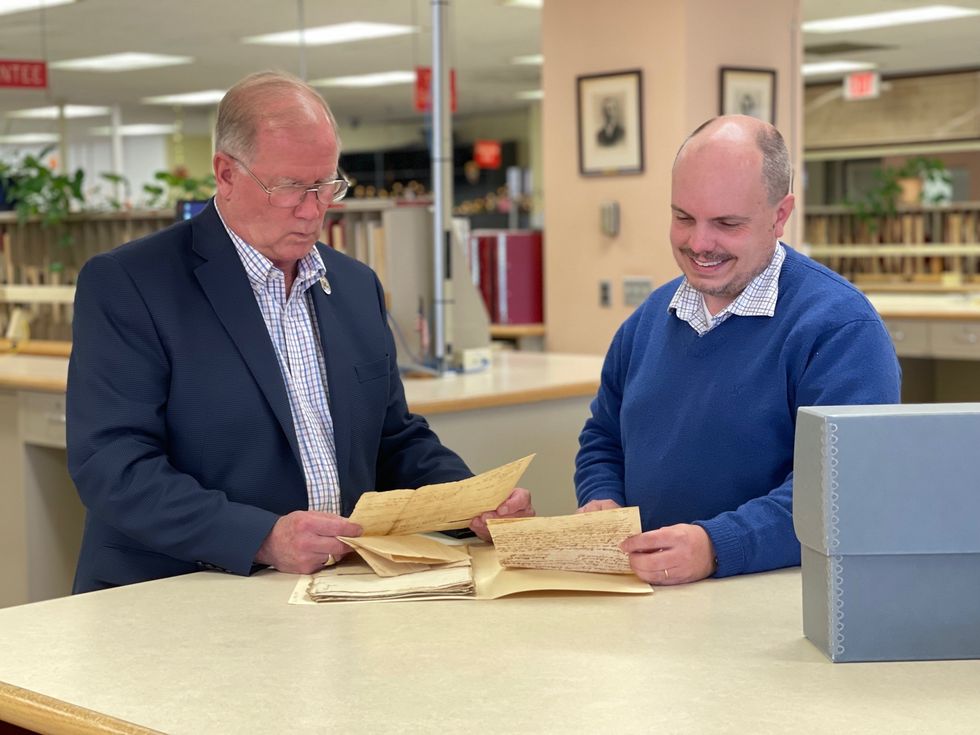
Dutchess County Clerk Brad Kendall, left, and Dutchess County Historian Will Tatum review a box of antique documents ready for imaging. Photo submitted

POUGHKEEPSIE — Dutchess County Historian Will Tatum, guardian of the written records of Dutchess County’s past, breathed a sigh of relief last week when he and his team completed Phase 9 of the Ancient Document Online Archive project.
At this point, 167,000 pages of handwritten records of the Dutchess County Courts of Common Pleas and General Sessions from 1721 to 1889 have been digitized and made accessible to the public, said Tatum.
“The Court of Common Pleas and General Sessions is the predecessor of today’s court system,” he explained.
They involve civil cases that mostly consisted of debts, he said, while “the criminal court ran the gamut from fraud to murder and all sort of salacious crimes.
“The contents of this collection are all the evidentiary statements, depositions—the narrations which laid out the case from the plaintiff’s perspective—and the various writs and other items which made up what we would consider the case file today,” he said.
By detailing personal and local history, the documents give valuable insight into the way the country evolved in the colonies, he said.
The many cases involving debts demonstrate the stark disparity between the haves and the have-nots, he said, and the ways in which many entrepreneurs and farmers struggled to overcome obstacles.
Other records showed that even members of the upper classes, such as a grandson of famous Revolutionary War Gen. Philip J. Schuyler, could also end up facing “financial calamity.”
The records also illustrate the small ways that the colonists resisted British rule. For example, British law restricted the degree to which ore could be refined, so that it would be processed in England instead, a limitation which affected the economic opportunities of the ironworks that dotted eastern Dutchess County.
However, a 1750 lawsuit against a Dover miner reveals that miners were processing ore and producing tools for blacksmiths and others despite the royal edicts.
Thousands of court records remain to be processed. To that end, the Online Archive project was recently awarded another year of funding from the New York State Archives Local Government Records Management Improvement Fund.
Once digitized, the fragile documents are treated and stored in acid-free containers at a specialized facility in Pennsylvania, then returned to the county for archiving.
Tatum, who credits County Clerk Brad Kendall with both the inspiration and implementation of the Online Archive project, explained that much of the local work was done by the staff of that office.
Noting that information is not of use to anyone if it is not used, Tatum encourages anyone having difficulty finding the material they want to call his office for help at 845-486-2381.
The digitized documents are available through www.dutchessny.gov/ancientdocuments and www.dutchess.gov/countyclerk

Farmland vista where one of the proposed solar arrays for Hecate Energy's proposed Shepherd's Run solar energy array on Route 23 in Craryville, New York.
COPAKE – The past year marked another herky-jerky dance on the community solar front for this otherwise quiet hamlet.
As 2025 rolled along, the battle between Hecate Energy LLC and residents opposed to its proposed 42-megawatt Shepherd’s Run solar farm entered its eighth year.
In February, New York State officials dismissed the company’s application, and the process of review continued through the rest of the year. Officials in Albany eventually issued two additional notices of incompleteness.
Meanwhile, state legislators also weighed in on the project. State Sen. Michelle Hinchey, D-41, and State Assemblywoman Didi Barrett, D-106, both expressed concerns about the project in letters to state officials and to Gov. Kathy Hochul. Hudson Mayor Kamal Johnson wrote about concerns the city’s Common Council cited in October 2024 about the safety of Hudson’s water supply.
The project has been controversial since it initially was discussed in 2017 — planned as a 60-megawatt solar farm to be located on farmland near the intersection of Routes 23 and 7. In January 2024, the project had to be downsized after the company lost control over a portion of designated land. As it now stands, Shepherd’s Run will span 700 acres with thousands of solar panels covering 225 acres.
In other developments, last summer Hecate found itself in Delaware Chancery Court as a creditor sought a restraining order against the Chicago-based developer, owner and operator of renewable power projects. A Hecate lender claimed: “Hecate Holdings is woefully insolvent, strapped for cash, and drastically over leveraged,” a motion stated. Then, soon thereafter, a second creditor filed a similar motion in the same court claiming Hecate was in default in its loan agreements.
By the middle of the next month, in September, state officials accepted the company’s Shepherd’s Run application as “complete” and within a requisite 60-day period issued a draft permit for the project. That was in mid-November.
Next up will be public hearings. Two will be virtual airings available on Tuesday, Jan. 27, at 2 p.m. and 6 p.m. Four in-person hearings are scheduled for 2 p.m. and 6 p.m. on Wednesday, Jan. 21, 2026, and Thursday, Jan. 22, 2026, at Town Hall in Copake.
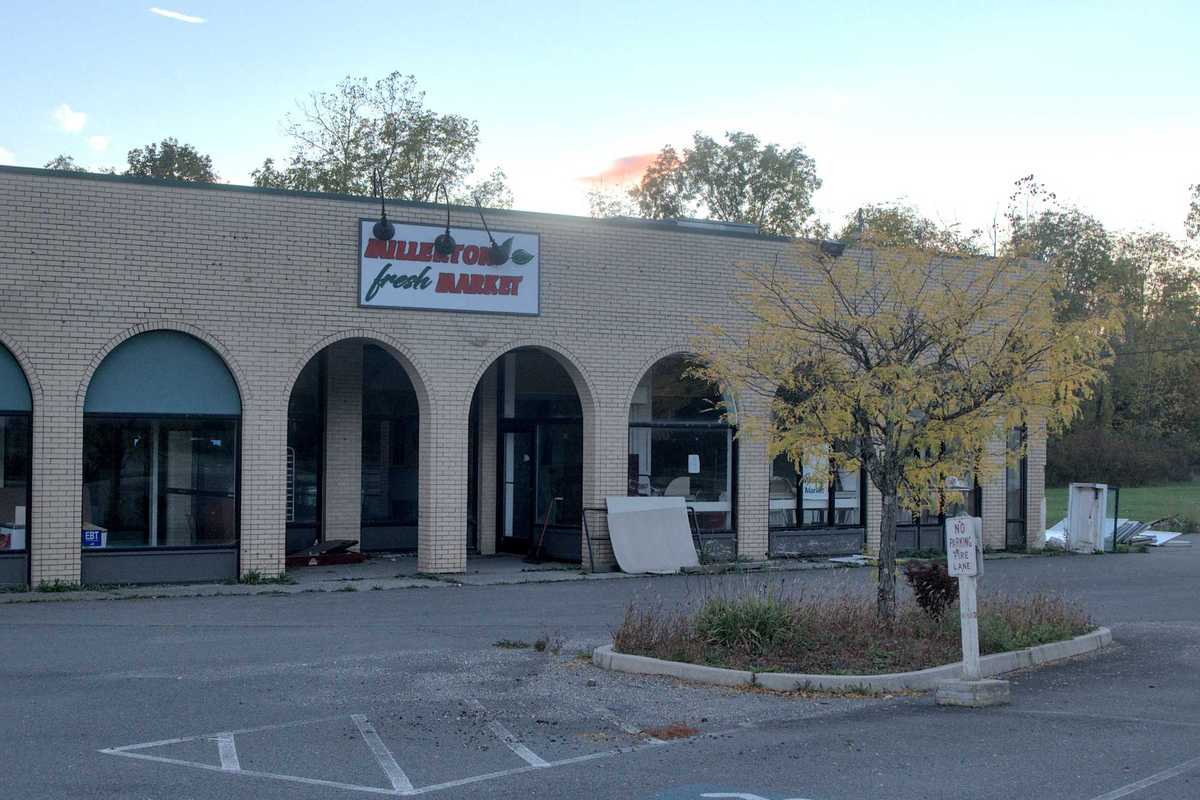
The Millerton Square plaza is still empty on Friday, Jan. 2, a little over eight months since the Town of North East Planning Board approved a site plan for major renovations to the grocery store in April.
MILLERTON – At a glance, Millerton’s year was marked by striking contrasts. Moments of division were set against moments of community building. Major municipal milestones were followed by delays and missed deadlines. And years-long efforts to prepare for the future unfolded alongside planning efforts to celebrate the past.
A Feb. 3 fire shaped what would become a year of rebuilding and resilience for the Village of Millerton. The early-morning blaze destroyed the highway and water department building, incinerating the village’s police vehicles, snow-removal equipment and everything inside the building.
What followed was an impressive effort to replace critical infrastructure, secure emergency funding, file and manage insurance claims and reimagine long-term plans for the site. The loss ignited nearly a year of logistical challenges, but also revealed a supportive community of workers, volunteers and neighbors. Demolition of the building began on Oct. 27, and efforts to build two new structures will begin early this year, although an official construction timeline has not been released by the village.

One of the biggest questions on residents’ minds this year was the long-awaited return of a full-scale grocery store to Millerton. Early optimism followed the 2024 sale of the Millerton Square Plaza to Kim and Chris Choe, veteran grocers who own the Sharon Farm Market. After the Town of North East Planning Board approved their site plan earlier this spring, many hoped the new “Town Gourmet Market” would open in 2025. The owners even floated an October target.
But as fall came and went, the plaza’s parking lot remained cluttered with debris, and visible disrepair raised new questions about timing. During a recent visit to the couple’s newly opened New Haven store, Market 360, co-owner Kim Choe said extensive interior renovations have delayed progress and that no updated timeline is available. Still, Choe emphasized that the project is moving forward.
In May, a group of residents and neighbors concerned about national immigration enforcement urged the Village Board to adopt a local law prohibiting Millerton police from assisting U.S. Immigration and Customs Enforcement (ICE) without a judicial warrant. Their request was heard at a May 21 board meeting, but momentum surged ahead of a July 29 follow-up meeting that drew nearly triple the crowd. The discussion revealed a deeply divided community. Ultimately, trustees declined to pursue the proposal, and Millerton Police said they would fully cooperate with federal authorities, including ICE, even without a judicial warrant, while noting that the department does not collect immigration status information.
In spite of that decision, local advocates have continued to organize independently. Residents have sought “Know Your Rights” training and rapid-response preparation through regional organizations such as the Columbia County Sanctuary Movement and Vecinos Seguros 2, building informal networks to support neighbors who may be vulnerable. While the village chose not to adopt the new policy, these community-led efforts reflect a broader regional movement to ensure residents understand their rights and have support in an increasingly uncertain enforcement landscape.

Millerton’s long-awaited pool at Eddie Collins Park saw both disappointment and progress this year. In July, Mayor Jenn Najdek announced that construction – originally scheduled to begin in spring 2025 – had been pushed to 2026 due to ongoing wetlands and septic-related reviews by county and state agencies. Residents and officials alike were disappointed that the pool will not be ready for the village’s upcoming 175th celebration in July. Trustees chose to delay construction until after the event, ensuring residents have a place to gather.
Even so, planning continues. Architects from LaBella Associates presented updated designs in December 2025, and trustees finalized several key decisions, including opting against a heated pool because of cost and choosing a fully equipped commercial kitchen for the pool house. With design details now refined and ready for county review, village officials say the project remains very much alive – just on a longer timeline than originally planned.
Zoning, often an overlooked topic, became one of the year’s most contentious issues, as the Town of North East moved toward a rewrite of its commercial zoning code for the first time since the 1970s. After four years of work by the volunteer Zoning Review Committee (ZRC) and nearly a year of Town Board review, officials released a 181-page draft in November outlining major updates intended to modernize the code. Officials stated that additional goals were to encourage new housing options, streamline approvals and support local business growth. A public hearing is set for Jan. 8, where residents will have an opportunity to weigh in.
In recent weeks, however, a group called “Save Millerton” has challenged the process, publishing information that alleges poor transparency, overly dense housing allowances and lax zoning enforcement. Town officials reject those claims, calling them misleading and emphasizing that the rewrite reflects years of public meetings, professional planning input and the goals laid out in the 2019 Comprehensive Plan.
Supervisor Chris Kennan said revisions may still follow the Jan. 8 hearing and stressed that the updated code is designed to encourage much-needed housing and welcome new and existing business development.
Even amid delay and division, Millerton continued to show up for one another. The community turned out in numbers for major events like the Oblong Books 50th Birthday Celebration, the Millerton News Street Fair and the Memorial Day Parade. And while zoning will continue to take center stage and shape Millerton’s future, planning is in full swing to honor its past with the 175th committee working alongside business owners and residents to create a birthday bash in July.
Family members of Army PFC Charles R. Johnson attended a May 29 ceremony at Nine Partners Cemetery dedicating a permanent marker recognizing Johnson’s Medal of Honor for valor during the Korean War.
MILLBROOK -- Throughout the year, a supportive Millbrook community turned out for civic participation and celebratory events, reinforcing strong local bonds while finding moments of shared pride and reflection.
Among the most significant was the long-sought recognition of PFC Charles R. Johnson, a Millbrook native who was posthumously awarded the Medal of Honor for extraordinary valor during the Korean War.
The honor was presented by President Joseph Biden at a White House ceremony in early January and carried special meaning in Millbrook. In late May, local and county officials, a military honor guard, and Johnson’s friends and family gathered at Nine Partners Cemetery for a ceremony honoring his bravery and dedicating a permanent plaque and flag markers.

Later in the year, Grace Church was filled to capacity as clergy, parishioners and community members gathered for the dedication of a new stained-glass window on the church’s west façade, marking a rare and historic moment for the congregation.
Voters also approved a Capital Budget proposal in May by a wide margin, authorizing more than $38 million for long-needed repairs and renovations to Millbrook Central School District buildings. The project is now proceeding through the schematic design phase.
At the Millbrook Library, a new native pollinator garden was dedicated in early October on the site of a 1953 memorial garden planted by the Millbrook Garden Club in honor of the Flagler family. The family, which has ties to the area, traces its roots to Henry Flagler, a co-founder of Standard Oil and one of the most influential American industrialists in the 19th Century.
Early October also marked the grand opening of the first phase of Bennett Park, developed on the former Bennett College campus. The event drew residents, donors and planning professionals, with a forest-green ribbon cut beneath a tent on the park’s Great Lawn. The phase created Millbrook’s largest public green space, a major undertaking led by the nonprofit Millbrook Community Partnership.

Planning also moved forward on a multi-million-dollar proposal to renovate the historic Thorne Building on Franklin Avenue into a comprehensive arts space, with the Planning Board expected to consider the application in early 2026. The building, which was constructed in the early 20th century and served as a public school, has fallen into disrepair and has largely been vacant for 20 years.
Community spirit was on full display during the long-planned Community Day in September, as residents welcomed visitors from across the region for a day of activities, parades, contests and celebration.
That sense of engagement continued through Millbrook Listens, a year-long effort inviting residents to share their vision for the village’s future, with volunteers gathering input at events throughout the year. Volunteers in colorful T-shirts have appeared at community events ready to listen to any and all ideas.
In the November elections, Washington Democrats won both board seats. Democrats Maxine Verne and Susan Mancuso won the two Town Council seats, defeating Republicans Nicholas Galente and Douglas Giles. Supervisor Gary Ciferri, a Republican, was unopposed.
In 2025, the historic weigh station on South Main Street was approved for reuse as Pine Plains’ first retail cannabis dispensary.
PINE PLAINS — In 2025, Pine Plains advanced plans for a new Town Hall and welcomed new business development, even as the community grappled with the loss of its only grocery store.
The Pine Plains Town Board began in earnest this year the planning stages for a new Town Hall building. Officials plan to construct the facility at 8 N. Main St., neighboring the Bank of Millbrook branch at the intersection of Main and Church Street.
Representatives from LaBella Associates, an architectural firm that frequently works with municipalities, presented draft drawings of the proposed Town Hall in October.
Eastern Region Vice President Pasquale Marchese led the presentation, sharing proposed floor plans and a conceptual sketch of the building’s exterior.
Marchese proposed a single-story structure with a basement for additional storage. Under the current concept, each department of town government would have its own office, arranged in a horseshoe-like configuration around a large central room that would serve as both a courtroom and a board meeting space.
The building and zoning departments would be clustered in one corner of the building, with a dedicated entrance designed to shorten the distance the public must walk to conduct business with those offices.
The proposed design encompasses approximately 6,000 square feet, significantly larger than the existing Town Hall, which contains 2,468 square feet of floor area. The current Town Hall, located at 3284 Route 199, was built in 1970 and houses town government offices, including the courthouse and police department.


Town officials also undertook a sidewalk safety audit in 2025, which identified 385 hazards. In September, Town Board members indicated they would work with a grant writer to seek funding for repairs.
Meanwhile, the Pine Plains Planning Board spent much of the year reviewing two major development proposals: a 50,000-square-foot lumber mill proposed by The Hudson Company and the town’s first retail cannabis dispensary.
The Hudson Company has operated for years in a rented Pine Plains location, but representatives said the business had outgrown its current space and sought to build a new facility to accommodate construction operations, a showroom and office space.
After eight months of site plan review and public hearings, the Planning Board approved the mill at its December meeting. The new facility will be located at 2246 Route 83 along South Main Street, south of the Stewart’s Shops gas station.
And Upstate Pines — a dispensary based in Red Hook, New York — also received approval to open a cannabis shop at 7723 S. Main St.
The dispensary will be located at the site of the historic weigh station building, where farmers used to gather to weigh their crops and livestock for sale. The proposal includes tentative plans to adapt other aging buildings on the property for future uses, such as a grocery store or an ice cream parlor.
A grocery store may soon be sorely needed in Pine Plains, as Peck’s Market all but closed over the past year.
Shelves grew increasingly bare, hours became inconsistent and sparse, and the store quietly shuttered in late September, with no public comment from owners Don and Charlene Peck.
Concerns have since emerged about the impact the loss may have on nearby businesses.

Pine Plains also saw an exceptionally close race for town supervisor. Incumbent Republican Brian Walsh was re-elected after the contest triggered a recount.
The Dutchess County Board of Elections later certified the results, confirming that Walsh defeated Democratic challenger Kevin Walsh by a margin of eight votes.