A Tangled First Foray to New York in 2026

Gary Dodson demonstrated the two-handed switch rod cast on the Schoharie Creek on April 18. The author failed to learn said cast.
Patrick L. Sullivan


Gary Dodson demonstrated the two-handed switch rod cast on the Schoharie Creek on April 18. The author failed to learn said cast.
The last time I tried fishing in the Catskills, in the fall of 2025, I had to stop pretty abruptly when it became apparent my hip was not going to cooperate.
So it was with considerable trepidation that I waded across a stretch of the “Little Esopus” that turned out to be a little bit deeper and a tad more robust than I thought.
This was on Thursday, April 16.
The Esopus is a tailwater, meaning cold water comes out of a dam and supplies the river with regular infusions of cold water that is good for trout.
But it is an unusual tailwater, in that the added flow comes out of the Schoharie Reservoir in Greene County and travels 18 miles through a pipe running under a considerable chunk of mountains and empties into the Esopus in the hamlet of Allaben.
This is officially known as “Diversion from Schoharie Reservoir” or the “Shandaken Tunnel.” In practice it is called “the Portal.”
Between the Portal and the Ashokan Reservoir about 13 miles downstream the Esopus is a big brawling trout river, roughly the same size as the Housatonic. Upstream of the Portal the Esopus is a medium-sized to small freestone stream. Hence “Little Esopus.”
My compatriot Gary Dodson and I were messing around on the “Little” section a couple weeks ago.
The weather was summery. The water temperature was 58 degrees F, about ideal.
The forsythia was blooming everywhere, and that usually means the first significant mayfly hatch of the year, the one imitated by the Hendrickson fly, is going on.
And I did see some Hendricksons floating around here and there.
But mostly I saw zip, except for when I spooked a couple of suckers.
Old joke: Suckers are often mistaken for brown trout. They tend to dive and tug like browns when hooked, adding to the illusion.
It’s only when one comes to the net that the angler feels like a sucker for being taken in. Again.
The day before, with high winds complementing the summer feel, we tried the Batavia Kill impoundment in Windham, where I attempted to crack the code on the two-handed rod cast.
I failed there and blamed it on the wind. So we went to the Schoharie, where legions of recently-stocked trout should have been eager to eat anything, and the wind wasn’t quite as bad.
I failed there too. This is going to take a while.
Meanwhile the usual Harry Homeowner opening up experience included a highly satisfactory lack of mice and their droppings, and a leaky hot water heater.
We’ve had the thing for about 50 years, so it’s hard to complain too much. Phil the Plumber installed a new one and we’re good for another 50 years.
The wading adventure described above felt a little hairy but I managed, and I found an easier place to cross on the return trip.
The new hip didn’t bother me at all. My thigh muscles were pretty sore the next day, though. Too much couch time over the bleak winter.
And while our rabbit population seems to have moved on, the resident deer were messing around on the lawn in the evenings. I like to sit outside reading and occasionally chirrup to them. They like to ignore me until they take fright for a mysterious deer reason and go bounding off into the woods.

Natalia Zukerman
Broadway is going way off Broadway when it heads outdoors for The Festival at Hutton Brickyards in Kingston Aug. 14-16, transforming the Hudson River waterfront into a three-day celebration of show tunes, stars and sing-alongs. The inaugural event features an all-star lineup including Audra McDonald, Kelli O’Hara, Renée Elise Goldsberry, Brian Stokes Mitchell and dozens more, along with a 30th anniversary celebration of the musical “Rent” featuring original cast members.
Hutton Brickyards is a former 19th-century brickyard transformed into a historic riverfront hotel and event destination spanning 100 acres along the Hudson. Beyond the nightly concerts, festivalgoers can expect campfire sing-alongs, dance parties, master classes, costume contests and a marketplace highlighting Hudson Valley food, drinks and artisans.
Three-day passes and more information are available at BroadwayFest.com.

Want more of our stories on Google? Click here to make us a Preferred Source.
Natalia Zukerman
The Crandell Theatre in 1948.
Originally built as an “atmospheric theater,” the Crandell was designed to transport audiences beyond the walls of the auditorium. Its sloped floor, proscenium arch, orchestra pit and balcony seating reflected the grandeur of early 20th-century movie palaces.
Crandell Theatre in Chatham has spent a century bringing stories to the big screen, and this December the historic theater will celebrate its 100th anniversary with a yearlong tribute to the films, filmmakers and community members who have helped keep it alive.
The celebration continues Sunday, Aug. 23, with a special screening of Martin Scorsese’s “The King of Comedy,” presented as part of the theater’s 100th Anniversary Series by Bill Kramer, CEO of the Academy of Motion Picture Arts and Sciences. Kramer will introduce the 1982 film, a darkly comic exploration of celebrity, obsession and the pursuit of fame.
The 100th Anniversary Series invites industry leaders and film experts to share movies that have influenced them and continue to inspire new generations of audiences.
“The King of Comedy” is a fitting selection for a theater whose own story is rooted in the enduring power of cinema. Built in 1926 by Chatham native Walter S. Crandell, the theater opened on Christmas Day of that year with the silent film “Michael Strogoff.” Designed by Glens Falls architect Louis L. Wetmore in the Spanish Renaissance style, the freestanding building quickly became a beloved fixture on Main Street.
Originally built as an “atmospheric theater,” the Crandell was designed to transport audiences beyond the walls of the auditorium. Its sloped floor, proscenium arch, orchestra pit and balcony seating reflected the grandeur of early 20th-century movie palaces. Sound equipment was added in 1929, allowing the theater to transition from silent films to “talkies.”
Over the decades, ownership changed hands, but the theater remained a gathering place for generations of moviegoers. In 2010, following the death of longtime owner Tony Quirino, the theater faced an uncertain future. Community members rallied to save it, with the Chatham Film Club raising approximately $600,000 to purchase the building and complete critical repairs.
The Crandell reopened as a nonprofit community theater in July 2010. In 2018, the organization officially adopted the theater’s name, bringing together its film programming, preservation efforts and annual FilmColumbia Festival under one mission: preserving the theater as a cultural anchor for Chatham and the surrounding region.
A major restoration and modernization project was completed in 2025, bringing the historic theater up to current standards while preserving its architectural character. The renovation included updates to the auditorium, projection systems and building infrastructure.
For former board member Carol Sadlon, the upcoming centennial represents both a celebration of the theater’s history and a testament to the community that has protected it.
“It has been an honor to serve on the Board of the extraordinarily unique Crandell Theatre, celebrating its 100th birthday this December,” Sadlon said. “Renovating the not-for-profit community theater has been a labor of love and commitment for all involved.”
Sadlon noted that the theater’s creation in 1926 reflected the optimism of the era, and that the same spirit continues today.
“Walter S. Crandell, successful Wall Street investor and native son of Chatham, built the 500-seat theater for a community of 3,000 people,” she said. “Thanks to an equally optimistic group of people, the Chatham Film Club, who purchased the theater in 2010, and a very generous community, the theater lives on to continue entertaining for future generations.”
The Crandell Theatre’s 100th Anniversary Series screening of “The King of Comedy” will take place Sunday, Aug. 23, at 4 p.m.
For tickets and more information, visit crandelltheatre.org.
Natalia Zukerman
MOMIX is one of the featured performers at this year’s Arts Connected fundraiser on Aug. 29.
The Northwest Connecticut Arts Council will celebrate the region’s vibrant arts community with Arts Connected 2026, its annual fundraising event, on Saturday, Aug. 29, from 5 to 8 p.m. at Buck’s Rock Camp in New Milford.
More than a fundraiser, Arts Connected is designed as a celebration of the artists, performers and organizations that make the Northwest Corner’s cultural landscape thrive. Guests can enjoy live music and performances, a curated gallery of artwork by regional artists, local food and drinks, and opportunities to connect with fellow arts supporters. Tickets include hors d’oeuvres, an open bar and all entertainment.

The evening will feature live plein air painting by artists from Plein Air Litchfield, performances by Our Culture Is Beautiful (OCIB), fire performer Cinderfella, and Susan Becker Aziz’s monumental humpback whale puppet, originally created for Paul Winter’s “Missa Gaia.” Guests will also have the opportunity to purchase artwork from a curated exhibition, with proceeds supporting the Arts Council’s mission to strengthen and promote the arts throughout Northwest Connecticut.
This year’s honorary host committee includes Meryl Streep, Diane von Furstenberg, Tim Daly, Téa Leoni, Maria Horn, Patti LuPone, Jack O’Brien, Sam Waterston and Paul Winter. Creative cocktail attire is encouraged, and attendance is limited. The event is open to guests 21 and older.
For more information or to purchase tickets, visit artsnwct.org
Robin Roraback
Once I get all the colors in, they change. Who knows? I might consider more radical colors and then bring it back a little.
— Robert Cronin
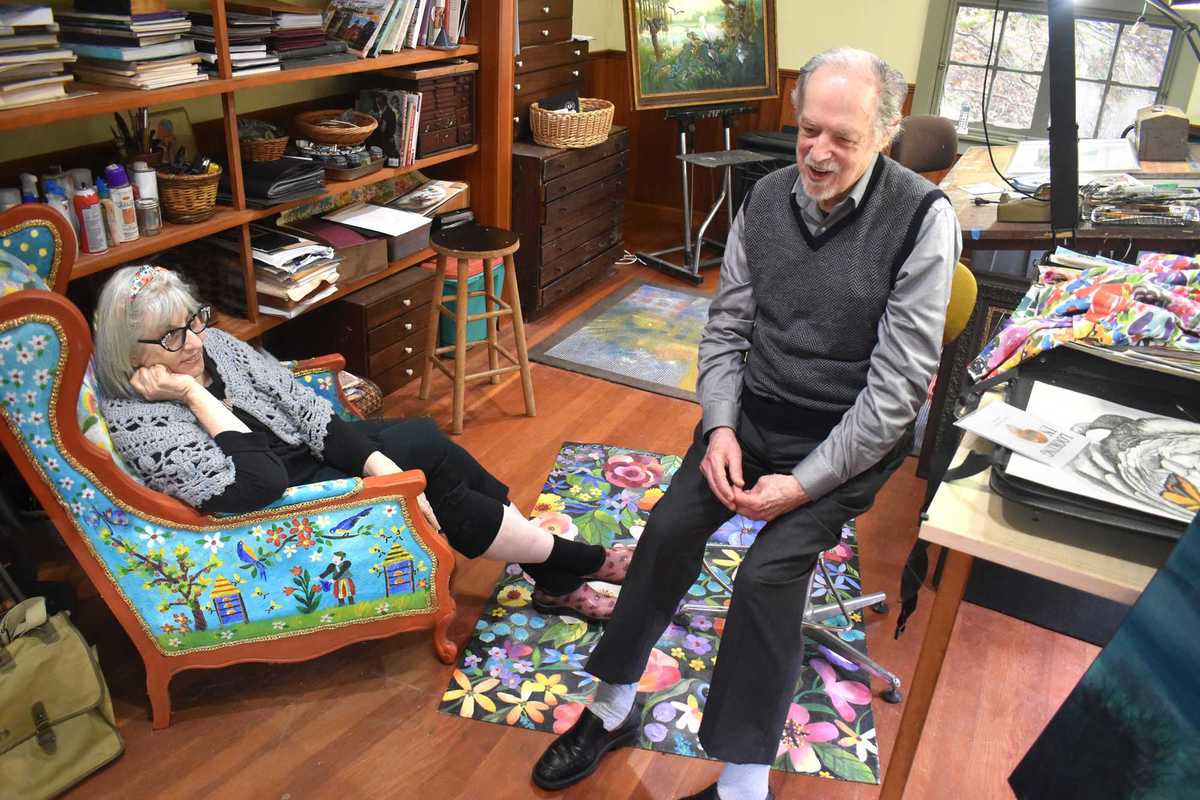
Renowned painter Robert Cronin of Falls Village celebrated his 90th birthday with an exhibition, “Robert Cronin: New Paintings,” at the Hunt Library in Falls Village which opened Aug. 8 and will be on view through Sept. 11.
Cronin paints most days in his home studio. He keeps his work fresh by trying new things and has had different phases of work, including figure paintings, paintings on paper, a modular, circle and enclosure series of paintings, as well as a tinplate sculpture series.
Cronin said he never expected to pursue art as a career. He started out at Boston College pursuing another degree but, luckily for him, flunked out and enrolled at the Rhode Island School of Design.
At first, he thought he’d pursue industrial design. But once he was immersed in drawing and painting, he realized he had a natural talent for it. “I fell in love with basic stuff. I had never owned a set of paints.” While at RISD, “In 1958, I instinctively fell into abstract work.”
After graduating from RISD and working for a time as a cleaner at Massachusetts General Hospital while painting whenever he could, he was awarded a full scholarship to an MFA program at Cornell University, along with a living stipend.
He went on to teach for 18 years at various schools, including Brown University, Bennington College and the School of the Worcester Art Museum, which he said he enjoyed the most. “I love my memory of that more than academic places. Whether Brown or a certificate program like Worcester, when you’re good, you’re good.”
After leaving Worcester in 1980, he moved to New York City to pursue his art career. He found success and exhibited his work in several galleries in New York City and around the world.
In 1990, Cronin moved to Connecticut, settling in Falls Village, where he left his tinplate sculpture phase behind and concentrated on painting again.
He explained his current approach to painting. “Everything in this show,” he said, “had a preliminary drawing. Most of my life has been starting from scratch, with no preliminary drawings.”
He makes many small sketches. “One out of 20 drawings may become a painting.” He enlarges the sketch on a copier, transfers it using a grid and paints it on a 16-by-20-inch canvas.
“Once I get all the colors in, they change. Who knows? I might consider more radical colors and then bring it back a little.”
Of starting a new painting, he said, “You don’t know what you are getting into, but it’s terrific.”
To learn more about Cronin and his work, visit robertcroninart.com.
The exhibition will be on view at Hunt Library in Falls Village through Sept. 11. Cronin will give an art talk Thursday, Aug. 13 at 5:30 p.m.

Want more of our stories on Google? Click here to make us a Preferred Source.

Want more of our stories on Google? Click here to make us a Preferred Source.