Tangled tackle fondling 2026

The average citizen looks at this and sees fly rods stored in garbage cans. The veteran angler sees an innovative modular storage system.
Patrick L. Sullivan

The average citizen looks at this and sees fly rods stored in garbage cans. The veteran angler sees an innovative modular storage system.
The snow is mostly gone, the mud is flowing, the stocking trucks are rolling and that means only one thing: it’s tackle fondling time!
Yes, it’s that happy time of year when we dig out all the gear we carefully cleaned and stowed away back in November.
What’s that? You left it all in the car until you had to help Aunt Edna move? And now it’s piled up in the garage?
Never mind that. What’s important is getting ahead of it,starting now.
Reels: Take the spools off and blast them with a can of compressed air. Then deploy a Q-tip to get the stubborn stuff. Then deploy something long and pointy to get the little bits of cotton that came off the Q-tip.
Lines: Clip off the old leader. It’s no good. Pull the fly line of the reel and clean it with something. There are many commercial products available. The Rio line cleaner seems to work pretty well, but it goes fast. I use a weak solution of Dawn dish soap and warmish water and a clean sponge or two, so I can see just how much yick comes off the line. Then I give it a shot of some stuff called Albolene, which is used for removing heavy theatrical makeup. It also functions as a line dressing and costs much less than actual line dressings.
Rods: I check guides and ferrules, and give everything a wipe with a chamois cloth or something similar. Then I start emailing people I barely know looking for someone who repairs rods.
I have something like 60 fly rods, and they are a pain in the neck to store. But I had a brain wave over the winter and bought four kitchen garbage cans. Ignoring the lids, I arranged them in a corner of my living room and to my delight found I can corral most of the rods in such a way that I can actually find the one I want.
It works very well. If the cans had an Orvis or Simms logo on them I could sell them for $85 apiece as a “modular rod storage system.”
Flies: What you absolutely don’t want to do is buy more fly boxes because the giant cardboard box filled with fly boxes is still in the back of the car and you can’t remember what’s in any of them so it’s better to just buy new flies and boxes and use those, reserving the joy of sorting through the old boxes for the summer when you’re at the summer camp that has a nice big table. Whatever you do, don’t do this. Oh, excuse me, that must be the Amazon guy at the door with my new boxes and flies.
Waders and boots: I have a dedicated wader rack where I hang them up. This is an improvement over my old method, which was to leave them in the car in a crumpled heap all winter. Check for leaks by taking a small flashlight and running it over the seams from the inside of the waders. If you see pinholes then it’s time to deploy Aquaseal. There are wader repair kits that have small tubes of Aquaseal and patches that can be cut to fit. Do not buy a big tube of Aquaseal unless you plan to use it very quickly, otherwise the big expensive tube turns to stone in a matter of days. That’s why the tubes in the kits are small. Ask me how I know this.
Check boot laces and replace if necessary. Paracord is your friend here, if you’re on a tight budget and don’t mind using a lighter to create an aglet. Look for missing studs and replace. Clean the soles with an old toothbrush. Do this outside. Ask me how I know this, too.
Note: Thanks for all the kind inquiries as to my new right hip. I am pleased to report that Ye Surgeon took me off the Injured Reserve list a couple of weeks ago, and as soon as things settle down a bit on the run-off, I will be back in action for the first time since September 2025.
Millerton News
The following excerpts from The Millerton News were compiled by Kathleen Spahn and Rhiannon Leo-Jameson of the North East-Millerton Library.
ALBANY-The Assembly has passed Senator Bontecou’s bill amending the judiciary law and the code of criminal procedure to provide for the payment of mileage of not more than four cents per mile to trial and grand jurors in Dutchess County residing outside the city of Poughkeepsie. The Senate had previously passed the measure, leaving only the Governor’s signature required to make it law.
An impression said to be prevalent among property owners of Millerton that tax assessments would be increased if buildings were painted or the property otherwise improved, was discounted today by Mayor Brewer. Speaking on behalf of the Village Board, Mr. Brewer pointed out that this idea was entirely erroneous, and at the same time encouraged home owners to paint or make other improvements to the beauty of the village.
The sustaining membership appeal committee for the annual budget campaign of the Dutchess County Council, Boy Scouts of America, was informed of the program for the current drive at a meeting held Monday night at the home of Mrs. James Roosevelt, mother of the President, at Hyde Park. Mrs. Roosevelt is co-chairman of the committee with Dr. James T. Harrington of Poughkeepsie.
Although unable to remain for the meeting because of having to return to New York City for the funeral of her nephew, Warren Delano Robbins, Mrs. Roosevelt greeted committee members who arrived early and led them into the spacious parlor. Dr. Harrington presided at the session, conveying Mrs. Roosevelt’s regrets and her sincere wishes for the success of the drive. An outline of the work to be carried on by the committee of thirty-six men and women in the next two weeks, Interviewing more than 300 persons on the matter of enrolling as sustaining members of the council, was given by Dr. Harrington.
[photo caption] Laura Conklin of Millerton takes off with her cart at the Millerton Super last Saturday. Laura’s mother, Alice Yankowski, won the Lions Shop-er-ama and Laura did the 3- minutes of shopping at Lions’ cost. She did just fine, garnering $672 worth of food.
The News isn’t the only paper in town; the March edition of Webutide ‘76 is hot off the mimeograph machine and almost 200 copies have been sold around school for a dime apiece and if the New York Times isn’t looking over its shoulder, the Webutuck Elementary School newspaper is doing just fine.
In its 2nd year, Webutide ‘76 is published monthly by some 15 4th, 5th and 6th graders at Webutuck. Rose Barer, a 4th grade teacher, is the advisor for all the young William Hearsts and she spends a lot of her time helping round up writers, editors and artists. When asked who does end up contributing to the paper, Rose said, “Anyone I can nab or buttonhole.”
The editors of Webutide ‘76 are mostly 6th graders and they all said the paper is going pretty well. What do the kids around school like best about the March issue? “The cover. They like just drawing on the cover,” responded 1 editor with a slight frown.
The Columbia Auto Parts store on Main Street in Millerton was burglarized early in the morning of Thursday, April 1, but the thieves escaped with little that was worthwhile; 2 defective stereo speakers and a few cans of paint in damaged cans.
The N.Y. State Police reported that entry was gained through the side door of the building at approximately 1:45 a.m. Thursday morning. Store manager Michael E. Wells said the culprits didn’t take much: “More damage was done to the door than to anything else.”
William Floyd Klippel of Millerton, recently made an initial purchase of one registered Ayrshire cow from Maurice F. Downey of Millerton, according to the Ayrshire Breeders’ Association secretary, David Gibson Jr., of Brandon, Vt.
The transaction was recorded in the national office of the association, where complete registry records on all purebred Ayrshire dairy cattle in the United States have been maintained since 1875.
MILLERTON - It is a rare gem of a man who can travel through this world encountering people from all walks of life and still be able to positively affect each and every one.
Mr. Eugene “Gene” Brooks was such a man.
“Ask a teacher, a custodian, a bus driver, a secretary, a cook — everyone had the same reaction to Gene. His smile, his laugh, his way with people could only make them love him,” said Justine Winters, a friend and co-worker of Mr. Brooks’.
Those fortunate enough to have met Mr. Brooks now mourn his absence; Mr. Brooks died April 7, causing a veil of sadness to envelop the community.
After coming to Millerton, Mr. Brooks continued in his educational endeavors, working for both Webutuck and Housatonic Valley Regional High School during the past 36 years.
Mr. Brooks impressed friends, students and co-workers with his overwhelming capacity for understanding and his ability to relate with children.
“As principal of a school, you get called upon to do a lot of unpleasant things,” said Mr. Rindsberg. “But Gene, through it all, maintained his love for children.”
“Gene has a way with children,” said Brad Rebillard, the Millerton Lions Club President. Mr. Rebillard related a story concerning Mr. Brooks’ dealings with a group of mischievous boys.
“Gene could make a difference,” concluded Mr. Rebillard. “You can bet each child remembers that.”
MILLERTON - Residents with post office boxes may have noticed they now have a place to put unwanted recyclable paper. Postmaster Martin Cavally has established a provisional recycling station within the Millerton post office as a personal effort to help the community.
“Anything that helps the environment is good for all of us,” said Mr. Cavally.
“We’re in the beginning phases now, and we’ll have to see how it pans out before we make any changes.” said Mr. Cavally, commenting on the current set-up.
Mr. Cavally has an additional reason to be concerned and willing to make a difference: “I’ve got a granddaughter, and she’s going to have to live in this world.”
Natalia Zukerman
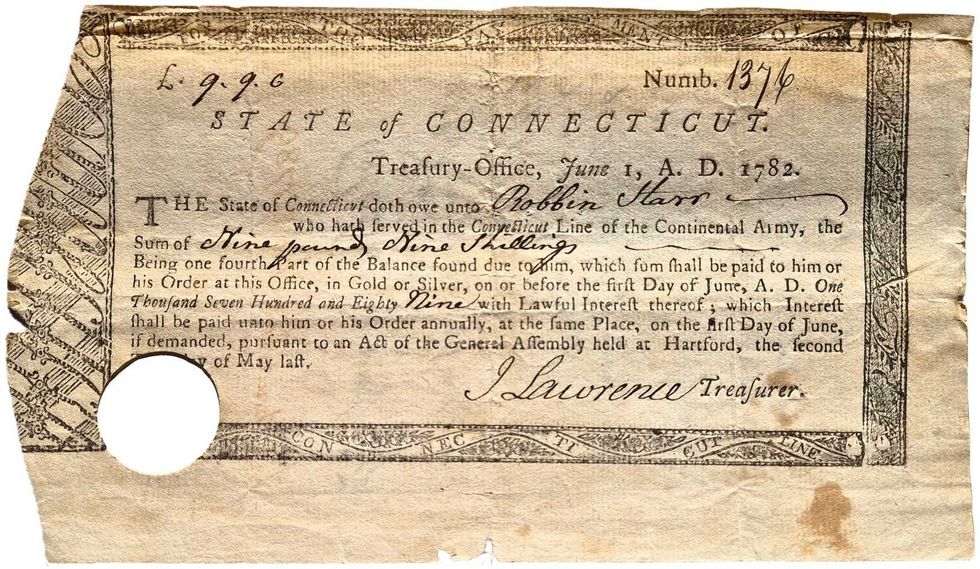
Indigo-dyed and printed linen, probably American, Mid- to late 18th century.
In an age of fast fashion and disposable wares, Sharon resident Titi Halle, a leader in the fields of textiles and costume, has spent decades immersed in a world where clothing endures, sometimes for centuries.
“I had very little idea that 300-year-old clothes survived,” Halle said. “Or that you could make a living out of it.”
That was before she met Cora Ginsburg in 1980, one of the country’s leading dealers in historical textiles and costume. Halle took over as owner of Cora Ginsburg LLC in 1997 and has built a career around preserving and interpreting garments that tell stories far beyond their seams. The work she does spans everything from museum consulting to sourcing rare pieces through auctions, private sales and travel.
She will bring that expertise to Sharon this spring as part of a two-part series on early American textiles and clothing.
The first, “The Fabric of Early American Life: Textiles at Home in the 18th Century,” will take place Sunday, April 12 at the Hotchkiss Library of Sharon. A second program, “Dressing Up in 18th-Century New England,” follows on May 3 at the Sharon Historical Society & Museum, featuring a display of period garments including shoes, stays, petticoats, and cloaks.
“America produced very little in the 18th century,” Halle explained. “So, if you’re looking at silk and cotton, those were commodities that traveled. They were luxury goods.”
That global exchange is central to what audiences will see. Printed cottons from India, silks from Europe, and locally made wool and linen reflect a world far more interconnected than we often imagine. At the same time, they reveal the labor — mostly women’s work — behind domestic life.
“I don’t just collect complete objects,” said Halle. “I collect small pieces and documents. It’s the best way to learn — and I’m always happy to share that experience.”
That spirit of sharing will be central to the upcoming exhibits. Halle plans to bring not only rare textiles but also fragments that visitors can handle — an unusually tactile opportunity in a field where preservation often keeps objects behind glass.
The clothing itself, she noted, offers its own revelations.
“These aren’t the kinds of clothes you worked in,” she said. “You can’t lift your arms much higher than your shoulders. They’re not terribly comfortable.”
What has survived, then, are often the “best” garments — the ones reserved for public life or special occasion. Through them, a picture emerges not just of how people dressed, but how they moved, traded, and understood the world around them.
For Halle, who has lived part-time in the region since the 1980s, bringing this work to Sharon feels both professional and personal.
“These are things people can look at,” she said. “And things they can touch. They won’t crumble.”
In other words, history not as something distant, but as something tangible — woven, worn, and still very much alive.
Both events are free, but registration is required for April 12 at the Hotchkiss Library at hotchkisslibrary.libcal.com. And for May 3 at the Sharon Historical Society, rsvp at rsvp@sharonhist.org.
Kerri-Lee Mayland
Objects that show age over time can be beautiful treasures.
Your home does not need to be perfect to be beautiful. In fact, the marks, softened edges, and quiet signs of daily life are not flaws to be erased, but stories to be embraced.
That idea has a name: patina. It is the natural aging of materials over time — the result of wood touched again and again, metal worn by air and use, fabrics settling into the rhythm of a lived-in space. Some may see it as damage, but it is better understood as evolution: the gentle, authentic record of a home being used as it was meant to be.
For years, design of all kinds leaned toward the pristine — homes that felt almost too perfect to settle into. But perfection, while beautiful at first glance, can create what feels like a museum or showroom. Such a space asks you to maintain it, to protect it, to exist very carefully inside it.
Patina offers the opposite.
It lets you exhale.
A dining table with a few marks from family dinners does not need to be replaced. A brass faucet that darkens over time becomes richer, not worn out. A leather chair that creases and softens becomes more inviting; these are the pieces I search for when clients want an instantly lived-in look. These changes are not signs that something is going wrong. They are signs that something is being used exactly as it should be.
This is where patina becomes more than a design choice. It becomes a mindset, a lifestyle.
It allows you to let your home live a little, too.
In practical terms, to incorporate patina, you must choose the right materials, ones that will age well. Natural wood is perhaps the most forgiving and rewarding. Look for finishes that are matte or lightly sealed rather than overly glossy. Woods with visible grain and variation will develop character over time, rather than showing wear in a way that feels damaged.
Metals are another opportunity. Unlacquered brass, bronze and copper are designed to change. Instead of resisting fingerprints or water spots, they respond to them, deepening in tone, creating variation, becoming uniquely yours. In kitchens and baths especially, these materials bring warmth that polished chrome simply cannot replicate.
Leather, too, is a favorite of designers for this reason. It softens, creases, and gains depth with use. A well-made leather chair will look better in five years than it does today. Linen and other natural textiles follow a similar path, becoming more relaxed and comfortable over time.
Vintage pieces naturally carry patina with them, which is part of their appeal. A worn wooden chest, an antique mirror with slight foxing, a set of timeworn stools—these elements anchor a space. They immediately give a room a sense of history, even if the rest of the home is newly designed.
The key, however, is balance.
A home filled entirely with aged pieces can feel heavy and old. But when patina is layered alongside clean lines and newer elements, a sense of calm emerges. The space feels both fresh and grounded. A modern sofa paired with a weathered coffee table. Crisp walls against an antique cabinet. It is this contrast that makes a home feel thoughtfully designed rather than overly styled.
And then there is the emotional shift.
When you embrace patina, you release yourself from the pressure of constant perfection. You stop noticing every small scratch or imperfection because they are no longer mistakes — they are part of the story. Your home becomes a place to live freely, not carefully, and that shift changes your mood and outlook.
It reflects a deeper understanding: that beauty is not found in preserving something exactly as it was, but in allowing it to evolve into what it becomes.

Want more of our stories on Google? Click here to make us a Preferred Source.
John Coston
At last year’s opening day celebration, T-ball coach DJ Reilly throws out the first pitch to Kaitlynn Dean, 12, of Wassaic at Beekman Park in Amenia.
MILLERTON — Little League players will celebrate the start of the 2026 season on Sunday, April 12, at Eddie Collins Memorial Park, leading off with a parade down Main Street.
The event will kick off at the Millerton Firehouse on Century Boulevard at 11:15 a.m., when players and coaches will make a procession to the park, walking down Main Street to the ball field pavilion.
Tori Gilleo will sing the national anthem. Planned activities include a blow-up bounce house and food and ice cream trucks. Festivities are planned to run until 2:30 p.m.
“We have a total of six teams. One tee-ball, three baseball and two softball,” said Scott Russo, president of the league’s board, which has been organizing this year’s season over the winter months.
This year, the League has signed up 80 players. As in past years, games will be played at Eddie Collins Memorial Park and in Amenia at Beekman Park. Lights newly installed at Eddie Collins field will enable a game “under the lights” this year.
The field is named after Eddie Collins, a Millerton native and professional baseball player and later major league executive who was a second baseman in the early 20th century for the Philadelphia Athletics and the Chicago White Sox.
Little League game schedules for this spring are not yet arranged.
In recent years, a group of parents led an ambitious and successful effort to affiliate the Webutuck Little League with Little League Baseball and Softball in South Williamsport, Pennsylvania, which organizes local leagues throughout the U.S. and across the world.
Leila Hawken
AMENIA — The town’s annual roadside Clean-Up Day will be held on Saturday, April 18, from 9 a.m. to noon. Residents can participate by going to one of two starting locations to pick up trash bags and reflective vests, and to inform organizers of the stretch of road they intend to clean.
All state and local roadways are eligible for clean-up. The Harlem Valley Rail Trail is also a possibility.
Fountain Square in Amenia is one of the two starting locations. The other is Borden Park in Wassaic, across from Maxon Mills, where the Wassaic Project currently operates.
At the April 1 Town Board meeting, councilmember Vicki Doyle, also a member of the Conservation Advisory Council, reported that two colors of bags will be distributed at the starting points. Orange bags are to be used if clean-up is happening anywhere along State Routes 44, 343, or 22. State trucks will pick up those filled bags from the roadside. Black bags are to be used along any town road.
Full black bags and items too large for the bags can be left roadside near the bags where they will be picked up by contacting organizer Vicki Doyle at 845-489-7826.
The annual event is organized by the Amenia Conservation Advisory Council and the Enhancement Committee.
D.H. Callahan
This year’s line-up is (clockwise from top left) Jane Curtin, Joanna Gleason, Deborah S. Craig, Michael Emerson.
On Sunday, April 12, the long-running public radio program “Selected Shorts” returns to the Stissing Center in Pine Plains.
Whether torn from the pages of history or pulled from the ether of the imagination, short stories have the power to build entire worlds in just a few digestible pages or paragraphs. But as powerful as they can be, they are rarely given the recognition or appreciation they deserve.
In 1985, Symphony Space on Manhattan’s Upper West Side created Selected Shorts, aiming to give short-form literature a greater audience. Selected Shorts puts the words of established and emerging authors into the mouths of some of the greatest actors of the stage and screen.
Since its founding, Selected Shorts has been a regular stage show at Symphony Space, a radio program, a podcast and, in this case and others, a traveling performance.
With a rotating line of hosts and actors bringing the literature to life, attendees at the Stissing Center will be treated to performances by Joanna Gleason, Deborah S. Craig, Michael Emerson and the legendary first-season “Saturday Night Live” cast member — and original Conehead — Jane Curtin.
Tickets at thestissingcenter.org

Want more of our stories on Google? Click here to make us a Preferred Source.

Want more of our stories on Google? Click here to make us a Preferred Source.