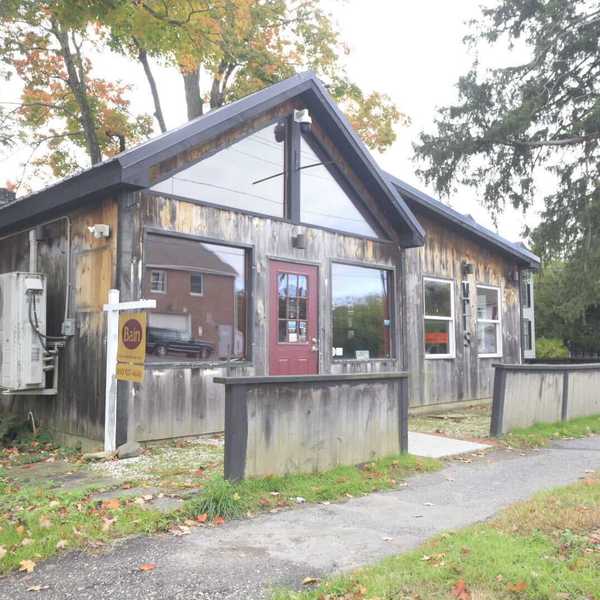
Zen Den Center opens in Winsted

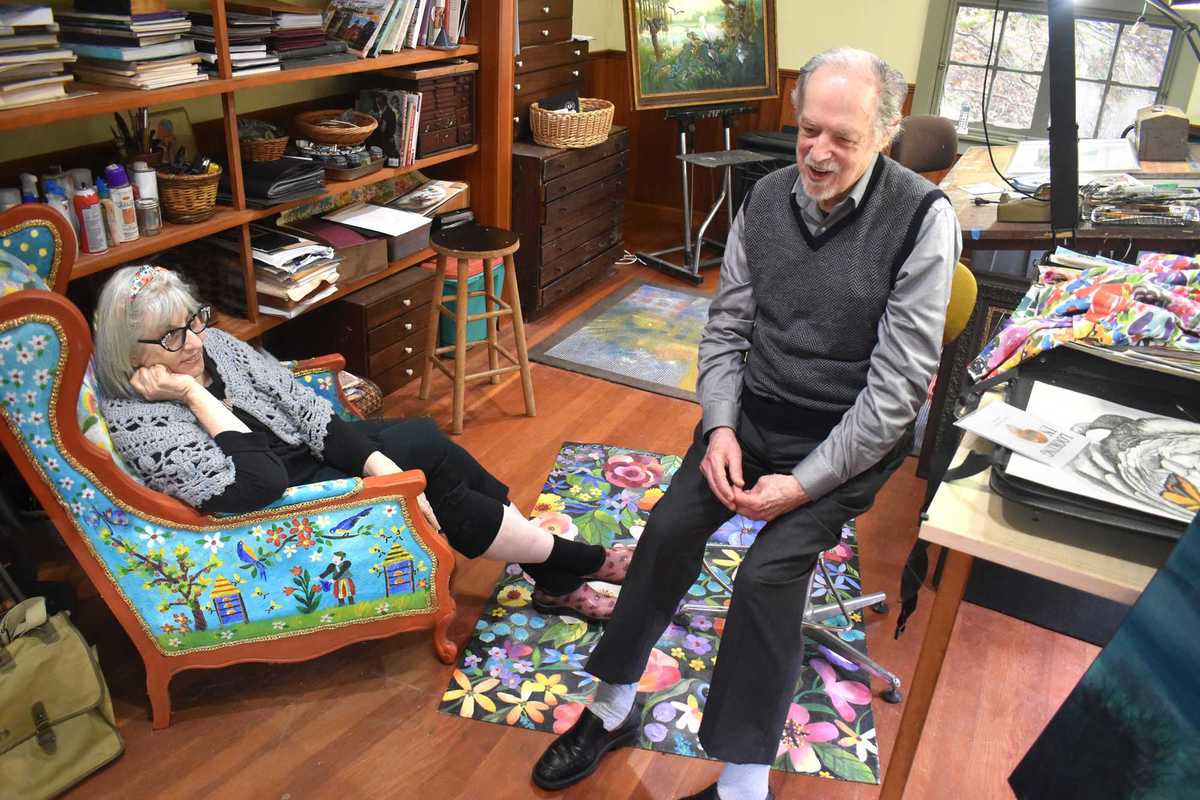
Thuan Nguyen and Britt Rovi are old friends and now business partners at the Zen Den.
Jennifer Almquist

Thuan Nguyen and Britt Rovi are old friends and now business partners at the Zen Den.
A holistic healing center, the Zen Den, has opened at 58 Main St. in Winsted. Described as a revolutionary clinical wellness center, it offers classes and individual, couples, and family therapy focused on trauma and wellness. Its intention is to bring high-end holistic healing practices to the masses. As the founders say, “Make it reasonable, doable, and achievable.”
The space is warm, soothing, sunny and inviting. At a soft opening for family and friends on Dec. 5, the mood was mellow and joyous. Each arrival was greeted with a hug as children twirled around the room. Soft coral walls, small Buddhas, sage for burning, a central gong, green plants, pastel sound bells and soft music create a sense of calm. The center even has a healing dog!
Founders Britt Rovi, an LPC, and Thuan Nguyen are old friends who most recently worked together at Mountainside Treatment Center in Canaan. They bring extensive experience as therapeutic healers and as survivors of their own journeys from adversity to wellness.
“We believe healing happens in community — where you can feel connected, seen and loved,” they said. “So please help us spread the word about this cool, soulful, and uplifting new space — a hip, spiritual hangout for those who crave purpose, meaning and connection.”
The new clinical wellness membership center combines holistic treatments such as yoga, reiki, qi gong, sound baths, somatic therapy and trauma-informed care for mind, body and soul with clinical groups for stress management, grief and trauma.
Nguyen, who was born in Vietnam during the War, survived a harrowing escape with his family, later settling in Westchester and attended Vassar College and Cornell University. He became addicted to crystal meth and his family got him into rehab. He recalled his journey to sobriety:
“In recovery meetings, people gave me a language for my experience, words I never had access to before. They shared their stories with honesty and courage, creating a space safe enough for me to find my own. My journey continued through meditation, yoga, energy healing and various wellness practices that helped me return to myself. I learned that true healing is holistic — it touches mind, body, spirit and community.”

Nguyen has since worked at two nationally recognized inpatient treatment centers as a 12-step coach, spiritual advisor, wellness coordinator, manager and director. He is also a master teacher in Usui Reiki and certified in Karuna Reiki.
Rovi is a clinical life and relationship coach with a master's degree in clinical mental health counseling and a specialization in family therapy. During college, the sudden suicide of a dear friend plunged her into a self-destructive spiral. A spiritual awakening centered her, and she began her remarkable journey to wellness.
When asked about her dream for the center, she said, “Community more than anything. We live in a world where everything is sad, stressful and hard.We need connection and to not feel alone. I want to ignite that spark in humanity again from a small local vibe. I want to breathe hope back into the world.”
Rovi and Nguyen are grateful for the support of the Winchester Economic Development Commission, which helped them open their doors on Main Street near the town green. At noon on Dec. 27, there will be a ribbon-cutting ceremony with members of the commission, and the community is invited.
For more information and to become a member of the Zen Den community, visit: thezendencenter.com

The North East Town Hall building, where town officials will hold a public hearing on Thursday, Jan. 8, at 7 p.m., on proposed zoning code amendments
MILLERTON — The zoning code changes that will be the focus of a public hearing on Thursday, Jan. 8, represent a major overhaul of the code since it was adopted in the 1970s, placing a strong focus on promoting housing options in the town’s commercial district.
The hearing is scheduled for Jan.8 at 7 p.m. at Town Hall and the draft of the amendments can be found online at townofnortheastny.gov/zoning-review-committee/ or in person at Town Hall or at the NorthEast-Millerton Library.
Zoning regulations, which date to the early 20th century, govern how residents and businesses can use their homes and buildings, and their land. Town officials say their goal in modernizing the code aims to support local business and create new housing options.
While there have been some updates over the years to address specific issues, the changes before the public this time are an ambitious attempt to align with the town’s Comprehensive Plan, which was adopted six years ago.
In this first go-round, the focus is on the town’s commercial districts, such as the so-called Boulevard District that runs along Route 44 to the Connecticut border. Residential and land conservation districts have been included to varying degrees in this proposed update, but largely are to be considered in a second phase of zoning review that soon will be initiated.
A housing focus
The 2019 Comprehensive Plan sought “to promote a variety of housing alternatives” and update zoning laws to allow for higher density development in the Town and Village, noting that fewer than one in five housing types were multi-family dwellings and most of them offered fewer than four units.
The predominant single-family housing stock in the Town and Village dated to the mid-twentieth century; 37% of the housing in the Town and 80% of the housing in the Village was built before 1950.“
This is a sea change but it depends on getting sewers in the Boulevard District,” said Edith Greenwood, who headed the six-member volunteer Zoning Review Committee that worked on all the amendments over years. The committee engaged professional consultants with a goal to make the town’s code more accessible, and streamline approval processes, as well as update language and definitions.
The zoning overhaul, however, addresses more than just housing. The revised code is laid out in extensive detail, and its comprehensive approach requires many pages of documentation — 181 pages to be exact. However, many provisions, regulations and procedures remain unchanged even though they are included in the complete document up for review at the Jan. 8 hearing. Here are some of the changes proposed in the new code:
Multifamily dwellings
Existing code doesn’t contain a section about multifamily dwellings, but the amended code applies standards.
“Multifamily dwellings may be located on upper floors of commercial buildings and/or within standalone buildings,” the amendment provides. “No less than three (3) and no more than twelve (12) individual dwelling units shall be contained in a single building,” according to the draft regulation. Floor areas are defined to conform to New York State codes.
Rental apartments above commercial space
This so-called mixed-use development allows for rental apartments above commercial spaces.
“The intent is to permit mixed use development under carefully regulated conditions to facilitate reinvestment in and the renovation of existing commercial buildings, as well as encourage the development of new mixed-use facilities, resulting in positive economic impacts to those properties and the town at large, while imposing minimal burden on town services and municipal infrastructure,” the draft proposal states.
Adding Affordable Housing standards
The current code is amended to include general standards for affordable housing units, including specifics related to the cost and ownership of such units, among others. Such housing provides homes priced below market rate allowing for housing opportunities to low- to moderate-income families with eligibility based on income.
Proposed affordable housing regulations in North East will limit the cost of affordable rental housing to 30% of 60% of the area median income for Dutchess County. The regulations will limit the cost of so-called “ownership” units to 30% of 80% of the county’s area median income.
Affordable housing regulations provide a benefit to developers, allowing additional commercial space on second and third stories in exchange for placing affordable housing units in the remaining floor area above a commercial space. Commercial buildings are allowed to host additional commercial uses on second and third floors as long as it does not exceed 50% of the floor area of those stories. All remaining floor space must be dedicated to affordable housing.
Accessory Apartment section becomes Accessory Dwelling Unit (ADU)
A section of the current code refers to ‘Accessory Apartments’ but that category is amended to regulate ‘Accessory Dwelling Units,’ which is the current terminology. “An ADU shall be clearly incidental and subordinate to the principal one-family dwelling use and shall not change the one-family residential character of the neighborhood,” the amended code reads.
'Everything but the kitchen sink'
The amended zoning regulations also seek to regulate a wide variety of businesses and activities.
Mobile food vendors will need permits to operate. Electric vehicle charging stations, which didn’t exist in the 1970s, will come under the regulations, including charging stations at residences. Outdoor vehicle storage will have requirements spelled out as well as outdoor dining at restaurants.
EV charging stations are allowed at all residences, but regulations require a zoning permit. Residential chargers are allowed inside garages, on an exterior wall or as a freestanding structure adjacent to a driveway. Chargers are also permitted in parking lots for commercial buildings, subject to site plan approval by the North East Planning Board. Parking regulations get extensive coverage in the amended regulations.
They also include amended regulations for roadside farm stands, cell towers and self-storage warehousing, among many others.
The amended regulations call for the creation of a zoning enforcement officer to receive, review applications for a zoning permit, sign permit and certificate of use, among other duties that include inspections to ensure compliance. The town currently contracts a zoning officer, whose services are shared with the Village and with other municipalities.
The amendments update design standards and site-plan expectations for off-street parking, signage, landscaping and exterior lighting, a category that takes up several pages and even includes illustrations. Motel provisions are deleted and replaced with hotel requirements, and include a requirement prohibiting “the establishment of a tenant/landlord relationship or legal residence by any such occupant.”
A section on cannabis regulates the location and operation of retail cannabis dispensaries “to ensure any such use will be in harmony with and will not have a detrimental effect upon the surrounding area and, that both the location and operation are protective of public health and welfare and preserve quality of life.”Cannabis dispensaries will be permitted within the town as long as they are at least 200 feet “from a private or public school, park, playground, library, adult or child day care, or a place of worship.”
Consumption of cannabis on the premises of a dispensary is prohibited, and an onlooker outside the building must be unable to see or smell the products inside. Regulations also require a detailed operational plan as part of the site plan approval process that would contain information about hours of operation, loitering mitigation, lighting and signage among other details of the business.
Public workshops that have been held with the Town Board to review the proposed changes have for the most part been sparsely attended by the public, as they dragged out for hours while board members quizzed the planning experts as well as the town attorney, Warren Replansky, about detail on any number of zoning matters and how North East’s requirements would align with those of New York State and Dutchess County. The amended zoning regulations have been reviewed by the Dutchess County Department of Planning and Development.
Supervisor Kris Kennan said additional public hearings will be scheduled as necessary. In August, Kennan remarked that the adoption of the updated zoning code amendments could stand as the most significant accomplishment of the current board.
The Town of North East’s Boulevard District — a stretch of Route 44 between Millerton and the New York State border — is the town’s largest commercial zone. The proposed zoning rewrite would allow mixed-use buildings with residential apartments above ground-floor retail.
MILLERTON — The zoning code changes that will be the focus of a public hearing on Thursday, Jan. 8, represent a major overhaul of the code since it was adopted in the 1970s, placing a strong focus on promoting housing options in the town’s commercial district.
The hearing is scheduled for Jan. 8 at 7 p.m. at Town Hall and the draft of the amendments can be found online at townofnortheastny.gov/zoning-review-committee/ or in person at Town Hall or at the NorthEast-Millerton Library.
Zoning regulations, which date to the early 20th century, govern how residents and businesses can use their homes and buildings, and their land. Town officials say their goal in modernizing the code aims to support local business and create new housing options.
While there have been some updates over the years to address specific issues, the changes before the public this time are an ambitious attempt to align with the town’s Comprehensive Plan, which was adopted six years ago. In this first go-round, the focus is on the town’s commercial districts, such as the so-called Boulevard District that runs along Route 44 to the Connecticut border.
Residential and land conservation districts have been included to varying degrees in this proposed update, but largely are to be considered in a second phase of zoning review that soon will be initiated.
The 2019 Comprehensive Plan sought “to promote a variety of housing alternatives” and update zoning laws to allow for higher density development in the Town and Village, noting that fewer than one in five housing types were multi-family dwellings and most of them offered fewer than four units.
The predominant single-family housing stock in the Town and Village dated to the mid-twentieth century; 37% of the housing in the Town and 80% of the housing in the Village was built before 1950.
“This is a sea change but it depends on getting sewers in the Boulevard District,” said Edith Greenwood, who headed the six-member volunteer Zoning Review Committee that worked on all the amendments over years. The committee engaged professional consultants with a goal to make the town’s code more accessible, and streamline approval processes, as well as update language and definitions.
The zoning overhaul, however, addresses more than just housing. The revised code is laid out in extensive detail, and its comprehensive approach requires many pages of documentation — 181 pages to be exact. However, many provisions, regulations and procedures remain unchanged even though they are included in the complete document up for review at the Jan. 8 hearing.
Here are some of the changes proposed in the new code:
Existing code doesn’t contain a section about multifamily dwellings, but the amended code applies standards.
“Multifamily dwellings may be located on upper floors of commercial buildings and/or within standalone buildings,” the amendment provides. “No less than three (3) and no more than twelve (12) individual dwelling units shall be contained in a single building,” according to the draft regulation.
Floor areas are defined to conform to New York State codes.
This so-called mixed-use development allows for rental apartments above commercial spaces.
“The intent is to permit mixed use development under carefully regulated conditions to facilitate reinvestment in and the renovation of existing commercial buildings, as well as encourage the development of new mixed-use facilities, resulting in positive economic impacts to those properties and the town at large, while imposing minimal burden on town services and municipal infrastructure,” the draft proposal states.
The current code is amended to include general standards for affordable housing units, including specifics related to the cost and ownership of such units, among others. Such housing provides homes priced below market rate allowing for housing opportunities to low- to moderate-income families with eligibility based on income.
Proposed affordable housing regulations in North East will limit the cost of affordable rental housing to 30% of 60% of the area median income for Dutchess County.
The regulations will limit the cost of so-called “ownership” units to 30% of 80% of the county’s area median income.
Affordable housing regulations provide a benefit to developers, allowing additional commercial space on second and third stories in exchange for placing affordable housing units in the remaining floor area above a commercial space.
Commercial buildings are allowed to host additional commercial uses on second and third floors as long as it does not exceed 50% of the floor area of those stories. All remaining floor space must be dedicated to affordable housing.
A section of the current code refers to ‘Accessory Apartments’ but that category is amended to regulate ‘Accessory Dwelling Units,’ which is the current terminology. “An ADU shall be clearly incidental and subordinate to the principal one-family dwelling use and shall not change the one-family residential character of the neighborhood,” the amended code reads.
The amended zoning regulations also seek to regulate a wide variety of businesses and activities.
Mobile food vendors will need permits to operate. Electric vehicle charging stations, which didn’t exist in the 1970s, will come under the regulations, including charging stations at residences. Outdoor vehicle storage will have requirements spelled out as well as outdoor dining at restaurants.
EV charging stations are allowed at all residences, but regulations require a zoning permit. Residential chargers are allowed inside garages, on an exterior wall or as a freestanding structure adjacent to a driveway.
Chargers are also permitted in parking lots for commercial buildings, subject to site plan approval by the North East Planning Board.
Parking regulations get extensive coverage in the amended regulations. They also include amended regulations for roadside farm stands, cell towers and self-storage warehousing, among many others.
The amended regulations call for the creation of a zoning enforcement officer to receive, review applications for a zoning permit, sign permit and certificate of use, among other duties that include inspections to ensure compliance. The town currently contracts a zoning officer, whose services are shared with the Village and with other municipalities.
The amendments update design standards and site-plan expectations for off-street parking, signage, landscaping and exterior lighting, a category that takes up several pages and even includes illustrations.
Motel provisions are deleted and replaced with hotel requirements, and include a requirement prohibiting “the establishment of a tenant/landlord relationship or legal residence by any such occupant.”
A section on cannabis regulates the location and operation of retail cannabis dispensaries “to ensure any such use will be in harmony with and will not have a detrimental effect upon the surrounding area and, that both the location and operation are protective of public health and welfare and preserve quality of life.”
Cannabis dispensaries will be permitted within the town as long as they are at least 200 feet “from a private or public school, park, playground, library, adult or child day care, or a place of worship.”
Consumption of cannabis on the premises of a dispensary is prohibited, and an onlooker outside the building must be unable to see or smell the products inside. Regulations also require a detailed operational plan as part of the site plan approval process that would contain information about hours of operation, loitering mitigation, lighting and signage among other details of the business.
Public workshops that have been held with the Town Board to review the proposed changes have for the most part been sparsely attended by the public, as they dragged out for hours while board members quizzed the planning experts as well as the town attorney, Warren Replansky, about detail on any number of zoning matters and how North East’s requirements would align with those of New York State and Dutchess County. The amended zoning regulations have been reviewed by the Dutchess County Department of Planning and Development.
Supervisor Kris Kennan said additional public hearings will be scheduled as necessary. In August, Kennan remarked that the adoption of the updated zoning code amendments could stand as the most significant accomplishment of the current board.
This month, the village Zoning Board of Appeals met to begin laying groundwork for an update to its zoning code — a process officials say is necessary to replace regulations they repeatedly describe as “outdated.”
Sharon Hospital in Sharon, Connecticut.
SHARON — Northern Dutchess Paramedics will cease operating in northwest Connecticut at the start of the new year, a move that emergency responders and first selectmen say would replace decades of advanced ambulance coverage with a more limited service arrangement.
Emergency officials say the change would shift the region from a staffed, on-call advanced life support service to a plan centered on a single paramedic covering multiple rural towns, raising concerns about delayed response times and gaps in care during simultaneous emergencies.
The decision became known on Dec. 11 when communities were informed that NDP’s service would end as of Jan. 1, according to Andrea Downs, president of the Falls Village Volunteer Fire Department and an employee of the organization.
Founded in 1994 and based in Rhinebeck, New York, NDP has provided advanced and basic life support ambulance services to communities in Dutchess and Columbia counties in New York, as well as parts of Litchfield County, for nearly three decades.
How the change came about was outlined by Al Tortorella of Sharon, also an employee of NDP.
Tortorella said every Connecticut municipality is required to have an advanced life support provider. For the past 28 years, Sharon Hospital has fulfilled that requirement by signing an annual hospital-sponsored agreement with NDP. In recent years, the agreement was signed by Dr. Ronald Santos, head of the hospital’s emergency department, under whose medical license NDP operates.
When NDP recently approached Santos to renew the agreement, he said he could not sign it, a decision that took the organization by surprise, Tortorella said.
Area towns operate volunteer ambulance squads that provide basic life support. NDP supplements those crews by delivering advanced medical care, administering medications and conducting inter-facility transports.
Sharon Hospital, which is part of Nuvance Health, merged earlier this year with Northwell Health.
Downs and Tortorella said they understand that the hospital system plans to replace NDP with its own paramedic service.
Under the proposed arrangement, a single paramedic would cover the Sharon Hospital catchment area, starting each shift in New Milford before traveling to Sharon. If needed, the paramedic would be assisted by a paid EMT provided by Nuvance.
Tortorella sharply criticized the model. “It’s a system designed to fail,” he said. “This is a huge issue.”
Downs echoed those concerns, noting that the paramedic’s 12-hour shift would include significant travel time between locations. “I’m very concerned about the health and well-being of residents in the Northwest Corner,” she said. “We don’t want any reduction in services for patients in the region. I can’t understand the rationale of taking services away. Northwell wants to maintain a model of corporate health care, but they can’t put a face to the people and culture we’ve established here. We’re talking life and death.”
Downs emphasized that the decision does not involve layoffs at NDP, which was recently acquired by Empress. She said there is ample demand for paramedic services in New York state and that employees’ jobs are secure. The concern, she said, is for the safety of families, friends and neighbors in Northwest Connecticut.
In an interview, Sharon Hospital President and CEO Christina McCulloch and Andrea Rynn, assistant vice president for community, government and public relations at Northwell Health, addressed the decision to discontinue the hospital-sponsored agreement with NDP.
“Recently, concerns were brought to our attention about compliance and [a lack of] communications,” they said. “This information left us unsettled and unable to be a sponsoring hospital at this time.”
They acknowledged that the timing of the transition was far from ideal. “Despite the tight timing, we are actively developing a coverage plan in concert with local first responders and area leaders. This is a process that is just beginning and we are confident it will strengthen over time.”
McCulloch and Rynn said the hospital and health system remain committed to maintaining service continuity and working with community partners to enhance emergency medical services across the region.
Max Amsterdam reaches out to pet a red panda at the Trevor-Lovejoy Zoo on Millbrook School’s campus on Wednesday, Dec. 17. Amsterdam is a senior at Millbrook School and serves as the zoo’s head student curator.
MILLBROOK — The Trevor-Lovejoy Zoo announced this month that it has received a $5 million donation — the largest in the organization’s history and made anonymously — that will primarily fund a state-of-the-art animal hospital, a key feature of the zoo’s current master plan for expansion. The zoo, which is located at the Millbrook School, currently houses 180 exotic animals from all over the world.
“It’s very exciting,” said Nancy Stahl, who oversees fundraising for the zoo. “This gift is going to enhance everything we already do and enable us to increase opportunities for science, our community and support the well-being of our animals.”
Stahl said the zoo has been engaged in a long-range master planning process for several years as part of preparing for its next Association of Zoos and Aquariums accreditation review in 2027. “We knew we had to make a plan and look toward the future,” Stahl said. “We had to think about what more we could be doing for the animals, for students and for the community.”
Construction is nearing completion on a new animal holding barn, the first step toward housing off-exhibit animals. Funded by philanthropist Barbara Tober — whom Stahl described as the project’s “catalyst” — the facility is required under AZA accreditation standards. The holding barn will serve as a first stop for new animals required to quarantine before entering an exhibit. It will also safely house animals when enclosures are being repaired or when they need rehabilitation.
The new animal hospital, which zoo staff are referring to as an animal wellness center, is poised to be four times larger than the existing space. Stahl said the team is looking forward to dramatically expanding the zoo’s ability to treat animals on campus, eliminating the need to transport them off-site for procedures like X-rays or ultrasounds.

Stahl said a primary goal of the master plan and the animal wellness center is to “bring the outside in.” The public will be allowed to watch certain procedures and operations to learn more about the veterinary work that goes on behind the scenes.
In addition to the zoo’s around-the-clock staff, rotating veterinarians visit the zoo each week to check on the animals and perform routine procedures. The current space is limited, and zoo staff are eager to have an expanded footprint.
“Right now we’re very limited space-wise,” Stahl said. “This new facility will let us have more space, more vets and more learning happening.”
Max Amsterdam has lived at the Millbrook School as a boarding student for four years and has held a working role at the zoo throughout that time. Today, in his senior year, he serves as the zoo’s head student curator — a coveted leadership role that requires a formal application and selection process.
When Amsterdam first applied to Millbrook School, the zoo was not front-of-mind. Although he wanted to become a veterinarian as a young child, the desire dissipated until he set foot in the Trevor-Lovejoy Zoo as a freshman.
“I watched a senior perform a biopsy on a red wolf that had passed away from a uterine tumor,” Amsterdam said. “I didn’t even know that students could do that. I realized right then how incredible this place was and the zoo became my thing.”
Over his four years at Millbrook, Amsterdam has assisted veterinarians, shadowed medical procedures, conducted necropsies and even traveled with staff to national AZA conferences. “As you grow, you gain a relationship with the staff and vets, and when they know you can handle it, they let you do more,” he said.
With graduation on the horizon and plans to study biology at Bucknell, Amsterdam admits he’s a little jealous of the future students that will benefit from the new zoo facilities.
At the end of the day, he is grateful for the hands-on experience he has received in his leadership roles at the zoo. Millbrook School is the only high school in the country with an AZA-accredited zoo on its campus.
“I’m jealous, but I’m also so grateful that the zoo got that donation because it’s needed,” Amsterdam smiled. “We deserve it, too. It’s a lot of hard work by the staff and students — it’s 200% effort seven days a week, and not many people see that.”