Robert Allen Weber


SALISBURY — Bob Weber, age 84, passed away suddenly and unexpectedly on Dec. 14, 2025, in his favorite chair in the home he built and loved in Salisbury. He was married to Jeanette Weber for 57 years.
Robert Allen Weber was born March 1, 1941, in New York City, the son of the late Harold and Theresa Zeitler Weber.
Bob graduated from DeWitt Clinton High School and City College where he majored in Industrial Engineering.
An outstanding athlete, he played lacrosse and ran track, primarily on a record-setting mile relay team. For many years, going on long runs after work was his stress-reducer.
Bob served in the U.S. Marine Corps and attended the Harvard Business School Management Program. He was employed by Bulova Watch Company for 43 years as an Industrial Engineer and rose to Vice President. Since his retirement in 2007, he served as a consultant to Bulova on environmental sites until his death.
Bob and Jeanette were married on May 4, 1968. Their son, Eric, was born in 1970 and twin daughters, Laura and Christine, followed in 1972. Having three babies in two years was indeed a “fun but challenging experience” for two parents who were only children. Bob and Jeanette moved from New York City to Glen Rock, New Jersey in 1970 where they raised their family, made many friends, and became involved in the community.
After searching for a weekend home for several years, Jeanette urged Bob to follow his dream of designing and building a house. His specifications were: a gravel road, an open meadow setting, and a western view of the mountains. And they found such a site north of Salisbury. The house was completed in 1998, and they were weekenders until becoming full-time residents in 2014. Why Salisbury? When the children were young, the family often traveled from New Jersey to Vermont, driving through Salisbury and stopping at the White Hart Inn where Elyse Harney had a general store with penny candy. There the children got to select candy for the rest of the drive. Each time, Bob would say: “I would love to live in Salisbury some day…”
Bob had a wide range of interests: landscaping and gardening, sports, cooking and grilling, U.S. history, music, dinner parties, travel, cars, NY Times, good wines, long walks with his dog – and most of all, spending time with his family and friends. He attended all the children’s soccer games, wrestling matches, and other events. He served on the Glen Rock Sports Association, was treasurer of the Salisbury Congregational Church, and grilled hundreds of hot dogs for the Salisbury Fall Festival for many years.
He had long-time close friendships from his single days in New York City, his many years at Bulova, and raising his family in New Jersey.
He and Jeanette enjoyed wonderful trips together throughout the United States, the Caribbean, Europe, Scandinavia, Asia, Australia, and New Zealand. Some trips were by themselves and others with family or close friends. Bob was usually the designated driver and learned to negotiate roundabouts, drive on the left, wait for herds of sheep, end up in very narrow lanes, discover too late the sign indicating “pedestrians only,” and numerous other funny memories.
Bob was a devoted husband to Jeanette. He was a beloved father to his children. Having lost his own father at age 7, Bob always tried to be the father that he never had. And he so enjoyed each grandchild as he or she joined the family.
He is survived by his wife, Jeanette; son Eric and wife Kristie of Brooklyn; daughter Laura and husband Timmy of El Cerrito, California; Christine and husband Scott of Cromwell, Connecticut; and seven grandchildren ranging in age from 22 to 1: Madison, Belle, Cooper, Ryan, Skyler, Theo, and Ethan. He was Robert, Bob, Dad, Papa, Weber, or Webs to those who knew him, loved him, and will miss him so very much.
Memorial contributions may be made to the Salisbury Volunteer Ambulance Service, PO Box 582, Salisbury, CT 06068.
A celebration of Bob’s life will be held in Salisbury in Spring 2026.
The Kenny Funeral Home has care of arrangements.
Millerton News
CANAAN — Anita L. (King) Gochey, 85, of 77 South Canaan Rd. died June 5, 2026, at Geer Village. She was the wife of the late Lester Gochey. Anita was born July 16, 1940,in Winsted, daughter of the late Ivan and Irene (Dulude) King.
Anita was well known throughout the Northwest Corner. She worked for many local businesses and organizations. Anita worked at the Rexall Drug Store, C.A. Lindell and Sons, Bob’s Clothing, Brooks Pharmacy, and the Housatonic Valley Regional High School in the cafeteria.She used her skills in calligraphy to complete the record books for the North Canaan Congregational Church.Anita’s daughter remembers her as being very creative with cardboard, and a loving mom.
Anita is survived by her son Raymond Gochey and his fiancee’ Chris Filkins of Hinsdale, Massachusetts; and her daughter Michele O’Brien of Sharon. She is also survived by her sister Denise Warner of Torrington and her brother Arthur King of Danbury. Her three grandchildren, Kyle Gochey of Pittsfield, Massachusetts, Cody O’Brien of Georgia, and Sabrina O’Brien of Falls Village. Anita was predeceased by her brother, Martin King.
A Celebration of Anita’s life will be held on Saturday June 20, 2026, at 2:00 p.m. in the Newkirk-Palmer Funeral Home 118 Main St. Canaan, CT 06018.
Nathan Miller
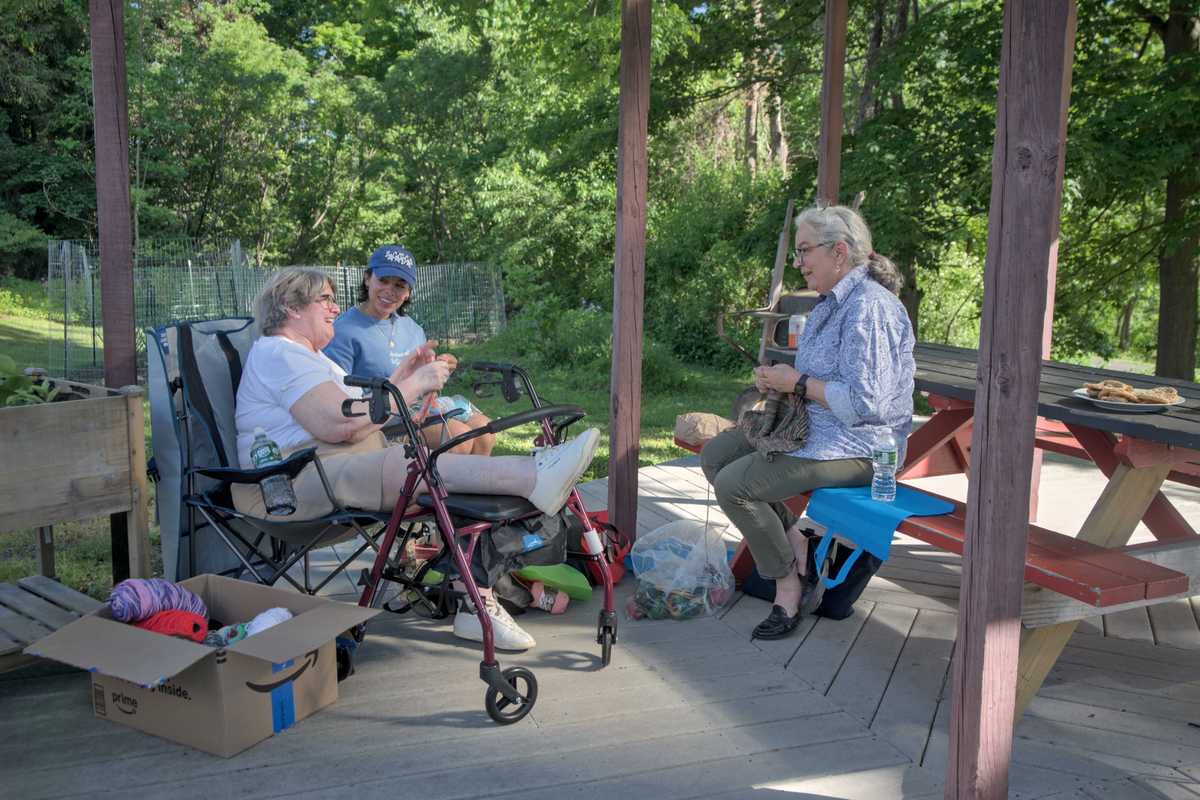
Carol Kneeland, left, Cyndhia Valle, center, and Irene Banning knit together on North East Community Center’s back porch during the first “Community Porch Party” on Wednesday, June 3.
MILLERTON — A new pilot program at the North East Community Center aims to bring in community members for chill hangs at the nonprofit’s office on South Center Street this summer.
The weekly “Community Porch Party” is an evolution of senior administrative assistant Ash Baldwin’s “Craft Collective,” which invited community members to enjoy a group crafting session where participants were encouraged to bring individual projects, swap tips and be together. The gathering on Wednesday, June 3, and the preceding “Craft Collective” meetings are part of a broader effort to provide accessible, community-building programming.
The pilot program is set to run every Wednesday through the end of July.
NECC board chair and interim Executive Director Irene Banning joined Baldwin along with Millerton resident Carol Kneeland and Pine Plains resident Cyndhia Valle at the program’s opening night. Kneeland brought enough knitting needles and yarn to go around, and taught Valle how to get started making a knitted square.
“She’s a total pro of 40 minutes,” Kneeland said, knitting needles in hand.
Banning said the community center is working to return to a former status as a community hub. She remembered the COVID-19 pandemic as a turning point for the organization, when it shifted to providing crisis management programs such as its food pantry and housing assistance.
While those programs are still important to NECC’s mission, Banning said, community building is equally so.
She recalled needing an outlet for social interaction when her son moved away from her home, prompting her to find a knitting group based out of Pine Plains.
“One day I just picked up my knitting and I decided to go,” Banning said. “It’s been a fabulous thing.”
The “Community Porch Party” is less focused on the crafting, and instead on just providing an opportunity for people to enjoy a nice yard and a chat with fellow community members. Baldwin and Banning assembled sweet treats and snacks for people to eat, and crafters are encouraged to bring a project but it’s not required.
The effort stems from a recognition that social interaction can be difficult to come by in northeast Dutchess County.
“It’s so hostile out there, and you always have to be careful about what you say or what you don’t say,” Banning said. “Just to have a place where that doesn’t matter is really nice.”
NECC’s “Community Porch Party” is set for Wednesdays from 3 p.m. to 5:30 through July 29.
Graham Corrigan
PINE PLAINS — Community Day returns to Pine Plains on June 13, reviving a tradition last celebrated in 2023 during the town’s bicentennial celebration.
The event’s return has been spearheaded by an ad hoc group of residents led by Lenora Champagne, Jeanne Valentine-Chase, Lisa Agnelli, Joan Taylor, Helene Marsh and others.
Champagne and Valentine-Chase, who are on the town’s Beautification Committee, said they recruited volunteers to help organize it, realizing that Community Day is a big undertaking. “It was clearly a bigger project than what that committee could take on,” said Champagne. “So we turned to people who’d been involved in previous Community Days.”
The community was up to the task. Some of the entertainment will be familiar: live music will fill the air, local businesses and nonprofits will set up booths along Main Street, and the Graham-Brush House will host fiddlers and reenactments.
New additions to Community Day abound, too: a 31-vendor market will set up shop by the Catholic church on Poplar and Church Street. The market will host makers offering sourdough bread, artisanal jewelry, and everything in between. The Pines, a historic Victorian inn on Maple Street, will open its doors for tours as well.
This year’s Community Day is also offering an eye-popping amount of complimentary experiences, for kids and adults alike. First there’s a free breakfast hosted by Pine Plains Fire Company. Free raffle tickets are on offer, with the chance to win prizes like gift certificates to local businesses like Chaseholm Farm and Factory Lane Automotive — or fruit trees donated by Full Circus Farm. There’s a free scavenger hunt to work up an appetite, and free lunch from local restaurants to sate it — all chased down with a postprandial stroll through the free corn maze.
“There ought to be something of interest for everyone,” Champagne said. “We’re really curious to see what people enjoy.”
Town Councilwoman Jeanine Sisco is the group’s liaison to the town. She’ll also be the one “collecting garbage and schlepping benches.”
“We did Community Day for years,” Sisco said. “But sometimes people just didn’t step up. We’re hoping this will be the start of doing it every year.”
The goal, Sisco says, is to bring people in to town. All the people: generational locals and weekenders alike. “We want to bring all those folks into a united venue to get to know what’s going on in town, and revitalize the spirit of community.”

Want more of our stories on Google? Click here to make us a Preferred Source.
Leila Hawken
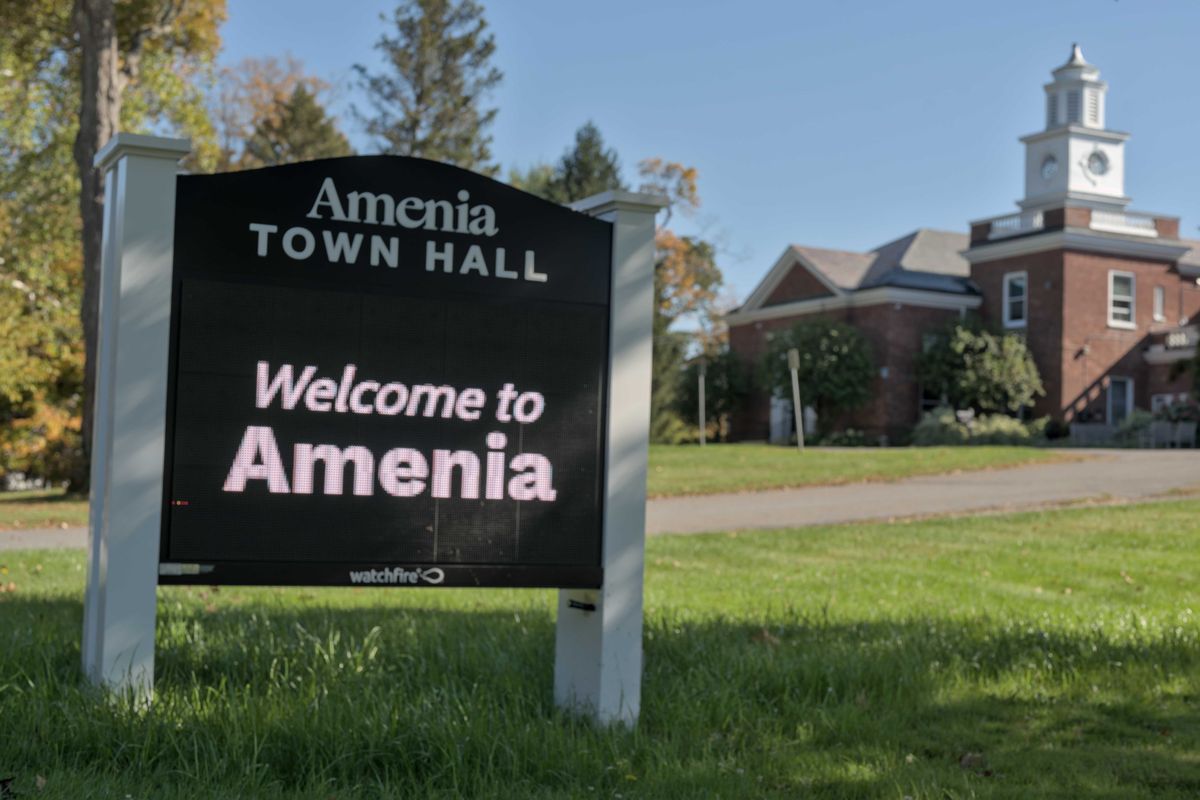
AMENIA — The Water Committee is exploring options to allow municipal water customers to pay their bills online and by credit card.
Responding to customer interest in additional payment options, the committee discussed potential billing software upgrades during its regular meeting Wednesday, June 3.
Town Billing Clerk Nancy Nowak presented information from Muni-Link of Bellwood, Pennsylvania, a cloud-based billing company that serves municipal utilities.
“This software is so much better,” Nowak said. “It is similar to what we have now, but it’s easier.”She added that the company works with four credit card processors.
Initial set-up cost for the system is estimated at $12,000, Nowak said, with an additional monthly charge of $650. Current administration costs for billing stands at $138 monthly for the town.
“But you would be getting twice as much service,” said Water Committee chairman Bill Flood, comparing the proposed streamlined billing system to the present one.
Nowak had explained that the current system provides limited account management capability, leaving much input to be done by hand. She reported also that over the years, customers have asked for the convenience of emailed billing and on-line payment.
For those water district customers who lack computer capability or who prefer to pay in person, there would still be the option for mailed billing.
The committee agreed to continue to explore the option, gathering additional information, before presenting a proposal to the Town Board.
In other discussion, Flood announced that the prefabricated pump house building is expected to be installed at the Lavelle Road site in the fall. The foundation is ready to accept the new structure.
A program to replace non-working water meters is progressing with VRI Environmental Services, the town’s water operator, having sent out 20 postcard notices. In response so far, 13 meters have been replaced.
In final action, the Water Committee agreed to meet quarterly, rather than the current monthly schedule. Special meetings will be scheduled as needed.
Millerton News

SHARON — Susanne Cecilia Berberoglu, beloved wife, mother, grandmother, and friend, passed away peacefully on May 14 surrounded by the love of her family.
Born on Fe 13, 1951, in New Milford, Susanne lived a life filled with warmth, adventure, compassion, and dedication to those she loved.
A graduate of Brookfield High School, Susanne went on to work as a travel agent, a career perfectly suited to her adventurous spirit and love of discovering the world. She especially cherished her travels to Australia, London, and Hawaii, creating memories that she carried throughout her life.
Susanne had a lifelong passion for antiques and found joy in collecting and appreciating beautiful pieces filled with history and character. She was also deeply devoted to her beloved Boston Terriers, whom she lovingly raised and cared for over many years. Her home was always filled with warmth, laughter, and the companionship of the dogs she adored.
Above all else, Susanne treasured her family. She is survived by her devoted husband of 54 years, Tayfun Berberoglu Sr.; her loving daughter, Jennifer; her son, Tayfun Berberoglu Jr.; and her cherished granddaughters, Faora and Sybella. Her love, kindness, strength, and gentle spirit will forever remain in the hearts of all who knew her.
Susanne will be remembered for her caring nature, adventurous soul, and unwavering love for her family, friends, and animals. Her memory will continue to inspire all whose lives she touched.
The Kenny Funeral Home has care of arrangements.
Millerton News
Want more of our stories on Google? Click here to make us a Preferred Source.
Want more of our stories on Google? Click here to make us a Preferred Source.