Stanford supervisor pushes transparency in first year

Julia Descoteaux
Photo by Aly Morrissey

Julia Descoteaux
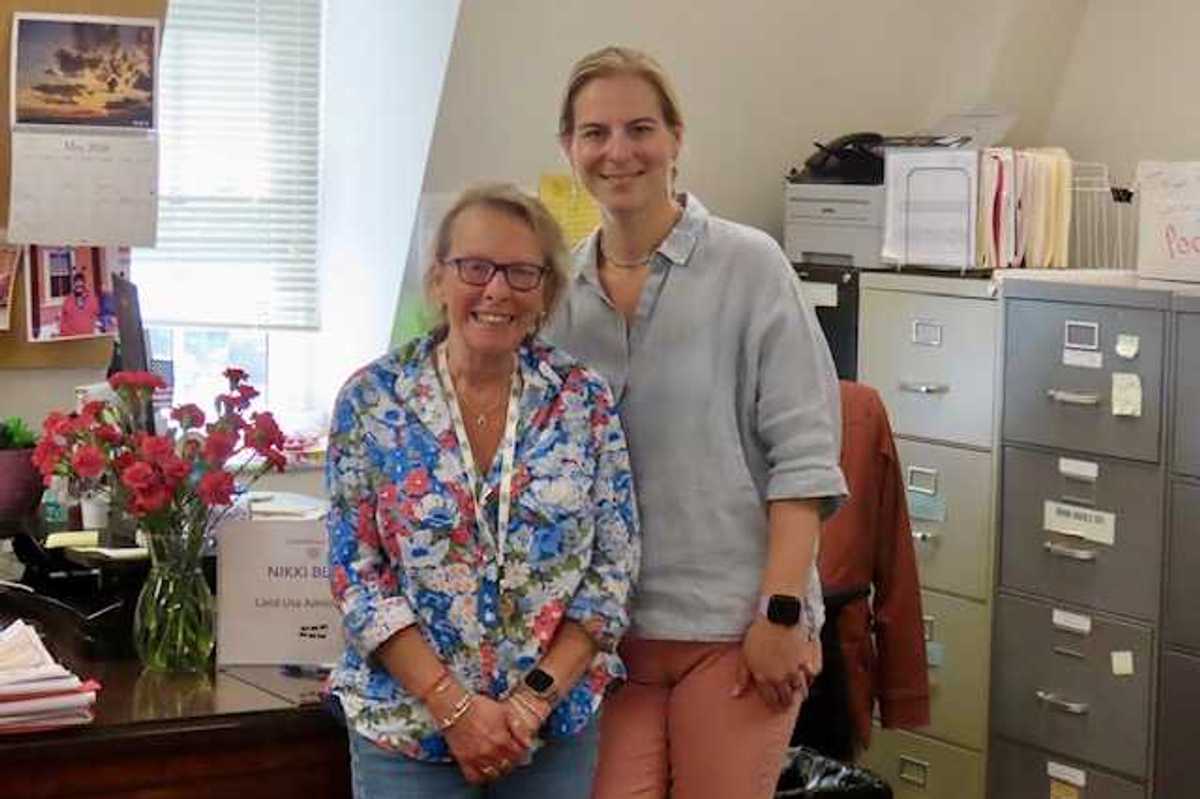
STANFORD — Last fall, Julia Descoteaux campaigned for and won election as Stanford’s supervisor — but she says she does not want Town Hall to feel political. Instead, she wants it to be accessible and transparent, qualities that recently earned Stanford top honors from the New York Association of Towns (NYAT).
Last week, Stanford’s town officials attended the annual NYAT luncheon to receive official recognition as a 2026 “Gold Town of Excellence,” an achievement that acknowledges towns that go above and beyond in the areas of economic development, sustainability, planning, community engagement, governance and transparency, and workforce development.
“This honor reflects the hard work happening every day,” Descoteaux said. “It belongs to our entire community.”
Descoteaux, a Democrat, describes the position as both representative and chief financial officer. As Stanford’s budget officer, she is responsible for keeping the town on stable financial footing while navigating the pressures common to rural communities. Rising housing costs, an aging population, limited staff capacity and a narrow tax base are among the challenges she said will command her focus in the year ahead.
“I try to lead with data and examples,” Descoteaux said. She moved from New York City to Stanford during the COVID-19 pandemic and now serves as town supervisor. “I think of myself as a very community-minded and neighbor-minded leader.”
Stanford has been helped in recent years by generous donors — including a sizable $2 million gift to subsidize EMS and ambulance service — but Descoteaux said philanthropy can’t replace long-term financial planning.
“That’s not a long-term solution,” she said.
Her approach, she said, is to minimize the burden on taxpayers by pursuing grants and outside funding — while being candid about the tradeoffs that come with them. Stanford is one of the only towns in Dutchess County not part of the Greenway Compact, she said, which can limit grants and funding.
“Everything has tradeoffs,” she said. “My goal is to talk about all of the pros and cons.”
The transparency-first stance is likely to be tested as the town prepares to take up zoning recommendations and changes later this year, tied to Stanford’s comprehensive plan “Preserving Our Rural Character and Advancing Economic Vitality,” adopted in December 2023. Descoteaux expects the conversation to be high-stakes — in part because residents are protective of the town’s rural character.
“Most people really want to keep Stanford rural,” she said. “They don’t want Stanford to turn into something it’s not.”
While a significant portion of Stanford’s land is permanently protected from development, those parcels generate little or no property tax revenue. As a result, the town must fund its services with a smaller tax base, creating additional financial strain.
At the same time, she said, preserving Stanford’s identity cannot come at the expense of long-term sustainability, particularly as housing costs continue to rise.
In the near term, Descoteaux said she hopes to make local government easier to access and understand. Her priorities include modernizing the town website, livestreaming meetings, digitizing the paper-based building department and, eventually, enabling electronic payments.
“These are things that can be solved with technology,” she said, describing efficiency as both a workforce issue and a fiscal one.
Descoteaux’s style is deliberately personal — a hockey mom and a dog mom who talks about government in the language of neighbors in an attempt to avoid divisiveness. Government works best when residents stay in the loop and the conversation, she said.
“Feedback is a gift,” she said. “We read everything. My ask is that we keep up that dialogue.”
Aly Morrissey
A provocative new billboard on Route 22 in the Town of North East appears to bear a political message but is actually an ad for a local paving company.
MILLERTON — A billboard located in North East recently received a new advertisement, and the message is catching drivers’ attention.
At first glance, the billboard appears to convey a political message. In large capital letters, it reads, “STOP ICE.” But in much smaller type below, the sign clarifies its real pitch: “from filling your driveway potholes next winter — pave it. Call Ben.”
The advertisement is for B. Metcalf Asphalt, a local paving company.
Ben Metcalf, the business owner, declined to comment on the billboard or his advertising approach.
However, after a photo of a new billboard was posted on Facebook, people started to weigh in, with some expressing alarm.
The sign — visible to drivers travelling south on Route 22 — is located on property owned by the McEnroe organic farm operation across the road from a New York State road salt shed.
One Facebook user called the billboard a “low-tech version of clickbait.”
Some residents said the billboard caused them to hit the brakes. “It startled me,” said Facebook user Karen Knudson. “Going past the sign at 50mph STOP ICE is all I saw!”
“Putting anything politically incitive on a sign advertising your business is probably a bad idea,” Dennis Williams commented. “You’re likely to cut your potential market right in half.”
While some made claims of self-promotion, an overwhelming number of Facebook comments indicated that the sign was mostly effective advertising, not intended to lean toward any side of the political issue.
“It got everyone talking,” one user wrote.
“They often have somewhat edgy outdoor advertising,” another user commented.
Pine Plains documentary filmmaker Stan Hirson, 88, posted the photo to Facebook, where it drew nearly 63 comments as of press time.
“My goal in all my work is to build community by bridging different types of people and getting them to interact with each other,” Hirson said. He said he doesn’t often take a stand on issues but likes to get people talking.
“Sometimes it’s messy, okay? If you look through some of the replies on this very innocent billboard post, you’ll see hostility,” he added. “People get very snarky and they need to show off. That’s ok, but we really need to do it face to face.”
Nathan Miller
Patrick Trettenero, Stissing Center Executive Director, displays a photo of the current state of the music and performing arts venue’s renovations at a regular meeting of the Pine Plains Planning Board on Wednesday, March 11.
PINE PLAINS — Planning Board members approved a second renewal for ongoing renovations to the Stissing Center, an arts venue in downtown Pine Plains.
Board members granted a 12-month renewal of the Stissing Center’s site plan, allowing the project to continue while construction moves forward. Planning board approvals typically expire after a set period if projects are not completed, requiring applicants to request extensions while work continues.
Patrick Trettenero, Executive Director of the Stissing Center, explained the 200-year-old building is undergoing significant renovations to solidify the building’s structure, replace the roof, and enhance the center’s ability to show films in addition to its regular roster of performances and musical acts.
Trettenero described the renovations as extensive. He said the current phase of the project, which involved replacing much of the building’s structural supports, is within six weeks of completion. Phase four will see a large addition to the building’s rear. Trettenero said that work may take longer than a year, and board members may have to grant another extension next March.
Earlier steps in the renovation included enhancing the building’s parking space and improvements to the basement that allowed the Stissing Center to open Grace Note — an intimate music venue space and bar below the center’s main event hall.
Board members unanimously approved the renewal. Planning Board attorney Warren Replansky said forward progress on the project was heartening. Board Chair Michael Stabile agreed and said the board would reconsider another renewal next year if necessary.
“They’re making progress,” Replansky said. “That’s what matters.”
The Stissing Center’s renovations were first heard and approved by the Planning Board in 2024. Board members granted a 12-month extension for the project last March. The most recent renewal is the second extension the center has received for major renovations to the building’s structure.
Trettenero said the Stissing Center still has to secure additional funding for the final phase of the project.
“We have to raise some money this year to unlock some matching funds from the State of New York to finish that phase,” Trettenero said. “We are confident we’ll get there.”
Aly Morrissey
The building that housed the North East Community Center’s Early Learning Program in Millerton. The program closed last November due to financial difficulties, a decision that drew criticism from parents and staff and preceded the recent departure of Executive Director Christine Sergent.
MILLERTON – The North East Community Center announced that Christine Sergent, who has served as the organization’s executive director for eight years, left her position as of Friday, March 13. Staff were notified on Friday shortly before a statement was sent to the community.
Board Chair Irene Banning said she and the board accepted Sergent’s resignation, but would not elaborate on the timing or circumstances surrounding the departure. Sergent was removed from the website’s staff page as of Friday evening.
“Leadership changes always feel like a loss, and they are,” Banning said. “But they are also opportunities.”
In a statement, Banning expressed gratitude for Sergent’s eight years of service, highlighting her work expanding the Food Pantry and championing the Transportation Program.
“While we are losing a skilled manager with Christine, change is an opportunity for reevaluation and the infusion of energy into the future of NECC.”
Banning said she and NECC’s Vice Chair Julie Berkun Fajgenbaum will step into Sergent’s role temporarily – serving as a “backstop” rather than taking charge – while the board organizes a search process for the next executive director. Banning said she hopes the process will be efficient and move quickly enough that an interim director will not be necessary.
The search process has yet to be formalized, Banning said, adding that it would likely include a committee consisting of board members and staff. A first step would be gathering information from employees and community members to help the committee draft a job description.
“We hope to collect lots of applications from very qualified candidates,” Banning said. The current NECC organization is filled with capable program directors and senior staff, she added.
“The organization is on solid ground and our programs are working well and are funded,” she added. “We have good relationships with donors and funders and show them on an ongoing basis that we perform up to and beyond expectations.”
As for what NECC is looking for in a new executive director, Banning said she can’t “jump the gun.” Conversations with current staff and board members will inform a job description, and Banning is confident that the right candidates will emerge.
Sergent and the board faced criticism following the unexpected closure of the organization’s Early Learning Program (ELP) last November, citing financial difficulties, which left families and staff scrambling.
Although parents said they understood the financial realities, they were frustrated by the way the closure was communicated, describing it as abrupt and lacking transparency.
“The way the announcement was made was disappointing and feels antithetical to the fabric and character of NECC,” said Finegan Ferreboeuf last fall, whose toddler was enrolled at the ELP prior to its closure.
Former ELP Director Emily Redmond, who was fired last November following the program’s closure, was also vocal in her criticism of the process. She said she and her colleagues would have valued the opportunity to discuss potential solutions before the decision to close was finalized.
However, Redmond also sees the change as an opportunity.
“I hope NECC finds someone wonderful who will fill that role with grace and courtesy and respect for the community they represent,” Redmond said.

Want more of our stories on Google? Click here to make us a Preferred Source.
Aly Morrissey
Dutchess County Emergency Medical Services Commissioner William Beale addresses the County Legislature's Public Safety Committee during a meeting in Poughkeepsie on Wednesday, March 4.
Ambulance response times to life-threatening emergencies in parts of northeastern Dutchess County were among the slowest in the county last year, according to newly released county data. Region 5, which includes Amenia, Dover, North East and the Village of Millerton, ranked last among the county’s seven EMS regions for the percentage of life-threatening calls reached within nine minutes — a benchmark widely used to measure acceptable response times.
The poor ranking comes even after Dutchess County spent roughly $4 million over two years on a supplemental emergency medical service program intended to improve coverage and response times.
In North East, ambulances reached Priority 1 calls within the nine-minute benchmark only half of the time, while in Amenia the rate dropped to 33%.
County-wide, ambulances reached those life-threatening calls within nine minutes 69% of the time.
In Pine Plains, ambulances took an average of nearly 13 minutes to arrive, and only 29% of critical calls were reached within nine minutes.
The response time data includes both municipal ambulance services that towns contract for — such as North East’s current contract with Empress, which will climb from $511,558 to $696,345 this year, a 36.1% increase — and the county’s supplemental EMS program, which adds ambulances, fly cars and technology to fill gaps in coverage.
But the data suggests rural communities in northeastern Dutchess received little direct support from those supplemental services. North East received just one supplemental EMS dispatch during the entire year, while Pine Plains and Milan each received 13, Amenia received eight, and Stanford and Millbrook each received fewer than 10.
Local legislators and municipal leaders say the numbers highlight an urgent need for short-term collaboration while the county develops a broader, long-term plan to address the region’s EMS challenges.
While the countywide average response time for life-threatening calls is just over eight minutes from dispatch to arrival, northeastern Dutchess towns see significantly longer waits.
The data comes on the heels of last year’s announcement that Empress Emergency Medical Services would absorb Northern Dutchess Paramedics, a move that further consolidates ambulance services in the area under a private provider backed by private equity. Empress EMS is owned by PatientCare EMS, a portfolio company of Grant Avenue Capital LLC, a healthcare-focused private equity firm.
Dutchess County Legislator Eric Alexander (D-25), who chairs the Public Safety Committee, and Vice Chair Chris Drago (D-19) invited Dutchess County Commissioner of the Department of Emergency Response (DER) William H. Beale to speak at last week’s Public Safety Committee meeting.
“We’re increasingly dependent on one provider of EMS,” Alexander said, addressing Commissioner Beale. He shared his concerns that the purchase of NDP by Empress is bordering on a monopoly.

“They see the growth of the market, an aging population, and I think they also see the opportunity to demand premium pricing and to defend it over the long term,” he said, adding that he doesn’t believe private companies think counties or towns will push back.
“The service is quickly growing beyond what is affordable,” Alexander added, pointing specifically to the Town of North East, which is expected to pay around $700,000 next year for its existing contract with Empress — one that was transferred from NDP.
Alexander and Drago asked Beale to address the state of EMS in the county and what the $4 million supplemental services program has achieved after two years.
Beale, who was appointed in August 2025, outlined his department’s efforts to date and shared next steps, acknowledging that residents in the northeastern parts of the county have seen limited support from supplemental services.
“It’s a multipronged approach,” Beale said of the county’s current efforts to improve EMS countywide. He said the Department of Emergency Response has expanded regional collaboration meetings with town officials and first responders, while also working to continue tracking and transparently sharing data across the county.
Beale pointed to workforce development efforts aimed at addressing a shortage of emergency responders, including initiatives to streamline EMT and paramedic certification.
The next step, he said, is preparing for a comprehensive countywide EMS plan now required by the state. Under legislation passed by Gov. Kathy Hochul earlier this year, counties must develop detailed EMS plans, while municipalities will also be expected to evaluate and plan for their own emergency response plans.
In an email to local municipal leaders, Town of Milan Supervisor Bill Jeffway said the region “needs to address immediate, short-term EMS needs as we all work with the County and State on longer-term solutions.”
Jeffway said an ad-hoc committee, advised by Dutchess County Legislator Chris Drago, was formed to support EMS services. The group will host a region-wide meeting to brainstorm ways small towns and villages can collaborate on short-term solutions.
The purpose of the meeting will be to hear from Jonathan Washko, Assistant Vice President Emergency Medical Services for Northwell Health — a company that some local leaders are hopeful could serve as a stop-gap option in the region. Washko, considered to be a leading industry expert, is expected to share what Northwell can offer locally.
Commissioner Beale said he and his team have met with Northwell Health recently and he is hopeful that Northwell’s ambulances and EMTs can be onboarded into the county’s existing dispatch.
“If they have units available in northern Dutchess County at Northern Dutchess Hospital, or if they have units available at Sharon Hospital, they could potentially serve northeastern Dutchess County,” Beale said. “It may take some time, but we will be moving forward on developing that plan very quickly.”
Beale also said that Northwell Health does not contract with specific municipalities, which could be a welcome change from other private companies like Empress.
Legislator Drago said he is advocating for a pilot program in northern Dutchess County and will be attending the upcoming meeting with local municipal leaders.
Aly Morrissey
Dan Cohen, left, dispenses whipped cream on a plate of maple syrup treats during a demonstration on the making of maple syrup at Trevor-Lovejoy Zoo on Millbrook School’s campus.
MILLBROOK — The Trevor-Lovejoy Zoo hosted its sixth annual Maple Syrup Madness Weekend on March 7 and 8, drawing visitors eager to sample fresh maple syrup, learn about the sugaring process and enjoy one of the region’s sweetest seasonal activities. The event will continue March 14 and 15, as long as the sap continues to flow, organizers said.
Visitors were treated to free tastings of locally made maple syrup with a side of waffles, while Alan Tousignant — a woodworker, syrup maker and director of the Trevor-Lovejoy Zoo — led demonstrations showing how sap collected from nearby maple trees is transformed into syrup.
“This is a very seasonal activity, and you’ve got to go while you can,” Tousignant said of the labor-intensive process.

Tousignant first experimented with making maple syrup in a backyard over an open campfire under the stars — a method he said required long nights and wasted much of the heat.
Today, he uses a specialized maple evaporator, a large stainless-steel pan heated by a wood fire from below that allows sap to boil efficiently and continuously.
Sap collected from the trees begins as a clear, watery liquid that contains only about two to two and a half percent sugar, Tousignant explained. Before boiling, the sap is run through a reverse-osmosis process to concentrate the sugar slightly. The liquid then enters the evaporator, where heat gradually removes the water as the sap flows through a series of channels.
By the time the liquid reaches about 215 degrees, the sugar has concentrated enough to become maple syrup.
Tousignant said he is currently collecting sap from around 50 maple trees, some of which have multiple taps. He said one gallon of maple syrup requires around 40 gallons of sap, a process that requires a lot of patience.
“That’s what I call ‘almost syrup,’ he laughed, pointing to a container of darkening liquid that had already been boiled and was completing a filtration process.
“Typically, the early season syrup is lighter, and as the season goes on, it gets darker,” he said. “Toward the end of the season, it can be really dark, almost like walnut syrup.”
Tousignant collects chunks of naturally formed ice that float in the sap buckets when the weather gets cold enough as a way to keep a 300-gallon tank of sap cool to prevent it from spoiling until it can be processed.

“I love trying to use Mother Nature to its fullest in a sustainable way,” he said.
He employs the same philosophy in his woodworking, using trees that have already died or fallen or collecting discarded wood pallets from Amazon deliveries to the Millbrook School, saving them from the burn pile.
Raised near the Canadian border in upstate New York, Tousignant said he has always enjoyed working outdoors. As a graduate student, he supported himself with a variety of hands-on jobs to make extra spending money.
“Raking leaves, washing houses, painting, anything to make a little cash for eating and paying the bills,” he said.
It was during this time when Tousignant developed an acronym that now serves as the label for his maple syrup — Hayibaco, short for Home and Yard Improvements by Alan.
This will mark his first year selling his own maple syrup under his custom label, which features an illustrated photo of him in his signature outfit — a plaid shirt and a fleece vest — against a backdrop of his syrup bottles. Syrup will be sold in the gift shop at the Trevor-Lovejoy Zoo and possibly at the Millerton Farmer’s Market in the future.
In addition to Hayibaco, other locally made maple syrup and maple products were available for sale at the tasting, including nearby Soukup Farms in Dover and Russell Farms in Rhinebeck.
Dan Cohen, Trevor-Lovejoy Zoo’s Director of Media, said that zoo attendance typically dips during the winter months. But for many of the zoo’s animals — particularly those who prefer the cold weather — winter can actually be one of the best times to visit.
Animals like Stanley the lynx, Cohen said, are far more active in the cold weather.
Cohen and his colleagues began brainstorming ways to encourage winter zoo visits and were pleased with the success of both a hot chocolate event earlier this year and the maple syrup weekend.
Aly Morrissey
Relief Chiropractic and Wellness on South Center Street in the Village of Millerton, where a stroller was reported stolen and later returned after Tyler Van Steenbergen
MILLERTON — News of a stolen stroller swept through Millerton last week after a grassroots effort to recover the expensive baby equipment gained traction on Main Street and social media.
The stroller, an UPPAbaby Vista model — widely considered a high-end brand and valued at more than $1,000 — was taken from outside Relief Chiropractic and Wellness on the corner of Main Street and South Center Street before it was anonymously returned the following day.
According to its owner, Tyler Van Steenbergen, the stroller had been tucked neatly outside of his office and was taken around 3:30 p.m. on Feb. 27.
Van Steenbergen said he and his wife, who also owns a Main Street business — Treefort Toys and Gifts — became uneasy after their stroller disappeared.
“It was a shock because Millerton is so safe all the time,” Van Steenbergen said.
The couple waited about two hours before calling the Millerton Police Department for assistance. Without adequate security footage, however, Van Steenbergen said officers told them they were not optimistic about recovering the stroller.
“They said it would be like finding a needle in a haystack,” he said.
Undeterred, Van Steenbergen posted flyers up and down Main Street and shared the information on Facebook.
Around 8 a.m. the following day, he said he received a text message from someone who apologized and claimed they believed the stroller had been left out for free, noting that baby equipment is sometimes left on the street for others to take.
The stroller was returned to the alley behind the chiropractor’s office on South Center Street.
Van Steenbergen said there was no sign indicating the stroller was free and that it had not been placed by the roadside.
“I find that hard to believe because it was tucked up right against my office,” he said of the person’s claims.
Following the incident, Van Steenbergen said he ordered additional security cameras for the property. He said he and his wife are just happy to have their stroller back, which is used by their seven-month-old baby.

Want more of our stories on Google? Click here to make us a Preferred Source.

Want more of our stories on Google? Click here to make us a Preferred Source.