Our visit to Hancock Shaker Village

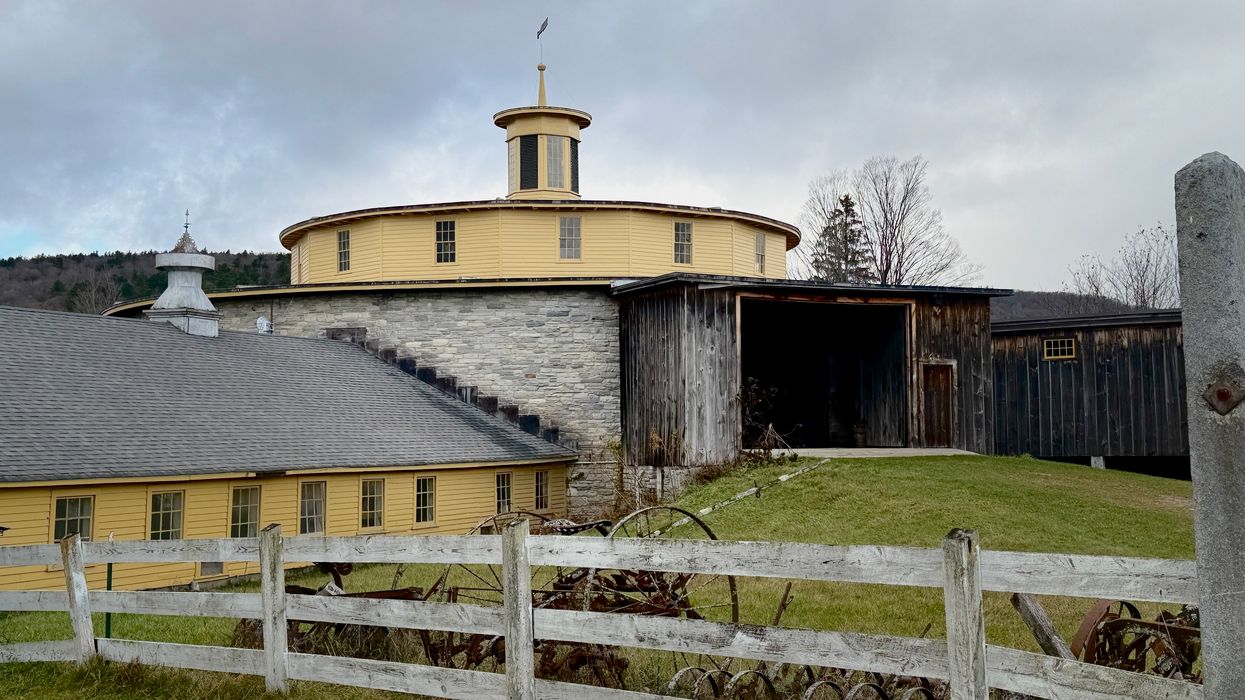
The Stone Round Barn at Hancock Shaker Village.
Jennifer Almquist

The Stone Round Barn at Hancock Shaker Village.
My husband Tom, our friend Jim Jasper and I spent the day at Hancock Shaker Village in Pittsfield, Massachusetts. A cold, blustery wind shook the limbs of an ancient apple tree still clinging to golden fruit. Spitting sleet drove us inside for warmth, and the lusty smells of manure from the goats, sheep, pigs and chickens in the Stone Round Barn filled our senses. We traveled back in time down sparse hallways lined with endless peg racks. The winter light was slightly crooked through the panes of old glass. The quiet life of the Shakers is preserved simply.

Originally founded in England, the Shakers brought their communal religious society to the New World 250 years ago. They sought the perfection of heaven on earth through their values of equality and pacifism. They followed strict protocols of behavior and belief. They were celibate and never married, yet they loved singing and ecstatic dancing, or “shaking,” and often adopted orphans. To achieve their millennialist goal of transcendental rapture, we learned, even their bedclothes had to conform: One must sleep in a bed painted deep green with blue and white coverings.
Shakers believed in gender and racial equality and anointed their visionary founding leader, Mother Ann Lee, an illiterate yet wise woman, as the Second Coming. They embraced sustainability and created practical designs of great utility and beauty, such as the mail-order seed packet, the wood stove, the circular saw, the metal pen, the flat broom and wooden clothespins.
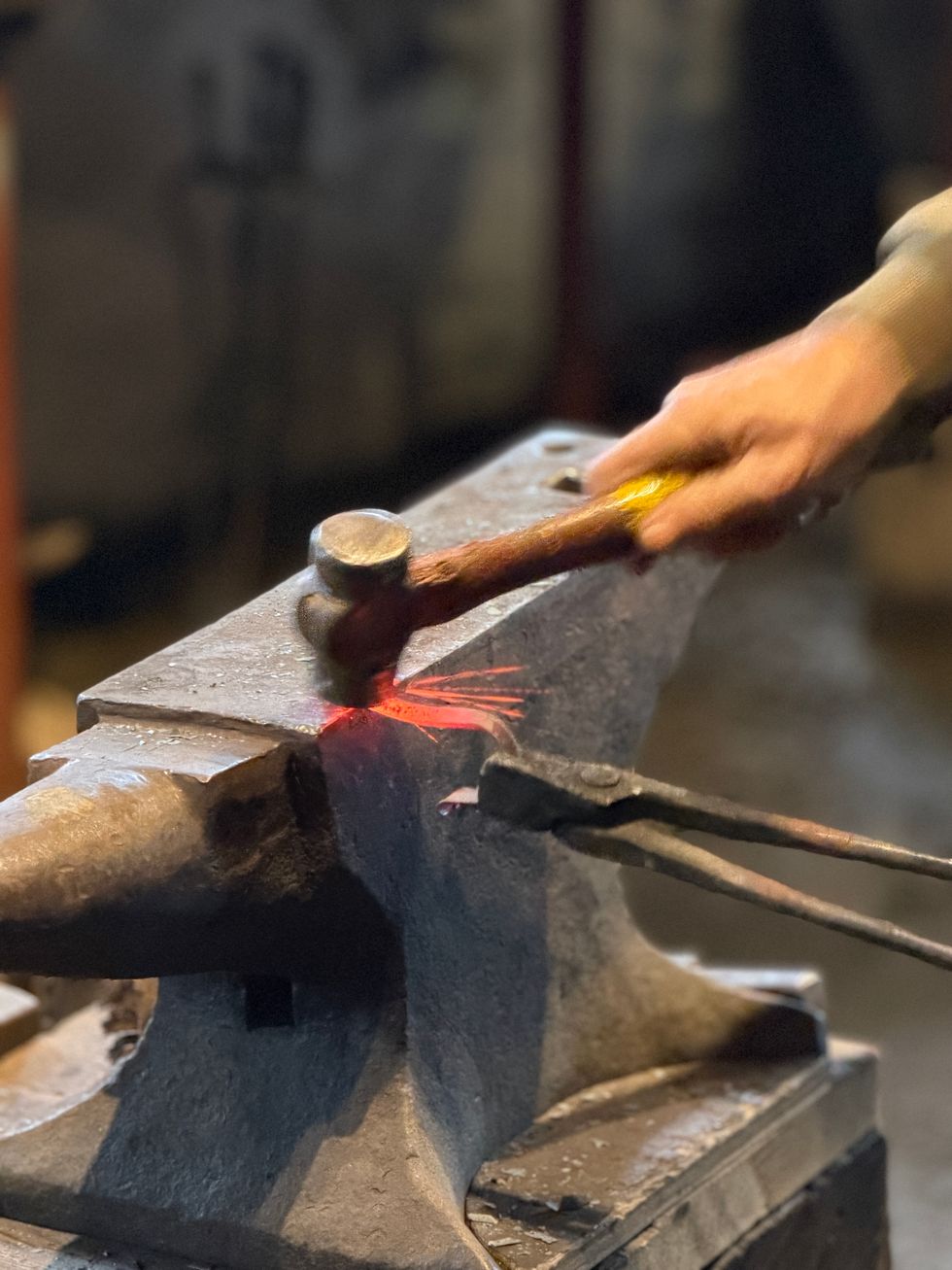
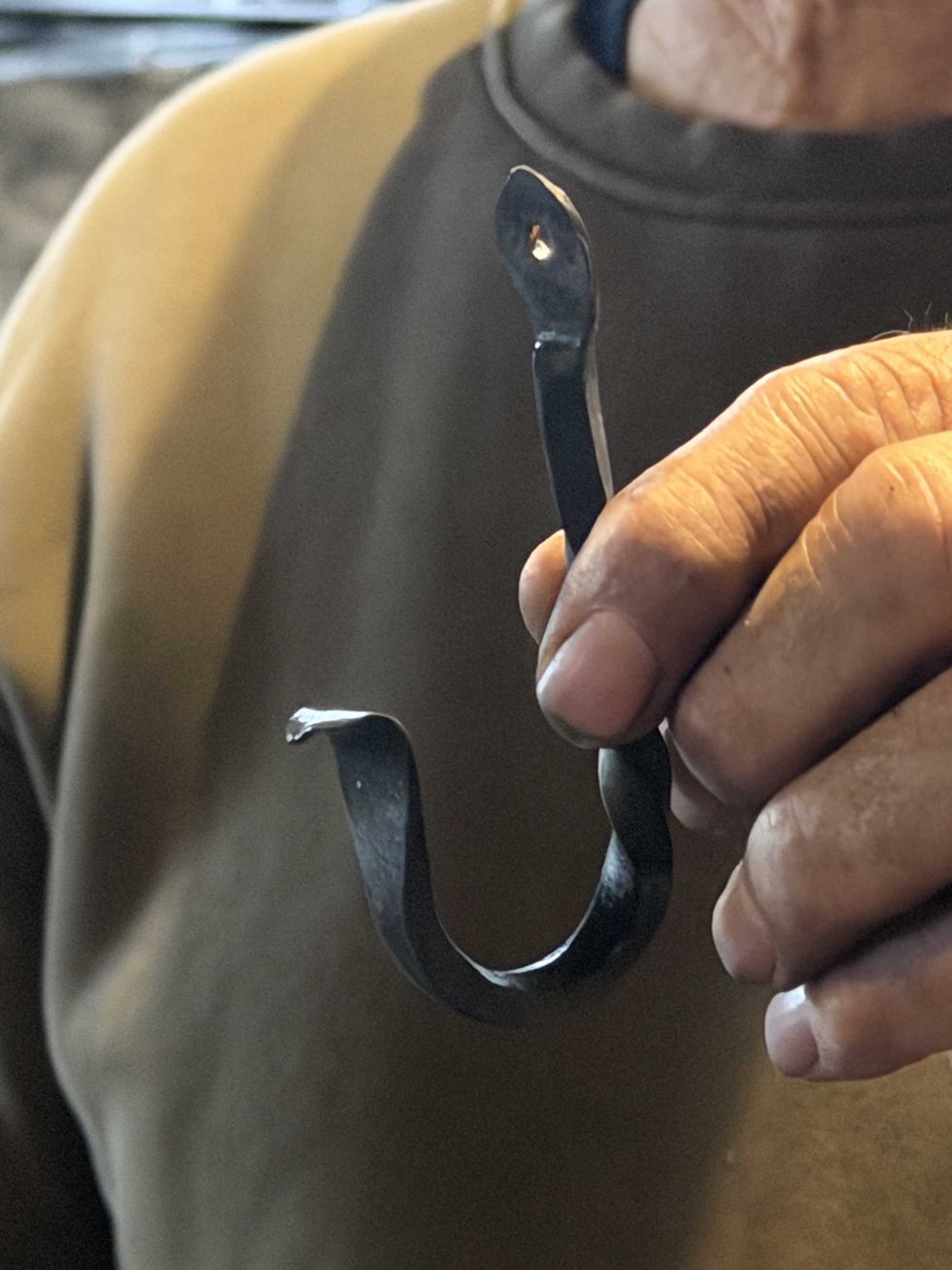
Burning coal smelled acrid as the blacksmith fired up his stove to heat the metal rod he was transforming into a hook. Hammer on anvil is an ancient sound. My husband has blacksmithing skills and once made the strap hinges and thumb latches for a friend’s home.
Shaker chairs and rockers are still made today in the woodworker’s shop. They are well made and functional, with woven cloth or rush seats. In the communal living space, or Brick Dwelling, chairs hang from the Shaker pegs that run the length of the hallways, which once housed more than 100 Shakers.

In 1826, the 95-foot Round Stone Barn was built of limestone quarried from the land of the 3,000-acre Hancock Shaker Village. Its unique design allowed a continuous workflow. Fifty cows could stand in a circle facing one another and be fed more easily. Manure could be shoveled into a pit below and removed by wagon and there was more light and better ventilation.
Shakers called us the “people of the world” and referred to their farm as the City of Peace. We take lessons away with us, yearning somehow for their simplicity and close relationship to nature. One Shaker said, “There’s as much reverence in pulling an onion as there is in singing hallelujah.”
A sense of calm came over me as I looked across the fields to the hills in the distance. A woman like me once stood between these long rows of herbs — summer savory, sage, sweet marjoram and thyme — leaned on her shovel brushing her hair back from her eyes, watching gray snow clouds roll down the Berkshires.
More information at hancockshakervillage.org

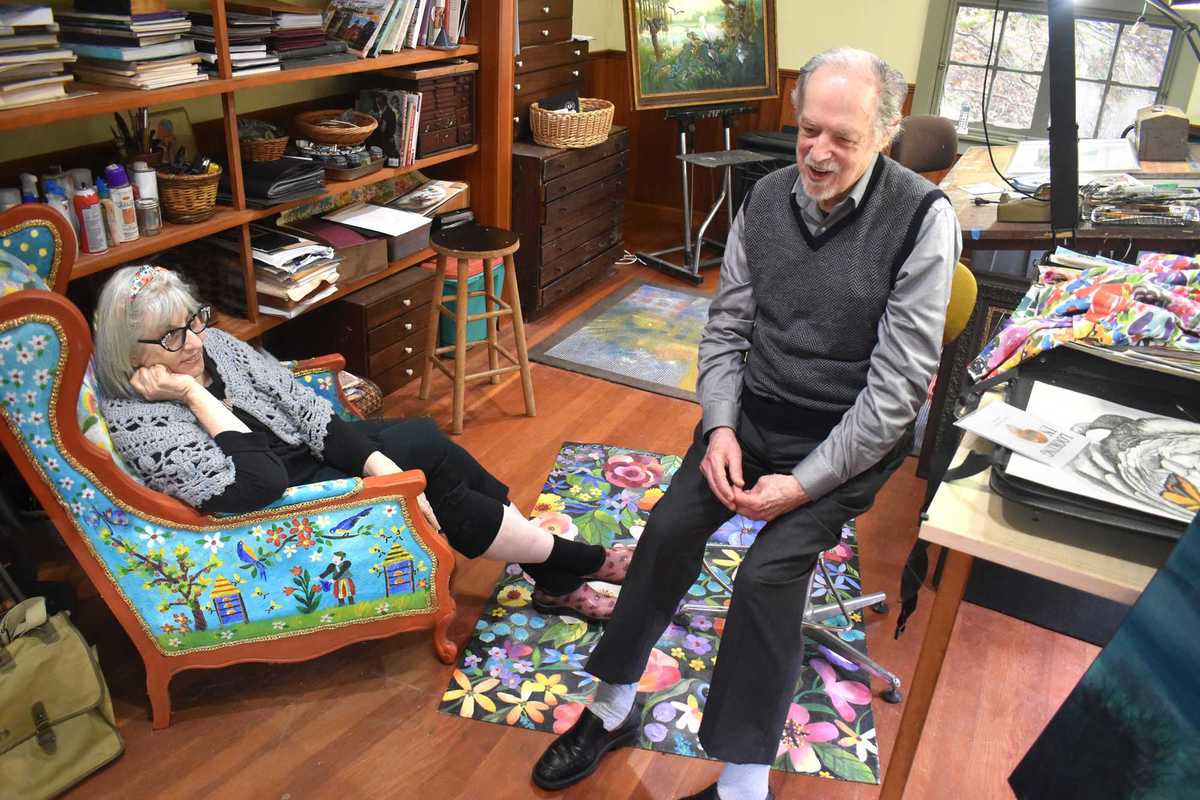
Artist Cheryl Heller, who makes eight-foot-tall paintings of song birdswill have an open studio from 10 a.m. to 3 p.m. on Saturday, Feb. 21.
The Ninth Annual Winter Weekend Festival returns to Norfolk, Feb. 21–22, offering a full slate of seasonal activities for all ages. The community celebration features outdoor adventures such as hiking, skiing and wildlife walks, alongside concerts, art shows, workshops, open studios, historic exhibits and family events. Highlights include live music, artist meet-and-greets, a pickleball tournament, stained-glass tours, craft demonstrations and a “Blizzard of Fun” kids program. Many activities are free, with select ticketed workshops. Early-bird events begin Friday evening with a pop-up gallery reception and documentary screening. Visitors can also enjoy special café and bakery offerings throughout the weekend. Organizers encourage guests to check the festival schedule at weekendinnorfolk.org for updates and return this summer for the three-day Weekend in Norfolk celebration July 31–Aug. 2.
Natalia Zukerman opens Stissing Center’s new speakeasy, The Grace Note.
The Stissing Center officially opened The Grace Note on Friday, Feb. 13, a new speakeasy-style venue aimed at turning Friday nights into a weekly home for local and regional talent.
Hidden in the basement of The Stissing Center, The Grace Note certainly has the feel of a speakeasy, with its brick walls, dim lights and fully stocked bar. Executive Director Patrick Trettenero welcomed the first sold-out crowd and said the inspiration for the reimagined venue came from a desire to offer performances that connect audiences with artists in an intimate setting.
The debut performance featured Natalia Zukerman, Compass Arts & Entertainment editor and Stissing Center advisory board member, who will also co-manage booking for the space as it rolls out weekly programming. From the moment she stepped onto the stage, Zukerman held the audience in the palm of her hand, leaving concert-goers hanging on her every word. There were moments of raucous laughter and moments when you could hear a pin drop.
A storyteller at heart, Zukerman wove an introspective thread throughout the night, exploring how connection, art and beauty can exist even amid injustice and a relentless news cycle. Between songs, she offered commentary and her personal reflections, while her lyrics echoed many of the same themes.
The Grace Note will be open every Friday night. For a schedule of upcoming performances and to purchase tickets, visit thestissingcenter.org
“This Beautiful Place,” paintings by Torrington artist Suzan Scott exploring the Litchfield Hills and surrounding landscapes will be on view Feb. 12‑March 13 at the David M. Hunt Library, 63 Main St., Falls Village. Opening rception: Saturday, Feb. 21, 5 to 7 p.m. Art talk: Thursday, March 12, 5:30 p.m. Free and open to all.

Want more of our stories on Google? Click here to make us a Preferred Source.
Legal Notice
Notice of formation of Glynevian Gundogs LLC. Arts of Org filed with SSNY on 9/25/2025. Office location: Dutchess County. SSNY designated as agent of LLC upon whom process may be served. SSNY shall mail process to Business Name and Address. Purpose: any lawful act or activity.
01-15-26
01-22-26
01-29-26
02-05-26
02-12-26
02-19-26
Legal Notice
Notice of Formation of Cat Kin Willow LLC. Articles of Organization were filed with the SSNY on 1/7/2026. Office Location: Dutchess County. SSNY has been designated as agent of the LLC upon whom process may be served. SSNY shall mail a copy of any process to: Cat Kin Willow LLC, 14 Poplar Ave, Pine Plains, NY, 12567. Purpose: Any lawful act or activity.
02-05-26
02-12-26
02-19-26
02-26-26
03-05-26
03-12-26
Legal Notice
Notice of Formation of Your Mom’s Bush Native & Medicinal Plant Nursery LLC. Arts. Of Org. file with SSNY on 1/20/2026. Office location: Dutchess County. SSNY designated as agent of LLC upon whom process may be served. SSNY shall mail process to 3657 U.S. 44, Millbrook, NY, 12545. Purpose: any lawful act or activity.
02-12-26
02-19-26
02-26-26
03-05-26
03-12-26
03-19-26
Legal Notice
On-Center Contracting LLC filed an Application for Authority with the Secretary of State of NY on 11/14/2025.
Office location: Dutchess County.
SSNY is designated as agent of the LLC upon whom process against it may be served.
SSNY shall mail a copy of any process served against the LLC to 183 Lake Rd, Warren, CT 06777.
The purpose of the LLC is contracting/carpentry. On-Center Contracting LLC can be reached at (860)-806-4934.
01-29-26
02-05-26
02-12-26
02-19-26
02-26-26
03-05-26
PART-TIME CARE-GIVER NEEDED: possibly LIVE-IN. Bright private STUDIO on 10 acres. Queen Bed, En-Suite Bathroom, Kitchenette & Garage. SHARON 407-620-7777.
The Salisbury Association’s Land Trust seeks part-time Land Steward: Responsibilities include monitoring easements and preserves, filing monitoring reports, documenting and reporting violations or encroachments, and recruiting and supervising volunteer monitors. The Steward will also execute preserve and trail stewardship according to Management Plans and manage contractor activity. Up to 10 hours per week, compensation commensurate with experience. Further details and requirements are available on request. To apply: Send cover letter, resume, and references to John Landon at info@salisburyassociation.org. The Salisbury Association is an equal opportunity employer.
Weatogue Stables in Salisbury, CT: has an opening for experienced barn help for Mondays and Tuesdays. More hours available if desired. Reliable and experienced please! All daily aspects of farm care - feeding, grooming, turnout/in, stall/barn/pasture cleaning. Possible housing available for a full-time applicant. Lovely facility, great staff and horses! Contact Bobbi at 860-307-8531. Text best for prompt reply.
Hector Pacay Landscaping and Construction LLC: Fully insured. Renovation, decking, painting; interior exterior, mowing lawn, garden, stone wall, patio, tree work, clean gutters, mowing fields. 845-636-3212.
PROFESSIONAL HOUSEKEEPING & HOUSE SITTING: Experienced, dependable, and respectful of your home. Excellent references. Reasonable prices. Flexible scheduling available. Residential/ commercial. Call/Text: 860-318-5385. Ana Mazo.

12 week old black and tan/blue tick coonhound: mix for sale. First set of puppy shots done at 8 weeks. Call 860-248-9947 for more info and price. Ask for Eric.
PUBLISHER’S NOTICE: Equal Housing Opportunity. All real estate advertised in this newspaper is subject to the Federal Fair Housing Act of 1966 revised March 12, 1989 which makes it illegal to advertise any preference, limitation, or discrimination based on race, color religion, sex, handicap or familial status or national origin or intention to make any such preference, limitation or discrimination. All residential property advertised in the State of Connecticut General Statutes 46a-64c which prohibit the making, printing or publishing or causing to be made, printed or published any notice, statement or advertisement with respect to the sale or rental of a dwelling that indicates any preference, limitation or discrimination based on race, creed, color, national origin, ancestry, sex, marital status, age, lawful source of income, familial status, physical or mental disability or an intention to make any such preference, limitation or discrimination.

FOR SALE: 39 Hospital Hill Road, Sharon. 1680 sq.ft. Two family, rare side-by-side units. 4 bed; 2 full bath, 2 half. Great investment, or live in one and rent other side. $485,000. Call/text Sava, 914 -227-4127.
A speed enforcement camera in New York City.
Speed cameras remain a tough sell across northwest Connecticut — and are still absent from local roads in neighboring Dutchess County.
Town leaders across northwest Connecticut are moving cautiously on speed cameras, despite a state law passed in 2023 that allows municipalities to install them. In contrast, no towns or villages in Dutchess County currently operate local automated speed-camera programs, even as New York City has relied on the technology for years.
In both states, officials say speeding remains a concern on local roads — particularly on through roads and in residential areas — but questions about cost, enforcement and public support have slowed momentum outside large cities.
For border communities in northeast Dutchess County, where traffic crosses state lines daily, the Connecticut debate hits close to home.
Supporters of speed cameras argue the technology can slow traffic and improve safety, particularly in communities with limited police coverage. Critics worry cameras could turn small towns into “speed traps,” and raise concerns about surveillance.
That caution mirrors the picture statewide in Connecticut. Since the law took effect, only 11 of the state’s 169 municipalities have implemented speed cameras.
In New York, automated speed cameras are widespread in New York City, where hundreds operate year-round in school zones under authority granted by the state Legislature.
However, unlike Connecticut’s opt-in law, New York requires separate legislative approval at the state level for each municipality to install local speed cameras. That authority has not been granted to towns or villages in Dutchess County.
Limited authorization has been extended by the state legislature to a small number of municipalities, including White Plains, Kingston, Schenectady and Albany.
As a result, automated enforcement in Dutchess County is currently limited to state-run work-zone speed cameras — temporary devices installed by the New York State Department of Transportation in active highway construction or maintenance areas that ticket drivers who exceed posted speed limits.
Washington is the only town in western Connecticut to adopt speed cameras so far, and officials there say the program is already changing driver behavior.
“Speeds are coming down,” said Washington First Selectman Jim Brinton, noting cameras were installed in May 2025. “We had tried everything — speed bumps, education. This is the only option that’s showing positive results.”
Elsewhere in the region, the response has been far more skeptical.
In Kent, voters overwhelmingly rejected a proposed speed-camera ordinance by a 391–100 margin in January 2025.
“I’m concerned about the atmosphere cameras create,” resident Lianna Gantt said during a public hearing. “Are we turning our town into a speed trap?”
Interviews with first selectmen in North Canaan, Falls Village, Sharon and Kent — along with responses from officials in Salisbury and Cornwall — show a shared concern about speeding but hesitancy to move forward with cameras.
Connecticut’s process for implementing speed cameras is extensive. Towns must adopt a local ordinance, present a traffic enforcement plan at a public hearing and secure voter approval at a town meeting or referendum. Any approved plan must then be reviewed by the Connecticut Department of Transportation.
Towns must also install camera equipment and complete a mandatory public awareness period of at least 30 days before issuing citations.
After that warning phase, drivers may be fined $50 for a first violation and $75 for subsequent offenses if they exceed the speed limit by more than 10 miles per hour. Camera systems are operated by third-party vendors, which provide images of alleged violations for municipal review.
Each violation must be approved by a qualified municipal employee, contracted agent or law enforcement officer before a citation is mailed — a requirement many small towns say strains limited staff, particularly those without resident state troopers.
With Kent having voted down the program, Sharon appears furthest along in northwest Connecticut in considering speed cameras.
First Selectman Casey Flanagan said the town began studying the option after a traffic analysis found widespread speeding on several local roads.
The study, conducted by Dacra Tech, examined six locations, including Route 41 southbound, Rhymus Road, Calkinstown Road and Williams Road.
“When they averaged it out, it came to almost 33,000 citable events a month on just six roads,” Flanagan said. “Some of these numbers are quite staggering.”
Sharon does not have a resident state trooper, meaning review of potential violations would likely fall to town staff.
“We need to figure out who is going to review the pictures and determine whether a citation gets mailed out,” Flanagan said, noting that the town is still studying the concept. “That could be me, or we could hire someone.”
While vendors have told town officials that citation volumes typically decline as driver behavior changes, Flanagan said Sharon is not rushing a decision.
“There really isn’t a clock on me right now,” he said.
North Canaan is expanding its use of digital speed feedback signs rather than pursuing cameras.
“No one has been asking for it,” First Selectman Jesse Bunce said.
The town is installing additional speed feedback signs along Route 44 and Sand Road through the state-supported Connecticut Speed Management Program, which also provides detailed speed data.
“Once we have that data, we can evaluate what to do next,” Bunce said.
Falls Village tested a temporary speed-monitoring camera about 18 months ago but ultimately pulled back.
“We found out the speed was not as great as we thought it was,” First Selectman David Barger said. “It was more perception than reality.”
Barger said the town relies on speed feedback signs and remains cautious about cameras, citing cost estimates of $26,000 to $28,000 per two-way unit and the lack of staff to review violations.
“The only reason we would want speed cameras is for safety,” he said. “It would not be a revenue generator.”
Salisbury and Cornwall also have no immediate plans to pursue speed cameras, though Salisbury First Selectman Curtis Rand has said he is not opposed to “a mechanical way of lowering speed.”
Washington approved a speed-camera ordinance unanimously in December 2024 and began issuing citations in May after years of resident complaints.
Since then, the town has issued 13,748 citations totaling about $696,000 in fines, with roughly $525,000 collected as of late January, according to Brinton.
A town constable reviews images in-house, a process that now takes about 10 hours a week.
“It was pretty overwhelming at first,” Brinton said. “The volume initially caused a lot of struggles.”
Brinton stopped short of recommending cameras for every community but said Washington’s experience shows the technology can work when tailored to local conditions.
“Every town is different,” he said. “But it has worked for us.”

Want more of our stories on Google? Click here to make us a Preferred Source.

Want more of our stories on Google? Click here to make us a Preferred Source.