Physical therapist finds new space

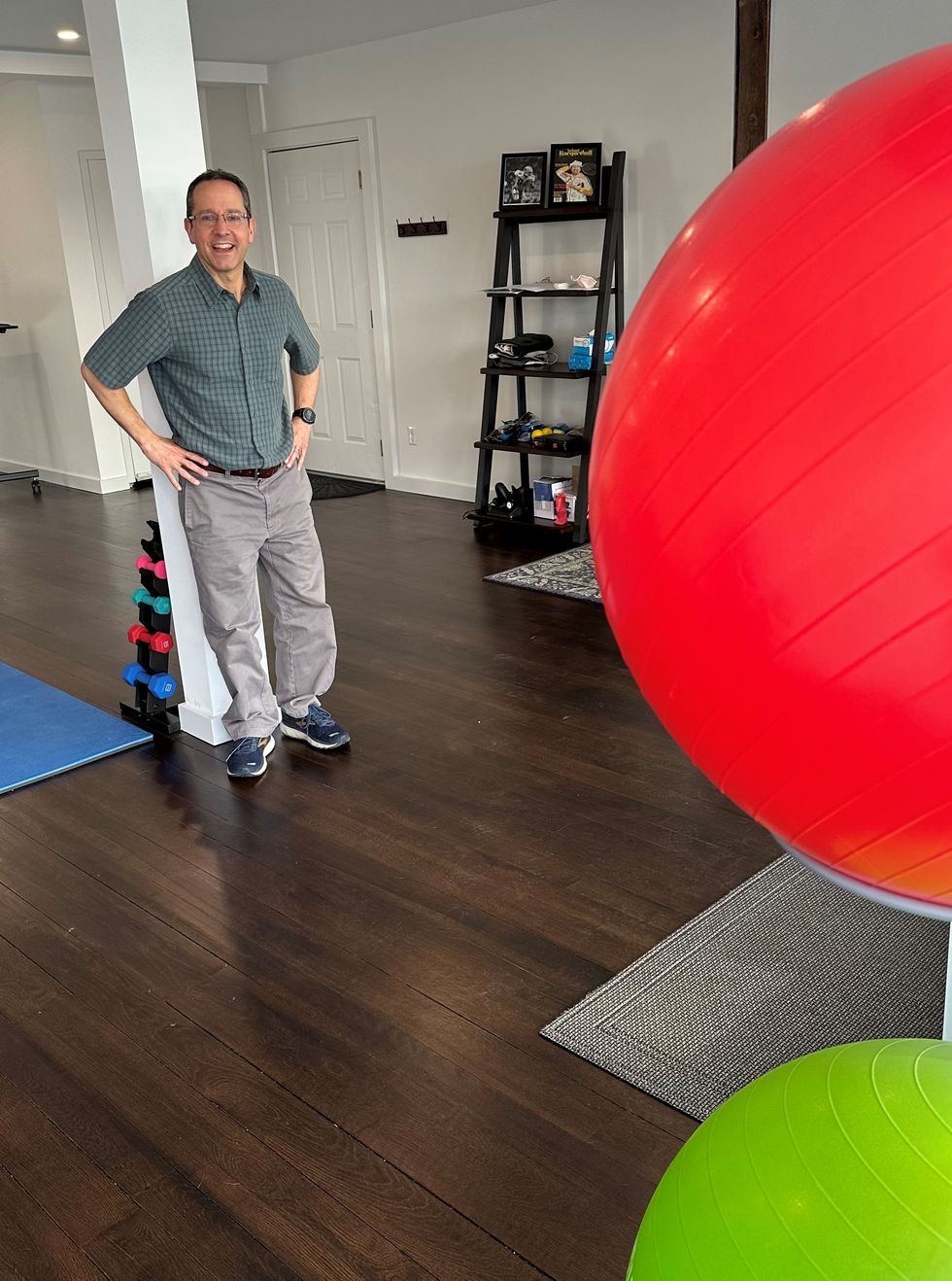
Physical therapist Mike Mangini opened his new private practice in North Canaan on Feb. 13.
Photo by Cynthia Hochswender

NORTH CANAAN — Devoted clients of physical therapist Mike Mangini will be relieved to know he has opened his new private practice, in North Canaan, as of Monday, Feb. 13.
Mangini, 55, was the founding director of outpatient therapy at Geer in North Canaan, where he saw patients for 25 years, building up a devoted clientele over the decades. The waiting list to see him or one of the two other therapists in the department was often five weeks.
Despite the need for the program, and its popularity, COVID and other challenges forced Geer to close the outpatient therapy department last September. Mangini spent a few months searching for just the right commercial space, one that was clean and spacious and which offered easy wheelchair access.
He found it at last at 10 Railroad St. in the center of town. Mangini said he is grateful to building owner John Considine for “being very accommodating and doing such a nice job creating this space.”
Considine owns several commercial properties in the North Canaan business district; Mangini said his landlord’s mission is to bring to town “more nice things to do; and I hope to add to what he’s started here in the center of town.”
The storefront space that Mangini now occupies is unexpectedly cheerful for a medical space, with two friendly signs announcing “physical therapy,” an inviting message that is enhanced by two giant brightly colored therapy balls next to the front door (the wheelchair access is through a side entry).
Generally, physical therapy is not a joyful activity, but somehow the upbeat and humorous Mangini manages to make appointments with him something to look forward to. He is an experienced and highly competent therapist with an advanced degree in orthopedic PT, thousands of hours of continuing education in (and experience in) manual therapy, including in the Mulligan manual therapy technique.
He does work that can be compared to chiropractic; he is expert in the technique of dry-needling, which is similar to acupuncture but which, he explained, “is based on anatomy and Western medicine, unlike acupuncture, which is based on the meridiens and on Chinese medicine.” Another difference: Dry needling is done in combination with a light electrical stimulation, “which has a way of changing how the brain internalizes pain information. The goal is to change the body tissue, but also to create systemic change in the brain and spinal cord.”
Mangini estimates that 75% of his patients are helped by dry needling, in combination with manual therapy and PT exercises.
“It’s fun and it doesn’t hurt,” he promised.
One of the main challenges of being a successful PT, of course, is not just the techniques you use but also the way in which you diagnose a problem and then choose the appropriate treatments.
“I try to be empathetic and a good listener. I try to remember that people have psycho-social needs and that sometimes I need to really hear what someone is saying to me. I try to look at what motivates people, and to understand that not everyone is going to go home and do all the exercises I recommend to them.
“I feel like if I can understand what motivates someone, I can more easily contribute to their recovery process. People want to move better and live better. I want to give them strategies and management tools so they can make good decisions about their health.”
While that all might sound a little earnest, Mangini presents those life lessons wrapped in a healthy dose of humor and good cheer. Unusually, there is nearly always laughter involved in a session with him, even when the road to mobility and relief is painful. So when Mangini promises that, for example, dry needling is fun, he means it, and he isn’t kidding (about that). Also fun: Pool therapy at the YMCA at Geer Village in North Canaan.
“It’s fun!” he promises. “And it’s effective for people with balance issues, spinal pain, arthritis.”
For patients who haven’t already worked with him at Geer, Mangini suggests a phone call or a text with questions of the “Hey, I’ve got something going on” variety.
“Then I can either say, ‘I think you should come in,’ or I might say, ‘That sounds complex, you should probably talk to a doctor.’”
Appointments are now booked directly through Mangini; although there is not yet a five-week waiting list, his calendar is beginning to fill up.
In addition to pool therapy at the Y, he is also doing some home visits, to reduce stress for patients who can’t always get a ride to his office, or for those who can’t easily be moved.
The office is now open Monday through Friday from 8 a.m. to 5 p.m.
“I’m an out-of-network provider for all major medical plans,” he said. “Or patients can do fee-for-service.”
Costs vary depending on how long the session lasts, with most costing between $60 and $120.
Contact Mike Mangini by text or phone at 860-309-4449; email him at mikemanginipt@gmail.com; or go to his website at www.manginiphysicaltherapy.com.
Aly Morrissey
Robin Wall Kimmerer inspired the audience with her grassroots initiative “Plant, Baby, Plant,” encouraging restoration, native planting and care for ecosystems.
Robin Wall Kimmerer, the bestselling author of “Braiding Sweetgrass” and a member of the Citizen Potawatomi Nation, urged a sold-out audience at the Cary Institute of Ecosystem Studies on Friday, March 13, to rethink humanity’s relationship with the natural world through gratitude, reciprocity and responsibility.
Introduced by Cary Institute President Joshua Ginsberg, Kimmerer opened the evening by greeting the audience in Potawatomi, the native language of her ancestors, and grounding the talk in a practice of gratitude.
“Gratitude is the doorway to reciprocity,” Kimmerer said.
Kimmerer, also a mother, botanist and professor, said that Indigenous wisdom does not have to be at odds with Western science, but rather it can help humans reframe the way they understand the Earth.
She also reflected on the personal journey that led to her lifelong commitment to promoting a lens of Indigenous wisdom in Western science. As a young woman entering the field of botany — then largely dominated by men — she said her path in academia was not always welcoming as a female Native scientist.
“It has been a lifelong journey,” she said. “I was born a botanist.”
Throughout the lecture, Kimmerer described how Indigenous ecological knowledge — rooted in observation, experience and ethical responsibility — can complement scientific inquiry and help solve today’s environmental crises.
She pointed to global data showing that about 80 percent of the planet’s remaining biodiversity is found on lands stewarded by Indigenous peoples, many of whom remain under threat from continued colonization and development.
A central theme of the evening was the concept of the “Honorable Harvest,” a code of practical ethics that governs what humans take from the natural world. Its principles include never taking the first one, always asking permission, taking only what is needed, minimizing harm and giving something back.
“Science is a great way to listen for the answer,” Kimmerer said, referring to the practice of asking permission of the natural world and paying attention to ecological limits.
By the end of the talk, Kimmerer turned to the question she said she hears most often: “What can I do?”
Her answer included a call to reciprocity and action. She urged audience members to consider their own “human gifts” and how those gifts might be used in service of the Earth. For example, Kimmerer said she uses her own gift of storytelling to distill complex information and inspire people to think differently about the living world.
“The Earth asks us to change,” she said.
Kimmerer left the audience with a call to action through her latest initiative. In contrast to the slogan “drill, baby, drill,” she said she has helped launch “plant, baby, plant,” a grassroots initiative that encourages people to support the living world through restoration, native planting and care for ecosystems.
D.H. Callahan
"There is no better feeling than working through something with your own brain and your own hands." —Melissa Gamwell
In an age of automation, Melissa Gamwell is keeping the human hand alive.
The Cornwall, Connecticut-based calligrapher is practicing an art form that’s been under attack by machines for nearly 400 years, and people are noticing. For proof, look no further than the line leading to her candle-lit table at the Stissing House Craft Feast each winter. In her first year there, she scribed around 1,200 gift tags, cards, and hand drawn ornaments.
Each piece makes a gift, a note or even a Christmas tree seem more personal, more considered, and more connected to humanity. Since then, demand for her personalized, hand-lettered tags, ornaments and cards has only grown, appearing in mailboxes across the region and at shops like the Cornwall Whale and Marton & Davis in Chatham, New York. Her precision is remarkable, and to watch her create these one-of-a-kind pieces is an art all unto itself.
In recent months, we’ve seen a deluge of stories on digital replacement. Data managers, bankers and even therapists are being replaced by computer programs in mass waves of layoffs. But what many still find surprising about the proliferation of nonhuman competitors in the job market is how it’s affecting the arts. Illustrators, animators, photographers, musicians and even on-screen actors are being supplanted by bots touted as “artificial intelligence agents.”
But calligraphy — and handwriting in general — has been in the crosshairs of mechanical progress for centuries. There was a time, if you can believe it, when writing anything required ink, paper and sometimes even a living, breathing human scribe. No typewriters, no word processors, no voice-to-text programs.
Then came Gutenberg’s printing press. Sure, it changed the world for the better, ensuring a greater distribution of ideas, and helping spark some of the most important political movements in history. But it also marked one of the first moments when technology replaced the artistic work of the human hand. Over the centuries, printers, designers and technologists have continued to innovate. Today, with Photoshop or Illustrator, an entire universe of alphabets exists, from ornate and embellished to precise and futuristic — all designed to replace the human hand.

Yet, despite this centuries-long assault from technology, Gamwell has found her own way to thrive. Largely self-taught, she combines her drawing and industrial design background with an old-school New England childhood in Maine that involved “very tangible, hands-on, creative problem-solving using many materials.” Raised by “parents who loved antiquarian books, often filled with hand-written dedications,” hers was the kind of upbringing in which “traditional practices were cherished and flaunted” — a time and place with “hand-painted lettering on churches, street signage, the stones in beautiful churchyard cemeteries, and log books.”
Those early impressions have stayed with her, heightening her appreciation of sometimes overlooked details.
“There’s so much ephemera floating around with traces of beautiful handwriting to see everywhere, even now in Connecticut,” she said.
Even in a digital age, she keeps technology at a distance.
“You will not find ChatGPT on my phone, and you will usually not find my phone on me,” she said. Instead, she opts for a notebook, a scrap of paper or the back of a receipt. Sometimes, she goes even further, gathering black walnuts from trees on her property to make the specialized ink for her practice.
Gamwell’s approach to her craft is also philosophical. “There is no better feeling than working through something with your own brain and your own hands, even if you find it less exemplary than you would hope. And it only uses the water you’re already consuming. Do you need to convey an idea? Draw it, however horrific or childish. Write it, even if you never learned proper grammar — because you’ve always had programs do it,” she said.
“Sometimes I think that everything I like is ‘historic’ but it’s really that I just find more value in the traditional methods, which are still alive and well, and desperately in need of stewards for the future.”
After nearly 400 years of pressure, it’s encouraging to see handwriting — an art form that once seemed destined for obsolescence — still thriving, one careful stroke at a time. And thanks to Gamwell, perhaps there’s a new generation of observers, collectors and future calligraphers ready to carry it forward.
D.H. Callahan is a voice actor, creative director and trail steward. He lives with his wife, artist Lane Arthur, in West Cornwall, Connecticut.

Want more of our stories on Google? Click here to make us a Preferred Source.
Natalia Zukerman
The cast of “The Addams Family” from Northwest Regional School District No. 7 with Principal Kelly Carroll from Ann Antolini Elementary School in New Hartford.
Nearly 50 students from across the region are helping bring the delightfully macabre world of “The Addams Family” to life in Northwestern Regional School District No. 7’s upcoming production. The student cast and crew, representing the towns of Barkhamsted, Colebrook, New Hartford and Norfolk, will stage the musical March 27 and 28 at 7 p.m., with a 2 p.m. matinee on March 29 in the school’s auditorium in Winsted.
Based on the iconic characters created by Charles Addams, the musical follows Wednesday Addams, who shocks her famously eccentric family by falling in love with a perfectly “normal” young man. When his parents come to dinner at the Addams’ mansion, two very different families collide, leading to an evening of secrets, surprises and unexpected revelations about love and belonging.
For director Ann DeCerbo, the show’s mix of humor, spectacle and heart made it an ideal choice for a high school production.
“It’s funny and a little spooky, but underneath that it’s really about family, acceptance and learning to embrace what makes us unique,” she said.
The large cast and crew also made the musical a good fit for the school’s thriving theater program.
“What’s impressed me most is the level of commitment,” DeCerbo said. “These students are balancing school, sports, work, family, lessons, driver’s ed. The list goes on and on. But they show up ready to work and to support each other.”
Senior Gustavo Zurita stars as Gomez Addams opposite Ivy Wallace as Morticia. The cast also includes Kaileigh Grant as Wednesday and Domonic Salz as her love interest Lucas Beineke, along with Maribelle Roach as Uncle Fester, Violet Swanson as Alice Beineke, Levi Swanson as Mal Beineke, Krystal Janak as Grandma Addams, Lorelai DeCerbo as Pugsley Addams and Juan Pablo Urbina Labarrere as Lurch.
Behind the scenes, students are also responsible for set construction, lighting, sound, costumes and stage management, essential elements in creating the Addams family’s famously eerie home.
“We started by really embracing the color palette for the show,” said DeCerbo. “Black and white with very purposeful pops of color. This is the biggest set we’ve had on the NWR7 stage in as long as I can remember.”
While the story is packed with humor and gothic charm, DeCerbo said its message resonates strongly with teenagers.
“High school can be a time when people feel pressure to fit in and meet external expectations,” she said. “This show does a great job of showcasing how much we all have in common while also celebrating individuality.”
That spirit, she added, is part of what makes theater such an important space for students.
“One of the things I appreciate most about theater is that it offers a really welcoming environment where students feel comfortable being exactly who they are,” she said.
Ultimately, DeCerbo hopes audiences come ready to laugh and leave with a reminder that every family has its quirks.
“First and foremost, I hope they have fun,” she said. “But beyond that, I hope audiences leave with a reminder that families and communities don’t have to look the same to work. There’s a lot of joy in celebrating what makes people unique.”
Robin Roraback
Garth Kobel, Art Wall Chair, Mary Randolph, Frank Halden, Ruth Giumarro, Project Chair, Maria Bulson, Barbara Lobdell, Sherry Newman, Elizabeth Frey-Thomas, Donna Heinz around “The Green Man.”
In honor of National Quilt Day, a tradition established in 1991, Hunt Library’s second annual quilt show, “Quilts of Many Colors,” will open Saturday, March 21, with a reception from 5 to 7 p.m. The quilts, made by members of the Hunt Library Quilters, will be displayed through April 17. All quilts will be for sale, and a portion of each sale goes to the library.
At the center of the exhibit is a quilt the Hunt Library Quilters collaborated on called the “Quilt of Many Colors,” inspired by Dolly Parton’s song”Coat of Many Colors.” Each member of the Hunt Library Quilters made two to four 10-inch squares for the twin-size quilt, with Gail Allyn embroidering “The Green Man” for the center square. The Green Man, a symbol of rebirth, is also a symbol of the library, seen carved in stone at the library’s entrance. One hundred percent of the sale of this quilt benefits the library.
Ruth Giumarro, who led the Hunt Library Quilters in this project, explained that the quilting group started last year with the theme “Playing With Art,” which was inspired by children’s book illustrator Eric Carle. Giumarro said, “We had so much fun last year that everyone said, ‘Let’s do it again!’”
“This has been exciting,” said Giumarro. “We started off small with seven people. This year more people came, and there are more who want to come.” The range of experience varies from none to years of sewing and quilting. All are welcome; be a resident of Falls Village is not required.
“It’s all practice,” explained Giumarro, who has been sewing since she was in seventh grade. “Getting a straight line is hardest.”
On March 6, the quilters gathered at Hunt Library to bring their own creations for the show and admire the finished “Quilt of Many Colors.” After looking at each other’s quilts and pricing them, they celebrated with cake.
The Hunt Library is located at 63 Main St. in Falls Village. More information is available at huntlibrary.org
Aly Morrissey
Benjamin Sprague, left, Nolan Howard, center, and Holden Slater conduct a Q&A with community members that came to watch their short documentary films after a filmmaking workshop at the Millerton Moviehouse on Thursday, March 12.
MILLERTON — Students from the Webutuck Central School District screened their five-minute documentaries at The Moviehouse Thursday, March12, showing off their newly acquired skills to an audience of friends, family and community members.
The films — written, directed, shot and edited by the students themselves with guidance from local filmmakers — were the culmination of a two-day student filmmaking bootcamp held earlier this month.
Nolan Howard, Benjamin Sprague and Holden Slater created short documentaries featuring two well-known Main Street businesses, Candy-O’s and Oblong Books, after learning filmmaking fundamentals and conducting interviews with the business owners.
The students worked over the course of a Saturday and Sunday from 9 a.m. to 1 p.m., an impressively short amount of time to write, shoot, edit and produce a complete five-minute documentary.
Local filmmakers Alix Diaconis — a freelance video editor, videographer and photographer based in Millerton — and Brian Gersten, an award-winning documentary filmmaker and editor, guided the students through the filmmaking process.
“We had a clear game plan,” she said, adding that students and faculty spent around an hour on pre-production, then an hour shooting. “Everything was mapped out ahead of time.”
Diaconis said she was largely hands off with her student.
“He edited the entire film himself.”
Jeremy Boviard, the general manager of The Moviehouse, put into context how impressive the student work was.
“What these students accomplished is really difficult, especially considering they did it in just a handful of hours,” Boviard said. “It speaks not only to their filmmaking potential, but also to the value of putting in the hard work and seeing the rewards of it.”
Ninth grader Nolan Howard, who loved his previous filmmaking bootcamp so much that he returned again, said he was inspired by the direction to create real stories people can relate to. Taking the storytelling element to heart, he decided to infuse a Jurassic Park theme into his documentary.
“It inspired me to create a very interesting storyline from an actual movie and put it into a documentary,” Nolan said.
The students edited on iPads using iMovie.
“It showed me how to be a better filmmaker and learn through trials and tribulations,” he added.
Darrin Butland, who teaches arts and media in Webutuck’s EBIS, said he announces the opportunity to students each year.
“Over the years, quite a few students have stepped up, which is great,” Butland said. “Hopefully this will give our students a spark — that creativity piece — and future projects will come from it.”
Butland said it was a gratifying experience as a teacher.
“Nolan has really come out of his shell over the past two years,” he said. “Seeing him speak tonight was huge for him. The other boys were the same way. Watching that kind of confidence grow through this program means everything.”
Aaron Howard, father of student filmmaker Nolan Howard, said he didn’t get a sneak peek of his son’s film, but he knew it was a five-minute documentary about Oblong Books.
“I thought the film was great,” Howard said. “I loved that Nolan put his own creativity and sense of humor into it, but he still covered the important details of the business.”
Howard said he believes the offering at The Moviehouse is a great opportunity for local students.
“To really open up students’ eyes to what it takes and to gain an appreciation for the entertainment industry — and how much time it takes to make a film — is really excellent,” he said.
Boviard said the event was part of The Moviehouse’s ongoing efforts to expand educational community programming.
“Having students involved in this kind of environment is really exciting,” Boviard said. He added that he enjoyed hearing a Webutuck teacher comment during the Q&A session about the students’ public speaking and her excitement to bring that confidence back into the classroom.
“It’s a great benefit because public speaking is something you might not immediately associate with making a film, but it’s such an important skill,” he said.
Diaconis’ work includes HBO and Magnolia Network’s Beach Cottage Chronicles, projects for ESPN and Vox Media, and award-winning films including the Brooklyn Film Festival Audience Award-winning Are You Glad I’m Here.
Gersten’s work has screened at major festivals and appears on platforms including Netflix, HBO, PBS, Amazon Prime, and Peacock. His editing credits include the acclaimed documentary Searching for Mr. Rugoff and Enter the Slipstream.
“I never had an opportunity like this growing up,” Gersten said. “It’s pretty rare for an area like this to offer something like this, especially a free program for middle schoolers. It’s amazing that the Moviehouse is providing this opportunity, and we’re hoping to spread the word.”

Want more of our stories on Google? Click here to make us a Preferred Source.

Want more of our stories on Google? Click here to make us a Preferred Source.