Horse therapy comes to the Fountains

Horse therapy comes to the Fountains
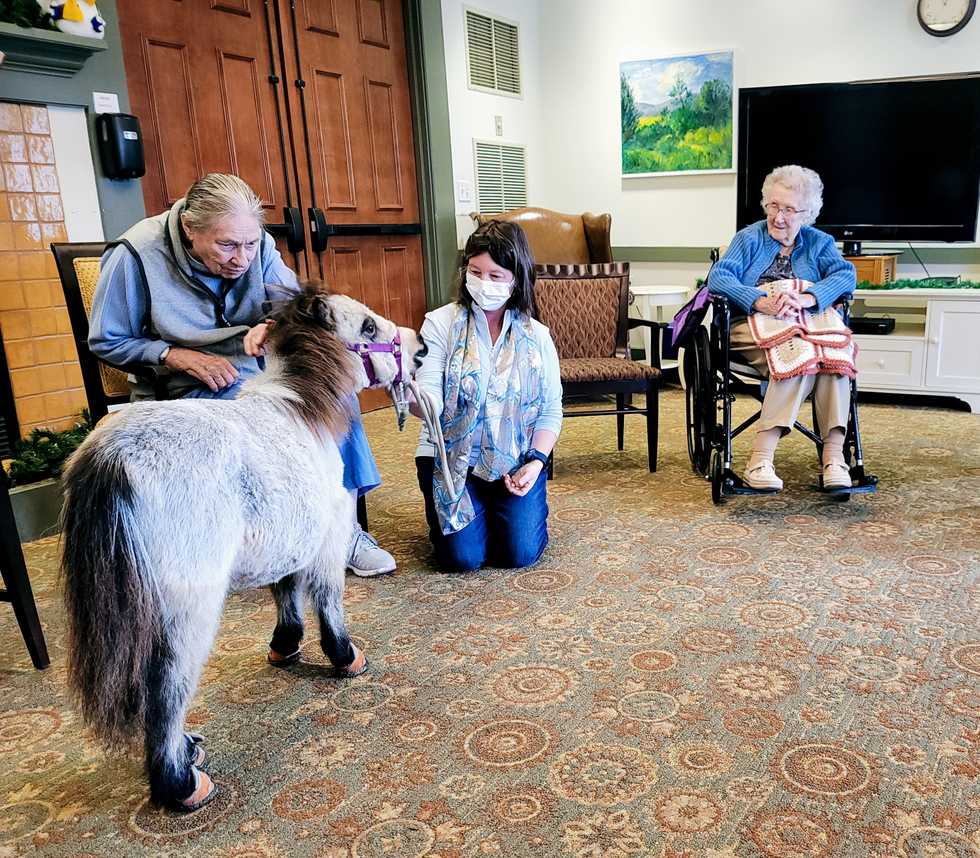
From left, Gerda Thuell reaches out to Baku, a six-month old miniature horse that came to visit at The Fountains on Thursday, Dec. 8. Equine therapist Kelly Lattin and resident Jenifer Thuell look on. photo by Judith O’hara Balfe
Photo by Judith O’hara Balfe

MILLBROOK — Dogs are probably the most common therapy animals; both cats and dogs are most likely the most popular house pets.

But if you ask the residents of the Fountains, there’s a good chance that they will say their favorites are the horses that visit them once a month.

Yes, Baku and Bug are very popular with them and it’s no wonder, because the miniature horses are friendly, mostly quiet, and unique when visiting in the living room at the Inn, or in the gardens outside when the weather is nice

Kelly Lattin is the volunteer who brings both Baku, 6 months old, and Bug, 5 months old, for the much anticipated visits.

Lattin is a U.S. Army veteran, having served from 1990-98. Originally from this area — growing up, in fact, in Morse Mills — Lattin has always been fond of horses and she has four horses besides Bug and Baku, some of which are rescues. She has a Thoroughbred named Jurney, and her family also includes a quarter horse called Kivi, and Felix, a Tennessee Walker.

The miniatures live with her at home and the others live on a farm that she leases, all in Pleasant Valley.

Volunteering at the Fountains came about after an unexpected encounter with an old acquaintance.

Lattin at one time taught horseback riding. Out for a stroll near the Fountains with one of the big horses, a person in a passing car, whose child she had taught, recognized her. That woman had a mother who lives at the Fountains, and she had Lattin get in touch with nursing director Linda Lomangino and Lisa Rieckermann, community life director. And soon, the equine therapy program began.

It started in the summer when Lattin brought Kivi and Jurney to spend some outdoor time with residents. Said Rieckermann: “These beautiful, gentle horses brought a lot of joy to our residents. They learned about the horses, were able to touch them, feel their breath, and admire their beauty.”

One resident told her it was the best day of her life. From there, Lattin began bringing the horses once a month, and they all look forward now to those visits.

“I’m a disabled veteran,” said Lattin, “and when I was first taken out of the workforce. I did two different equine therapy programs. I always feel better around horses. They help us release positive endorphins; slow our heart rate; and alleviate depression, anxiety and loneliness.”

When the colder weather came in, Lattin began bringing the miniature horses, Baku and Bug, because they can go indoors.

On a recent morning, Baku and Lattin spent two hours in the living room at the Inn at the Fountains with several of the residents. On his leash, Baku meandered to each of them, and he seemed to enjoy their company as much as they did his. At the end of the visit, he and Lattin took the elevator upstairs to visit one of the residents at home. Bug stayed home for that visit, but he’ll be back.

Bug has a special bond with resident Gerda Bruder.

The little horses travel with Lattin in the back seat of her pickup truck. It takes patience, but, says Lattin, “I believe strongly in volunteering my time and my horses to those who can benefit from and appreciate them.”

Lattin does other volunteering but limits the efforts, because even horses, big and little, need downtime. She makes sure they’re never tired or stressed, which can happen because horses are very sensitive to people’s emotions and feelings. But she looks forward to her visits to the residents at the Fountains. During the winter, Bug and Baku will enjoy their trips indoors with carpeting fireplaces, but come summer, when all is green and lush around the 200 acres of the Fountains, the big horses will have their days in the sun to visit the eager residents.

Latest News

Classifieds - February 26, 2026

Classifieds - February 26, 2026

Help Wanted

PART-TIME CARE-GIVER NEEDED: possibly LIVE-IN. Bright private STUDIO on 10 acres. Queen Bed, En-Suite Bathroom, Kitchenette & Garage. SHARON 407-620-7777.

The Salisbury Association’s Land Trust seeks part-time Land Steward: Responsibilities include monitoring easements and preserves, filing monitoring reports, documenting and reporting violations or encroachments, and recruiting and supervising volunteer monitors. The Steward will also execute preserve and trail stewardship according to Management Plans and manage contractor activity. Up to 10 hours per week, compensation commensurate with experience. Further details and requirements are available on request. To apply: Send cover letter, resume, and references to info@salisburyassociation.org. The Salisbury Association is an equal opportunity employer.

Keep ReadingShow less
google preferred source

Want more of our stories on Google? Click here to make us a Preferred Source.

To save birds, plant for caterpillars

Fireweed attracts the fabulous hummingbird sphinx moth.

Photo provided by Wild Seed Project

You must figure that, as rough as the cold weather has been for us, it’s worse for wildlife. Here, by the banks of the Housatonic, flocks of dark-eyed juncos, song sparrows, tufted titmice and black-capped chickadees have taken up residence in the boxwood — presumably because of its proximity to the breakfast bar. I no longer have a bird feeder after bears destroyed two versions and simply throw chili-flavored birdseed onto the snow twice a day. The tiny creatures from the boxwood are joined by blue jays, cardinals and a solitary flicker.

These birds will soon enough be nesting, and their babies will require a nonstop diet of caterpillars. This source of soft-bodied protein makes up more than 90 percent of native bird chicks’ diets, with each clutch consuming between 6,000 and 9,000 caterpillars before they fledge. That means we need a lot of caterpillars if we want our bird population to survive.

Keep ReadingShow less
Stephanie Haboush Plunkett and the home for American illustration

Stephanie Haboush Plunkett

L. Tomaino
"The field of illustration is very close to my heart"
— Stephanie Plunkett

For more than three decades, Stephanie Haboush Plunkett has worked to elevate illustration as a serious art form. As chief curator and Rockwell Center director at the Norman Rockwell Museum in Stockbridge, Massachusetts, she has helped bring national and international attention to an art form long dismissed as merely commercial.

Her commitment to illustration is deeply personal. Plunkett grew up watching her father, Joseph Haboush, an illustrator and graphic designer, work late into the night in his home studio creating art and hand-lettered logos for package designs, toys and licensed-character products for the Walt Disney Co. and other clients.

Keep ReadingShow less

The power of one tray

The power of one tray

A tray can help group items in a way that looks and feels thoughtful and intentional.

Kerri-Lee Mayland

Winter is a season that invites us to notice our surroundings more closely and crave small, comforting changes rather than big projects.

That’s often when clients ask what they can do to make their homes feel finished or fresh again — without redecorating, renovating or shopping endlessly. My answer: start with one tray.

Keep ReadingShow less
google preferred source

Want more of our stories on Google? Click here to make us a Preferred Source.

google preferred source

Want more of our stories on Google? Click here to make us a Preferred Source.