Forum speaker critiques media role in 2024 presidential campaign

Forum speaker critiques media role in 2024 presidential campaign

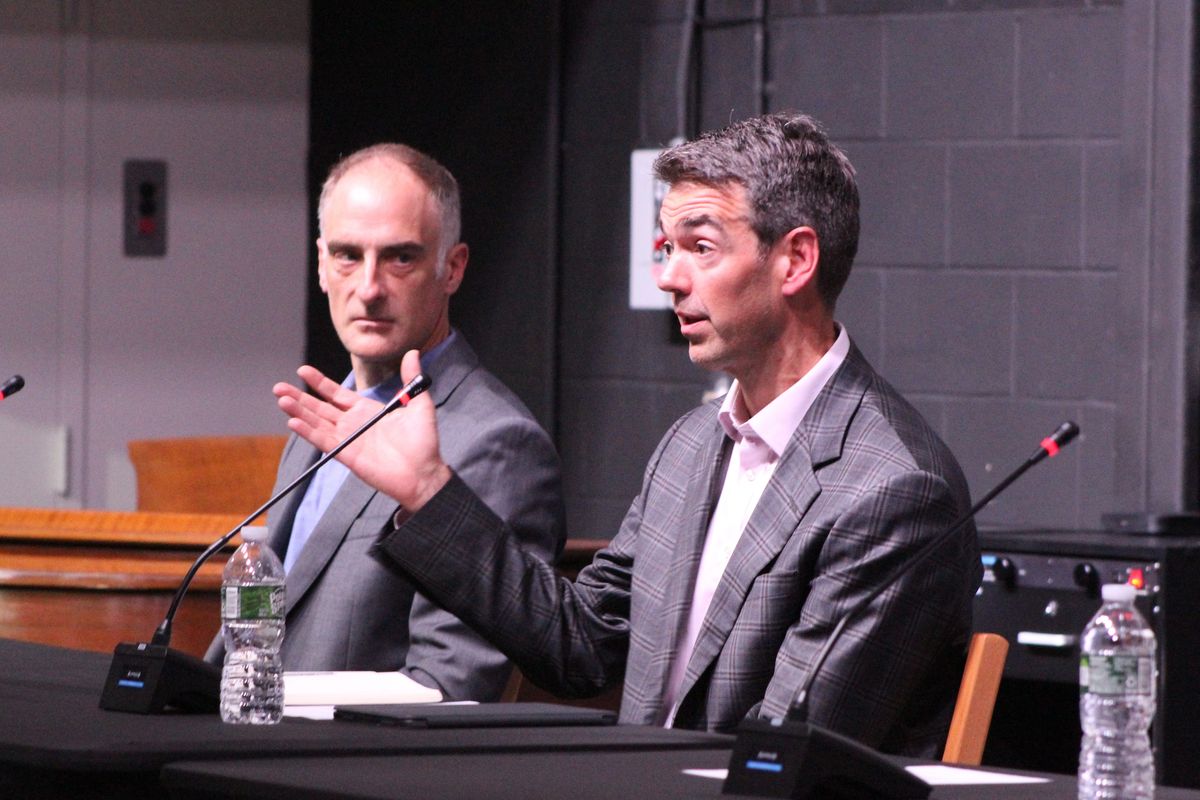
David D. Kirkpatrick spoke at HVRHS Oct. 25.

Patrick L. Sullivan

FALLS VILLAGE — David D. Kirkpatrick, a staff writer for The New Yorker and a former investigative reporter for the New York Times, was critical of how the media have covered the 2024 presidential election at a Salisbury Forum talk Friday, Oct. 25 at Housatonic Valley Regional High School.

He said the press has produced “voluminous explorations” of what a second presidency of Republican Donald J. Trump would be like.

But this coverage “turned out to be a distraction.”

“What was the biggest surprise in this campaign?” he asked the audience.

Answer: The June 27 debate between then-candidate and incumbent President Joe Biden (D) and Trump.

The debate was a disaster for Biden, who appeared confused. After an outcry from his own party, on July 21 Biden announced he was withdrawing from the race. Vice-President Kamala Harris was subsequently chosen to replace Biden at the top of the Democratic ticket.

“There is no way to argue this was not an enormous lapse” on the part of the media, Kirkpatrick said.

He said the New York Times’ Peter Baker was writing about Biden’s decline as early as July 2022.

“He took a lot of static” for his reporting.

In February 2024, Special Counsel Robert Hur, who was investigating the case of Biden’s handling of classified documents, closed his investigation and declined to prosecute the President, saying “Biden would likely present himself to a jury ... as a sympathetic, well-meaning, elderly man with a poor memory.”

Kirkpatrick said at this point the story “was out in public” and could not be ignored.

But he questioned why The Times then ran a piece labeled “analysis” that examined why the age question was hurting Biden more than Trump.

“They made it a sociological story.”

If Trump wins a second term, the press will be blamed for not reporting on Biden’s decline earlier, Kirkpatrick predicted.

“Wouldn’t Harris be better off if she’d had more time? Was Harris the best candidate?”

Latest News

Speed cameras gain ground in Connecticut, stall in Dutchess County

A speed enforcement camera in New York City.

Photo courtesy NYC DOT

Speed cameras remain a tough sell across northwest Connecticut — and are still absent from local roads in neighboring Dutchess County.

Town leaders across northwest Connecticut are moving cautiously on speed cameras, despite a state law passed in 2023 that allows municipalities to install them. In contrast, no towns or villages in Dutchess County currently operate local automated speed-camera programs, even as New York City has relied on the technology for years.

Keep ReadingShow less
In remembrance:
Tim Prentice and the art of making the wind visible
In remembrance: Tim Prentice and the art of making the wind visible

There are artists who make objects, and then there are artists who alter the way we move through the world. Tim Prentice belonged to the latter. The kinetic sculptor, architect and longtime Cornwall resident died in November 2025 at age 95, leaving a legacy of what he called “toys for the wind,” work that did not simply occupy space but activated it, inviting viewers to slow down, look longer and feel more deeply the invisible forces that shape daily life.

Prentice received a master’s degree from the Yale School of Art and Architecture in 1960, where he studied with German-born American artist and educator Josef Albers, taking his course once as an undergraduate and again in graduate school.In “The Air Made Visible,” a 2024 short film by the Vision & Art Project produced by the American Macular Degeneration Fund, a nonprofit organization that documents artists working with vision loss, Prentice spoke of his admiration for Albers’ discipline and his ability to strip away everything but color. He recalled thinking, “If I could do that same thing with motion, I’d have a chance of finding a new form.”

Keep ReadingShow less
Strategic partnership unites design, architecture and construction

Hyalite Builders is leading the structural rehabilitation of The Stissing Center in Pine Plains.

Provided

For homeowners overwhelmed by juggling designers, architects and contractors, a new Salisbury-based collaboration is offering a one-team approach from concept to construction. Casa Marcelo Interior Design Studio, based in Salisbury, has joined forces with Charles Matz Architect, led by Charles Matz, AIA RIBA, and Hyalite Builders, led by Matt Soleau. The alliance introduces an integrated design-build model that aims to streamline the sometimes-fragmented process of home renovation and new construction.

“The whole thing is based on integrated services,” said Marcelo, founder of Casa Marcelo. “Normally when clients come to us, they are coming to us for design. But there’s also some architecture and construction that needs to happen eventually. So, I thought, why don’t we just partner with people that we know we can work well with together?”

Keep ReadingShow less