SALISBURY, Conn. — Raised Bill No. 7174 was proposed earlier this year in Hartford as a series of amendments to the state’s existing laws surrounding protections of wetlands, rivers and streams. It has since passed through the state’s Environmental Committee and currently awaits a General Assembly vote.
Salisbury resident Bruce Palmer warned the Inland Wetlands and Watercourses Commission (IWWC) during its April 14 meeting to familiarize itself with the bill, suggesting it could significantly affect the commission by altering its jurisdiction on property adjacent to lakes, rivers, streams and wetlands, known as the upland review area.
“It might warrant us that we could be pioneers, like we should be,” said Palmer, suggesting that Salisbury should seek to be an example in ecological governance in a state that is “well behind most states in New England on just about everything, including upland review.”
The bill’s stated purpose is “to establish protections for riparian buffer zones, protect fishways along certain water passages and require certain insurance surcharge fees for environmental measures,” according to the draft language. The bill defines a riparian buffer zone as the area surrounding a wetland or watercourse for “a distance of not less than 100 feet.”
Land Use Administrator Abby Conroy said that the bill may pose jurisdiction issues with municipal IWWC commissions. She explained that it began as a bill to establish protective vegetative buffer zones around waterways but morphed into the implementation of a 100-foot minimum upland review area that could be regulated without specific reference to the actual site.
Conroy told the Commission that if the bill is adopted, it would alter the IWWC’s governance of the review area.
Commission alternate Russel Conklin speculated that regulations could be enacted without any basis in the actual impact on the site — “that seems like trouble,” he said.
The IWWC has already faced difficulty surrounding upland review areas in recent months, with debates over altering the regulated zone for Salisbury’s major lakes — Wononscopomuc, Wononpakook, Washining, and Washinee — proving a major roadblock in developing new local regulations.
As the current regulations draft stands, each lake has a 75-foot upland review area, which is substantially lower than the upland review areas designated for other watercourses and waterbodies in town.
The regulations have been sent out to the state Department of Energy and the Environment for review and are expected to see a public hearing on May 12.
IWWC Chair Vivian Garfein said lake associations that wish to extend or change the upland review area may petition the Commission to do so after the public hearing closes. “It shouldn’t be a difficult thing to accomplish,” she said.
As for Raised Bill 7174, Garfein maintained that while she was aware of the proposed legislation, the Commission will address it when and if the time comes: “When it’s law, I’ll worry about it.”




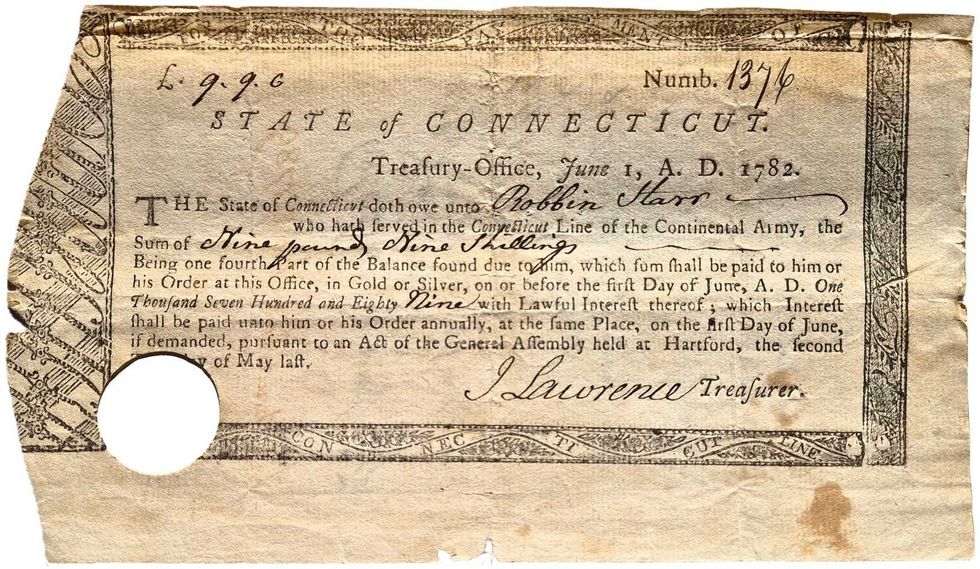 Pay Bill for Robin Starr’s service in the Continental Army.Courtesy the Alex Breanne Corporation
 John Mills speaking at Quinnipiac University.Courtesy the Alex Breanne Corporation

 Stephanie Saetta,with her rescue dog George and Blue (left), a shepherd mix awaiting his forever home.Madi Long