The problem with tariffs is that it weakens the political hold on the population, setting up an adversarial relationship as prices rise. Tariffs, in other words price control – for that is in effect what tariffs do – are a governmental restriction to free trade for the population. Even if the goal was to balance import/export trade balance, the real effect is that the government is telling the population that the price of goods is politically controlled by the government. In America this is seen as loss of freedom, loss of getting what you want at a price you could previously afford, and, more than anything, a loss of your individual sovereignty.
America is made of people who demand control over their own lives – even if it’s illusory at times. Americans, spoiled as many foreign cultures seem to think, cannot fathom not being able to do as they damn well please, buy what they darn well want to, and especially want to feel in control of their own happiness.
When you suddenly have to pay 50% more for gasoline or diesel, as an American you do not blame yourself for needing the fuel, you blame “them” for raising the price without your consent. You go to your local gas station and get angry at that supplier. Yesterday I watched a man filling his diesel truck, cursing at the state of affairs as he slammed the nozzle back into the pump. I asked him who he was angry at for the ridiculous diesel price. “We were promised no damn wars, and this is what I get.” The key part of that response is “…what I get.” Personal pronoun. It’s being done to him, taking away his control over his own destiny.
Compare the situation here to China. The same top-down control of prices is put into place but the difference is the Chinese people do not have a feeling of entitlement to happiness, they know their happiness, their personal sovereignty, is controlled by the state. As China moves slowly to a market-oriented economy, or seen another way state-led capitalism, there will come a time when people expect to be able to control their own happiness rather than have it bestowed at the state’s whim. For now, however, that same top-down control in Russia is the very reason there has not been a popular uprising of any effect since the people in Russia are completely devoid of that individualistic desire to be in sole control – or even think they can be in sole control – of their happiness.
Think of tariffs and top-down price control as a stretched rubber band. It can only stretch so far. Pressure is building in America and unlike a true top-down socialist or communist government full control, American political control over tariffs or perhaps the adverse effect of imposed tariffs at an American consumer level, could suddenly cause the rubber band to snap, causing chaos. That could cause a ripple effect across all markets, across the globe, and political upheaval. This pressure, this stress, is always the risk of top-down control of a population’s desires. Unlike socialist countries’ populations, Americans’ desires, American’s happiness quotients, are always tied to the individual, not the state. If the state gets this wrong – and so far they really have -- a repeat rebellion is assured in one form or another.
Peter Riva, a former resident of Amenia Union, New York, now lives in Gila, New Mexico.



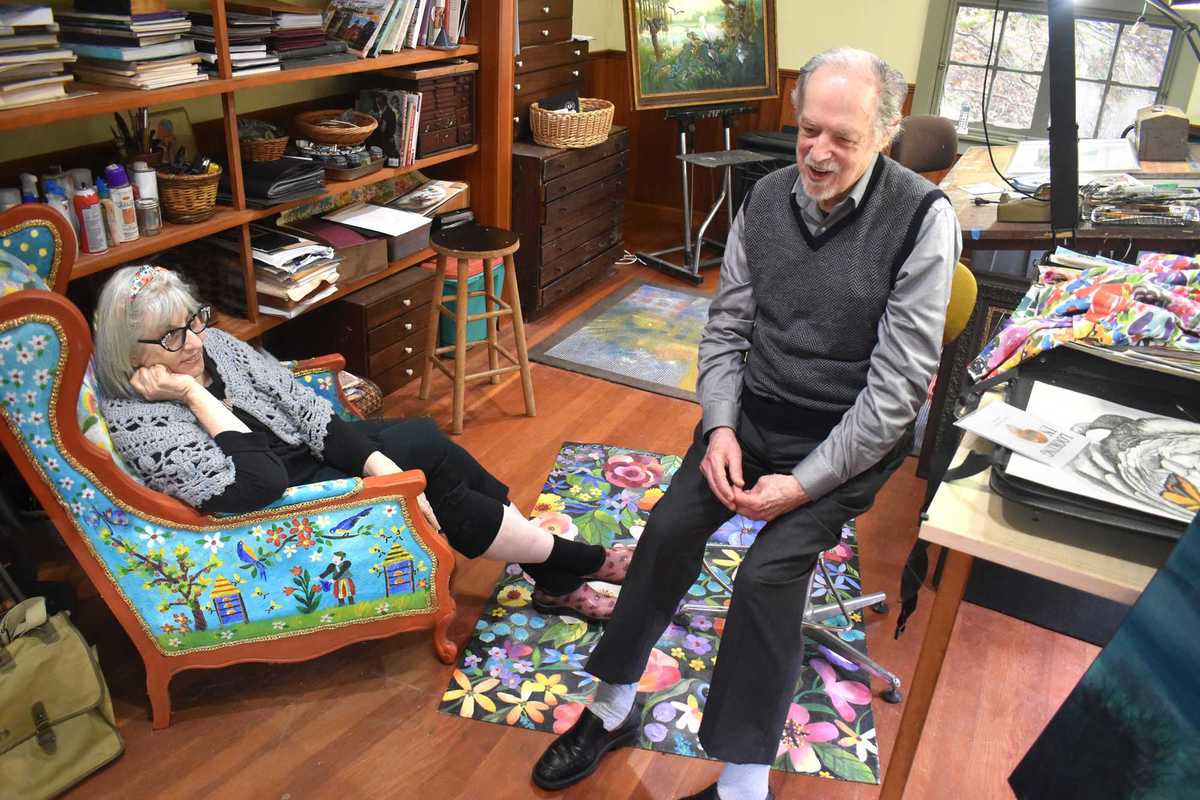
 Justine and Victor Valla in their studio with a painting of Victor’s,”Jonah and the Whale.” Robin Roraback