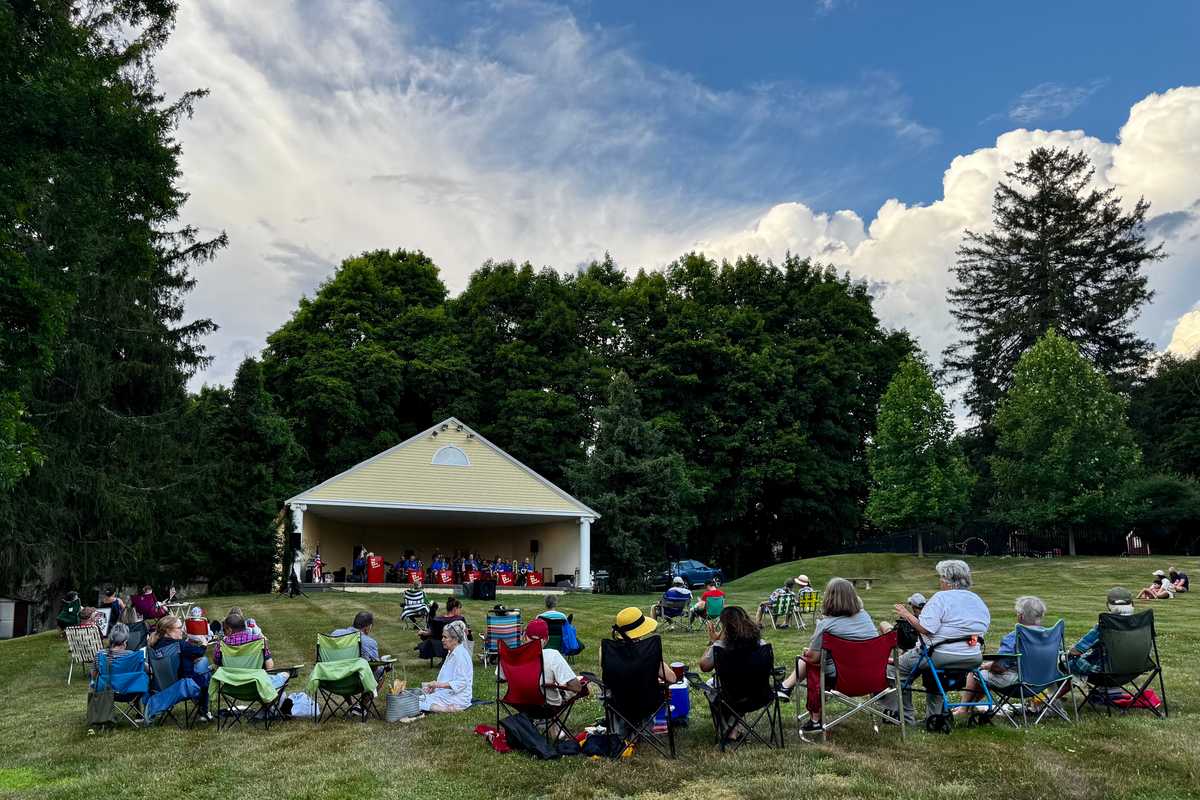
Dover High School’s Guitar Club prepares for Community Day performance

Members of the Dover Guitar Club prepare for a performance.
Photo Provided


Members of the Dover Guitar Club prepare for a performance.
DOVER PLAINS — Members of Dover High School’s Guitar Club are tuning up for another community performance as they prepare to take the stage at Dover Community Day on Sept. 19.
Since 2019, the club has given students a place to learn guitar, perform live and build confidence while giving back to the community. Led by Dover High School social studies teacher Eric Anderson, students meet after school to learn new music, rehearse and perform at school and community events.
What began as a club where students played guitar and watched music documentaries quickly evolved into a regular rehearsal group focused on learning songs and performing for audiences. Their first concert, scheduled for March 13, 2020, was postponed by the COVID-19 pandemic, but the students eventually made a name for themselves by performing in the community when many live music events had been canceled.
The club’s mission is rooted in community service, and members have performed at multiple fundraising events for residents and members of the school district
“A lot of our biggest acts and the things that we spend a lot of the year preparing for are these bigger events that support the community,” Anderson said.
Some of the students in Guitar Club have even started their own band and written original music. The band, Due Date, consists of Guitar Club members who now write and produce their own music. Due Date has performed as a group through Guitar Club, but additionally put on performances in the community at quinceañeras and the Dover Legacy Racing Cars & Guitars show.
Aiden Austin is a rising senior at Dover High School and a member of Due Date. He said Guitar Club had an impact on the group’s overall confidence and aided in preparation efforts for shows.
“The ability for me to even play at a show when I was a freshman is insane,” Austin said, “That’s why I am super grateful for Guitar Club.”

Nathan Miller
The sidewalk extension project along Route 44 to Beekman Park remains incomplete nearly eight months after state transportation officials halted the project.
AMENIA — Town officials are facing a lawsuit alleging nonpayment for contracted services relating to work on the sidewalk extension along Route 44 to Beekman Park.
Amenia’s Town Board appointed town attorney Ian Lindars to handle litigation against the town stemming from a contract with Raja Contractors Inc. that was originally approved in 2023.
According to court documents and public meeting minutes available at ameniany.gov, the Town Board originally contracted Raja to complete construction work on the project in July 2023. The work was stalled, however, as state Department of Transportation officials ordered changes to the plans that meant builders couldn’t start construction.
The town then terminated the contract in February 2025, intending to re-bid the project and seek another contractor to complete the work. Raja Contractors alleges the town did not pay bills totalling $54,757, incurred while the company was under contract and conducting pre-construction work between 2023 and 2025.
After terminating the contract, the town reopened bidding for the project and eventually chose construction firm Southern Industries. That work officially began in September 2025, but dragged into the winter and eventually stalled at an incomplete state.
The lawsuit was filed in Dutchess County Supreme Court on July 7.
The effort to install a new sidewalk along Route 44 connecting Beekman Park to downtown Amenia remains stalled as Lindars continues negotiations to secure funding needed to complete the project. Those negotiations are independent from the current lawsuit.
Town Supervisor Rosanna Hamm said the town is seeking compensation through the project’s performance bond after construction problems forced work to stop earlier this year. The bond is intended to reimburse the town for the additional costs of completing the project when a contractor fails to meet its contractual obligations.
Hamm said Town Attorney Ian Lindars has been negotiating with the bonding company for months, but there is little the town can do until those discussions are complete.
“It’s incredibly frustrating,” Hamm said. “All I can do is nag.”
The sidewalk project has been at a standstill since January, after the New York State Department of Transportation issued a stop-work order citing concerns over stormwater catch basins that didn’t match specifications and other construction-related issues.
The project is half-finished and several sections of concrete need to be replaced.
Southern Industries, the contractor hired for the project, was later terminated. Town officials have said the company was the low bidder selected after engineering firm LaBella Associates reviewed its references.
Hamm said the town’s attorney and the bonding company are currently working out how much compensation the town will receive to complete the remainder of the work. She didn’t have any updates on the status of those talks as of Tuesday, Aug. 11.
Despite the hold-up, Hamm said homeowners on property abutting the sidewalk project have had their mailboxes and driveway access restored. However, the sidewalk remains unfinished, and several sections of concrete will need to be removed and replaced after they were poured during cold weather and failed to cure properly.
Town officials said the contractor’s inconsistent work schedule contributed to repeated delays that ultimately led to the construction deficiencies.
“It’s the bane of my existence,” Hamm said. “This whole thing has been a nightmare.”
Southern Industries and its chief executive, Jonathan Delisa, have been named in multiple pending lawsuits alleging professional misconduct including wage theft, forgery, impersonation and defaulting on a loan for construction equipment.
Delisa denied wrongdoing in May, but otherwise refused to comment on the allegations in the lawsuits. He also said he was not the chief executive of Southern Industries, and merely served as a construction manager and foreman. Public filings with the New York Secretary of State’s office lists Delisa as the company’s chief executive.
Delisa could not be reached for further comment.
Washington Town Supervisor Gary Ciferri said in May that his town had similar issues with Southern Industries when the construction company won a bid to complete renovations at Washington’s Town Park in 2023.
Ciferri said construction crews didn’t keep a consistent schedule and eventually abandoned the project, causing the town to hire another company to finish the work.
Jacquelyn Drain
Apartment buildings at 26-32 S. Center St. currently host four housing units. Owners are seeking to renovate a fifth at the property.
MILLERTON — Owners of a South Center Street apartment building can now move forward with a special permit application after the Zoning Board of Appeals granted a variance for parking at the property.
The Village of Millerton Zoning Board of Appeals granted a parking variance to the owners of 26-32 South Center St. on Tuesday, Aug. 4, allowing the property to be non-compliant with village parking laws.
Following a public hearing on Aug. 4, the board approved the variance sought by owner Alex Magalhaes for an exemption to the village’s minimum onsite parking requirements. Under village zoning code, residences must have space on the property for at least 1.5 cars per housing unit. Magalhaes is seeking to restore a fifth apartment on the property, bringing his total parking burden to 7.5 spaces.
The property has onsite parking for up to four cars, Magalhaes said in a July ZBA meeting, but no additional off-street parking exists on that parcel or neighboring parcels.
Board members said the variance will allow for more housing in the area, a key issue in the community. Because the space has operated as an apartment for many years without issue, the board concluded that parking conditions could continue as previously established.
Jenn Najdek, resident of 33-35 S. Center St. and Mayor of the village, expressed support for the proposed parking solution and parking on the street. Najdek’s grandparents and brother previously owned the property before it was purchased by Magalhaes.
“With Millerton not having a lot of housing, I can’t see the renovation of an existing apartment creating any more adverse driving or parking conditions than already exist,” Najdek said. “It wouldn’t affect me at all.”
Catherine Fenn, a Millerton Resident, also expressed support for the project.
“Seems pretty simple, the building has always had that many apartments,” Fenn said. “It sounds like a moot question.”
Following the public hearing, Magalhaes can now go back to the Planning Board for the special use permit he requested in June to renovate the fifth apartment.
“We’re not changing any layout inside, we’re keeping everything the same,” Magahlhaes said. “The building permit is for me to bring life to the unit.”
Nathan Miller
Dutchess County Legislators approved on Monday, Aug. 10, a ban on concentrated kratom products often sold at gas stations.
The proposal comes just over a week after County Executive Sue Serino issued a statement calling for a ban on all kratom product sales. Democratic members of the county legislature responded with a more focused ban that restricts the sale of concentrated, synthetic substances derived from kratom known as “7-OH,” or 7-hydroxymytraginine.
Kratom is the name for leaves from a southeast asian tree that has been used for millennia for pain relief, energy and spiritual purposes. Traditionally the leaf is smoked, chewed or brewed into a tea. Gas stations and tobacco stores across the U.S. sell bags of powdered kratom leaf alongside 7-OH and other synthetically-derived products.
Legislators contend the concentrated 7-OH products are dangerous and addictive, citing guidance from the federal Drug Enforcement Agency and New York health authorities. The proposed county-wide ban will affect those products but allow the sale of “natural” leaf products below a certain potency. One of the resolution’s sponsors — Kristofer Munn, who represents Red Hook, Tivoli and Rhinebeck — said the potency and packaging of 7-OH products distinguished them from kratom leaf powders during a Thursday, Aug. 6, Government Services committee meeting.
“I know at least one resident of our town who overdosed and died as a result,” he said. “It’s just something that really is getting a lot of attention — the DEA is looking to move on it in the next few months.”
Authorities have said that concentrated 7-OH products pose a greater risk to the public because of their strength, likening them to prescription opioids such as morphine. Munn also drew attention to the products’ packaging and prominent location near the cash registers at gas stations, saying they appear attractive to vulnerable children.
Dutchess County legislators drew a distinction between the concentrated 7-OH products and “natural” kratom leaf products, saying in a statement the 7-OH compound occurs naturally in trace amounts in the leaf products. Synthetic derivatives concentrate this compound at much higher potencies, creating an opioid-like effect that legislators say is addictive and dangerous.
New York State lawmakers restricted sale of all kratom products to adults over 21 at the end of 2025. A bill currently being deliberated by lawmakers seeks to ban 7-OH products statewide.
Munn said the county-wide ban follows the logic in those state efforts and in DEA guidance. It breaks with Serino’s call to ban all kratom products outright, and county legislator John Metzger, who represents East Fishkill, pointed out that the U.S. Food and Drug Administration has issued guidance saying no kratom products are safe as dietary supplements.
“If the FDA is saying ‘no, the leaf is no good,’ and we’re saying ‘we’re going to keep it on the shelf because people use it,’ that’s what I don’t understand,” he said. “Is the FDA only speaking about the synthetic and the high doses?”
Munn said FDA approval is not required for dietary supplements, and that kratom leaf users are typically adults using the product for spiritual purposes or as a self-administered medicine. He pointed to DEA efforts to temporarily schedule the synthetic 7-OH products, saying health authorities are recognizing a difference between the pills and leaf products that warrant treating each differently under the law.
The law draws a hard line between kratom leaf products and all other synthetically-derived alternatives. Munn said the bill restricts the sale of 7-OH and all other synthetic derivatives of the kratom leaf, including any that have yet to be developed and distributed to retailers.
The ban is set to go into effect immediately. First offense violations carry a maximum $1,500 fine with all subsequent violations carrying maximum $3,000 fines.
Gas stations in northeast Dutchess County could not be reached for comment on the legislation.

Want more of our stories on Google? Click here to make us a Preferred Source.
Patrick L. Sullivan
Luiza, 6; Cecilia, 4; Nathan, 4; and Aria, 6, show off their face paint and balloon animals during the fifth annual Lakeville Journal Street Fair on Aug. 8.
SALISBURY, Conn. — Live music, lobster rolls, face painting and a mix of local nonprofit organizations filled Academy Street in downtown Salisbury on Saturday, Aug. 8, for the fifth annual street fair hosted by The Lakeville Journal.
Audrey Cole of the Western Connecticut Area Agency on Aging (WCAAA) was on site with information on the often-bewildering subject of Medicare.
Cole, who lives in Sharon, said the WCAAA is a nonprofit serving 41 towns in Western Connecticut with Medicare counseling, Alzheimer’s care, caregiver support, meals, transportation, chore assistance and more.
Medicare is always a hot topic, she said, in part because figuring out which program to choose — and when to sign up — can be difficult.
“There are lots of deadlines, lots of programs,” she said.
The advantage in asking WCAAA for help, Cole said, is its independence.
“We work for the taxpayers. We don’t steer anyone in any direction.”
Cole said the two big questions someone new to Medicare needs to answer are “How is your overall health?” and “What is your financial situation?”
Nearby, Danny Tieger was tuning his guitar in anticipation of a crowd of youngsters eager to hear live music. When they appeared, he had them brainstorm about what kind of animal they’d like to hear a song about. As the children pitched ideas, Tieger drew rapidly on a sketchpad propped up on an easel for everyone to see.
The children came up with a combination of a lion, a bird and an alligator.
Some people might find that melange a little daunting, but Tieger immediately launched into a song, made up on the spot.
“What’s our alligator-bird-lion’s name?” he asked.
“Chomps,” said a little boy.
“Chomps it is,” Tieger replied.
In the parking lot of Johnnycake Books, Linda Ciano, director of community engagement for Project SAGE, greeted visitors beneath a large tent.
The Lakeville-based nonprofit domestic violence agency has two fundraisers currently underway.
“The Bling’s the Thing” offers jewelry donated by supporters at bargain prices, while a five-dollar bill gets shoppers an extra sturdy, large blue Project SAGE tote bag.
Project SAGE is also sponsoring a community art project and inviting anyone to participate — no artistic skills required. The results will be displayed at an event at the Scoville Memorial Library on Sunday, Sept. 13.
At the Salisbury Association, Lou Bucceri held forth on a range of local history, from Salisbury’s iron industry and the role of its cannons in the American Revolution to the Holley knife collection and Ethan Allen’s insistence on being inoculated against smallpox by his friend Dr. Thomas Young of Amenia Union.
The idea of deliberately injecting a healthy person with a small amount of a disease was very new and, to many, seemed unwise if not downright evil. So Allen got his smallpox inoculation on the steps on the Congregational Church on a Sunday, for maximum publicity.
“And he was hauled into court on a charge of blasphemy,” Bucceri said.
Allen subsequently beat the charge.
Around 1 p.m. John Keilty of Litchfield took over the live music duties. He set up a Bo Diddley beat on one note, turning it into a repeating motif recorded electronically. He then soloed over it, soaring off in unexpected directions before bringing it back to the riff.
Keilty said his primary job is running a guitar repair business. He plays in a couple of bands, including Shake the Dust out of Litchfield.
“We call ourselves the Farm Band, because we always seem to play events held at farms,” he said.
Graham Corrigan
Developers plan to convert a 1920s farmhouse on the former Green Briar Nursing Home campus in Millbrook into apartment buildings.
MILLBROOK — A developer has submitted plans to renovate the old Green Briar Adult Home into residences.
Developers Kingston Investors tentatively plan to build 16 rental units, utilizing the existing farmhouse and rebuilding an addition for the apartments. Currently there are no plans for affordable housing units, but the new owners say they’re open to discussions. The existing building footprint is about 15,000 square feet, and the new developments will be about the same size.
Green Briar’s closure concluded a 40 year run as a nursing home and assisted living facility. Prior to closing, Green Briar had been marred by disputes between the home’s residents and their neighbors.
Accusations of lawbreaking, drunken behavior, and frequent police activity led to calls for a stricter vetting process. In 2018, a Green Briar resident was arrested for theft from a neighboring property. A member of the nursing home’s staff member was arrested that same year for sexually assaulting a Green Briar resident.
In 2019, police and rescue squads frequented the property to break up fights and conduct psychiatric evaluations.
The property was closed by the Department of Health in 2023.
After the closure, the property fell into disrepair. The 4-acre property, located at 26 Old Route 82, consists of two adjoining structures: a farmhouse dating back to the 1920s and a 1970s addition.
Kingston Investors acquired the former nursing home for $400,000 in January 2026. “We saw a neglected property in need of transformation that could provide much needed housing to the local community,” said the company’s vice president David Krulewitch. “We do not plan to run a healthcare facility at the site.”
Kingston Investors hired Millbrook’s Sloan Architects to reimagine the space for residential apartments. “Our current thinking is to rehabilitate the 1920s farmhouse into rental apartments, demolish the 1970s structure, and build additional rental apartments in its place,” Krulewitch said. “Our design intends to blend in with the country aesthetic of the surrounding community.” The two northern acres abutting neighboring properties will remain as open space.
In July, Kingston and Sloan Architects presented their proposal to the Town of Washington Planning Board in a pre-application meeting. The application emphasized that the plan “preserves open space, reduces the existing lot coverage by 3% compared to existing conditions, and enables a transformation of a blighted property.”
Having received positive feedback, the developers are now working with land use counsel to further refine the plans. Krulewitch said they hope to reappear before the Planning Board in the fall with revised designs.
Leila Hawken
AMENIA — Construction plans for a new town garage complex, including a salt shed, moved ahead as the Town Board awarded construction contracts to a number of companies at their regular meeting on Thursday, August 6. The vote was unanimous.
Construction Manager for the project Palumbo Group recommended that contracts totaling $8 million be awarded to three companies. Mid-Hudson Construction Management is contracted for $6,353,470. Successful bidders for specialty contracts were S&O Construction Services for both HVAC installation and plumbing at a total of $1,077,207 and LBS 2020 for electrical work at a cost of $750,000.
The entire project for the 5-acre site involves construction of a 12,620 square foot building housing 6 double-bays and an office/breakroom, mechanical bay with lift and washing bay. Also to be constructed will be a 60 by 80-foot salt shed and attached storage building of four closed bays and two open bays, and a fueling station for diesel and gasoline.
Westerly Ridge property
Discussion continued about a proposed gift to the town of property at 108 Westerly Ridge. The question posed by Town Supervisor Rosanna Hamm was whether the Town Board was willing to entertain the idea of the gift and all councilmembers indicated that willingness.
Two questions that had been raised were whether the homeowners’ association at Westerly Ridge had approved the idea and whether the Dutchess County Land Conservancy had ruled on it.
Town Board attorney Ian Lindars said that he had recently received the conservation easement paperwork and planned to review it and report to the board at its next meeting.
During the Town Board meeting of July 23 Sharon resident Carol Flaton had introduced her planned donation of a 27-acre parcel that would be designated for conservation. Flaton has owned the parcel for more than a month and she seeks to complete the property transfer before the end of the year.
The property is the final piece of the ridgeline. Accepting the gift would ensure that the entire ridge would forever be protected from development.
“That piece of property is close to my heart,” Town Supervisor Rosanna Hamm had commented at the July 23 meeting, recalling that her grandfather had farmed it and her father had been raised on the farm.
The property faced controversy in recent years over proposed construction. In 2023, Amenia’s Planning Board approved plans for a home on the property that were then challenged in Dutchess County Supreme Court and embroiled in years of litigation.
Carol Flaton purchased the property in July from Cameron and Liza Smith, according to public deeds available on the Dutchess County Clerk’s website. The Smiths intended to build a house on the property but plans stalled after neighboring property owner Barbara Meili sued to halt construction in 2023.
The court rejected Meili’s complaint in 2025, triggering an appeal from Meili. That appeal was rescinded in April.
New billing system for Water District
In response to a need for an automated meter reading, billing and payment system for Water District customers, the Town Board voted unanimously to enter into a contract with Muni-Link for those services.
The new system will allow for on-line payment of water bills, a convenience that has frequently been requested.
To implement the new system, Muni-Link will charge a one-time fee of $12,000, including three years of historical customer usage data and all training. Going forward, the town water district will pay a $650 monthly fee for up to 300 customer accounts, although the number of users will be unlimited under the fee schedule.

Want more of our stories on Google? Click here to make us a Preferred Source.

Want more of our stories on Google? Click here to make us a Preferred Source.