It has been ten years since Brexit took center stage in the politics of the Western world. The populist furor of an unhappy electorate triggered Great Britain’s exit from the European Union. How has that worked out for the Brits?
The populist rhetoric of a “Global Britain,” their answer to MAGA, was supposed to secure their borders by reducing immigration. Bureaucracy would be jettisoned; regulations and the budget would finally be restored after 14 years of Conservative Party mismanagement.
It would be the first populism-led attempt to overhaul one of the world’s oldest and wealthiest democracies. A decade later, it appears the nation is up to its ears in chaos. Prime Minister Keir Starmer resigned this month after serving less than two years despite a landslide Labor Party victory. He was supposed to save the country from years of successive Conservative Party prime ministers.
Instead, the country is struggling with low growth, higher inflation, faltering public services and an electorate that is every bit as angry and partisan as our own. Over the past decade, the country has had six prime ministers. David Cameron, Theresa May, Boris Johnson, Liz Truss, Rishi Sunak and now Keir Starmer are some of the names you may recognize. Brexit itself, scandal, market panic, immigration, and electoral rejection are just some of the factors that have sunk Britain’s leaders.
Back when, many economists were predicting an immediate recession if the country left the EU. It didn’t happen. What happened was that, over time, the British economy grew far less than it might have if it had stayed in the trade bloc. At the same time, business investment and productivity slumped as trade suffered. The typical family is worse off by thousands of pounds per year.
The pound dripped sharply after the Brexit vote, collapsing by 10%, the largest one-day drop in its history. That triggered a sharp increase in import prices, leading to an inflation shock that affected everyone across the board. The exit from the EU also involved erecting trade barriers that hit goods exports, since the EU was still the UK’s largest trading partner until last year.
The problem deepened since no one in government had a clear plan on what to do once the votes were counted. This led to years of political infighting and indecision. A weaker currency should have led to a surge in exports, but the uncertainty around Britain’s future clouded business judgment and investment. Investment is estimated to be almost 18% lower and productivity 4% lower than it would have been if a plan had been forthcoming.
The currency has never recovered.
The Office for Budget Responsibility, the independent watchdog of the UK Treasury, predicts that the UK is on track to suffer a 4% hit to national income over a 15-year period. A U.S. National Bureau of Economic Research report claims that the country’s GDP per head is between 6% and 8% lower than it would have been without Brexit.
As for unemployment, that fell dramatically in the initial Brexit days to the lowest rates since the 1970s. However, Covid took its toll on the labor market. The employment rate has never really recovered and remains between 3% and 4% below what it would be under a “remain” decision.
Can I extrapolate from the Uk’s experiences to the present immigration, trade, and tariff policies of the Trump administration? Not really, at least in the short-term. Equity markets in both countries recovered quickly after the referendum and Trump’s Liberation Day. Both countries’ economists initially predicted a steep decline in economic activity, and both were wrong. However, over the long term (a decade in the UK), large trade policy shocks seem to lead to lower investment, productivity, and employment growth as supply chains and trade patterns unravel.
Not surprisingly, public support for Brexit has fallen since the 52% versus 48% leave vote. Today a majority of voters (56%) would back rejoining the EU, according to YouGov, and 70% of Britons support a closer relationship with the EU. Support is strongest among Labour and Green Party voters and weakest among Nigel Farage’s right-wing, Reform UK party. Reform UK members oppose rejoining the bloc by 83%. That party has gained support as immigration and affordability have become major issues for voters.
The next candidate for PM, at least among the Labour Party, is Andy Burnham, a Manchester mayor with authentic populist appeal. In a special election, Burnham beat the Reform Party, which pundits believe will clear the way for him to head his party and win the PM title in Britain. The question is how long he can last, given the issues and the populism in his country and around the world.
Readers may recall several of my past columns in which I have explained the populist wave of discontent in the U.S. and worldwide. I wrote that, here at home, over a twenty-plus-year period, no single president survived to serve a second term, except Richard Nixon (who was impeached without completing his second term).
Populist voters have a very short fuse. Promises are made, but unless real progress is made within four years, the electorate has no patience for incumbents who can’t or won’t deliver. Overseas, beyond the UK, France, Germany, and Hungary, several other countries are facing populist challenges to incumbent parties.
We are seeing this here in the U.S. as we head into the midterms. Promises made but not kept have sent President Trump’s approval ratings into the 30s. Within the Democrat Party primaries, a war is already brewing between a growing populist wing of the party and the more conservative incumbents. Established Democrats, their critics say, offer failed forty-year-old policy solutions that have been rejected out of hand by younger generations of disenfranchised voters.
Bill Schmick is a founding partner of Onota Partners, Inc., in the Berkshires. Bill’s forecasts and opinions are purely his own and do not necessarily represent the views of Onota Partners Inc.




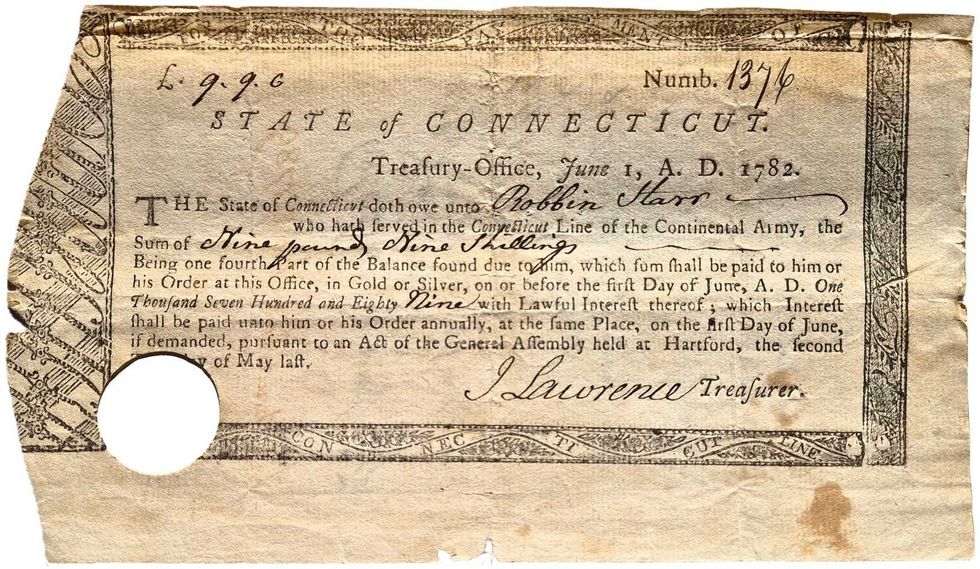 Pay Bill for Robin Starr’s service in the Continental Army.Courtesy the Alex Breanne Corporation
 John Mills speaking at Quinnipiac University.Courtesy the Alex Breanne Corporation

 Stephanie Saetta,with her rescue dog George and Blue (left), a shepherd mix awaiting his forever home.Madi Long