Project Lifesaver helps locate missing individuals

Project Lifesaver helps locate missing individuals
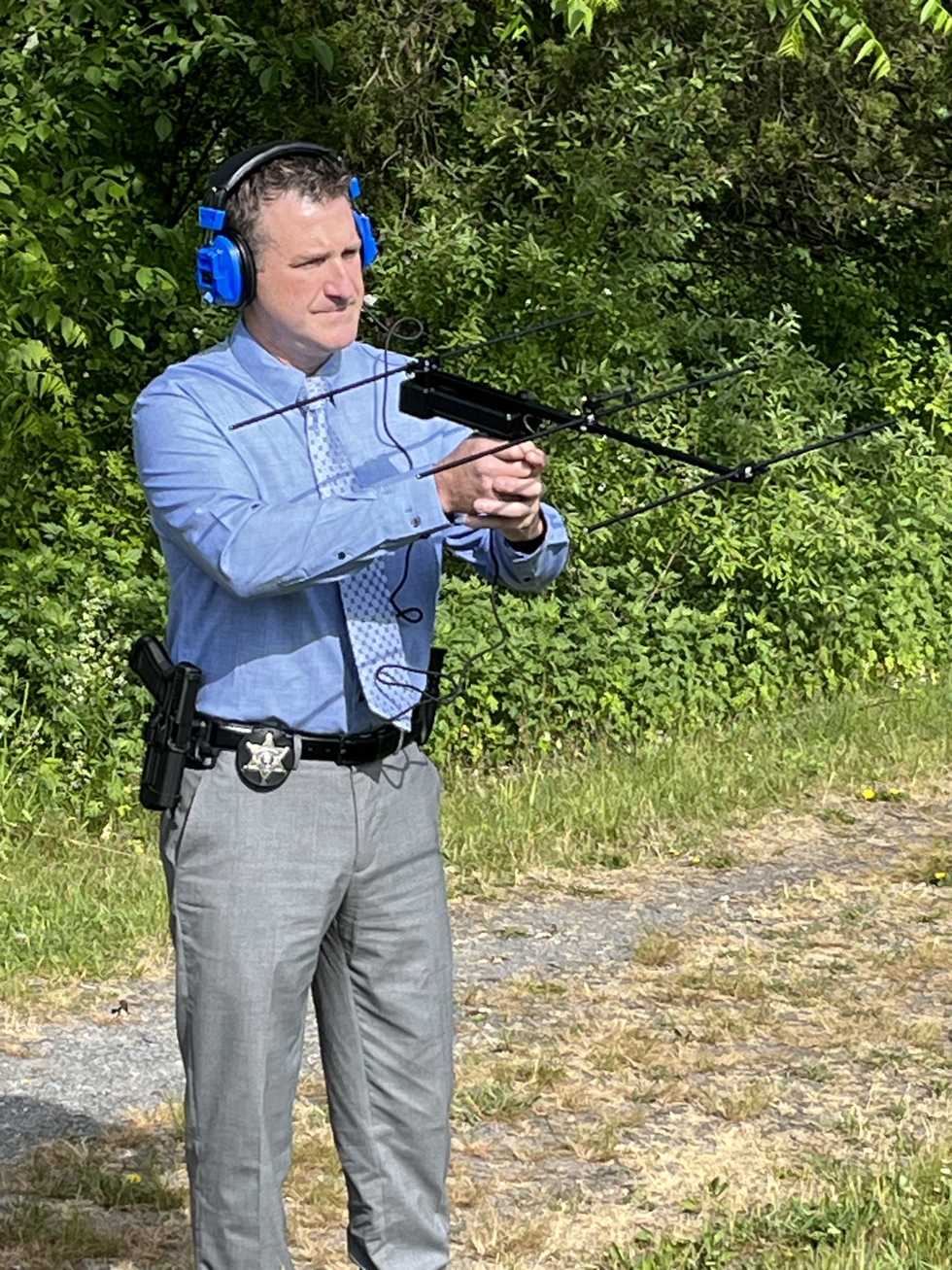
Dutchess County Sheriff Deputy Russell Seymour, coordinator of Project Lifesaver, demonstrates part of the transmitter system that helps locate vulnerable individuals who have gone missing. Photo submitted
AMENIA —  When a vulnerable loved one goes missing, there is always a high level of anxiety for the family as well as for those who have been called in to help a search.

But now, according to Dutchess County Sheriff Russell Seymour, his department has a new tool in the form of a transmitter system known as Project Lifesaver, which can help to bring a happy resolution to the situation.

Program coordinator Seymour said: “I think it’s a great tool to have. The fact that the system has a 100% recovery rate to date speaks volumes. It’s just great to be able to have that as an additional resource.”

He emphasized: “One of the most difficult things is to go to a missing person and always wonder if you’re actually  going to be able to find them. There’s different conditions:  what time of year, whether it’s wintertime, whether its dark or light, how old the person is, whether they’re vulnerable. It gives peace of mind to us as well to know we have equipment that’s going to help us locate that subject and bring them home safely.”

Designed for use with impaired individuals both young and old such as those with Alzheimer’s disease, autism, Down syndrome and the like,  particularly those who are at risk of serious injury or death due to a tendency to wander, the system includes a watch-like device the endangered individual wears.

If they go missing, families or other caretakers immediately call the sheriff’s department, which dispatches a specially trained officer such as Seymour with portable tracking equipment that begins the search even as it approaches the targeted area.

Touting the effectiveness of the system, Seymour explained: “The reason this is typically more accurate than, say, GPS is because it is not affected by atmospheric conditions. You don’t need three satellites to be able to pinpoint a location. It’s directional and it’s a radio frequency. It can get wet. It can be submerged. You’re still going to get a frequency from it” even in mountainous or rural areas.

Because the transmissions work up to approximately 1 mile on the ground and 7 miles in the air, it is important to report a disappearance as soon as possible.

As part of the registration process for the program, families also provide current photos as well as information about the individual which might provide clues about their possible destinations.

Users wear the device 24/7, whether near home or traveling, and searches can be implemented wherever a law enforcement or another agency has tracking ability.

Seymour said the department currently has four trackers located through out the county including the one he carries at all times, and is hoping to obtain several more at a cost of approximately $2,000, which is funded through the county.

He and several other officers have already qualified to use the system, with plans to train others through the one-and-a-half-day sessions with hopes that it will eventually be part of the normal police academy preparation.

Families are responsible for purchasing the personal transmitter, which costs $375, but there is no other cost to them beyond occasional battery and wristband changes.

In some instances, individual funding for the  devices may be obtained through various programs such as the state Office for People with Developmental Disabilities.

The international Project Lifesaver had its start in Virginia and so far has had a 100% success rate locating more than 4,000 missing individuals with its use, providing a sense of security for families concerned about loved ones safety.

Seymour recounted a call with a mother of a young autistic child who had moved to the county from a Project Lifesaver area about a year before the service was available here.

He said that when he called to tell her the program was in force, “the mother was in tears, so it was really  nice to be able to come out there and get her son hooked back up to the transmitter so that they could have that peace of mind. She was very grateful.”

For further information, contact Seymour at 845-486-3658 or rseymour@-dutchessny.gov

Latest News

Classifieds - February 26, 2026

Classifieds - February 26, 2026

Help Wanted

PART-TIME CARE-GIVER NEEDED: possibly LIVE-IN. Bright private STUDIO on 10 acres. Queen Bed, En-Suite Bathroom, Kitchenette & Garage. SHARON 407-620-7777.

The Salisbury Association’s Land Trust seeks part-time Land Steward: Responsibilities include monitoring easements and preserves, filing monitoring reports, documenting and reporting violations or encroachments, and recruiting and supervising volunteer monitors. The Steward will also execute preserve and trail stewardship according to Management Plans and manage contractor activity. Up to 10 hours per week, compensation commensurate with experience. Further details and requirements are available on request. To apply: Send cover letter, resume, and references to info@salisburyassociation.org. The Salisbury Association is an equal opportunity employer.

Keep ReadingShow less
google preferred source

Want more of our stories on Google? Click here to make us a Preferred Source.

To save birds, plant for caterpillars

Fireweed attracts the fabulous hummingbird sphinx moth.

Photo provided by Wild Seed Project

You must figure that, as rough as the cold weather has been for us, it’s worse for wildlife. Here, by the banks of the Housatonic, flocks of dark-eyed juncos, song sparrows, tufted titmice and black-capped chickadees have taken up residence in the boxwood — presumably because of its proximity to the breakfast bar. I no longer have a bird feeder after bears destroyed two versions and simply throw chili-flavored birdseed onto the snow twice a day. The tiny creatures from the boxwood are joined by blue jays, cardinals and a solitary flicker.

These birds will soon enough be nesting, and their babies will require a nonstop diet of caterpillars. This source of soft-bodied protein makes up more than 90 percent of native bird chicks’ diets, with each clutch consuming between 6,000 and 9,000 caterpillars before they fledge. That means we need a lot of caterpillars if we want our bird population to survive.

Keep ReadingShow less
Stephanie Haboush Plunkett and the home for American illustration

Stephanie Haboush Plunkett

L. Tomaino
"The field of illustration is very close to my heart"
— Stephanie Plunkett

For more than three decades, Stephanie Haboush Plunkett has worked to elevate illustration as a serious art form. As chief curator and Rockwell Center director at the Norman Rockwell Museum in Stockbridge, Massachusetts, she has helped bring national and international attention to an art form long dismissed as merely commercial.

Her commitment to illustration is deeply personal. Plunkett grew up watching her father, Joseph Haboush, an illustrator and graphic designer, work late into the night in his home studio creating art and hand-lettered logos for package designs, toys and licensed-character products for the Walt Disney Co. and other clients.

Keep ReadingShow less

The power of one tray

The power of one tray

A tray can help group items in a way that looks and feels thoughtful and intentional.

Kerri-Lee Mayland

Winter is a season that invites us to notice our surroundings more closely and crave small, comforting changes rather than big projects.

That’s often when clients ask what they can do to make their homes feel finished or fresh again — without redecorating, renovating or shopping endlessly. My answer: start with one tray.

Keep ReadingShow less
google preferred source

Want more of our stories on Google? Click here to make us a Preferred Source.

google preferred source

Want more of our stories on Google? Click here to make us a Preferred Source.