AMENIA — Recent changes to the Silo Ridge management team prompted the Amenia Planning Board to meet the new team members at the board’s regular meeting Thursday, Sept. 25.
The board also held preliminary discussions on a proposed local law to regulate distribution of cannabis.
Although he retired 16 months ago as Silo Ridge project engineer, Patrick O’Leary interrupted his retirement to serve as consultant to the organization as it introduces a new leadership team. Acting as a consultant for Silo Ridge Ventures, he is assisting with the transition period. O’Leary attended the planning board meeting to introduce members of that new team.
Introduced were Mike Clark, Sr. Vice-President for Development, Silo Ridge Ventures; Saul Scherl, President, Silo Ridge; Zach Winick, Sr. Vice-President, Operations and Development, Silo Ridge Field Club; and Richard Fricke, Project Chief Financial Officer, Silo Ridge. Also present was Michael Ryan, General Manager, Silo Ridge, a continuing member of the team.
O’Leary explained that although there were changes to the management team, there has been no change in Silo Ridge ownership.
“We must work together to achieve goals,” said Scherl, suggesting a new and improved relationship with town officials.
“We are eager to work with the town in a collaborative way,” Scherl added.
Clark echoed the sentiment, indicating that the team is eager to receive the planning board’s input. He said that Silo Ridge is coming up with a new concept and plan, what he termed a “thoughtful design.”
“We are working toward elevating the community and making it fit together,” Clark said.
O’Leary said that the team is re-thinking aspects of the original Silo Ridge planning and would be preparing a revised master plan for future presentation to the Planning Board.
Planning Board member Ken Topolsky, who also serves on the Comprehensive Plan Review Committee, suggested that people who live within the Silo Ridge Community no longer be considered “members.”
“Are they not residents of Amenia?” he asked.
Feeling that an overall organizational chart defining the Silo Ridge business structure would be helpful to the Planning Board, member Nina Peek asked that such a chart be submitted.
O’Leary agreed, adding that he is preparing a status review report showing existing development, scheduled development and envisioned development.
Board member Walter Dietrich suggested that a summary be prepared to describe the Silo Ridge organizational structure to assist local residents in understanding the various elements.
Cannabis distribution
Having received a draft of a local law that would seek to determine a possible location for a cannabis distribution retail establishment and determine as well whether a cannabis grower might be permitted to sell on his own acreage, the Planning Board opened discussion of the drafted law that had been prepared by Town Attorney Ian Lindars and AKRF Consulting.
The Town Board had agreed to preparation of the drafted local law and that it be sent on to the Planning Board for comment.
Planning Board engineer John Andrews said that he felt that the draft law needs to be expanded in detail.
“Do you think you as a Planning Board are better able to look at issues related to an eventual site plan?” Andrews asked.
Board member Peek felt that the Planning Board should retain the responsibility for site plan approval and she sought clarification of regulations, feeling that the local law draft would need to be fleshed out.
The maps attempting to define possible sites in view of separation rules where the state requires that any distribution point stand a determined distance from public entities including schools, houses of worship, parks, playgrounds were also discussed. While the maps showed separation measured by radius, Peek wanted that measurement method examined further.
Town Board liaison to the planning board, Rosanna Hamm, agreed that measurement methods might be examined and reiterated her concerns about parking.
Andrews advised that several towns have required any applicant to obtain a state license before pursuing final approval from the towns.
Planning Board attorney Paul Van Cott commented that the board had been invited to conduct an informal review of the local law draft and to send their comments back to the Town Board. He noted that the planning board will have an opportunity to review the drafted law later in the process.
“It’s a more complicated calculus,” Peek observed, involving location, lighting and parking.
“The site plan is an essential element in making this work,” Andrews said.





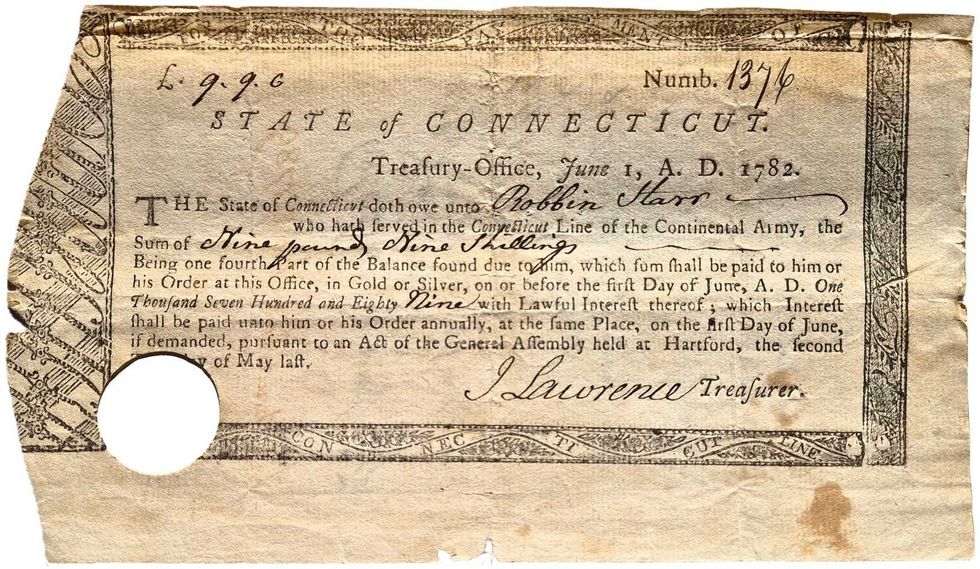 Pay Bill for Robin Starr’s service in the Continental Army.Courtesy the Alex Breanne Corporation
 John Mills speaking at Quinnipiac University.Courtesy the Alex Breanne Corporation

 Stephanie Saetta,with her rescue dog George and Blue (left), a shepherd mix awaiting his forever home.Madi Long