




Latest News
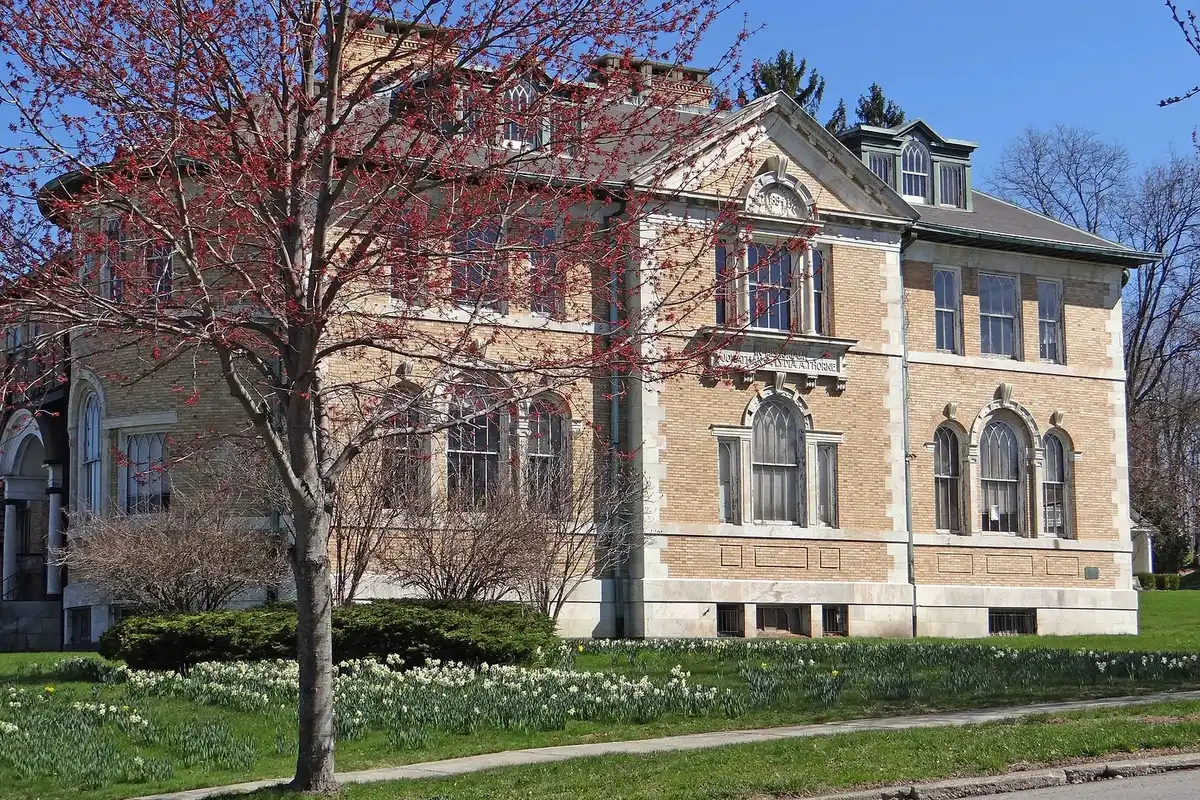
The North East Town Hall building, where town officials will hold a public hearing on Thursday, Jan. 8, at 7 p.m., on proposed zoning code amendments
By Nathan Miller
MILLERTON — The zoning code changes that will be the focus of a public hearing on Thursday, Jan. 8, represent a major overhaul of the code since it was adopted in the 1970s, placing a strong focus on promoting housing options in the town’s commercial district.
The hearing is scheduled for Jan.8 at 7 p.m. at Town Hall and the draft of the amendments can be found online at townofnortheastny.gov/zoning-review-committee/ or in person at Town Hall or at the NorthEast-Millerton Library.
Zoning regulations, which date to the early 20th century, govern how residents and businesses can use their homes and buildings, and their land. Town officials say their goal in modernizing the code aims to support local business and create new housing options.
While there have been some updates over the years to address specific issues, the changes before the public this time are an ambitious attempt to align with the town’s Comprehensive Plan, which was adopted six years ago.
In this first go-round, the focus is on the town’s commercial districts, such as the so-called Boulevard District that runs along Route 44 to the Connecticut border. Residential and land conservation districts have been included to varying degrees in this proposed update, but largely are to be considered in a second phase of zoning review that soon will be initiated.
A housing focus
The 2019 Comprehensive Plan sought “to promote a variety of housing alternatives” and update zoning laws to allow for higher density development in the Town and Village, noting that fewer than one in five housing types were multi-family dwellings and most of them offered fewer than four units.
The predominant single-family housing stock in the Town and Village dated to the mid-twentieth century; 37% of the housing in the Town and 80% of the housing in the Village was built before 1950.“
This is a sea change but it depends on getting sewers in the Boulevard District,” said Edith Greenwood, who headed the six-member volunteer Zoning Review Committee that worked on all the amendments over years. The committee engaged professional consultants with a goal to make the town’s code more accessible, and streamline approval processes, as well as update language and definitions.
The zoning overhaul, however, addresses more than just housing. The revised code is laid out in extensive detail, and its comprehensive approach requires many pages of documentation — 181 pages to be exact. However, many provisions, regulations and procedures remain unchanged even though they are included in the complete document up for review at the Jan. 8 hearing. Here are some of the changes proposed in the new code:
Multifamily dwellings
Existing code doesn’t contain a section about multifamily dwellings, but the amended code applies standards.
“Multifamily dwellings may be located on upper floors of commercial buildings and/or within standalone buildings,” the amendment provides. “No less than three (3) and no more than twelve (12) individual dwelling units shall be contained in a single building,” according to the draft regulation. Floor areas are defined to conform to New York State codes.
Rental apartments above commercial space
This so-called mixed-use development allows for rental apartments above commercial spaces.
“The intent is to permit mixed use development under carefully regulated conditions to facilitate reinvestment in and the renovation of existing commercial buildings, as well as encourage the development of new mixed-use facilities, resulting in positive economic impacts to those properties and the town at large, while imposing minimal burden on town services and municipal infrastructure,” the draft proposal states.
Adding Affordable Housing standards
The current code is amended to include general standards for affordable housing units, including specifics related to the cost and ownership of such units, among others. Such housing provides homes priced below market rate allowing for housing opportunities to low- to moderate-income families with eligibility based on income.
Proposed affordable housing regulations in North East will limit the cost of affordable rental housing to 30% of 60% of the area median income for Dutchess County. The regulations will limit the cost of so-called “ownership” units to 30% of 80% of the county’s area median income.
Affordable housing regulations provide a benefit to developers, allowing additional commercial space on second and third stories in exchange for placing affordable housing units in the remaining floor area above a commercial space. Commercial buildings are allowed to host additional commercial uses on second and third floors as long as it does not exceed 50% of the floor area of those stories. All remaining floor space must be dedicated to affordable housing.
Accessory Apartment section becomes Accessory Dwelling Unit (ADU)
A section of the current code refers to ‘Accessory Apartments’ but that category is amended to regulate ‘Accessory Dwelling Units,’ which is the current terminology. “An ADU shall be clearly incidental and subordinate to the principal one-family dwelling use and shall not change the one-family residential character of the neighborhood,” the amended code reads.
'Everything but the kitchen sink'
The amended zoning regulations also seek to regulate a wide variety of businesses and activities.
Mobile food vendors will need permits to operate. Electric vehicle charging stations, which didn’t exist in the 1970s, will come under the regulations, including charging stations at residences. Outdoor vehicle storage will have requirements spelled out as well as outdoor dining at restaurants.
EV charging stations are allowed at all residences, but regulations require a zoning permit. Residential chargers are allowed inside garages, on an exterior wall or as a freestanding structure adjacent to a driveway. Chargers are also permitted in parking lots for commercial buildings, subject to site plan approval by the North East Planning Board. Parking regulations get extensive coverage in the amended regulations.
They also include amended regulations for roadside farm stands, cell towers and self-storage warehousing, among many others.
The amended regulations call for the creation of a zoning enforcement officer to receive, review applications for a zoning permit, sign permit and certificate of use, among other duties that include inspections to ensure compliance. The town currently contracts a zoning officer, whose services are shared with the Village and with other municipalities.
The amendments update design standards and site-plan expectations for off-street parking, signage, landscaping and exterior lighting, a category that takes up several pages and even includes illustrations. Motel provisions are deleted and replaced with hotel requirements, and include a requirement prohibiting “the establishment of a tenant/landlord relationship or legal residence by any such occupant.”
A section on cannabis regulates the location and operation of retail cannabis dispensaries “to ensure any such use will be in harmony with and will not have a detrimental effect upon the surrounding area and, that both the location and operation are protective of public health and welfare and preserve quality of life.”Cannabis dispensaries will be permitted within the town as long as they are at least 200 feet “from a private or public school, park, playground, library, adult or child day care, or a place of worship.”
Consumption of cannabis on the premises of a dispensary is prohibited, and an onlooker outside the building must be unable to see or smell the products inside. Regulations also require a detailed operational plan as part of the site plan approval process that would contain information about hours of operation, loitering mitigation, lighting and signage among other details of the business.
Public workshops that have been held with the Town Board to review the proposed changes have for the most part been sparsely attended by the public, as they dragged out for hours while board members quizzed the planning experts as well as the town attorney, Warren Replansky, about detail on any number of zoning matters and how North East’s requirements would align with those of New York State and Dutchess County. The amended zoning regulations have been reviewed by the Dutchess County Department of Planning and Development.
Supervisor Kris Kennan said additional public hearings will be scheduled as necessary. In August, Kennan remarked that the adoption of the updated zoning code amendments could stand as the most significant accomplishment of the current board.
Keep ReadingShow less
The Town of North East’s Boulevard District — a stretch of Route 44 between Millerton and the New York State border — is the town’s largest commercial zone. The proposed zoning rewrite would allow mixed-use buildings with residential apartments above ground-floor retail.
Photo by Aly Morrisey
MILLERTON — The zoning code changes that will be the focus of a public hearing on Thursday, Jan. 8, represent a major overhaul of the code since it was adopted in the 1970s, placing a strong focus on promoting housing options in the town’s commercial district.
The hearing is scheduled for Jan. 8 at 7 p.m. at Town Hall and the draft of the amendments can be found online at townofnortheastny.gov/zoning-review-committee/ or in person at Town Hall or at the NorthEast-Millerton Library.
Zoning regulations, which date to the early 20th century, govern how residents and businesses can use their homes and buildings, and their land. Town officials say their goal in modernizing the code aims to support local business and create new housing options.
While there have been some updates over the years to address specific issues, the changes before the public this time are an ambitious attempt to align with the town’s Comprehensive Plan, which was adopted six years ago. In this first go-round, the focus is on the town’s commercial districts, such as the so-called Boulevard District that runs along Route 44 to the Connecticut border.
Residential and land conservation districts have been included to varying degrees in this proposed update, but largely are to be considered in a second phase of zoning review that soon will be initiated.
A housing focus
The 2019 Comprehensive Plan sought “to promote a variety of housing alternatives” and update zoning laws to allow for higher density development in the Town and Village, noting that fewer than one in five housing types were multi-family dwellings and most of them offered fewer than four units.
The predominant single-family housing stock in the Town and Village dated to the mid-twentieth century; 37% of the housing in the Town and 80% of the housing in the Village was built before 1950.
“This is a sea change but it depends on getting sewers in the Boulevard District,” said Edith Greenwood, who headed the six-member volunteer Zoning Review Committee that worked on all the amendments over years. The committee engaged professional consultants with a goal to make the town’s code more accessible, and streamline approval processes, as well as update language and definitions.
The zoning overhaul, however, addresses more than just housing. The revised code is laid out in extensive detail, and its comprehensive approach requires many pages of documentation — 181 pages to be exact. However, many provisions, regulations and procedures remain unchanged even though they are included in the complete document up for review at the Jan. 8 hearing.
Here are some of the changes proposed in the new code:
Multifamily dwellings
Existing code doesn’t contain a section about multifamily dwellings, but the amended code applies standards.
“Multifamily dwellings may be located on upper floors of commercial buildings and/or within standalone buildings,” the amendment provides. “No less than three (3) and no more than twelve (12) individual dwelling units shall be contained in a single building,” according to the draft regulation.
Floor areas are defined to conform to New York State codes.
Rental apartments above commercial space
This so-called mixed-use development allows for rental apartments above commercial spaces.
“The intent is to permit mixed use development under carefully regulated conditions to facilitate reinvestment in and the renovation of existing commercial buildings, as well as encourage the development of new mixed-use facilities, resulting in positive economic impacts to those properties and the town at large, while imposing minimal burden on town services and municipal infrastructure,” the draft proposal states.
Adding Affordable Housing standards
The current code is amended to include general standards for affordable housing units, including specifics related to the cost and ownership of such units, among others. Such housing provides homes priced below market rate allowing for housing opportunities to low- to moderate-income families with eligibility based on income.
Proposed affordable housing regulations in North East will limit the cost of affordable rental housing to 30% of 60% of the area median income for Dutchess County.
The regulations will limit the cost of so-called “ownership” units to 30% of 80% of the county’s area median income.
Affordable housing regulations provide a benefit to developers, allowing additional commercial space on second and third stories in exchange for placing affordable housing units in the remaining floor area above a commercial space.
Commercial buildings are allowed to host additional commercial uses on second and third floors as long as it does not exceed 50% of the floor area of those stories. All remaining floor space must be dedicated to affordable housing.
Accessory Apartment section becomes Accessory Dwelling Unit (ADU)
A section of the current code refers to ‘Accessory Apartments’ but that category is amended to regulate ‘Accessory Dwelling Units,’ which is the current terminology. “An ADU shall be clearly incidental and subordinate to the principal one-family dwelling use and shall not change the one-family residential character of the neighborhood,” the amended code reads.
‘Everything but the kitchen sink’
The amended zoning regulations also seek to regulate a wide variety of businesses and activities.
Mobile food vendors will need permits to operate. Electric vehicle charging stations, which didn’t exist in the 1970s, will come under the regulations, including charging stations at residences. Outdoor vehicle storage will have requirements spelled out as well as outdoor dining at restaurants.
EV charging stations are allowed at all residences, but regulations require a zoning permit. Residential chargers are allowed inside garages, on an exterior wall or as a freestanding structure adjacent to a driveway.
Chargers are also permitted in parking lots for commercial buildings, subject to site plan approval by the North East Planning Board.
Parking regulations get extensive coverage in the amended regulations. They also include amended regulations for roadside farm stands, cell towers and self-storage warehousing, among many others.
The amended regulations call for the creation of a zoning enforcement officer to receive, review applications for a zoning permit, sign permit and certificate of use, among other duties that include inspections to ensure compliance. The town currently contracts a zoning officer, whose services are shared with the Village and with other municipalities.
The amendments update design standards and site-plan expectations for off-street parking, signage, landscaping and exterior lighting, a category that takes up several pages and even includes illustrations.
Motel provisions are deleted and replaced with hotel requirements, and include a requirement prohibiting “the establishment of a tenant/landlord relationship or legal residence by any such occupant.”
A section on cannabis regulates the location and operation of retail cannabis dispensaries “to ensure any such use will be in harmony with and will not have a detrimental effect upon the surrounding area and, that both the location and operation are protective of public health and welfare and preserve quality of life.”
Cannabis dispensaries will be permitted within the town as long as they are at least 200 feet “from a private or public school, park, playground, library, adult or child day care, or a place of worship.”
Consumption of cannabis on the premises of a dispensary is prohibited, and an onlooker outside the building must be unable to see or smell the products inside. Regulations also require a detailed operational plan as part of the site plan approval process that would contain information about hours of operation, loitering mitigation, lighting and signage among other details of the business.
Public workshops that have been held with the Town Board to review the proposed changes have for the most part been sparsely attended by the public, as they dragged out for hours while board members quizzed the planning experts as well as the town attorney, Warren Replansky, about detail on any number of zoning matters and how North East’s requirements would align with those of New York State and Dutchess County. The amended zoning regulations have been reviewed by the Dutchess County Department of Planning and Development.
Supervisor Kris Kennan said additional public hearings will be scheduled as necessary. In August, Kennan remarked that the adoption of the updated zoning code amendments could stand as the most significant accomplishment of the current board.
This month, the village Zoning Board of Appeals met to begin laying groundwork for an update to its zoning code — a process officials say is necessary to replace regulations they repeatedly describe as “outdated.”
Keep ReadingShow less
Sharon Hospital in Sharon, Connecticut.
Archive photo
SHARON — Northern Dutchess Paramedics will cease operating in northwest Connecticut at the start of the new year, a move that emergency responders and first selectmen say would replace decades of advanced ambulance coverage with a more limited service arrangement.
Emergency officials say the change would shift the region from a staffed, on-call advanced life support service to a plan centered on a single paramedic covering multiple rural towns, raising concerns about delayed response times and gaps in care during simultaneous emergencies.
The decision became known on Dec. 11 when communities were informed that NDP’s service would end as of Jan. 1, according to Andrea Downs, president of the Falls Village Volunteer Fire Department and an employee of the organization.
Founded in 1994 and based in Rhinebeck, New York, NDP has provided advanced and basic life support ambulance services to communities in Dutchess and Columbia counties in New York, as well as parts of Litchfield County, for nearly three decades.
How the change came about was outlined by Al Tortorella of Sharon, also an employee of NDP.
Tortorella said every Connecticut municipality is required to have an advanced life support provider. For the past 28 years, Sharon Hospital has fulfilled that requirement by signing an annual hospital-sponsored agreement with NDP. In recent years, the agreement was signed by Dr. Ronald Santos, head of the hospital’s emergency department, under whose medical license NDP operates.
When NDP recently approached Santos to renew the agreement, he said he could not sign it, a decision that took the organization by surprise, Tortorella said.
Area towns operate volunteer ambulance squads that provide basic life support. NDP supplements those crews by delivering advanced medical care, administering medications and conducting inter-facility transports.
Sharon Hospital, which is part of Nuvance Health, merged earlier this year with Northwell Health.
Downs and Tortorella said they understand that the hospital system plans to replace NDP with its own paramedic service.
Under the proposed arrangement, a single paramedic would cover the Sharon Hospital catchment area, starting each shift in New Milford before traveling to Sharon. If needed, the paramedic would be assisted by a paid EMT provided by Nuvance.
Tortorella sharply criticized the model. “It’s a system designed to fail,” he said. “This is a huge issue.”
Downs echoed those concerns, noting that the paramedic’s 12-hour shift would include significant travel time between locations. “I’m very concerned about the health and well-being of residents in the Northwest Corner,” she said. “We don’t want any reduction in services for patients in the region. I can’t understand the rationale of taking services away. Northwell wants to maintain a model of corporate health care, but they can’t put a face to the people and culture we’ve established here. We’re talking life and death.”
Downs emphasized that the decision does not involve layoffs at NDP, which was recently acquired by Empress. She said there is ample demand for paramedic services in New York state and that employees’ jobs are secure. The concern, she said, is for the safety of families, friends and neighbors in Northwest Connecticut.
In an interview, Sharon Hospital President and CEO Christina McCulloch and Andrea Rynn, assistant vice president for community, government and public relations at Northwell Health, addressed the decision to discontinue the hospital-sponsored agreement with NDP.
“Recently, concerns were brought to our attention about compliance and [a lack of] communications,” they said. “This information left us unsettled and unable to be a sponsoring hospital at this time.”
They acknowledged that the timing of the transition was far from ideal. “Despite the tight timing, we are actively developing a coverage plan in concert with local first responders and area leaders. This is a process that is just beginning and we are confident it will strengthen over time.”
McCulloch and Rynn said the hospital and health system remain committed to maintaining service continuity and working with community partners to enhance emergency medical services across the region.
Keep ReadingShow less
loading