Salisbury prepares for launch of 100th Jumpfest

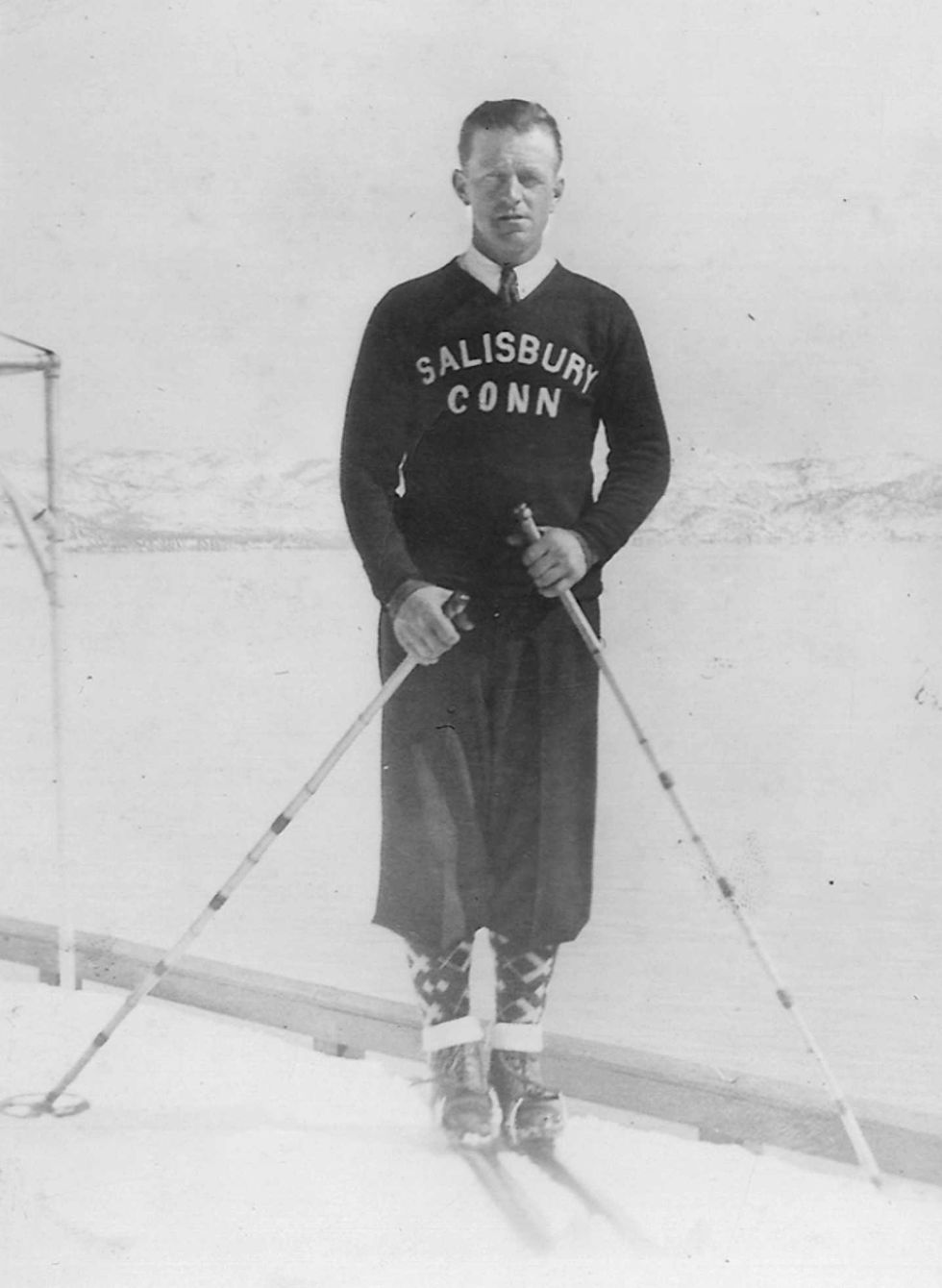
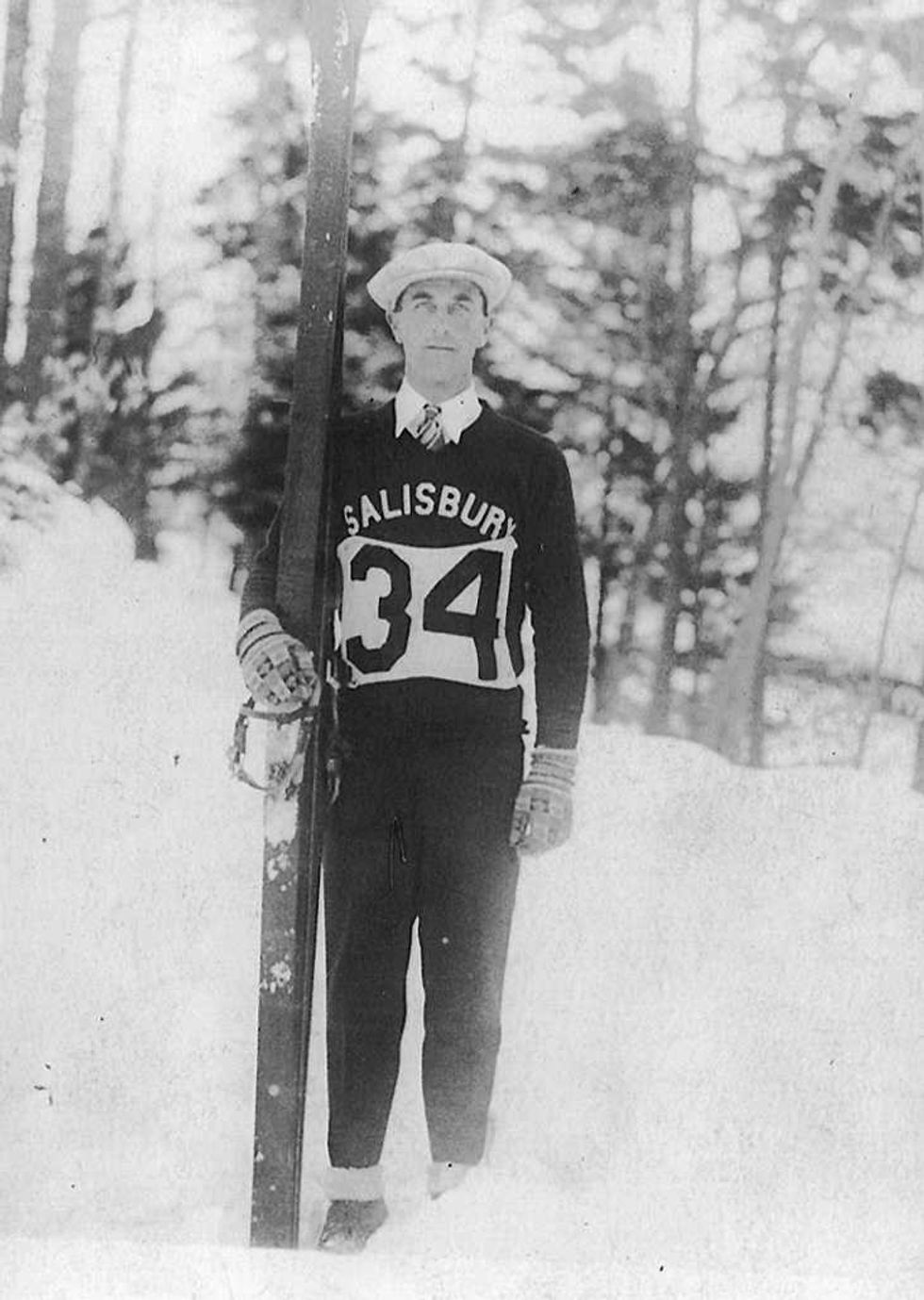
John Satre, one of the original Satre brothers, is credited with pioneering the sport of ski jumping in the United States.
Photo Provided

John Satre, one of the original Satre brothers, is credited with pioneering the sport of ski jumping in the United States.
SALISBURY, Conn. — Salisbury’s longstanding tradition of ski jumping is reaching new heights this year with the 100th annual Jumpfest, scheduled for Feb. 6–8 at Satre Hill.
The weekend-long celebration opens with a community night on Friday, Feb. 6, followed by youth ski jumping competitions and the Salisbury Invitational on Saturday. The event concludes Sunday with the Eastern U.S. Ski Jumping Championships.
While spectators look skyward to watch the high-flying athletes, Jumpfest will also invite the community to look back on Salisbury’s deep-rooted ski jumping history.
Ski jumping originated in Norway in the 19th century and is a tradition familiar to most Nordic children. That was the case for the five Satre brothers — John, Magnus, Ottar, Sverre and Olaf — who grew up competing in ski jumping and cross-country skiing.
When John Satre moved to Salisbury in 1923 to work as a chauffeur, he brought the tradition with him. The rolling hills and heavy winters of the Northwest Corner resembled those of Norway, allowing John to seamlessly integrate his passion into his new community.
Within a year, his brothers followed him to Salisbury.
In 1926, John Satre captivated roughly 200 spectators by skiing off a snow-covered barn roof.
The brothers soon formed the Salisbury Outing Club — now known as the Salisbury Winter Sports Association (SWSA) — and began construction of a permanent ski jump in the same location it sits today: Satre Hill.
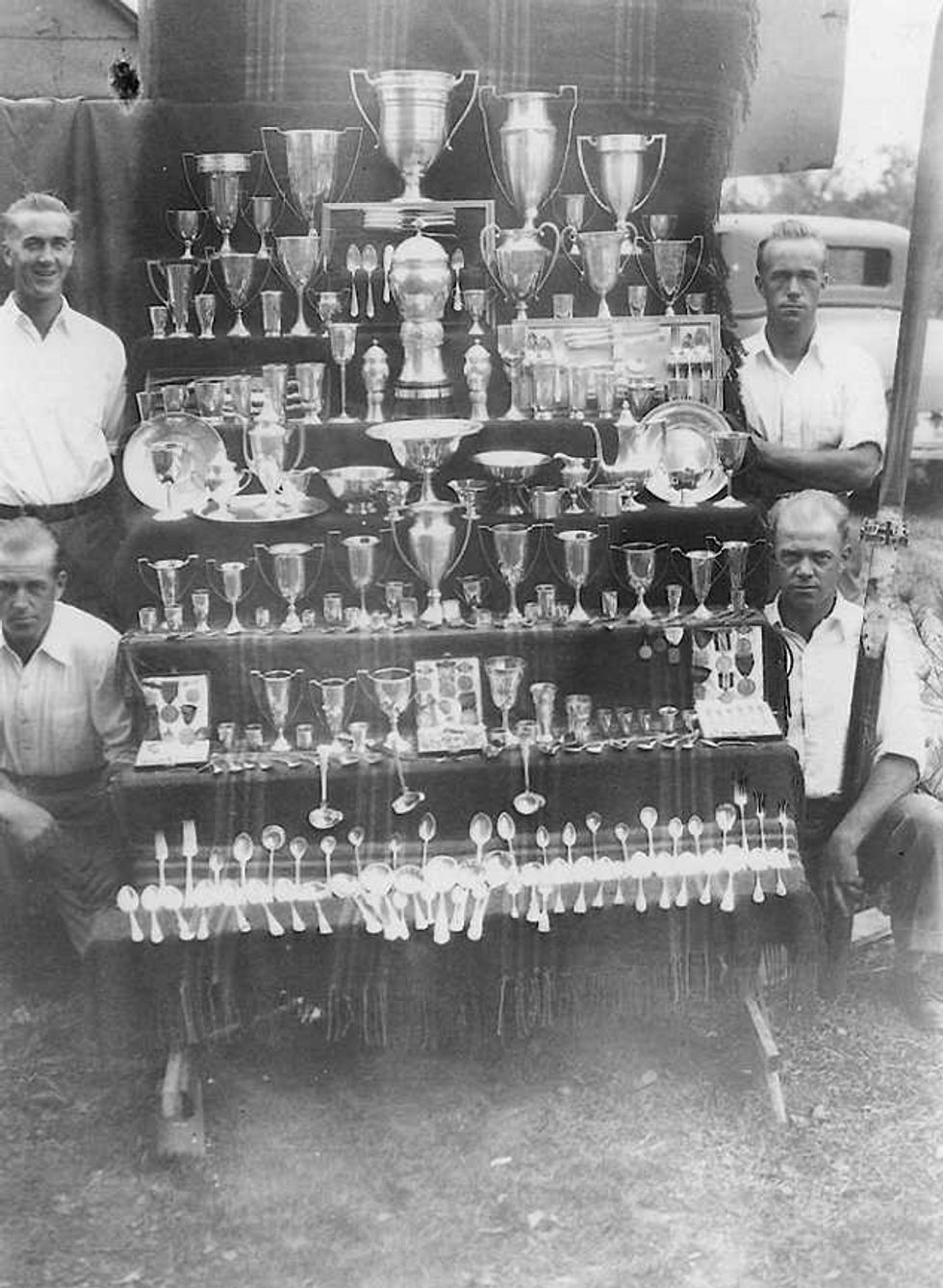
By 1933, the Satre brothers had won numerous championships and helped popularize the sport across the United States. Salisbury hosted the U.S. Olympic Trials in 1932, and the following year hosted the National Championships.
Tragically in 1934, at the age of 40, John Satre was killed in a car accident. The New York Times hailed him as a pioneer in U.S. skiing and his legacy is carried on in the winter sports culture that is nurtured in Salisbury today.
During this time, local children were introduced to the sport, creating makeshift jumps in their backyards out of crates and hay bales. One of these children was Richard Parsons, who became the first Salisbury resident to earn recognition for cross country skills. He earned a spot for the 1932 Lake Placid Winter Olympic Games and in 1936 competed in the Winter Olympics in Garmisch, Germany, where he was the leading American-born cross-country skier.
During World War II, young athletes who would have normally been jumping were enlisted in the service, causing a lull in the sport and deterioration of the jump itself. After the war, however, community members eagerly worked to rebuild the jump, and another Salisbury athlete emerged.
Roy Sherwood was first introduced to ski jumping when his father built him and his brother their own ski jump in their backyard. Sherwood quickly gained ground, earning himself the title of “hometown hero.” By 1954, Sherwood was offered a spot on the U.S. Olympic Team for the 1956 games in Cortina, Italy.
Sherwood’s path to the Olympics was far from easy. A year before the Games, he was diagnosed with polio, threatening his ability to compete. He recovered enough to travel to Italy, only to hit an icy patch during a practice run.
Sherwood rebounded and competed the next day, placing 36th out of 51 — the second-highest finish by an American — and was later inducted into the U.S. Ski & Snowboard Hall of Fame.
Today, four jumps line Satre Hill — K10, K20, K30, and K65. The 65-meter jump is used for competitions, and the smaller jumps are used to teach local youth during winter camps.
Islay Sheil, a Housatonic Valley Regional High School student and Lakeville resident, is the current SWSA athlete on the rise in ski jumping today. Her passion for the sport emerged during one of the SWSA winter camps, and last March earned gold in the Junior National Championships. The next Junior National Championships will be hosted in Salisbury in 2027.
While Salisbury celebrates the 100th anniversary of its own ski jump this year, the Olympic Games will be held in Milan and Cortina, Italy, the same place that Sherwood gained global recognition.
To honor the town’s remarkable history and tradition of ski jumping, Jumpfest will begin early with a Winter Warmer on Jan. 31 between 5:30 to 8 p.m. It will be at the home of Salisbury First Selectman Curtis Rand. Small plates and drinks will be served. Limited tickets are available for $50 and more details can be found at Jumpfest.org/100years/
On Feb. 1, a double feature screening of On the Hill and Downhill Racer will be held at The Moviehouse in Millerton, followed by a panel discussion on winter sports and SWSA’s role in Salisbury’s history. There will also be a raffle and SWSA merchandise for sale.
Tickets for the showing are $16 and details can be found at Jumpfest.org/100years/.
On Friday, Feb. 6, Jumpfest will host community night at Satre Hill. SWSA will offer free admission for the night. Gates open at 6 p.m. and “Target Jumping Under the Lights” will begin at 7 p.m. There will be fireworks sponsored by NBT Bank, bonfires, and food and drinks available for purchase. The Human Dogsled Race is set for 8:30 p.m. Teams of five can register at Jumpfest.org
On Saturday, Feb. 7, the Junior Competition on K20 jump will begin at 9 a.m. The Salisbury Invitational Ski Jumping Competition will practice from 11 a.m. to noon and compete at 1 p.m. Community members are invited to the Snow Ball at the Lakeville Town Grove at 8 p.m. Dancers will be accompanied by live music from the Steve Dunn Band. Entrance to the Ball is $20 with children 12 and under free of charge.
On Sunday, Feb. 8, Satre Hill will hold the Eastern U.S. Ski Jumping Championships. Athletes will practice between 11 a.m. to noon and compete at 1 p.m.
Willie Hallihan of SWSA explained that the length of time and number of people involved on an emotional level has made the sport “iconic to Salisbury.”
Hallihan recounted in the PBS documentary “The Jump” that the ski jumps are “like a family member to a lot of people”.

Millerton firefighters exit a rear door at 5873-5875 S. Elm St. in Millerton after responding to a carbon monoxide exposure call at 2 p.m. on Monday, Feb. 9. Millerton Fire Chief Keith Roger said a deep fryer running indoors and the propane furnace may have contributed to the high levels of carbon monoxide in the building.
MILLERTON — As many as six are displaced from their homes due to uncertainty over the safety of the furnace after fumes from a gas-fired deep fryer filled an apartment building on South Elm Street.
Millerton Fire Chief Keith Roger said residents of 5873-5875 S. Elm St. operated a fryer indoors with no ventilation, potentially causing much of the exposure, but the propane furnace may have also contributed. No damage to the building was reported, but three people were treated for carbon monoxide exposure at Sharon Hospital.
Roger said the investigation was turned over to the Village of Millerton building inspector, who deemed the duplex apartment building an unsafe structure until the furnace can be inspected and approved.

Crews from the Millerton Fire Department, Amenia Fire Department, Empress EMS and the New York State Police responded to the call. The building was evacuated and ventilation of the dangerous gas had started when Amenia fire crews arrived on the scene around 2:45 p.m.
Carbon monoxide concentration reached as high as 180 parts per million on the second floor of the building, Roger said. Carbon monoxide exposure starts to become dangerous between 35 and 100 ppm, with concentrations of 200 ppm causing nausea, headaches and dizziness.
Roger said two people had already been transported to Sharon Hospital when first responders arrived. Crews discovered a third person showing signs of exposure during evacuation. No other injuries were reported.
John Dennis, of Millerton, presents a bluegill he caught in Rudd Pond on Friday morning, Feb. 6. Dennis said he catches enough fish for a meal — usually about a dozen fish — before packing up and shuffling off the ice.
MILLERTON — Rudd Pond is open for ice fishing as of Thursday, Feb. 5.
Taconic State Park rangers announced the ice was safe for fishing in a Facebook post Thursday morning. Ice on the pond must average at least 6 inches thick across the entire surface before it is opened to recreation, according to park staff.
On Friday, Feb. 6, Brian Booth of Millbrook and John Dennis of Millerton were out on the ice catching crappie and bluegill at 10 a.m.
"I've been fishing here since I was a kid," Dennis said. He was jigging, which is a fishing technique where a baited hook is dropped through a hole in the ice and "jigged" to simulate natural movement.
Booth was fishing through a combination of jigging and devices called "flip-ups," which have a line connected to a spring-loaded flag that flips up when a fish grabs the hook.

Temperatures are predicted to stay well below freezing for the next week. An extreme cold weather warning was in effect for the region all weekend and stretched into Monday morning on Feb. 9.
Forecasts predict heavy winds and blustery conditions to continue this week, with a chance for temperatures to increase leading into this weekend. Booth and Dennis each said that wind is a major contributor to uncomfortable conditions on the ice, where natural wind breaks are nonexistent.
Dennis uses a sled with a collapsible shelter to haul his ice fishing equipment onto the pond. He said that the tent can be a great boon, especially when combined with a small space heater.
"I could fish in my t-shirt," Dennis said.
But wind has caused problems when Dennis’s sled wasn’t anchored properly. He said he was dragged across the ice by strong gusts during a recent trip to a frozen lake in Connecticut.
Rudd Pond is open from sunrise to sunset year-round. Taconic State Park employees said they will continue to monitor the ice and provide updates on its status.
Drivers should expect more police on the roads this weekend as law enforcement warns of ramped-up DWI check-points over Super Bowl weekend.
Law enforcement is expected to ramp up DWI check-points across the region this weekend.
Across Dutchess County, local law enforcement agencies will take part in a “high-visibility enforcement effort” during Super Bowl weekend aimed at preventing drivers from operating vehicles under the influence of drugs and alcohol. Increased patrols and sobriety checkpoints are planned throughout the county from Sunday, Feb. 8, through Monday, Feb. 9.
In a statement, Dutchess County Executive Sue Serino emphasized the need for safe roads and thanked law enforcement who “work year-round to keep our neighborhoods safe.” She added, “Make the winning play during Super Bowl weekend and plan for a safe ride home.”
Nationwide, traffic fatality data indicates Super Bowl Sunday is one of the deadliest days of the year for impaired driving, with a significantly higher number of alcohol-related deaths than on typical Sundays.
During the Jan. 29 Village Board meeting, trustees voted to sign the annual STOP-DWI agreement with Dutchess County, part of a statewide effort to keep dangerous drivers off the roads. Similar efforts also take place around Memorial Day, Independence Day, Labor Day, Halloween, Thanksgiving and during the December holiday season.
Millerton Police Chief Joseph Olenik said his department typically participates in all DWI check-points, but will not this weekend because of staffing issues. He said that does not mean county and state police will not be active in the Millerton area.
Students wore black at Housatonic Valley Regional High School Friday, Jan. 30, while recognizing a day of silence to protest Immigration and Customs Enforcement.
FALLS VILLAGE — In the wake of two fatal shootings involving Immigration and Customs Enforcement agents in Minnesota, students across the country have organized demonstrations to protest the federal agency. While some teens have staged school walkouts or public protests, students at Housatonic Valley Regional High School chose a quieter approach.
On Friday, Jan. 30, a group of HVRHS students organized a voluntary “day of silence,” encouraging participants to wear black as a form of peaceful protest without disrupting classes.
The idea was spearheaded by junior Sophia Fitz, who said she wanted a way for students to express their concerns while remaining in school.
“What really inspired me was that I was feeling very helpless with these issues,” Fitz said. “Staying educated with what’s going on in not only our country but globally can be very stressful as a teenager. Kids right now are feeling very hopeless and want to do something, but don’t know how.”
Teachers Peter Verymilyea and Damon Osora were on board with the idea early on, describing it as a peaceful and respectful way for students to express their beliefs.
Assistant Principal Steven Schibi also backed the effort, emphasizing the importance of student participation.“I think it’s important for us to listen to students,” he said. “And they have to learn how to have a voice in such a way that it’s not disruptive.”
After discussions with Superintendent Melony Brady-Shanley and Principal Ian Strever, school administrators agreed that participation would be optional and that students could choose whether to wear black or not.
Schibi, along with several staff members, participated in the movement by wearing black themselves. Math department chair Kara Jones was among the participating teachers. “Everybody deserves their voice, so I’d rather do the day of silence than everybody stay home,” she said.
Among HVRHS students who supported the protest, at least one cited concern for friends affected by immigration enforcement.
Sophomore Peyton Bushnell said he felt anxious, fearing for the safety of friends and acquaintances. “I think it’s all really messed up,” Bushnell said. “I have a lot of Hispanic friends, and I worry if there’s ICE in Great Barrington, if they came here [and] deported my friends. I can’t even imagine.”
Bushnell said Fitz’s initiative encouraged him to speak more openly about the issue.
Senior Molly Ford echoed that sentiment. “I think it’s a peaceful way to protest and I think it’s the best way to do so,” Ford said.
Many students wore black to show support, and senior Victoria Brooks shared her thoughts on what it meant to her. “It means following along in a form of advocacy alongside other students,” Brooks said.
Some students declined to comment when asked about the protest. Others said they were unaware the protest was taking place. Three seniors interviewed during lunch said they would have participated had they known, calling it a “neat idea.”
Not all students were convinced of the protest’s impact. A group of juniors questioned whether it would make a difference.
“I think that it is good that we’re trying to do something,” one student said. “But I’m not sure how much the silence aspect of it will help, but I think that it’s good that we’re trying.”
Some students questioned the efficacy of the protests, including a group of seniors who offered their opinions. They expressed the belief that the protests were “pointless,” and that President Donald Trump probably didn’t even know that HVRHS existed.
“I just don’t think it’s the best way to go about it. Like, what is us being silent and wearing black gonna do,” one of the seniors said.
Senior Cohen Cecchinato voiced his opposition to the protests in another interview.
“The staying silent, I think, is for the lives that were lost, which I agree with,” Cecchinato said. “But I think that wearing black, like the movement that it’s behind, the people that are putting it into place in our school are doing it because it’s like the ‘F ICE’ movement or the abolish ICE movement, which I think is just wrong.”
Other students said they believed political protests don’t belong in school.
“I just don’t think we should bring politics into school,” one senior said. Another added, “I think it’s causing … a really big divide and people are using it to be advantageous to themselves and their own beliefs.”
However, one senior expressed a sharply critical view of the protest. Senior Ashton Osborne dismissed students who chose to wear black or participate in the demonstration and criticized organizer Sophia Fitz. He also said he strongly supported the federal immigration agency and added that if he were old enough, he would want to work for ICE.
The comments reflected a minority viewpoint among students.
Mia DiRocco, Hannah Johnson and Peter Austin are seniors at Housatonic Valley Regional High School and participants in The Lakeville Journal’s student journalism program, which produces HVRHS Today.