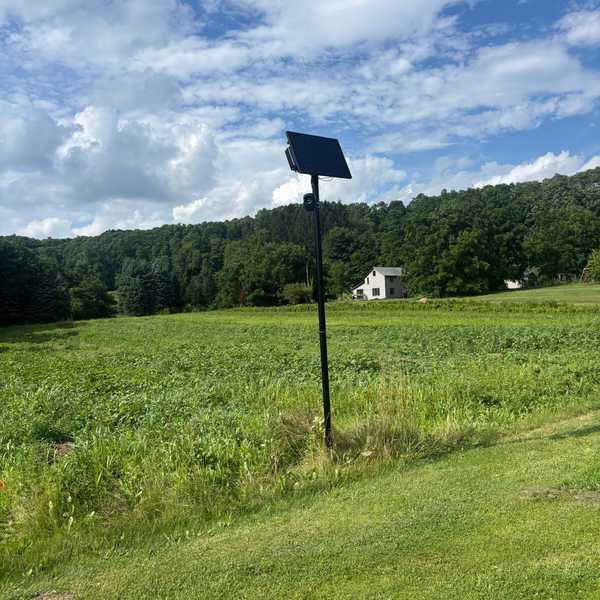
As county-operated license plate readers are set to come down across northeast Dutchess County, a state senator has introduced legislation to put the first statewide limits on how the technology is used.
State Sen. Michelle Hinchey announced the bill last Tuesday, Sept. 22. It would regulate automatic license plate readers, or ALPRs, including those made by Flock Safety, the company behind the cameras that have been installed in Millerton, Amenia, Pine Plains and Milan.
Under current New York law, there are no limits on who can access ALPR data, how it is stored and shared, or how long it is kept. “Our bill would be the first to do that in New York,” Hinchey said in a statement.
The bill would require ALPR data to be deleted within 48 hours unless it is used as evidence or held under a warrant. It would ban the sale of the data to private entities and bar agencies from building databases to be kept for future use. Out-of-state law enforcement would need judicial authorization to access New York data.
Agencies would have to keep auditable logs of who searches the data and publish annual reports listing camera locations and the number of plates captured. People harmed by unlawful use could sue for damages and attorney’s fees. Such unlawful use has been regularly reported, Hinchey noted. “As ALPRs proliferate, too often over the objections of local residents, reports of bad actors using this technology to stalk and spy on innocent people — often crimes against women — are becoming more frequent,” she said.
Law enforcement could still use the cameras to investigate felonies, find missing persons and stolen vehicles, and enforce traffic and parking laws.
The legislation is backed by the New York Civil Liberties Union, the Legal Aid Society, the Institute for Justice and the Surveillance Technology Oversight Project, among others. Daniel Schwarz of the NYCLU called the current situation “dangerous.” Corinne Worthington of the Surveillance Technology Oversight Project noted that communities across the country, including Millbrook, Pine Plains, and Windsor, have cancelled their Flock contracts.
The bill arrives amid a year of debate over automatic license plate readers. In February, revelations that Pine Plains police had entered a preliminary contract with Flock prompted an emergency meeting and the contract’s eventual cancellation.
In July, landowners near Millerton said the cameras had been installed on their property with little notice. Julie Schroeder of Silamar Farm said she had agreed to a camera two years earlier, only to find it placed roadside, in the way of her farm machinery. Reporting at the time counted at least four Flock cameras in northeast Dutchess, one of them on Route 343 east of Amenia.
Another property owner in Pine Plains, who had initially agreed to a Flock camera, has asked for its removal.
At a September town hall in Amenia, Dutchess County Deputy Steve Reverri said Flock cameras were operational in every town in the county.
The debate took center stage this week at a public forum in Pleasant Valley. Dutchess County District Attorney Anthony Parisi and Sheriff Kirk Imperati discussed the cameras at Pleasant Valley Town Hall, hosted by County Legislator Eric Alexander. Parisi has pointed to the county’s online portal, which lists camera locations and arrests tied to the system, as evidence of accountability. Residents’ concerns about privacy and constitutional protections, however, dominated the discussion.
Two days after the public forum, D.A. Parisi and Sheriff Imperati announced they were withdrawing their support for the cameras in the region, though details on if and how the cameras will be removed from the information pipeline have yet to be determined.
Hinchey’s bill has not yet been assigned a hearing date. The Legislature returns to Albany in January.









 Justine and Victor Valla in their studio with a painting of Victor’s,”Jonah and the Whale.” Robin Roraback

 A ceramic vase by Kathleen Heidemann.Provided
  Joy Brown’s delightful ceramic sculptures.Provided