Salisbury Handmade draws shoppers to White Hart Inn

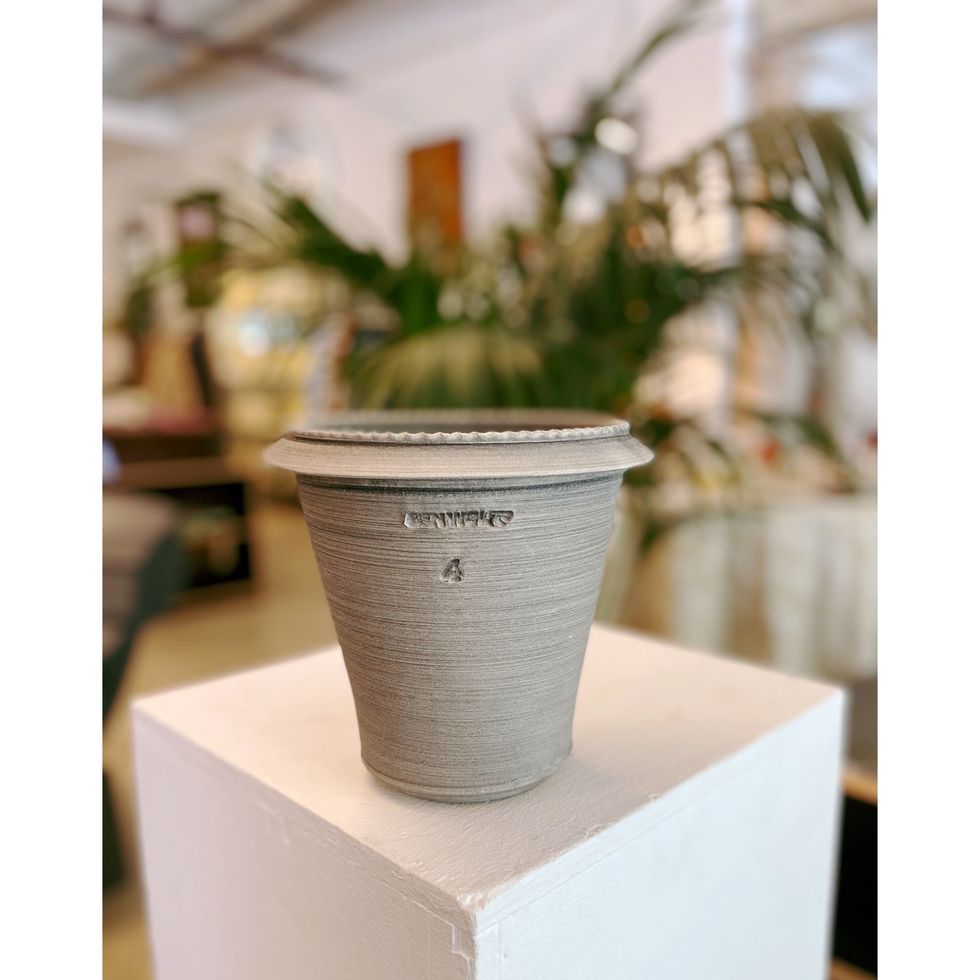
Rie McCarthy’s ceramics caught the eye of Keavey Bedell at Salisbury Handmade .
Patrick L. Sullivan


Rie McCarthy’s ceramics caught the eye of Keavey Bedell at Salisbury Handmade .
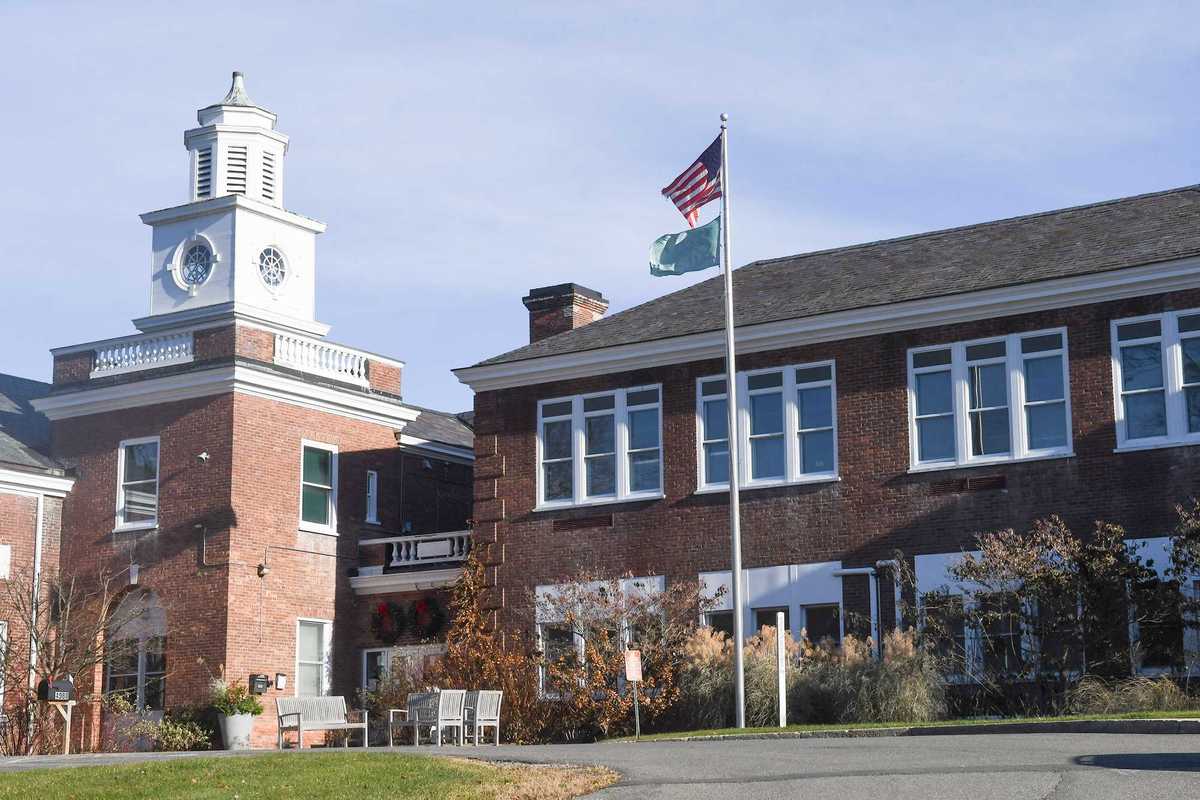
SALISBURY — The curious and the driven bustled into the White Hart Saturday, Nov. 29 for the first of two Salisbury Handmade events. Vendors offered a wide range of handmade products that the average holiday shopper is not going to find at a chain store.
Most of the people there were in the curious camp. Keavey Bedell looked casually at Rie McCarthy’s ceramics, and then more closely at a Jizo statue (a small representation of the Buddha). Bedell decided on the larger of the two Jizos.
McCarthy’s wares start around $25 for small bowls suitable for condiments to $35 for minimalist tea cups to larger items like serving bowls. She makes them in her studio in Mt. Washington, Massachusetts, and while she will not be at the second event on Dec. 13, her goods are available in Great Barrington at the Railroad St. Collective at 25 Railroad St. or at RIESMceramics.com.
Ambling around the corner, a reporter found Marilyn Davis of Amesville and her assortment of four-color prints of local scenes such as Lake Wonoscopomuc and Twin Lakes, all nicely framed and eminently affordable at $30 and up.
Davis’ work is available online Etsy under the name “FavoritePlacesArt,” or email mollyhardy2@gmail.com.
Continuing the circuit, the reporter, who was in the “driven” camp and looking for consumable gifts for his mother who does not want any more permanent “stuff,” came across Ani Jenkins of Falls Village, with assorted skin care items and herbal teas, all hand made.
The teas did the trick. After sampling the two on offer, the decision was made to go with the Peace Blend, consisting of chamomile, tulsi,and sitka rose ($16). It’s loose tea— Jenkins is adamantly anti-tea bag — and she had a couple of mason jar infusers for sale as well.
Jenkins either grows or collects these ingredients, sometimes from Alaska, where she and her husband have a summer cabin. She said she has had many interesting conversations with Transportation Safety Administration officials while bringing back Alaskan herbs. See www.umbotanicals.com for more information.
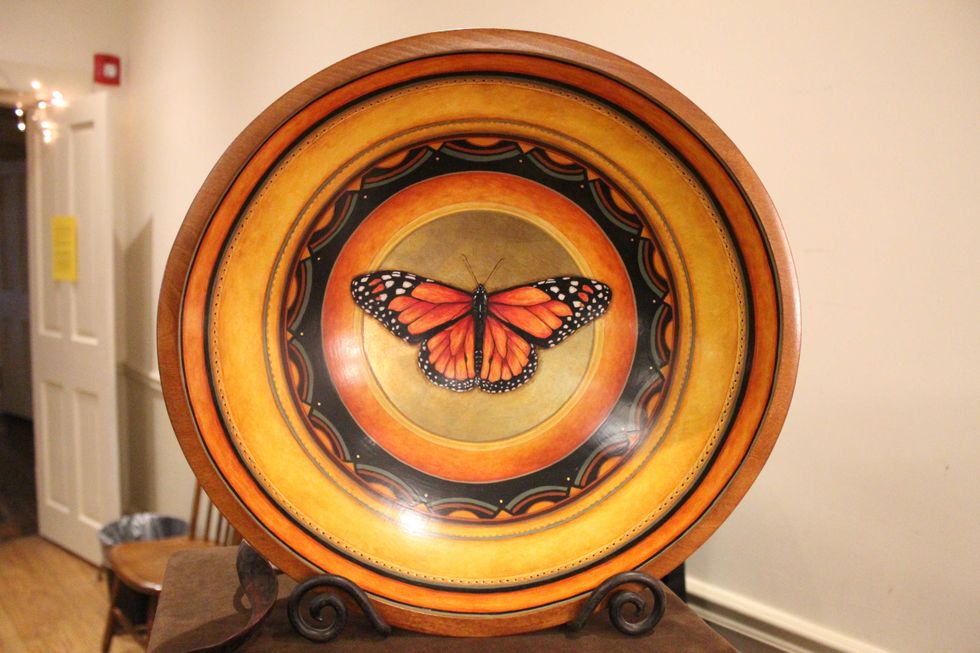
Shaari Horowitz, a veteran of the Salisbury Handmade scene, had her usual array of truly spectacular wooden bowls, decorated in such a way that actually using them as bowls seems unlikely, like putting the Mona Lisa on a couple of sawhorses as an impromptu picnic table.
No such ambiguity exists with Horowitz’ selection of interesting earrings, starting at $45. Horowitz will be on hand on Dec. 13.
As will Karin Gerstel of Undermountain Weavers. This year the weavers feature rugs and blankets made from Sam’s Wool (Sam Waterston is the Sam involved) starting at $150, plus wool beanies that are perfect for winter ($38).
Salisbury Handmade was established about 18 years ago when a number of local artisans banded together after the closing of Creative Hands, a local craft consignment store.
The group began to organize local shows to showcase local artists and their handmade items under several names, including Renegade Artisans Group, Salisbury Artisans Group and Salisbury Handmade.
Salisbury Handmade promotes four shows per year. The one-day spring show happens outdoors on the White Hart lawn in mid-May. The two-day autumn show, also on the lawn, occurs during the Salisbury Fall Festiva, and two one-day holiday shows are hosted inside the Inn.
Salisbury Handmade shares proceeds from the shows with local non-profits. The group also thanks the White Hart for hosting the shows.

Anne Day is a photographer who lives in Salisbury. In November 2025, a small book titled “Les Flashs d’Anne: Friendship Among the Ashes with Hervé Guibert,” written by Day and edited by Jordan Weitzman, was published by Magic Hour Press.
The book features photographs salvaged from the fire that destroyed her home in 2013. A chronicle of loss, this collection of stories and charred images quietly reveals the story of her close friendship with Hervé Guibert (1955-1991), the French journalist, writer and photographer, and the adventures they shared on assignments for French daily newspaper Le Monde. The book’s title refers to an epoymous article Guibert wrote about Day.
On Dec. 11, at 6:30 p.m., at the White Hart Inn in Salisbury, Day and Weitzman will share their memories in a conversation moderated by noted designer Matthew Patrick Smyth. The event is organized by Oblong Books and the Scoville Library.
Fresh home from her exhibition and book signing in Paris, Day sat in her Salisbury aerie high above the distant hills, her daughter’s black cat on her lap. She told the story of “Les Flashs d’Anne,” and the kismet that spurred its evolution.
In 2024, afterlearning that Day had worked with Guibert in New York and Paris, Weitzman — the author of numerous books about Guibert —saw her salvaged images, sought her out and announced, “We must do a book together.”
Weitzman writes in the book’s prologue, “This book is the dreamlike, uncanny result of that serendipitous encounter with a remarkable woman.”

During the 1980s, Day was a working photographer living on Fifth Avenue. A friend, the editor of Le Monde, asked whether Guibert, on his maiden voyage to New York, could stay with her. “I remember it was a cold night when Hervé showed up at my door,” she said.“His flight had just gotten in from Paris and he had this big box of Guerlain perfume. It was wrapped in beautiful pink paper. Within four minutes, we were friends.”
Thus began a whirlwind collaboration that took them from Manhattan, where they interviewed André Kertész, to Paris where they dined with Henri Cartier-Bresson and Duane Michals, and on to interviews with Isabelle Huppert, Gina Lollobrigida, designer Madeleine Castaing, Orson Welles and other luminaries of that time.
Day never saw Guibert after 1983. “Hervé got AIDS in the late ’80s and was quite militant. He now has a following of young people,” Day saidwistfully. During his final days, Guibert wrote five books based on his existential journey.

Day recalled the devastating house fire in which her family tragically lost their friend Maria Paz Reyes and their dog. Day survived by jumping from the second story. A lifetime of images, negatives and slides were lost or damaged. “To lose pictures is like losing friends. Everything was piled into metal file cabinets in my studio. All my negatives and slides were packed in tight. The fire started at the farthest point from there as possible. It was the only thing that wasn’t destroyed— every other single thing was gone. Nothing left. It was raining, so my friend Christopher covered everything with a tarp. The fabulous part of this story is how much help I had from my town, which gave me the empty firehouse to lay out everything to dry. Friends came from near and far to help. Some days I had ten volunteers, and it went on for a month, which gave me something to move forward with. It was so tragic and awful.”

A veteran photojournalist, portrait, wedding, and architectural photographer, Day created images for five books featuring the architecture of the Library of Congress, the U.S. Capitol, and the New York Public Library. She covered events in Cuba, Haiti and South Africa, where she took an iconic image of Nelson Mandela emerging from his prison cell. Her commissioned images of four Presidential Inaugurations are featured in the Smithsonian. Her work has appeared in Newsweek, Time, The New York Times, The Washington Post, Fortune, Paris Match and Vogue. She was the editor of Compass at the Lakeville Journal and The Millerton News.
Currently, she enjoys shooting digital photographs of nature. “I am interested in migration, large groups of birds and insects. I’ve been to New Mexico to photograph monarchs, Nebraska to photograph Sandhill cranes, and Ireland to photograph a murmuration of starlings.”
Day summed up her life: “Things just happened to me.”
Tickets to the event at The White Hart Inn on Dec. 11 are available at oblongbooks.com
In 1983, writer and performer Nurit Koppel met comedian Richard Lewis in a bodega on Eighth Avenue in New York City, and they became instant best friends. The story of their extraordinary bond, the love affair that blossomed from it, and the winding roads their lives took are the basis of “Apologies Necessary,” the deeply personal and sharply funny one-woman show that Koppel will perform in an intimate staged reading at Stissing Center for Arts and Culture in Pine Plains on Dec. 14.
The show humorously reflects on friendship, fame and forgiveness, and recalls a memorable encounter with Lewis’ best friend — yes, that Larry David — who pops up to offer his signature commentary on everything from babies on planes to cookie brands and sports obsessions.
Koppel has good friends in the Pine Plains area and she calls the opportunity to present the piece at the Stissing Center a gift to her and her artistic process, which she shares with her son, Gideon McCarty, who serves as her director and dramaturg.
“He is the one person I listen to,” said Koppel.She credited him with helping her shape, in her own words, “real events from her life with Lewis.” For Mother’s Day this year, McCarty gave her the time to further develop the material and Koppel worked uninterrupted for 12 hours to hone and bring the piece to its current form. She plays 11 characters, not through impersonation but by presenting their authentic voices.
Koppel is clear that writing this piece was the right way for her to respond to Lewis’ passing in 2024, and that theatre is the right way to share it with others. “I wanted to have artistic control over the development process,” she said, and to bring to life her romantic relationship with Lewis, their experiences in New York City comedy clubs, and their neurotic New York friends. She also is open to opportunities to expand further on the material, perhaps in film or TV, as she still has a lot to say.
Koppel hopes primarily that people will be entertained by the world of the play. “I’m a pie-in-the-face kind of person and I want the play to give everyone a good laugh.” Considering her cast of characters, “Apologies Necessary” promises to offer plenty of laughs —plus much more.
“‘Apologies Necessary’ continues Stissing Center’s tradition to serve as a platform for new works of theater, providing playwrights with the opportunity to showcase their work and hone their craft,” said Patrick Trettenero, executive director of the Stissing Center. “We are excited to have Nurit present this reading of her new work in progress.”
Running time: approx. 90 minutes. Sunday, Dec. 14 at 7 p.m., Downstairs at Stissing Center. Tickets are vailable at thestissingcenter.org or 518-771-3339.
Richard Feiner and Annette Stover have worked and taught in the arts, communications, and philanthropy in Berlin, Paris, Tokyo, and New York. Passionate supporters of the arts, they live in Salisbury and Greenwich Village.
A stand of trees in the woods.
Did you notice that some sugar maples lost their leaves far earlier this fall than others, missing out on the color parade? The leaves wilted from dull yellow to brown in August before falling off in early September. Where we live, it has happened for several years to a few older maples near the house.
I called two arborists to get as accurate a diagnosis as possible by phone and received two opinions on the issue, both involving fungal pathogens. Skip Kosciusko, a West Cornwall arborist, diagnosed the problem as verticillium wilt, which he says has reached pandemic levels among the area’s sugar maples. “It looks like we have climate conditions that prevent the really cold air from settling in the winter. Cold is helpful in killing the fungus deep inside the tree.” Verticillium wilt enters through the roots and blocks the tree’s vascular system, preventing water from reaching the leaves. It will most often kill the tree, especially young or poorly maintained ones.
Chris Roddick, formerly head arborist at the Brooklyn Botanic Garden, blames anthracnose. You may be familiar with the way anthracnose affects sycamore trees, a type of maple. Infected sycamores lose their first set of leaves in early spring, after which another set grows back. In the case of sugar maples infected with anthracnose, the leaves fall in August — about six weeks early — and they do not grow back until the following spring. We don’t yet know what this shorter life cycle will mean for the long-term viability of infected trees.
Skip has been treating infected sugar maples with a product called Kphite, which he describes as a salt from the minerals potassium and phosphate, known as phosphonate. He has found that it works well on beech trees, too, but he does not claim it is a cure. Rather, it bolsters trees’ natural defense mechanisms and their ability to deal with fungal infection. This product is available only to commercial entities, so homeowners need an arborist for its application.
Chris does not use any fertilizers on trees aside from compost. He is concerned about the long-term effects and unintended consequences of chemicals — even mineral supplements — that can leach into the water supply. He is “okay” with trees dying, and he’s “not doing nothing”; instead of applying chemicals, he is planting other species. His approach encourages a diversity of native plants so he can see what thrives in this new environment.
“Understanding disease pressures in plants is difficult. We often isolate an individual maple tree and see what happens. It’s different in the woods or for a stand of trees — here we have a system. If you manipulate one, you have consequences for the others. We think there are things to be done; we just don’t know what.” What we do know: fungi are quickly adapting to a warming climate, and changes in precipitation patterns may also favor fungal spread to trees.
As with humans, plants require minerals for healthy functioning. Humans can eat nutritious food or take supplements for overall health or to improve immunity; plants rely on the soil. There seem to be at least two reasons why plants are not getting what they need. One is that necessary nutrients have been depleted from the soil. Research suggests this may result from the recent Asian jumping worm infestation. The worms voraciously ingest soil — and the minerals that would otherwise be available to plants. In doing so, they turn the topsoil into a porous texture best described as coffee grounds. Rain can more easily wash through soil in this state, carrying away nutrients trees and other plants rely on.
A second reason is that trees may no longer be able to access needed minerals. This can happen if naturally acidic soil becomes alkaline or vice versa. Plants thrive at certain pH levels; a shift can inhibit nutrient absorption. We are seeing soil chemistry change in our woodlands as invasive plants proliferate. A 2003 study examined forest soils and mycorrhizal fungi associated with sugar maples and found that “a profound change in the mycorrhizal system will be one component of the potential ecosystem effects of invasion of new forest habitat by nonnative earthworms.” Mycorrhizae are the underground fungal threads that help trees share and trade nutrients. The study found that Asian jumping worms are breaking up the mycorrhizal network that helps sugar maples share and trade nutrients. (See theungardener.com for full citations of this and other studies.)
Can trees wait for science to help them? Should we experiment with possible solutions without understanding the full consequences, even if doing so might save trees? What actions do we take in the face of continuing species decline? It’s a subject we are obliged to explore here in the Northwest Corner, where so much of our experience relies on the view-enhancing, shade-giving, wind-breaking, habitat-restoring tree population.
Dee Salomon ‘ungardens’ in Litchfield County.