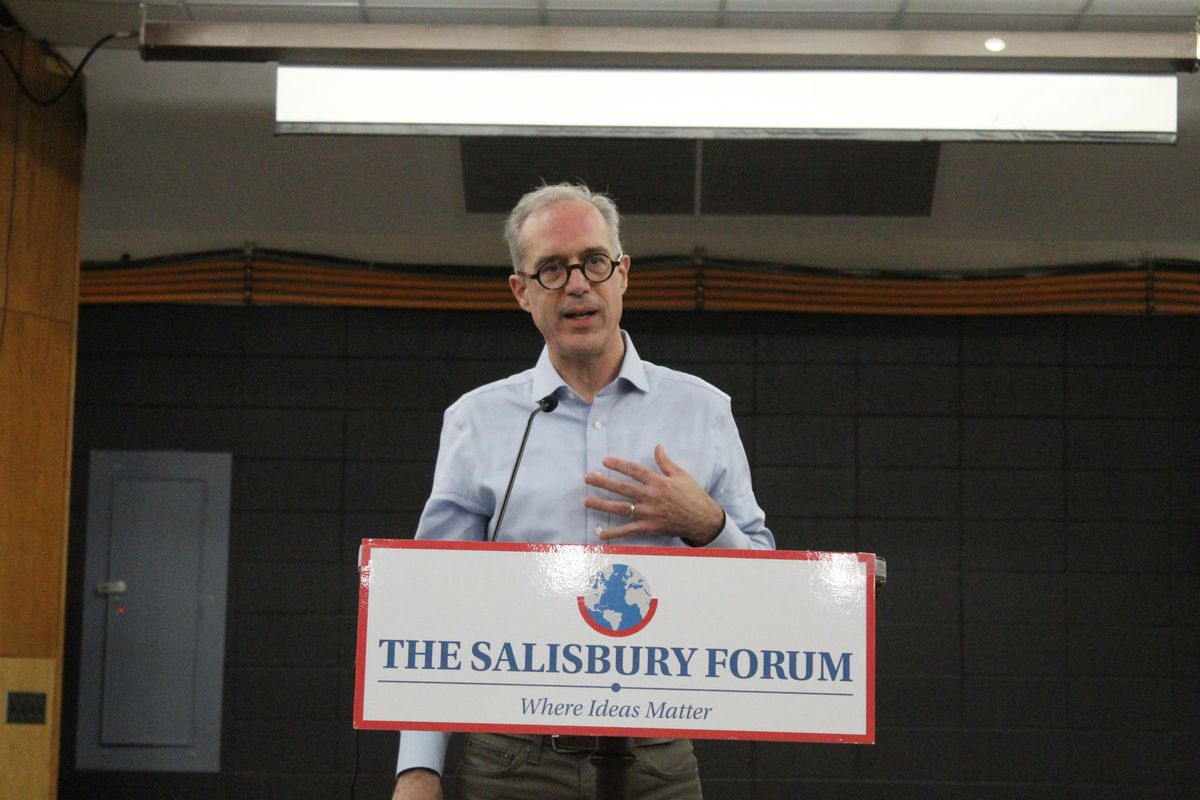
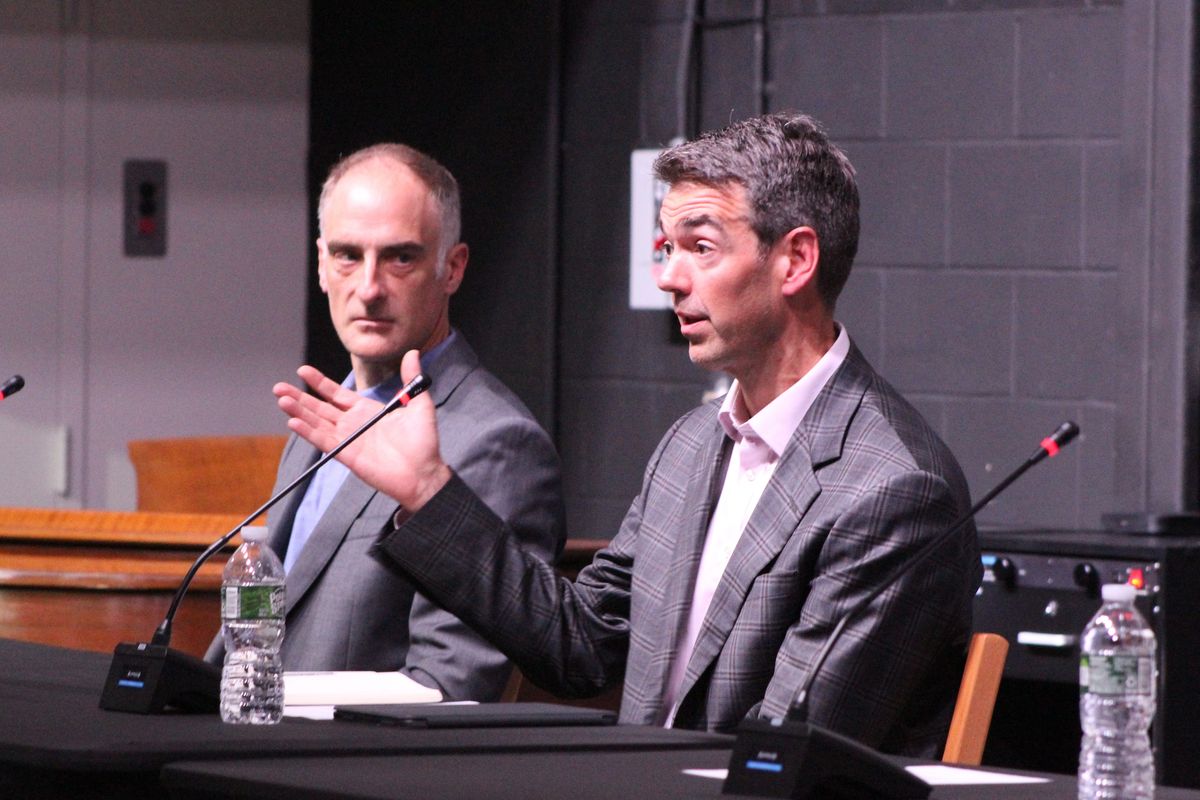
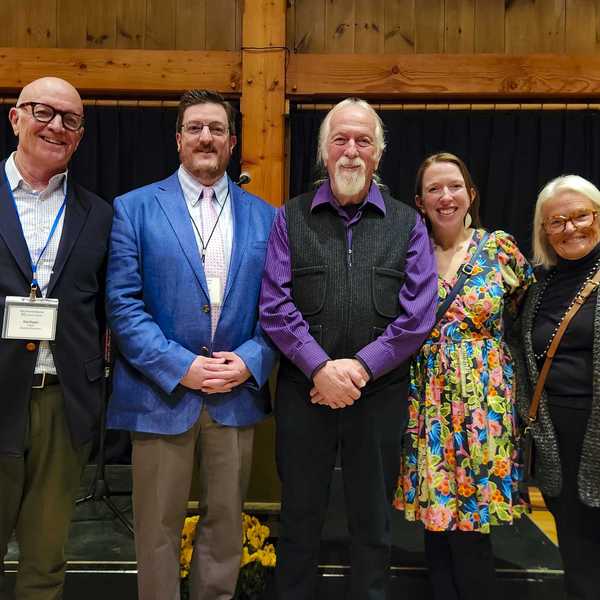
Historian Russell Shorto joins local educators Peter Vermilyea and Rhonan Mokriski for a conversation about Shorto’s “Revolution Song” on March 27 at the Salisbury Forum, marking Salisbury’s commemoration of the 250th anniversary of the Declaration of Independence. The event begins at 7:30 p.m. at Housatonic Valley Regional High School. Register at salisburyforum.org

Latest News
Dutchess County Flock cameras deactivated after public outcry
Graham Corrigan
Sep 29, 2026
More than 100 Dutchess County residents crowded into the community meeting room at Pleasant Valley Town Hall on Wednesday, Sept. 23, to voice their concerns over the county’s use of license plate reading surveillance cameras.
Photo by Nathan Miller
Flock cameras in Dutchess County will no longer capture license plates, and the cameras will come down in the next 30 days.
The news comes after Dutchess County District Attorney Anthony Parisi and Sheriff Kirk Imperati announced Thursday that they are withdrawing their support for the county’s continued use of Flock Safety license plate readers. The law enforcement officials made the announcement less than 48 hours after a packed public forum in Pleasant Valley, where residents overwhelmingly voiced their objections to the cameras.
“We listened to the questions that were asked and the concerns that were raised,” Parisi said in a statement. “After those discussions, we agreed that the appropriate response is to listen to our community and change course.”
Parisi said the cameras would immediately stop collecting data.
Dutchess County Executive Sue Serino backed their decision.
“If the District Attorney and the Sheriff no longer believe that Flock Safety technology is a tool that they need, I stand by them in that decision,” Serino said. “I commend them for being responsive to community concerns and being willing to change course.”
Last Wednesday’s forum was organized by County Legislator Eric Alexander, who represents Amenia, Washington and Pleasant Valley and serves as chairman of the legislature’s Public Safety Committee. More than 100 residents from across the county attended, standing along the town hall’s back walls and hallways to make their point. Once Alexander opened the floor for questions, a long line of residents quickly queued to the microphone. The youngest questioner was 8, and the oldest were in their 80s, but the message was unanimous: take down the cameras.
The concerns were wide-ranging: Privacy, Fourth Amendment rights, unlawful use of the gathered data, government overreach, misidentification, accountability, and cooperation with immigration enforcement were chief among them.
In their opening statements, the local officials emphasized the importance of transparency and dialogue in enacting good governance. “As Chair of the Public Safety Committee, I’ve heard a lot of concerns and frustration about this technology,” said Alexander. “That’s why we’re here, to get answers to your questions, and ensure your positions are reflected in what happens in Dutchess County.”
“Transparency is the cornerstone of public trust,” Parisi added. “And that’s how we tried to design and develop this project…our goal was for license plate reading technology in Dutchess County to be a community project.”
“Through my tenure at the Sheriff’s office, we’ve lived by the golden rule,” said Sheriff Imperati. “Treat others how you want to be treated…the most important thing to me is to protect your rights.”
The crowd often broke into spontaneous applause and shouts to emphasize their distrust of Flock and its cameras. North East Town Board member Meg Winkler called for towns to explore ways to prevent private citizens from hosting the cameras.
Aaron Baldwin, a Beacon resident, sparked a prolonged round of applause when he questioned Flock’s motives. “The idea that you can control a company whose main motive is profit is laughably naive,” he said. “If you don’t come out against these cameras,” he said, “we will come out against you in November.”
Pine Plains resident Jim Griffin offered free “Flock socks,” a 3D-printed slip on cover, for any interested party. Poughkeepsie’s Jamar Cummings, a local NAACP leader, questioned the camera’s disproportionate effect on non-white residents.
Beacon’s Joe Kruse pointed to the cameras as a pivotal moment for any and all local elected officials. “This isn’t a left versus right issue,” he said. “It’s our neighbors getting together and saying enough ... election signs are littering our yards asking for our support, but today we’re asking for your help and support.”
Several residents said opposition to Flock’s license plate readers has brought people together across the political spectrum and prompted an unusually strong response in local politics.
In northern Dutchess County, cameras in Millerton, Amenia, Pine Plains, and Milan were installed over the past year. The cameras were installed through private agreements with property owners, which allowed law enforcement to place cameras on private property rather than seek town officials’ approval to place the cameras on public property.
The county’s policy reversal will bring down cameras operated by both the District Attorney’s office and the Sheriff’s office that are installed on private and public property.
In response to their constituents’ concerns at the meeting, Parisi, Sheriff Imperati, and Alexander defended the cameras’ public safety utility. They insisted on a commitment to transparency, citing the county’s ARTCIC portal and individual case stories they said exemplified the cameras’ abilities to help solve crimes and unify multiple agencies under a single platform.
But two days later, county officials came to a new consensus. With their recent statement, law enforcement has taken the first step to dismantling the county’s Flock network. Parisi confirmed on Friday, Sept. 25, that the County has contacted Flock to terminate their existing contract with the company, and will turn the cameras off effective immediately. Physically dismantling the cameras will take place over the next 30 days.
“We asked people to come out, learn about this technology, ask hard questions and tell us what they thought,” Parisi said in the Friday announcement. “They did exactly that. We cannot ask the public to participate in the process and then disregard what they tell us.” Imperati, while reiterating that he still sees investigative value in the technology, said usefulness alone didn’t outweigh what residents had told the two of them directly.
“The District Attorney and I supported this technology because we believed it could help law enforcement protect people and investigate serious crimes,” Imperati said. “But we also heard the concerns residents raised about Flock technology…Public safety depends on public trust.”
Parisi and Imperati said they will now work with county officials to unwind the program, including addressing existing contractual and operational obligations tied to the Flock system.
Keep ReadingShow less
Motorcycle crash survivor fights through weeks of surgeries
Nathan Miller
Sep 29, 2026
Paris Perkins sits in his hospital bed at Westchester Medical Center, awaiting further surgeries.
Photo provided
MILLERTON — Nearly three weeks after a motorcycle crash cost him his left leg, Paris Perkins remains at Westchester Medical Center, facing more surgery and a long rehabilitation. But his father says the 22-year-old Millerton resident is already talking about running again.
Perkins was injured Sept. 10 in a collision with a delivery truck at Route 44 and Kennels Road in the Town of Washington. The collision threw Perkins into a roadside utility pole. His left leg was amputated below the knee, and he suffered fractures to his right leg and pelvis.
Despite the injuries, Perkins has remained in good spirits and even cracks jokes with the doctors and nurses that care for him, his father, Paul, said.
“Later on, he says ‘I was actually interested in losing some weight but this isn’t quite what I had in mind,’” Paul said as an example of Paris’ positive attitude following the crash.
Paris has undergone 10 surgeries at Westchester Medical Center to treat injuries to his right leg and other parts of his body, in addition to the loss of his left leg. Paul said the doctors discovered a fracture between two vertebrae in Paris’ back, restricting him to lying on his back while much of his body is wrapped in bandages and braces to immobilize him between surgeries and while bones set and heal.
Paris was expected to have at least one more surgery, bringing the total number of surgeries following the accident to 11 so far.
Despite the severity and extent of the injuries, Paul said his son’s outlook is positive and the family is confident that Paris will make a full recovery. Paul credits Paris’s physical conditioning for his resilience.
“He was in terrific shape — very strong muscles, very strong endurance, very strong heart,” Paul said.
The Perkins family takes physical fitness seriously. Paul, at the age of 76, is a powerlifting champion and espouses the benefits of regular exercise and clean dieting. He said Paris decided to follow suit, and has been an avid athlete since childhood.
As a high school student at Webutuck, Paris competed with the Track & Field team running in the 800 meter dash, the 1-mile dash and the 2-mile dash. Paul said his son won or came in second place in almost every race.
Another factor in Paris’s positive mental attitude was a recent visit from the husband of one of the Westchester nurses — a U.S. Marine veteran who also lost his leg in a motorcycle accident named Matt Brendan. Brendan visited Paris in the hospital to demonstrate how his prosthetic leg didn’t hold him back from staying physically active.
“Matt Brendan comes in and he starts dancing, he starts kickboxing,” Paul said. “He showed Paris pictures of him snorkeling and SCUBA diving, rock climbing — basically giving him the A1 pep talk about ‘you can do whatever you want.’ That just meant the world to him and to us, because we saw how these things can be overcome.”
The Perkins family is determined to get Paris walking and running again, with Paul framing it as a foregone decision that will now require hard work and determination. “He wants to walk — not only walk, he wants to run again,” Paul said. The family is hoping that Paris will qualify for an athletic prosthetic under their insurance plan so he can still follow his passion for running.
Paris has lived in Millerton since he was about 8 years old, when his parents moved their family from Barra de Lagoa in Brazil in 2012. He began attending classes at Webutuck, where he remained a student until graduation from Webutuck High School in 2022.
Paul said the community response to Paris’ accident has been astounding. Paris’ sister, Tiffany, started a GoFundMe campaign that has raised nearly $60,000 in donations in just under three weeks.
The GoFundMe campaign remains open and accepting donations. The campaign has a total goal of $120,000 intended to assist with covering the cost of surgeries, hospital stay, rehab and prosthetics.
Between the support from community members and Paris’ high spirits, Paul is confident in his son’s recovery. He spoke highly of his son last weekend as the family spent their fifteenth night at the hospital.
“He’s so polite and so kind and so loving,” Paul said. “He’s a special guy.”
Keep ReadingShow less
At home
Millerton News
Sep 29, 2026
The Webutuck Wildcats hosted Rondout at Webutuck High School for a sunny matchup on Wednesday, Sept. 23. The Wildcats won out over Rondout 2-1 after scoring a goal in overtime. The win at home on Wednesday brings Webutuck’s season record to 2-4 so far this season.
Photo by Joe Bartlett
The Webutuck Wildcats hosted Rondout at Webutuck High School for a sunny matchup on Wednesday, Sept. 23. The Wildcats won out over Rondout 2-1 after scoring a goal in overtime. The win at home on Wednesday brings Webutuck’s season record to 2-4 so far this season.

Want more of our stories on Google? Click here to make us a Preferred Source.

State bill aims to curtail Flock cameras
Graham Corrigan
Sep 29, 2026
As county-operated license plate readers are set to come down across northeast Dutchess County, a state senator has introduced legislation to put the first statewide limits on how the technology is used.
State Sen. Michelle Hinchey announced the bill last Tuesday, Sept. 22. It would regulate automatic license plate readers, or ALPRs, including those made by Flock Safety, the company behind the cameras that have been installed in Millerton, Amenia, Pine Plains and Milan.
Under current New York law, there are no limits on who can access ALPR data, how it is stored and shared, or how long it is kept. “Our bill would be the first to do that in New York,” Hinchey said in a statement.
The bill would require ALPR data to be deleted within 48 hours unless it is used as evidence or held under a warrant. It would ban the sale of the data to private entities and bar agencies from building databases to be kept for future use. Out-of-state law enforcement would need judicial authorization to access New York data.
Agencies would have to keep auditable logs of who searches the data and publish annual reports listing camera locations and the number of plates captured. People harmed by unlawful use could sue for damages and attorney’s fees. Such unlawful use has been regularly reported, Hinchey noted. “As ALPRs proliferate, too often over the objections of local residents, reports of bad actors using this technology to stalk and spy on innocent people — often crimes against women — are becoming more frequent,” she said.
Law enforcement could still use the cameras to investigate felonies, find missing persons and stolen vehicles, and enforce traffic and parking laws.
The legislation is backed by the New York Civil Liberties Union, the Legal Aid Society, the Institute for Justice and the Surveillance Technology Oversight Project, among others. Daniel Schwarz of the NYCLU called the current situation “dangerous.” Corinne Worthington of the Surveillance Technology Oversight Project noted that communities across the country, including Millbrook, Pine Plains, and Windsor, have cancelled their Flock contracts.
The bill arrives amid a year of debate over automatic license plate readers. In February, revelations that Pine Plains police had entered a preliminary contract with Flock prompted an emergency meeting and the contract’s eventual cancellation.
In July, landowners near Millerton said the cameras had been installed on their property with little notice. Julie Schroeder of Silamar Farm said she had agreed to a camera two years earlier, only to find it placed roadside, in the way of her farm machinery. Reporting at the time counted at least four Flock cameras in northeast Dutchess, one of them on Route 343 east of Amenia.
Another property owner in Pine Plains, who had initially agreed to a Flock camera, has asked for its removal.
At a September town hall in Amenia, Dutchess County Deputy Steve Reverri said Flock cameras were operational in every town in the county.
The debate took center stage this week at a public forum in Pleasant Valley. Dutchess County District Attorney Anthony Parisi and Sheriff Kirk Imperati discussed the cameras at Pleasant Valley Town Hall, hosted by County Legislator Eric Alexander. Parisi has pointed to the county’s online portal, which lists camera locations and arrests tied to the system, as evidence of accountability. Residents’ concerns about privacy and constitutional protections, however, dominated the discussion.
Two days after the public forum, D.A. Parisi and Sheriff Imperati announced they were withdrawing their support for the cameras in the region, though details on if and how the cameras will be removed from the information pipeline have yet to be determined.
Hinchey’s bill has not yet been assigned a hearing date. The Legislature returns to Albany in January.
Keep ReadingShow less
Stanfordville local uses 3D printers to block Flock cameras
Nathan Miller
Sep 29, 2026
STANFORDVILLE — Jim Griffin was among dozens of Dutchess County residents who stood up in opposition to local law enforcement’s adoption of license plate reading cameras at a community forum in Pleasant Valley on Wednesday, Sept. 23.
But rather than simply voicing his disapproval of the technology, Griffin had something to offer to county residents in the room — a chance to take matters into their own hands. Griffin, using his collection of 3D printers and a penchant for hacking, which he said dates back to the early ‘90s, is manufacturing plastic covers that he said disables the cameras without damaging them.
Griffin was inspired by the increased use of license plate readers manufactured by Flock Safety, an Austin, Texas, based company that produces the cameras and provides software that police use to identify and track persons of interest. Opponents of the cameras nationwide have taken to cutting down the cameras — an act that has been met with criminal charges.
Griffin acknowledged using the plastic covers would still likely lead to criminal charges, but hoped they would be lesser than if opponents damaged the cameras.
“Doing civil disobedience — which is an American tradition — always comes with a consequence,” Griffin said. “I think if we can make those consequences as small as possible for people, the better off we are.”
Griffin’s concern over the technology grew in February when Pine Plains residents and the Town Board members discovered police department officials had entered into an agreement with Flock Safety without involving the Town Board. He initially set out to design his own cover for the cameras, but eventually discovered the “Flock Sock” design online on a site where makers share designs with others.
The Flock Sock is a plastic sleeve that slides over top of Flock cameras. The devices block the camera’s view but cause no damage to the device or the pole it’s installed on. Griffin said he thought the coverings were a perfect solution, allowing concerned citizens a physical manifestation of their opposition to the cameras that doesn’t carry the same risk of criminal prosecution.
“My intent was protection of the government investment from vandalism,” Griffin said wryly. “We want to protect this investment so that when it’s returned, it’s returned at full value.”
Griffin, a 50-year-old network architect, said his opposition to license plate reading cameras is rooted in values he’s had since he was a high schooler. He framed the technology, which has become widespread across the United States in recent years, as a mass surveillance network that grants police unprecedented access to information about citizens’ movements without a warrant.
He said he has been voicing his concerns about the technology to local leaders for months, and he was glad to see the swell of opposition in Dutchess County. When Dutchess County District Attorney Anthony Parisi and Sheriff Kirk Imperati announced just two days later that the cameras were coming down, Griffin was pleasantly surprised.
Griffin urged county residents to remain vigilant in opposition to the cameras, acknowledging that county officials’ decision to terminate Dutchess’s Flock camera program does not restrict local municipalities from forming independent agreements with the company. He said he will still make Flock Socks for concerned citizens who would like some.
Keep ReadingShow less
Habitat for Humanity plans first build in Amenia
Graham Corrigan
Sep 29, 2026
Habitat Dutchess CEO Eelco Kessels, left, COO Jen Radicone, center, and Construction Director Todd Bowen III visit the site of a planned affordable home in Amenia on Tuesday, Sept. 22. Prospective homebuyers will soon be allowed to apply to purchase and live in the planned home.
Photo by Graham Corrigan
AMENIA — Habitat for Humanity plans to begin construction of a home on Depot Hill Road in October and open applications for prospective buyers in December.
The structure, which will be located near the Harlem Valley Rail Trail parking lot in Amenia, is part of a $1.2 million round of federal housing and community development grants announced earlier this year by Dutchess County Executive Sue Serino.
At a site visit last week, Habitat for Humanity of Dutchess County CEO Eelco Kessels was joined by COO Jen Radicone and Construction Director Todd Bowen III. The land has been cleared of trees, and groundbreaking is set to begin in October.
“The plan was always to build a home that fits in with the other homes here,” said Kessels. “We want to make sure that this becomes a place where a family is going to thrive, affordably, for the next 30-plus years.”
The 3-bedroom, 2-bath home will be a modular home.
“It exceeds New York State energy codes,” added Bowen, the construction director. “And we’ll be looking for volunteers when springtime comes around.”
In December, the home will be delivered in 4 boxes. Applications for ownership will open that same month, and remain open until February. Porches, landscaping, and the driveway will be added in March, and the owners will — tentatively — be able to close in May.
Kessels said the home’s price will fall in line with Amenia’s workforce housing regulations. Applicants must have an income between 60% and 80% of the area’s median and housing costs will not exceed 30% of the chosen family’s annual income, he said.
Habitat will host information sessions about this particular property in October and November. Additionally, prospective homeowners have the ability to participate in Habitat for Humanity’s Homebuying University, which runs from September to December. A Spanish language version of the course is available in January and February.
“Affordability isn’t just helping folks acquire a home, it’s helping them stay in a home,” said Kessels. “We have one of the older housing stocks in New York state, so we’re not just dealing with a shortage of new construction, but also a lot of homes in need of critical maintenance and repairs.”
While this Habitat branch has largely focused on Poughkeepsie in the past, there are plans to expand into Dutchess County’s eastern edge. Kessels says the organization is in talks to purchase properties that could accommodate as many as six houses in Millerton. It’s still early days, but one thing is certain: the area’s need for affordable housing has reached critical levels.
“We’ve really found a community here that is seeing their nurses, teachers, and shop workers get priced out,” said Kessels. “But we’re investing in home ownership, and in individual families that are going to be in the community for a long time.”
The Depot Hill home is one of 14 projects funded through the county’s 2026 Community Development Block Grant (CDBG) and HOME programs. Both are funded by the U.S. Department of Housing and Urban Development. County Executive Sue Serino said the awards “help people right here in Dutchess County, supporting our neighbors who need extra help,” and cited expanded affordable housing for families as one goal.
Habitat for Humanity of Dutchess County, founded in 1986, focuses on first-time homeownership. The organization builds for families earning 60-80% of the area median income for low-interest mortgages.
Elsewhere in the county, the funding will pay for sidewalk replacement near a Beacon elementary school, ADA improvements at Pawling Village Hall, and infrastructure for a five-lot housing subdivision in Poughkeepsie.
Keep ReadingShow less

Want more of our stories on Google? Click here to make us a Preferred Source.
loading