Opera project draws inspiration from Amenia’s wetlands

Amenia residents discuss the ecology of the town’s bogs and fens during a Conservation Advisory Council meeting Wednesday, Aug. 19.
Photo by Leila Hawken


Amenia residents discuss the ecology of the town’s bogs and fens during a Conservation Advisory Council meeting Wednesday, Aug. 19.
AMENIA — Local bogs and fens have quietly supported the town’s environment for thousands of years, storing carbon, absorbing water and preserving records of ecological change. But these fragile wetlands can be damaged quickly.
Christy Gast and other members of Opera Turbia joined the Amenia Conservation Advisory Council for a public meeting Wednesday, Aug. 19, as part of the group’s research for an opera about U.S. wetlands.
The three-act work will premiere at the Massachusetts Museum of Contemporary Art, known as MASS MoCA, in North Adams, Massachusetts, on Saturday, March 20, 2027. It will be presented as part of an exhibition titled “Until We Get to the Core.”
Opera Turbia is co-directed by Camila Marambio and Ariel Bustamante, with collaborators Gast, Rosario Ureta and Antonia Peón-Veiga. The group’s research has taken its members to peatlands and bogs in Puerto Rico, Tierra del Fuego, the Berkshires and, most recently, Amenia.
The session began with a presentation by ecologist Terryanne Maenza-Gmelch, who explained how bogs and fens formed after glaciers retreated at the end of the Ice Age. Over time, pollen, sphagnum moss and other organic material accumulated in the wetlands, eventually forming peat. Core samples can provide a record of those environmental changes.
Much of the discussion focused on the difference between bogs and fens, both of which can be found in Amenia.
Bogs generally receive most of their water from precipitation, while fens are fed by groundwater or surface water. Both can accumulate peat, store carbon and help regulate water. Fens can also act like sponges, holding water and reducing flooding.
The group discussed Amenia’s ecological history, the environmental value of its wetlands and ways to conserve those resources.
Participants also considered alternatives to peat-based gardening products.
“We’re surrounded by wetlands,” Gast observed.
Resident Vicki Doyle noted that the wetlands south of Freshtown Plaza play an important role in absorbing stormwater runoff.
“It takes thousands of years to create [a bog], but it can be destroyed in a day,” said one resident.
After taking notes on words and phrases shared during the discussion, Natalia Zukerman led a collaborative songwriting workshop. Participants’ observations, memories and ideas became the basis of a song recorded by Opera Turbia that may be incorporated into a chorus at the MASS MoCA installation.
The Arts Mid-Hudson project is supported by the Statewide Community Regrants Program, a regrant program of the New York State Council on the Arts, with support from the governor’s office and the New York State Legislature.
For more info, contact cgast@ameniany.gov.

Leila Hawken
AMENIA — The Town Board voted unanimously at its regular meeting Thursday, Aug. 20, to schedule a public hearing on a proposed law prohibiting smoking and vaping on all town-owned property.
The hearing will be held Thursday, Sept. 17, at 7 p.m. at Town Hall.
The proposed law would prohibit smoking or vaping tobacco — as well as cannabis products — in town-owned parks and other public recreational areas. The ban would apply to Town Hall and its surrounding grounds and parking lots, the basketball court, Beekman Park, Fountain Square, the Mygatt, Leedsville and Bangall-Amenia Road cemeteries, and the town highway garage and salt shed.
If enacted, the law would impose a $50 fine for a first violation and fines ranging from $200 to $500 for subsequent violations.
In other business, the board unanimously adopted a state-mandated 2026 Emergency Operations Plan outlining procedures for responding to and recovering from a local disaster.
Affordability fair
Dutchess County Legislator Eric Alexander, who represents Amenia, attended the meeting to provide an update on county matters and announce the Amenia Affordability Fair, scheduled for Thursday, Sept. 17, from 5 to 7 p.m. at Town Hall.
Representatives from county and local organizations will provide residents with information and assistance related to household expenses, tax relief, senior and veterans services, low-cost veterinary care, free hot meals and other resources.
Animal control
Animal Control Officer Kenneth Wallace reported on a proposed collaboration between Amenia and Dover aimed at improving animal control services. Wallace also serves on the county’s Animal Welfare Stewardship Committee.
“My hope is to make an alliance between Amenia and Dover an example to serve as a model for other Dutchess County communities,” Wallace said.
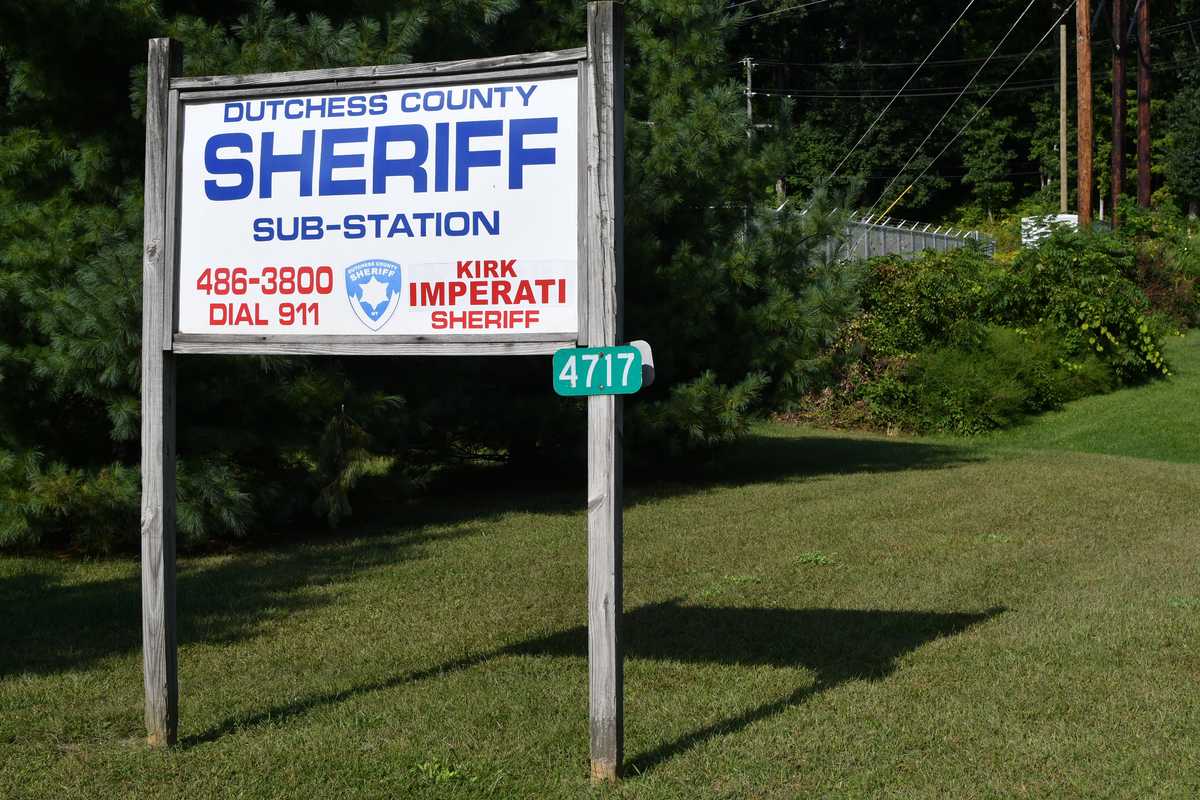
Wallace said local animal control officers lack enforcement authority and currently work through the Dutchess County Sheriff’s Office.
“We can only pick up and drop off animals,” he said. Officers may respond to complaints but cannot investigate or collect evidence of animal abuse. Such investigations also require veterinary services, which Wallace said the two towns could provide cooperatively.
Board members also discussed whether local constables could assist with animal control enforcement.
Leila Hawken
Describing best practices in organizing a lifetime of photos and documents, resident Margaret Cornell led a program on Archiving Family Records at The Fountains on Monday, Aug. 17. Following the talk, Cornell, left, showed a scrapbook sample to Fountains resident Susan Haber.
MILLBROOK — Residents of assisted living facility The Fountains received an education in archiving personal records on Monday, Aug. 17.
Archivist Margaret Cornell, a resident at The Fountains of Millbrook, presented a program to assist fellow residents with the task of sifting through accumulated items, discarding what is irrelevant, and documenting what should be kept. An audience of 17 residents gathered.
Common to the experience of many is the accumulation of a lifetime of papers and photographs stored in boxes awaiting organization. Without that organization, the family memories contained in those boxes could dim and be lost.
Purposefully archiving those materials can be the answer to keeping those stories intact.
“What is archiving?” Cornell asked at the outset.
“Archiving is the care and putting in order many types of records so that they can be preserved and researched to capture the timeline of a family,” Cornell explained.
“It can be daunting,” she said of the work that can include photos, letters, diplomas, diaries, yearbooks, scrapbooks, family records, newspaper clippings, clothing, quilts, and more.
When sorting photographs, for example, concentrate on the person represented and sort by the person, being careful to fully identify persons and the location in the photo. Write on the reverse of the photo with a pencil, not with ink.
Remove letters from their envelopes and attach the envelope with a plastic clip, not metal.
For preservation, obtain acid-free paper and acid-free boxes. If looking to preserve newspaper clippings, less essential in the digital age, but perhaps desirable to preserve family obituaries, it is best to copy the obituary onto acid-free paper.
To examine an individual document, it is best not to lay it on a table where exhaled breath would damage the paper with moisture. Instead hold it vertically.
Be sure to refold quilts and larger fabrics at least twice each year and store them in acid-free boxes, Cornell said.
The question period was active and lively, exchanging ideas for curating photos, and flattening curled photos, with tips on decisions about what to keep and what to discard.
“Never do something you cannot undo,” cautioned Cornell, recommending archival glue for scrapbooking, allowing the document to be moved without damage to the document.
Cornell concluded the session by offering to help any resident with the task of archiving their collections of boxes of stuff.
Nathan Miller
DOVER PLAINS — Planning Board Chair Ryan Courtien has resigned, two weeks after his disappearance triggered a multiday search involving police, firefighters, K-9 teams, drones, and helicopters from across New York and Connecticut.
The Town Board accepted Courtien’s resignation at its July 27 meeting. That night, it also appointed two new Planning Board members, filling Courtien’s seat and another that had been vacant for several months.
Courtien disappeared from his home on July 12 and remained missing for nearly a week. Authorities ended the search after determining that he had boarded a train to Manhattan shortly after his disappearance.
Courtien was located by Dutchess County sheriff’s deputies at the Harlem Valley-Wingdale train station on Friday, July 17.
Town Supervisor Rich Yeno said he has had sporadic contact with Courtien and his family in the weeks following his disappearance.
“I know they’re going through some things,” Yeno said. “That’s about it.”
He said the Town Board received a letter before its July meeting from Courtien’s wife, Suzanne Calligan-Courtien, asking the board to accept Courtien’s resignation from the Planning Board and the chair position.
Calligan-Courtien sent the letter on Thursday, July 23. She cited “sudden, unexpected medical complications” as the cause for her husband’s resignation but did not provide further details in the letter.
The town’s Planning Board did not meet this month due to a lack of permit applications. Yeno said interim chair Valerie LaRobardier handled behind-the-scenes work through the month, and the board will return with a full slate and a designated chair when meetings resume in September.
Dick Hermans, founder of the Harlem Valley Rail Trail Association and a current board member, said Courtien had been removed from his position as operations manager for the trail earlier this month. He did not provide further details. Harlem Valley Rail Trail Association President Phil Meeks could not be reached for comment.
Courtien has not responded to requests for comment on his disappearance or his resignation from the Planning Board.

Want more of our stories on Google? Click here to make us a Preferred Source.
Millerton News
As summer comes to a close and students head back to school, the new season brings a chance to reflect on what we’ve learned along the way. Whether it came from a summer adventure, a new experience, a challenge or simply spending time in the community, we want to hear what lessons people are carrying with them into the fall.
What’s one thing you learned this summer—big or small—that you’ll take with you into the fall?
Send your responses to social@lakevillejournal.com by Monday, Aug. 31 at 10 a.m. or comment on Facebook or Instagram.
We’ll publish a selection in next week’s paper.
Bill Schmick
The U.S. and Mexico are the only countries out of 19 other OECD countries where a substantial portion of the population lacks any form of health insurance. In the U.S., about 8% of the population, or 27 million people, are uninsured. That number is about to grow larger.
That data is part of an independent research study conducted by The Commonwealth Fund, a private foundation. And that is despite the U.S. has spent more on health care than any other nation. In 2024, we spent 18% of gross domestic product on health care. That is nearly two times as much as the average OECD country.
Over a year ago, the Republican led U.S. Congress cut health care spending by cutting public subsidies for private health care insurance which caused millions to lose healthcare coverage. While on paper the savings seemed justifiable, in reality the cuts have just shifted the burden of paying for the uninsured patient to the hospitals, and ultimately, the taxpayer.
Before you ask, the Emergency Medical Treatment and Labor Act mandates that hospitals provide treatment to patients with emergency medical conditions, regardless of their insurance status or ability to pay. This federal law was enacted in 1986 to prevent patient dumping, where hospitals would refuse treatment to individuals based on their inability to pay or lack of insurance. This places hospitals and other health care clinics in harm’s way.
This is not some dire predicament that may happen in the years to come. Some for-profit hospitals are already reporting a 20% increase in uninsured visits, and one company is expecting as much as $1 billion less in profits for this year. And the administration is only getting started.
As part of the “Big Beautiful Bill,” the administration and Congress are cutting an additional $625 billion in Medicaid over 10 years. The CBO estimates another 7.8 million people will become uninsured as a direct result of these changes. That would bring the total number of newly uninsured Americans to almost 17 million.
And the trend is not your friend. Baby Boomers of all income levels are retiring and will need increasing health care regardless of their ability to pay. If you look at the demographics, those most impacted by these changes are low-income adults in Medicaid expansion states. Young adults (ages 19-34) will be hurt as well. To put that in perspective, that’s 3 in 10 Gen Zers who are vulnerable according to the Urban Institute. People with disabilities who do not qualify for federal disability benefits (2.6 million), and rural residents, where it is estimated that $155 billion in reductions of Medicaid spending will occur.
In 2025, the federal, state, and local governments collectively spent $30.6 billion to cover the medical costs of uninsured patients, according to recent government studies. The total cost to taxpayers is higher when you consider uncompensated care costs. Each newly uninsured person can generate as much as $900 in lost revenues for hospitals, two-thirds of which translates into loss profits. Uninsured patients frequently pay 2 to 5 times more for care than insured patients. And that was before the ACA reductions and the expected cuts in Medicaid coverage.
In this era of populism, where the GOP majority is already razor-thin, some might think that this kind of legislation is tantamount to political suicide. It would be, but politicians are a crafty lot. Most of the cuts in Medicaid will only become law after the midterm elections this year. In which case some of the base that Republicans depend upon the most to deliver a majority in Congress in November won’t realize the devastation to their well-being until it is too late. I won’t mention the potential loss of life involved since some might accuse me of valuing human life more than money.
Hospitals and emergency rooms will continue to absorb rising uncompensated care from a combination of state-directed payment cuts, much higher charity care, reduced Medicaid/ACA funding, and limited stopgap state programs. Some will attempt to pass on those higher costs to you via increased premiums on your own health care. Others will need to apply to the government to bail them out. In which case, you, the taxpayer, will pay for those bailouts as well.
Our health care system is a wreck. The U.S. has one of the lowest rates of physician graduates and the lowest rate of primary care physicians per 1,000 people. Americans also have one of the highest rates of dying prematurely where men are more likely to die from avoidable causes than women.
The U.S., on average, has the poorest health outcomes of any high-income country, according to The Commonwealth Fund. The May 28, 2026, paper “U.S. Health Care from a Global Perspective, 2026” argued that a “Lack of universal coverage, weak primary care infrastructure, high out-of-pocket costs, and a complex insurance system contribute to and exacerbate the nation’s uniquely poor performance relative to its peers.” I couldn’t have said it better.
Bill Schmick is a founding partner of Onota Partners, Inc., in the Berkshires. Bill’s forecasts and opinions are purely his own and do not necessarily represent the views of Onota Partners Inc. None of his commentary is or should be considered investment advice.

Want more of our stories on Google? Click here to make us a Preferred Source.

Want more of our stories on Google? Click here to make us a Preferred Source.