Latest News
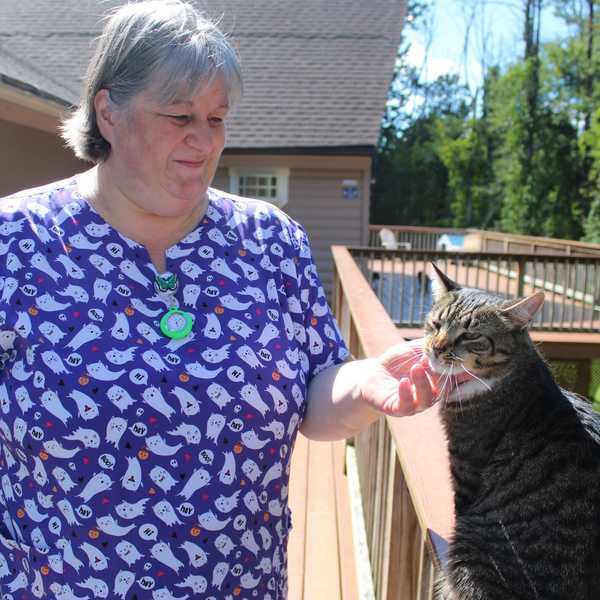
Max Amsterdam reaches out to pet a red panda at the Trevor-Lovejoy Zoo on Millbrook School’s campus on Wednesday, Dec. 17. Amsterdam is a senior at Millbrook School and serves as the zoo’s head student curator.
Photo by Aly Morrissey
MILLBROOK — The Trevor-Lovejoy Zoo announced this month that it has received a $5 million donation — the largest in the organization’s history and made anonymously — that will primarily fund a state-of-the-art animal hospital, a key feature of the zoo’s current master plan for expansion. The zoo, which is located at the Millbrook School, currently houses 180 exotic animals from all over the world.
“It’s very exciting,” said Nancy Stahl, who oversees fundraising for the zoo. “This gift is going to enhance everything we already do and enable us to increase opportunities for science, our community and support the well-being of our animals.”
Stahl said the zoo has been engaged in a long-range master planning process for several years as part of preparing for its next Association of Zoos and Aquariums accreditation review in 2027. “We knew we had to make a plan and look toward the future,” Stahl said. “We had to think about what more we could be doing for the animals, for students and for the community.”
Construction is nearing completion on a new animal holding barn, the first step toward housing off-exhibit animals. Funded by philanthropist Barbara Tober — whom Stahl described as the project’s “catalyst” — the facility is required under AZA accreditation standards. The holding barn will serve as a first stop for new animals required to quarantine before entering an exhibit. It will also safely house animals when enclosures are being repaired or when they need rehabilitation.
The new animal hospital, which zoo staff are referring to as an animal wellness center, is poised to be four times larger than the existing space. Stahl said the team is looking forward to dramatically expanding the zoo’s ability to treat animals on campus, eliminating the need to transport them off-site for procedures like X-rays or ultrasounds.

Stahl said a primary goal of the master plan and the animal wellness center is to “bring the outside in.” The public will be allowed to watch certain procedures and operations to learn more about the veterinary work that goes on behind the scenes.
In addition to the zoo’s around-the-clock staff, rotating veterinarians visit the zoo each week to check on the animals and perform routine procedures. The current space is limited, and zoo staff are eager to have an expanded footprint.
“Right now we’re very limited space-wise,” Stahl said. “This new facility will let us have more space, more vets and more learning happening.”
Max Amsterdam has lived at the Millbrook School as a boarding student for four years and has held a working role at the zoo throughout that time. Today, in his senior year, he serves as the zoo’s head student curator — a coveted leadership role that requires a formal application and selection process.
When Amsterdam first applied to Millbrook School, the zoo was not front-of-mind. Although he wanted to become a veterinarian as a young child, the desire dissipated until he set foot in the Trevor-Lovejoy Zoo as a freshman.
“I watched a senior perform a biopsy on a red wolf that had passed away from a uterine tumor,” Amsterdam said. “I didn’t even know that students could do that. I realized right then how incredible this place was and the zoo became my thing.”
Over his four years at Millbrook, Amsterdam has assisted veterinarians, shadowed medical procedures, conducted necropsies and even traveled with staff to national AZA conferences. “As you grow, you gain a relationship with the staff and vets, and when they know you can handle it, they let you do more,” he said.
With graduation on the horizon and plans to study biology at Bucknell, Amsterdam admits he’s a little jealous of the future students that will benefit from the new zoo facilities.
At the end of the day, he is grateful for the hands-on experience he has received in his leadership roles at the zoo. Millbrook School is the only high school in the country with an AZA-accredited zoo on its campus.
“I’m jealous, but I’m also so grateful that the zoo got that donation because it’s needed,” Amsterdam smiled. “We deserve it, too. It’s a lot of hard work by the staff and students — it’s 200% effort seven days a week, and not many people see that.”
Keep ReadingShow less
Erich McEnroe standing in front of McEnroe Farms’ organic composting piles on the farm’s grounds at 194 Coleman Station Road in the Town of North East.
Photo by Aly Morrissey
MILLERTON — Farming has been in Erich McEnroe’s family for generations, dating back to a time when his great-grandfather could buy and sell land at the local tavern. Though Erich never met him, he and his four brothers grew up on stories of his grit, like how he got his start hauling iron ore with horses and carts and later bought farmland for his three sons.
The McEnroe family began dairy farming in 1953 — a chapter Erich still looks back on fondly — which lasted four decades until they transitioned to cattle and organic farming. Today, McEnroe’s is certified with the Northeast Organic Farming Association (NOFA) in the state of New York, which requires the farm to comply with stringent federal standards related to soil quality and the humane treatment of animals, to name a few. With more than 1,200 acres of fields, pastures and greenhouses, McEnroe’s is one of the state’s oldest and most diverse certified organic farms and, today, produces premium soil and compost blends, as well as produce and livestock.
Despite a difficult period marked by the passing of Erich’s father, Ray, and the closing of the farm market on Route 44 near Coleman Station Road, McEnroe’s is poised to enter a new era, bolstered by a renewed sense of optimism and a recent $335,000 grant awarded by the New York Business Food Waste Mitigation Program. The grant will fund a new screener, a sifting machine that separates plastic, metals or other objects from organic matter. Erich said the machine will enhance composting operations and allow the farm to take in more food waste from across the region.
“It was definitely a year of change,” Erich said. “But I’m optimistic. Sometimes when you think something is bad at the moment, you take a step back and realize it might be the best thing.”
A childhood shaped by dairy farming
Erich grew up as a dairy farmer. His earliest responsibilities were feeding calves, hauling milk pails up the hill after school and traveling to fairs to show Holsteins with his father.
“Dairy farming is the most addictive thing when you’re in it,” Erich said. “You have to milk the cows twice a day and you’re always trying to progress on your genetics and production and facility. It’s really intense work — seven days a week.”
When his father decided to sell the cows in 1994, it was heartbreaking for the boys, but ultimately transformative. “We were in tears, but my dad said, ‘Someday you’ll thank me.’ And I do,” Erich reflected.
Pioneers in composting
Today, McEnroe’s Organic Farm has a DEC permit allowing it to recycle up to 55,000 cubic yards of organic material each year, including 15,000 yards of food waste. But getting there wasn’t easy.
“In the ‘90s, we were often in the Millerton News headlines,” Erich said with a laugh. “There was a group of neighbors who didn’t want to see the compost put in.” He said concerns ranged from fears of a smell to truck traffic.
Over time, as the environmental and agricultural benefits became clear, attitudes toward composting shifted. “This is now a highly important regional site from an environmental aspect,” Erich said.
The farm accepts food scraps from transfer stations in Queens and Brooklyn, along with leaves from Westchester County, horse bedding, and manure from its own livestock. Local residents can also donate their personal food waste. The farm receives an estimated 50 to 70 tons of food waste each week.
Those scraps are composted and blended into potting and field mixes using “recipes that haven’t changed much in 40 years,” Erich said. The technology, however, has.
In 2015, McEnroe’s switched to a covered windrow system that allowed the farm to go “more vertical” with compost piles. Sheets cover the long rows of composting matter, providing structure to the piles that allow for taller stacking.
The latest upgrade, funded partly by the state grant, is a German-built screener Erich calls “a game changer.” It uses vacuums to remove plastic such as produce stickers and features magnets to pull out metal.
The farm currently produces around 8,000 yards of compost annually but is permitted for nearly double that. “The more product we can screen, the more we can bring in, which is good for everyone,” Erich said.
A working classroom for organic practices
McEnroe’s also functions as a working classroom. An educational arm of the business was created in 2007 to inspire the next generation of organic farmers and inform the public. It includes an apprenticeship program, offering annual placements in vegetables, livestock and compost.
Olivia Skeen, who oversees the farm’s educational programs, said apprentices are exposed to all areas of farm operations. “All of our practices are integral and related — manure from the livestock comes up to compost and becomes soil. Any waste from vegetables goes into the soil. And the soil goes back into vegetables and into the livestock crops.”
Over the years, the program has drawn close to 100 apprentices from across the country and beyond. The farm also hosts frequent tours, from elementary school groups to Cornell University’s waste management program, which is partnering with McEnroe’s on several studies, including peat moss alternatives and greenhouse production.
Looking ahead
Despite the closure of the farm market, both Erich and Skeen emphasized that McEnroe’s remains very much in operation. “We’re looking to get the market open again,” Erich said. “Compost and cattle and our land base are our big driving forces.”
For Erich, there’s no real separation between work and life.
“I don’t know what life is without the farm, really,” he said. “It’s seven days a week and it’s just … it’s not even work. It’s life.”
Keep ReadingShow less
Photo by Leila Hawken
The Upstate Celtic Allstars brought holiday cheer at their third annual concert at the Amenia Town Hall on Saturday, Dec. 20. The five-member ensemble included, left to right, Ambrose Verdibello, fiddle; Isa Simon, fiddle and vocals; Claudine Langille, vocals and banjo; Joseph Sobol, citern; and Dave Paton, concertina and dulcimer.
loading