Collaborations and communication in Millerton’s art scene: Brigitta Varadi at Geary Contemporary

Collaborations and communication in Millerton’s  art scene: Brigitta Varadi at Geary Contemporary
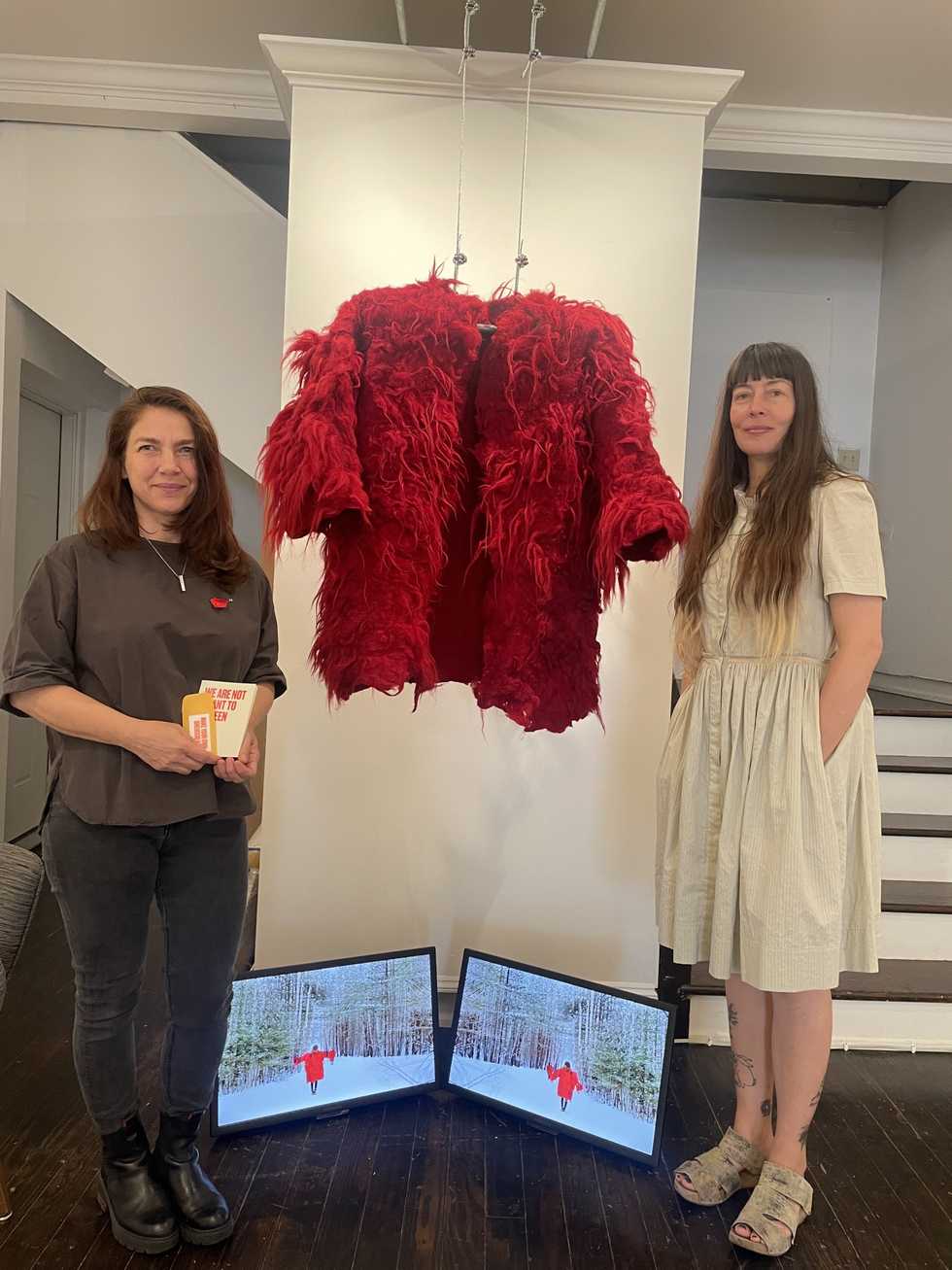
Artist Brigitta Varadi, left, and Geary Contemporary gallery associate Tara Foley bracket Varadi’s video/felted wool installation on the last day of Geary’s current show.  Varadi holds limited edition booklets and kits and wears an exemplar of talismans created by women in the hill country in Italy during a recent residency there. 
Photo by Deborah Maier

MILLERTON —  “I felt an instant buzzing throughout my whole brain and body,” said artist Brigitta Varadi of the moment at age 16 when she first experienced the process of felting wool. This kind of visceral knowledge, coupled with a lot of intellectual and clerical footwork, are the hallmarks of the multidisciplinary art of Varadi, whose video/sculpture installation piece was in the back room of Geary Contemporary’s mid-June to late July show, “Who Is To Say I’m Awake; Are You?”

Varadi (accent on the first syllable), whose work has been supported by numerous awards, grants and residencies, is also currently director of residencies at ChaNorth, the Pine Plains branch of ChaShaMa, a New York organization that arranges artist residencies in work spaces in otherwise unused buildings in the region. A resident of Pine Plains, Varadi travels extensively worldwide, with her two most recent distant residencies having been in Ireland and in Italy.

The theme underlying much of Varadi’s work is the everyday working life of people around the world, disappearing traditions related to those lives, and the toll taken on those populations. In Ireland, one of her projects involved tracking the use of sheep, marking with various colors related to age, condition and so on. She also did textile and felting projects in prisons in Limerick and Roscommon.

“Why the obsession with felting?”, she asked in a presentation on Saturday, July 29, as if standing in for the audience, and proceeded to link it with her own family history as part of the stateless Carpatho-Rusyn population group, a people without a homeland, dwellers in the high valleys of a shifting area of east central Europe, subject to various pressures from the governments where they live, including Magyarization, the forcing of Hungarian culture and language on Carpathians.

The question of language—itself varying according to region—is even more vexing for people who speak and think in two languages, with their particular stress patterns, semantics and pronunciations.  In perplexity as a child, Varadi says, she would ask her grandmother, “Who are we?  Are we Ukrainian? Polish? Czech?” When all the answers were “No,” she asked, “What is this language we speak?” The response? “We speak /Po Nashomu—the [language of the] people who speak like us.” With the many shifting borders attending the historical changes, this was as close to an identity as they got.

A quarter-million Carpatho-Rusyns immigrated to the U.S., particularly to Pennsylvania, to work in coal mines and steel factories in the period from 1870 to 1930.  Until the end of that period, when unionization improved their pay and conditions, men worked 12-hour shifts seven days a week, switching shifts every two weeks, which meant one shift of 24 hours every two weeks, and one period of 24 hours “off.” Their pay averaged $5 per week. But to leave such thankless misery to return would have been worse, since the Austro-Hungarian empire was no friend of the Carpatho-Rusyns.

In 1939, Carpathians in Khust in present-day Ukraine declared independence from Czechoslovakia, only to be formally annexed by Hungary one day later. The Carpathian state thus existed for a mere 24 hours, the shortest-lived state in history.  In our time, Carpatho-Rusyns live as a national minority in Hungary, Slovakia, Poland and Ukraine.

Varadi’s approach to this story of longing to belong centers around solitary walks she took in the forests of New Hampshire last winter as a resident at the famed MacDowell Colony, when the temperature on some days dipped to minus 40 degrees. With no cameraperson other than herself, she wandered the woods—carefully so as not to unduly disturb the snow’s surface—wrapped in the mammoth bright red felted coat that hung, suspended from steel cables in honor of the workers in Pennsylvania.

She edited the 58 takes she filmed over two weeks into a looping video in which camera changes are invisible.  The resulting dreamlike quality, where some close-ups of the red coat stain images of long shots, reminiscent of blood, are, for Varadi, intimately linked to memories of walking the woods in Carpathia with her great-grandfather, her personal archive of a family that itself did not allow recording of their lives.

“The thrill of connecting with others, their stories and memories brought up by seeing the work, all crept into the editing of this film,” Varadi said.

Latest News

Speed cameras gain ground in Connecticut, stall in Dutchess County

A speed enforcement camera in New York City.

Photo courtesy NYC DOT

Speed cameras remain a tough sell across northwest Connecticut — and are still absent from local roads in neighboring Dutchess County.

Town leaders across northwest Connecticut are moving cautiously on speed cameras, despite a state law passed in 2023 that allows municipalities to install them. In contrast, no towns or villages in Dutchess County currently operate local automated speed-camera programs, even as New York City has relied on the technology for years.

Keep ReadingShow less
In remembrance:
Tim Prentice and the art of making the wind visible
In remembrance: Tim Prentice and the art of making the wind visible

There are artists who make objects, and then there are artists who alter the way we move through the world. Tim Prentice belonged to the latter. The kinetic sculptor, architect and longtime Cornwall resident died in November 2025 at age 95, leaving a legacy of what he called “toys for the wind,” work that did not simply occupy space but activated it, inviting viewers to slow down, look longer and feel more deeply the invisible forces that shape daily life.

Prentice received a master’s degree from the Yale School of Art and Architecture in 1960, where he studied with German-born American artist and educator Josef Albers, taking his course once as an undergraduate and again in graduate school.In “The Air Made Visible,” a 2024 short film by the Vision & Art Project produced by the American Macular Degeneration Fund, a nonprofit organization that documents artists working with vision loss, Prentice spoke of his admiration for Albers’ discipline and his ability to strip away everything but color. He recalled thinking, “If I could do that same thing with motion, I’d have a chance of finding a new form.”

Keep ReadingShow less
google preferred source

Want more of our stories on Google? Click here to make us a Preferred Source.

Strategic partnership unites design, architecture and construction

Hyalite Builders is leading the structural rehabilitation of The Stissing Center in Pine Plains.

Provided

For homeowners overwhelmed by juggling designers, architects and contractors, a new Salisbury-based collaboration is offering a one-team approach from concept to construction. Casa Marcelo Interior Design Studio, based in Salisbury, has joined forces with Charles Matz Architect, led by Charles Matz, AIA RIBA, and Hyalite Builders, led by Matt Soleau. The alliance introduces an integrated design-build model that aims to streamline the sometimes-fragmented process of home renovation and new construction.

“The whole thing is based on integrated services,” said Marcelo, founder of Casa Marcelo. “Normally when clients come to us, they are coming to us for design. But there’s also some architecture and construction that needs to happen eventually. So, I thought, why don’t we just partner with people that we know we can work well with together?”

Keep ReadingShow less
‘The Dark’ turns midwinter into a weeklong arts celebration

Autumn Knight will perform as part of PS21’s “The Dark.”

Provided

This February, PS21: Center for Contemporary Performance in Chatham, New York, will transform the depths of midwinter into a radiant week of cutting-edge art, music, dance, theater and performance with its inaugural winter festival, The Dark. Running Feb. 16–22, the ambitious festival features more than 60 international artists and over 80 performances, making it one of the most expansive cultural events in the region.

Curated to explore winter as a season of extremes — community and solitude, fire and ice, darkness and light — The Dark will take place not only at PS21’s sprawling campus in Chatham, but in theaters, restaurants, libraries, saunas and outdoor spaces across Columbia County. Attendees can warm up between performances with complimentary sauna sessions, glide across a seasonal ice-skating rink or gather around nightly bonfires, making the festival as much a social winter experience as an artistic one.

Keep ReadingShow less
Tanglewood Learning Institute expands year-round programming

Exterior of the Linde Center for Music and Learning.

Mike Meija, courtesy of the BSO

The Tanglewood Learning Institute (TLI), based at Tanglewood, the legendary summer home of the Boston Symphony Orchestra, is celebrating an expanded season of adventurous music and arts education programming, featuring star performers across genres, BSO musicians, and local collaborators.

Launched in the summer of 2019 in conjunction with the opening of the Linde Center for Music and Learning on the Tanglewood campus, TLI now fulfills its founding mission to welcome audiences year-round. The season includes a new jazz series, solo and chamber recitals, a film series, family programs, open rehearsals and master classes led by world-renowned musicians.

Keep ReadingShow less
google preferred source

Want more of our stories on Google? Click here to make us a Preferred Source.

google preferred source

Want more of our stories on Google? Click here to make us a Preferred Source.