Thus far, 2020 has been quite a year — and believe us, there’s still more to come (does Tuesday, Nov. 3, better known as Election Day, ring a bell?). Already this year we’ve experienced a global health pandemic, which has led to everything from the postponement of the 2020 Olympic Games in Tokyo, to the cancellation of in-person schooling to whole economies shutting down internationally, leading to many millions of unemployment claims in the U.S. alone — with the highest rates of joblessness since the Great Depression; a national social justice movement that’s led to more than 100 days of protests and counter protests in the U.S., with the movement going worldwide and leading to a re-examination of police practices, with many calling to either defund or reform police departments nationwide.
That’s only the tip of the iceberg, so to speak, there’s been much more to the year — even if we were just to speak about meteorological events. There have been tropical storms, even in our area (Isaias hit the Tri-state fairly hard on Aug. 4, knocking out power for nearly a week for some residents in Connecticut, though New Yorkers fared slightly better); across the U.S. there have been hurricanes, tornadoes, and who can forget the ghastly images of those deadly wildfires engulfing roughly a dozen states out West? (The West is experiencing its worst wildfire season ever right now — with more than 3.1 million acres burned in California alone as of Thursday, Sept. 10, the largest amount of land on record — and the fire season for Southern California has yet to come.) The toll those wildfires is taking on human life, on wildlife, on homes and on businesses, on forests and on other native environments is just devastating, not to mention how they’re draining resources and endangering the men and women who are risking life and limb trying to fight the deadly infernos. Climate change hasn’t been easy on planet Earth or its inhabitants, and science shows if we don’t make some quick changes, it’s not going to get any better anytime soon.
But enough about the hand 2020 has dealt all of us so far. Let’s just agree it’s been tough, more than tough: It’s been downright challenging, onerous, demanding, burdensome, grueling, let’s even say it’s been punishing… fiendishly difficult… more than most people should have to deal with, granted, but such is life sometimes. Sometimes, though, good can come from bad.
Let’s look at the call to improve police tactics, for instance. In June of 2020, Dutchess County Executive Marc Molinaro and Dutchess County Sheriff Adrian “Butch” Anderson established the Police Reform and Modernization Collaborative to help every municipality in the county “enact broad based police reform,” according to a website set up for that purpose, at www.dutchessny.gov/County-Government/Police-Reform-and-Modernization-Col.... The move was prompted by Gov. Andrew Cuomo’s threat that without reform, funds would be withheld.
Deputy Commissioner of the Department of Emergency Response Ken Roman has previously joined Molinaro to discuss the county’s initiative to create a unified, countywide law enforcement plan, including reforms, policies and procedures necessary “to eliminate racial inequities in policing, to modify and modernize policing strategies, policies, procedures and practices, and to develop practices to better address the particular needs of communities of color to promote public safety, improve community engagement and foster trust,” stated Roman, as noted in Cuomo’s Executive Order No. 202, signed on June 12.
As explained on the Collaborative’s website, it’s made up of three workgroups, which include community stakeholders, municipal leaders, police chiefs and administrators. Members for each group come from diverse backgrounds within the county and offer differing viewpoints.
The county is currently holding virtual community forums facilitated by its Commission on Human Rights; one was held for local Harlem Valley residents on Saturday, Sept. 12. Interestingly, as loud as the call for reform has sounded in recent months, few participated on the 12th and the forum was cut short after just 30 minutes. For a full report, read this week’s front page article by reporter Kaitlin Lyle. The forum for Dover residents is Thursday, Sept. 17, from 6 to 8 p.m.; The forum for Milan residents is Saturday, Sept. 26, from 3 to 5 p.m. Go to the Collaborative’s website for registration details or to view past forums.
Transparency is always a good thing, and we applaud the governor and the county executive for reminding police departments they are responsible for their actions and need to be socially aware. But we all must remember as we ask for reform that the police also deserve our support. They’re out there on the front lines, every day, risking their lives to keep us safe, to protect our communities, to prevent dangerous and violent crime — they deserve our respect, our encouragement and our cooperation.
Without the police we would be living in a lawless society. And considering how chaotic things have gotten this year alone — when we are fortunate enough to have law enforcement to help maintain peace and order as we struggle as a society to deal with issues as far ranging as a worldwide health crisis, a social justice movement centuries in the making and extreme weather and climate change conditions that wait for no man or woman — just envision what our world would look like without the police. We shudder to imagine.


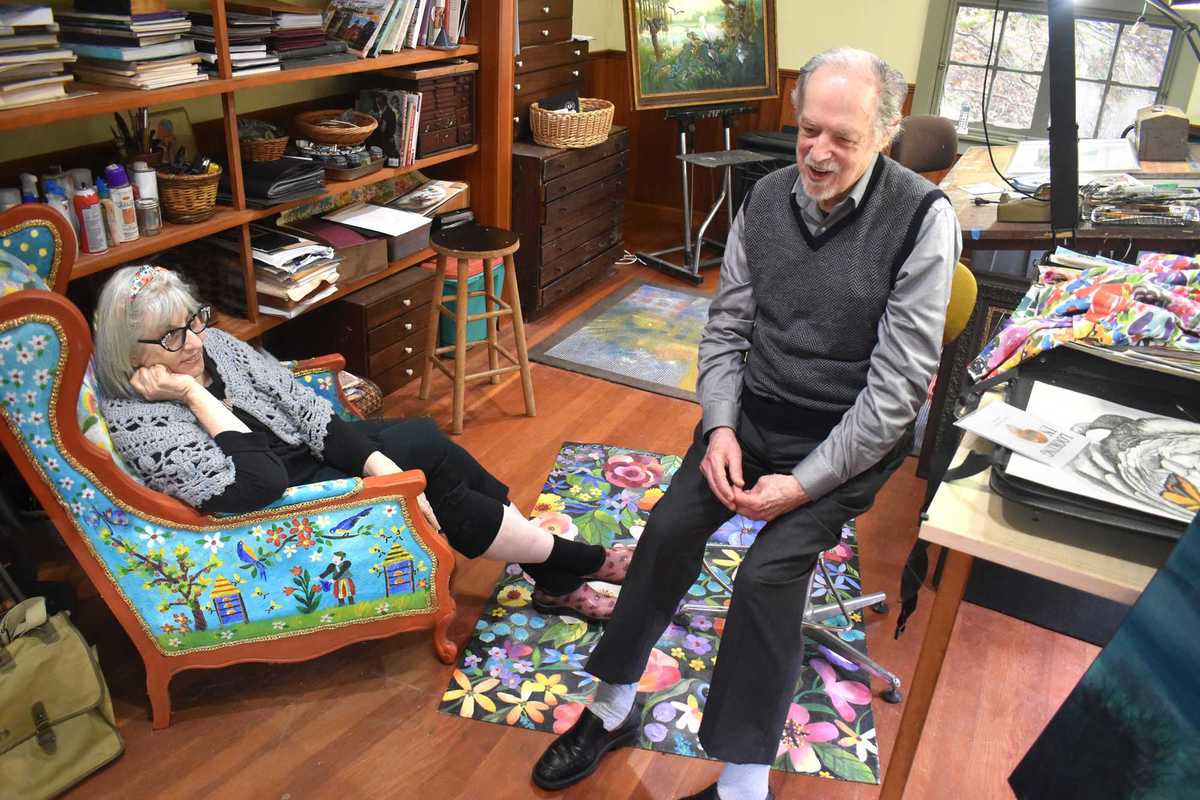
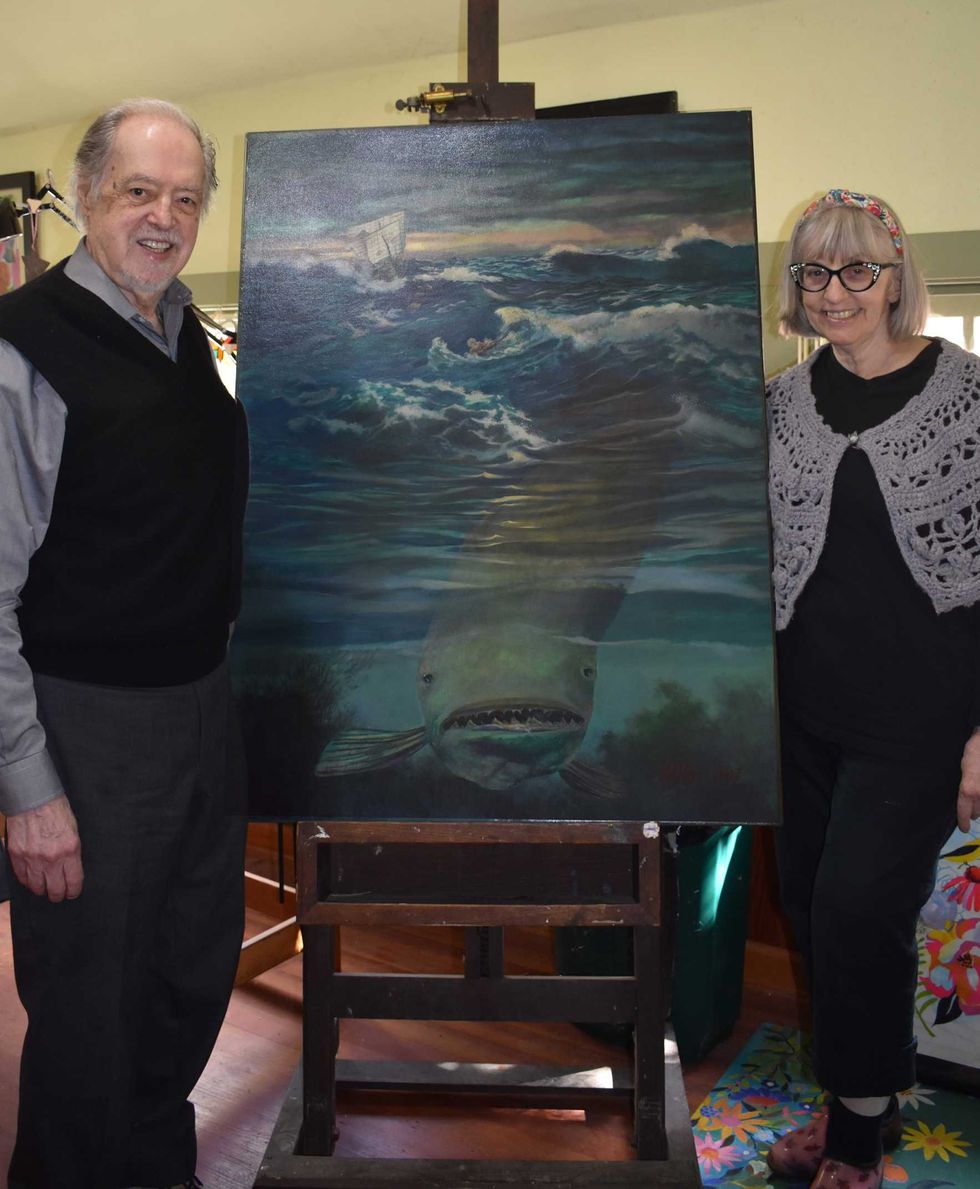 Justine and Victor Valla in their studio with a painting of Victor’s,”Jonah and the Whale.” Robin Roraback