

Many people have heard that there are five stages of grief. To be accurate, Dr. Elizabeth Kubler-Ross did groundbreaking research with dying patients who appeared to go through several phases of coming to terms, sometimes, with the dying experience. David Kessler co-authored two books with Kubler-Ross and adapted these stages to reflect the grief journey. They don’t map on exactly, I suggest. In his website, we read: “The five stages, denial, anger, bargaining, depression and acceptance, are a part of the framework that makes up our learning to live with the one we lost. They are tools to help us frame and identify what we may be feeling. But they are not stops on some linear timeline in grief. Not everyone goes through all of them or in a prescribed order. Our hope is that with these stages comes the knowledge of grief ‘s terrain, making us better equipped to cope with life and loss. At times, people in grief will often report more stages. Just remember your grief is as unique as you are.” Go to www.grief.com/the-five-stages-of-grief.
There are many models of grieving, all of which are useful if you don’t pin yourself down to any particular one. Future columns will explore other models. Everyone grieves differently but most people experience numbness and/or emotional tsunamis, mental disorganization, chaos, confusion and fear pretty much right out the gate. Go to www.aftertheheartbreak.com/stop-telling-me-about-the-5-stages-of-grief.
When you’ve lost a loved one you can feel as though you’ve been hit by a truck and all your bones are broken and you just hurt all over. One woman said recently in my group, “My fingertips hurt, I’m telling you. The tips of my fingers actually ache.”
However, you don’t have any bandages or bruises and you’re not in the hospital. It is critically important to take care of yourself, especially when you don’t feel like it. Have someone be watching over you, perhaps from a distance, but checking in. Because sometimes you just don’t care about anything, least of all yourself.
What has hit you affects you mentally, physically and emotionally and it is possible to put yourself or someone else in danger because you are not thinking clearly. You may misplace things, forget where you put your keys, and lose essential information. You may forget names of people you know well. A common report is driving somewhere and having zero idea how you got to your destination; you were in a fog as you drove but you did not realize you were. You may be obsessed with thinking about your loved one and unable to focus. And there is all that ------ paperwork to handle. You can fear you are losing your mind. You may be, but most likely you are not, but ‘attention must be paid,’ as Linda Loman says in the Arthur Miller play, “The Death of a Salesman.”
Physically, you may get sick. You may be sleeping a lot or you may not be able to sleep. You may not want to budge off the sofa or you may not be able to sit still.
Emotionally, you can be all over the place. Out of control. Crying the moment you hear a certain song or smell a certain fragrance — the grocery store may be a dangerous place for you to go. Too public.
You are in a tender place. Your humanness has been struck, slammed and stunned — the mental, physical and emotional impacts are real and need to be included rather than resisted.
The sense of being broken inside is a physical experience. You need a lot more down time. You may not recognize yourself. Allow extra time to do everything: cooking, driving, getting to sleep, walking the dog (“Where is the LEASH?”).
Especially If you are driving and seized with sobbing, pull over and go through it before you get back on the road. Be careful even though you have never felt less interested in doing that.
The Rev. Dr. Eileen L. Epperson has lived in Salisbury for 20 years. She is a Life Coach specializing in grief support, forgiveness, communication coaching, and facilitating grief support groups. Reach her at elethegriefjourney@gmail.com.








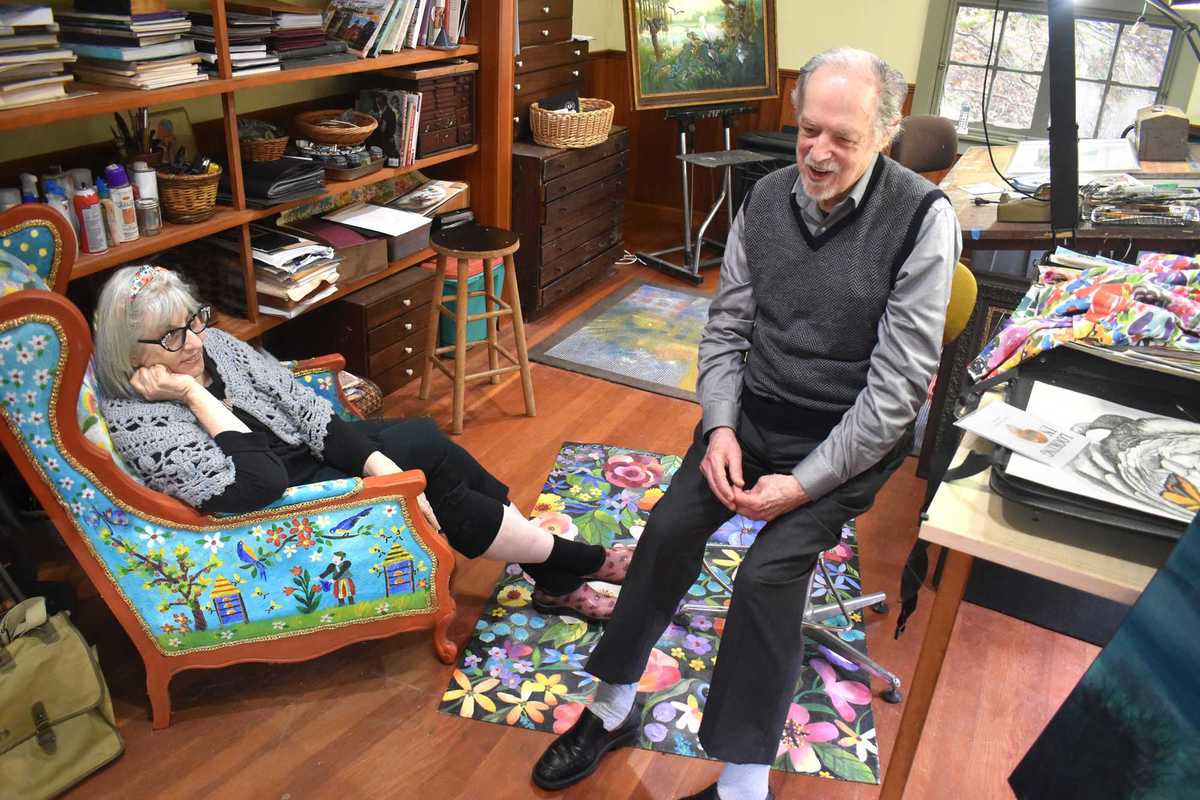
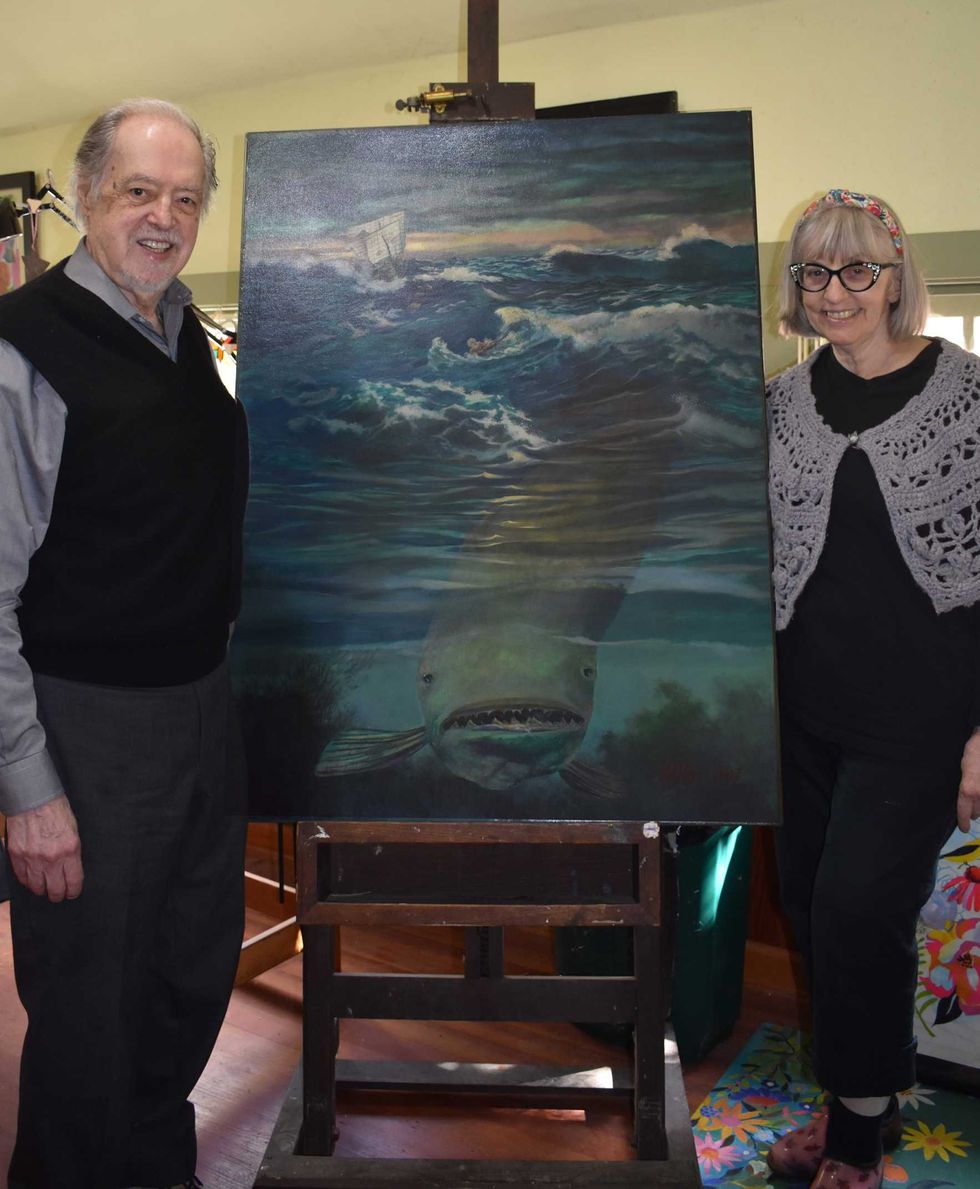 Justine and Victor Valla in their studio with a painting of Victor’s,”Jonah and the Whale.” Robin Roraback




Hit by a truck, but not in the hospital