Amenia voters reject retail cannabis sales

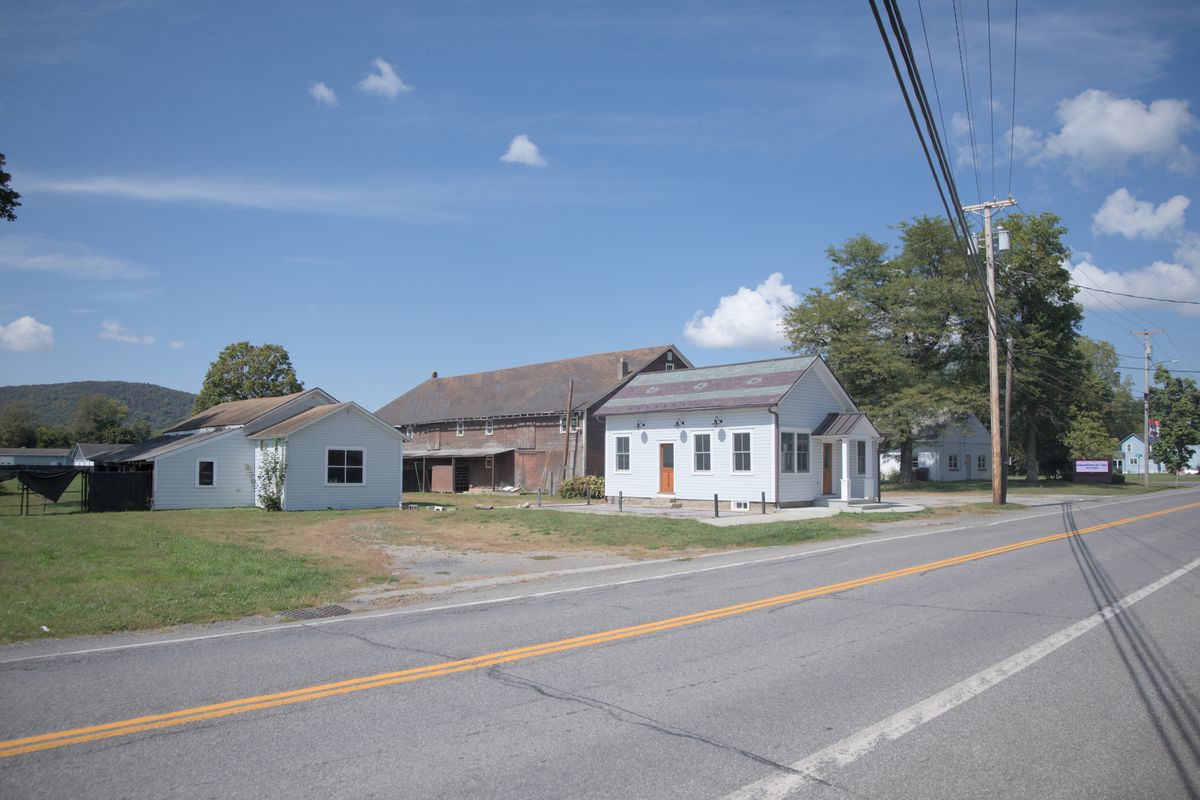
The site of the proposed new location of Red Hook, New York, -based dispensary Upstate Pines in the historic weigh station building on Route 82 south of downtown Pine Plains.
Photo by Nathan Miller

The site of the proposed new location of Red Hook, New York, -based dispensary Upstate Pines in the historic weigh station building on Route 82 south of downtown Pine Plains.
AMENIA — Voters in the Town of Amenia narrowly rejected a proposal to allow retail cannabis sales, choosing instead to keep the town’s 2021 opt-out law in place.
Local Proposition No. 2 — listed on the back of the ballot — asked residents whether to repeal Amenia’s November 2021 decision to prohibit cannabis retail and on-site consumption.
The proposition failed by just 43 votes, with 560 opposed and 515 in favor. The margin was large enough to avoid an automatic recount under New York State law, which only mandates recounts when the margin is fewer than 20 votes or less than 0.5%.
Under the New York State Cannabis Law, local municipalities were required to opt-out of retail sales and on-site consumption of cannabis before Dec. 31, 2021. Amenia’s opt-out law, enacted that year, is part of the Town Code, under “Chapter 48: Cannabis.”
North East, Washington and Stanford town governments all passed opt-out ordinances prior to the December 2021 deadline.
Pine Plains will remain the only town in northeast Dutchess County that allows retail cannabis sales.
The Red Hook–based dispensary Upstate Pines is currently seeking site plan approval from the Pine Plains Planning Board for a proposed dispensary in the site of the historic agricultural weigh station across Route 82 from the Pine Plains Post Office.
Municipalities that opted-out may reverse that policy at any time.
Part of the tax scheme for retail cannabis is a 4% sales tax that goes directly to local governments. Of that 4%, one-quarter goes to county coffers and the other three-quarters goes directly to the town where the dispensary is located. If a dispensary is located in a village then municipalities have the option of creating a tax-split agreement or sharing the revenue equally between town and village governments.

North East Zoning Board of Appeals members met on Thursday, Jan. 15, to hear a request from the Vitiello family, who own the property at 208 Cooper Road, to reconsider a 2005 ZBA decision that bars the residence on the property from obtaining a certificate of occupancy. The residence has been occupied for years despite a court injunction and an affirming appeals court decision in 2018 that ordered the house must be vacated.
MILLERTON — A decades-long dispute on Cooper Road returned to the spotlight on Thursday, Jan. 15, as a tense meeting of the Zoning Board of Appeals (ZBA) concluded with members unanimously rejecting a request to reconsider a decision that was made more than 20 years ago — a move that would have reopened conditions tied to the property’s original approval.
At the center of the conflict is an illegal dwelling owned by Erasmo and Josephine Vitiello on Cooper Road that has never received a certificate of occupancy. Although the structure received a building permit in 2005, it remains illegal under the town’s zoning code. Litigation between the town and homeowners in 2018 resulted in an injunction requiring the property to be vacated. The home, however, remains occupied, prompting public questions about enforcement by the Town Board.
Homeowner Josephine Vitiello appeared before the ZBA and spoke at length about her family’s efforts to “do all of the right things” in pursuit of a certificate of occupancy, telling the board that the prolonged dispute has caused significant turmoil for her family and their neighbors. Vitiello claimed the two outstanding items stemming from the 2005 decision — issues related to her driveway and drainage — have been “substantially completed.” ZBA member Jeff Stark pressed Vitiello with sharp questions before the board voted unanimously not to move forward with reconsideration.
Town Attorney Warren Replansky said during the meeting that the building permit never should have been issued, explaining that the structure was approved as a shed but built as a single-family residence without the required frontage. Replansky characterized the original paperwork submitted to the building inspector as a “false application.”
Under the town’s zoning code, a residential lot must abut a public street for at least 40 feet in order to be legally permitted. While the Vitiellos’ driveway provides access from Cooper Road to the home and is approximately 10 feet wide, the lot itself does not meet the frontage requirement because it does not directly abut the roadway as required by zoning.
Vitiello said that her son, daughter-in-law, and two young grandchildren live together in the home.
“We have been part of the community for 30 years,” she said. “My children literally grew up here, and we’ve done everything possible to try to resolve any issues.”
She described the home as well maintained and said the driveway is safe and fully functional, adding that meeting the town’s sight-distance requirements is impossible because the driveway is curved.
“I’ve tried it all,” Vitiello said. “Twenty years is a long time to still be dealing with this. I just want to move on and continue minding my own business — like we always have.”
The request for reconsideration follows renewed public criticism from Cooper Road residents, including comments at recent town meetings calling for stronger zoning enforcement related to the property.
North East resident Tyler Graham recently created a group called “Save Millerton” that he hopes will call attention to gaps in town zoning enforcement and demand greater transparency, among other things.
The group’s focus grew out of the long-running dispute on Cooper Road, where Graham and several neighbors allege that the Vitiello property has gone unenforced for years and caused tension in the neighborhood. Graham was not present at the Thursday night meeting.
Ed Covert, whose property is adjacent to the Vitiellos’, has also expressed frustration with the lack of zoning enforcement. He maintains that the driveway is actually not a driveway, but a “right of way” that passes over his property that he said is being “destroyed” by widening the path, changing angles and laying down peastone without permission. Covert said he was pleased with the decision of the ZBA.
ZBA member Jeff Stark was the first to question Vitiello, referencing the long history of litigation tied to the property.
“In the past 20 years, the Vitiellos have sued everyone and everyone has sued the Vitiellos over this property,” Stark said, before asking why the Highway Supervisor and the Building Inspector were the only officials not involved in past lawsuits.
Stark asked, “Are you aware that if a building inspector refuses to grant the building permit and abuses his discretion, that a judge has the power and the duty to require him to issue them?”
In response, a confused Vitiello asked, “You're questioning why I'm not suing one of your departments? I find that a little rough, but if I can't get it resolved in this manner then I guess that's going to have to be the next step.”
Changing course, Stark said he was not suggesting any specific course of action. He framed his comments as questions about jurisdictions, asking why Vitiello believed the issue fell under the ZBA’s jurisdiction and not the highway department.
Under town law, the ZBA does not have authority to determine whether a driveway meets safety or highway standards, which fall under the jurisdiction of the highway supervisor.
“Everyone keeps pointing to everyone else,” Vitiello said. “I’m here to tell you that I’ve tried it all.”
In the lead-up to the vote, tensions surfaced among board members during a procedural discussion involving Town Attorney Warren Replansky, who attended the meeting in-person at the request of ZBA Chair Edie Greenwood. Replansky said reconsideration would require a unanimous vote and that a motion to reconsider would first need to be made, though such a motion would not constitute a vote in favor of the homeowner.
Stark pushed back sharply.
“I don't believe that,” he said. “In fact, I don't believe much of what our attorney just said.”
Stark went on to argue that the wording of the board’s original decision 20 years ago was “faulty in the extreme,” and likely led the Vitiello family to believe the ZBA had taken on responsibility for determining whether their driveway met legal or safety standards.
“We don't have the right to take over that decision,” Stark said. “But reading our first decision, she might well have believed we thought we did.” He reiterated that the role belongs to the highway supervisor.
Tensions emerged again over the written statement to be issued following the vote, which requires signatures from board members. While Greenwood asked Replansky to draft the document, Stark objected, saying he would not sign a version prepared by the town attorney.
“I’ve already written a decision,” Stark said. “You can have Mr. Replansky write a decision for the rest of you. But I’ll be signing the decision that I wrote.”
The News was unable to reach Stark for clarification as to why he had prepared a written decision prior to the hearing.
The board ultimately voted in favor to request a statement from Replansky, with Stark as the only member who voted “no.”
Stark also criticized Greenwood’s decision to request Replansky’s attendance at the meeting, citing the cost of legal fees and pointing out the collective experience of the board. “I request that any future decisions about whether we need counsel or not be determined by the board,” Stark said.
With the ZBA declining to reopen the case, any further action related to the occupied dwelling — including enforcement of the existing injunction — now rests with town officials outside the board.
Edward Aparo passed away peacefully at his home on January 7, 2026 surrounded by his loving family.
Edward was born on May 10, 1936 in New Britain, CT. He was the beloved son of the late Anthony and Rose Valenti Aparo and attended New Britain schools. On April 7, 1958 Edward married his school sweetheart Jean Ackerman beginning a devoted marriage that spanned 67 years. Together they built a life rooted in family, hard work and love.
Edward began his career working in the family business, Aparo’s Electric Motor Service Inc. where he learned the trade alongside his father. Following his father’s passing, Edward became the owner of the business, carrying on the family legacy with dedication and pride. Edward is survived by his loving wife Jean Ackerman Aparo, his sons Stephen Aparo and his wife Marie of New Britain, CT and Craig Aparo and his wife Valerie of Naples, Fl, his sister Arlene Aparo StGermain and husband Joseph of Hobe Sound FL and his cherished grandchildren Danny Aparo and wife Nicole, Tyler Aparo and Morgan Wilson and Jared Aparo all of New Britain.
Services with be private.
WASSAIC — Ariel Yotive has a motto, “Work with what you’ve got.” Her unique Vitsky Bakery in Wassaic has the fruits of that motivation flying off the shelves.
Literally, during apricot season, one of her neighboring farm orchards may be harvesting fresh-off-the-tree fruit that is transformed into danishes. Local hives supply honey for sweet toppings or chunks of honeycomb for a delicious and rustic garnish. “I use what is around,” said the baker.
At Vitsky Bakery, Yotive’s approach has become a defining philosophy. Working closely with nearby farms, beekeepers and gardeners, she creates a constantly shifting menu shaped by the season, surplus and chance, turning overlooked or fleeting ingredients into inventive pastries that have made her Wassaic bakery a destination for locals and weekend visitors alike.
Yotive wanted to be a baker since she was five and has a video of her vowing to do it way back when. Alongside her grandfather, she learned to make bread — and still has his recipes and notes — but got started out in the food trade roasting whole animals and cooking everything in a resort camp in Patagonia.
After a stint at Bard College from 2006 to 2010, she worked at Troutbeck in Amenia and fell in love with the Oblong Valley, where today she has created a warm, sun-splashed mecca for baked goods of all sorts.
Vitsky Bakery is located at the south end of Wassaic’s Main Street, nestled in front of the Metro-North railroad, which flies by behind the counter, and an atmospheric creek that burbles along with its otters and snapping turtles.
There are chairs outside and picnic tables to sip coffee and tea, and even on a brisk, snowy day, a family munched pretzel croissants and traditional hot cross buns. Yotive is still working on getting a café inside.
Yotive’s workday starts at 1:30 a.m., baking bread and proofing yeast. Dozens of muffins take three to four hours, and some mornings in the winter she has to shovel snow. She opens at 8:30 a.m. every Friday, which includes a challah bread special, and on Saturday and Sunday, which feature the big hits: cardamom buns and bialys.
The baker describes her style as rustic with “Frankenstein” touches — meaning she puts together unlikely components. One morning she made croissants that didn’t work out. Rather than trash them, she repurposed them as her famous and madly popular Walnut Croissants, cut in half and rebaked after being filled with walnut frangipane. “I bake what I want and what is local,” she said, avoiding ingredients like lemons which don’t grow in these parts. “I’ve learned to let go of expectations.”
Yotive’s partnership with local organic farms and neighbor-sourced ingredients has created a network of local businesses that help support one another. Part of her philosophy is to be part of the community and bring people together. Yet long hours and driving from farm to farm to collect ingredients takes its toll. “It’s hard to have a social life and a family when you work from the middle of the night to late afternoon, instead of 9 to 5,” Yotive said.
Using fresh also requires long hours preserving and freezing the fruit or vegetables of the moment. Tomatoes later become Focaccia Slices and fruits become bottled jams.
Yotive also has regular bakery items like chocolate croissants, cookie boxes, sunflower bread, babka, honeyoat rye and even some gluten-free options.
Yotive said she tries to allow her brain to combine what is immediately available with a standard item, producing dishes like her Brown Butter Apple Custard, which goes beyond the bakery status quo. “I like to punch it up, try the exotic, and go beyond food culture,” she said, mentioning her Earl Gray Buns. “I try to utilize what I have.”
Most of Vitsky's retail customers are walk-ins, with a steady stream of customers through the day, but she also occasionally sets things aside for call-in orders. Yotive doesn’t make cakes to order but she said customers are glad to accept whatever she has available.
And as for the name? Ariel Yotive’s grandfather dropped the “Vitsky” from the family name “Yotvitsky” so his Quality Bakery didn’t sound too "un-American," Yotive said. Ariel has picked it up and run with it. Her outpost of inventive and enticing baked goods must be visited to be appreciated, an experience best summed up by one customer who bought for his family one of everything that was left. He absentmindedly bit into something he just purchased without knowing the clever name, or the unexpected ingredients, only the flavor that turned his face to joyous wonderment.
Dr. Mark Marshall, an internist at Sharon Hospital, said, “The statistics suggest it’s the worst flu season in 30 years.”
A severe and fast-moving flu season is straining health care systems on both sides of the state line, with Connecticut and New York reporting “very high” levels of respiratory illness activity.
Hospitals, schools and clinics are seeing a surge in influenza cases—a trend now being felt acutely across the Northwest Corner.
“The statistics suggest it’s the worst flu season in 30 years,” said Dr. Mark Marshall, an internist at Sharon Hospital.
According to the U.S. Centers for Disease Control and Prevention, respiratory illness activity is currently classified as “very high” in both Connecticut and New York. Emergency department visits for influenza are very high and increasing, the agency reported, while COVID-19 and respiratory syncytial virus (RSV) activity remain at low levels but are also trending upward.
Health officials say the holiday season created prime conditions for the virus to spread, as people gathered indoors in close quarters and traveled more frequently, increasing exposure and transmission.
Hospitals, schools, nursing homes and primary care providers across the Northwest Corner are also reporting unusually high flu volumes.
Dr. Sarah Humphreys, chief medical officer at Community Health and Wellness Center in North Canaan, said influenza has dominated patient visits since the holidays.
“We’re seeing a ton of influenza. People are coming in with body aches, fever, congestion and gastrointestinal issues,” Humphreys said.
She noted that clinicians are also seeing many infected children, particularly those connected to boarding schools. One private school in the region, she said, shut down prior to winter break after reporting more than 100 flu cases. “At boarding schools it spreads like wildfire.”
At Sharon Hospital, emergency department physicians are reporting a sharp increase in influenza cases, with more patients requiring hospitalizations than in a typical winter.
Between Dec. 1 through Dec. 9, “Our emergency department saw 100 patients who tested positive for influenza A,” said Marshall. Of those patients, he said, 11 required hospitalizations.
The Sharon Hospital physician said clinicians have seen an uptick in flu cases since the COVID-19 pandemic eased, which he attributed in part to people becoming less vigilant about preventive measures such as staying home when sick, masking when appropriate and hand hygiene.
He also noted that a mutated strain of influenza A, H3N2 subclade K, which is associated with more severe illness, particularly among older adults and individuals with preexisting health issues, is contributing to higher hospitalization rates.
That local experience mirrors what health officials are reporting across New York.
The New York State Department of Health announced Jan. 2 that the state recorded the highest number of flu-related hospitalizations ever reported in a single week.
“We are having a more severe flu season than prior years,” State Health Commissioner Dr. James McDonald said in a statement. “Almost 12,000 more people were admitted to a hospital during this most recent seven-day period compared to the prior week.”
The department’s most recent data shows a total of 4,546 flu-related hospitalizations statewide, nearly 1,000 more than the previous week.
Marshall said the impacts of the flu season extend beyond Sharon Hospital and the Northwest Corner, with mounting pressure within the broader Nuvance/Northwell health network, underscoring the pace at which the virus continues to spread.
He described what clinicians refer to as “surging,” a rapid influx of patients arriving with respiratory illness, many of whom require hospitalization, which leads to backups as patients wait in emergency departments for inpatient beds.
“We’re seeing a little of that in Sharon, but at Vassar, they are seeing severe surging,” Marshall said, referring to Vassar Brothers Medical Center, a 349-bed, acute care hospital in Poughkeepsie.
The North Canaan Community Health and Wellness Center has been inundated with flu-infected children in recent weeks, and officials advise families to isolate sick children from older adults and others most at risk for serious illness.
The facility’s chief medical officer emphasized that clinicians continue to recommend the seasonal flu vaccine, despite misinformation suggesting this year’s vaccine is ineffective because it was distributed before the emergence of the H2N3 strain.
“The flu vaccine will decrease the severity of the illness. Unfortunately, it has not stopped spreading,” said Humphreys, who also advised people to protect themselves by wearing a mask in waiting rooms or while moving through health care facilities where the virus may be airborne.
Public and private schools across the region have also been affected by this year’s brutal flu season, particularly in the weeks leading up to the holiday break.
On Dec. 19, the last day before winter break “about 12 percent of the high school’s population, 39 students, were absent,” Nichols noted. Teachers, too, caught the flu, with about 36 staff members falling ill prior to the break.
However, once students returned to class after break, flu cases declined.
“When you don’t have 200 to 300 kids in the same space, you lessen the transmission,” said School Superintendent Melony Brady-Shanley.
“I wouldn’t be shocked if in the next couple of weeks to 10 days, between COVID, RSV and Flu, that the numbers go up.”
Brady-Shanley stressed the importance of keeping children home when sick until they are fever-free, and reinforced basic hygiene.
“If you can get kids to wash their hands three to four times per day, they are less likely to get sick.”