In the days following Christmas in 1893, prominent Millerton couple George and Mary Kisselbrack stepped out of their home at 54 Main St. into the cool winter air after an unseasonably warm holiday. Their destination was a concert in nearby Pine Plains.
What was expected to be an evening of music and socializing quickly descended into chaos when an oil stove in the venue tipped over, sending concertgoers rushing for the exit. The stove was quickly moved outside, but not before a window was broken, several coats were scorched and more than one woman fainted in the commotion. In the end, the incident amounted to little more than a scare.
This encounter involving the Millerton-based train conductor and his wife was recorded in a Dec. 31, 1893 issue of The Poughkeepsie Journal in the “Vicinity Correspondence” section.
The newspaper’s brief mention offers only a glimpse of the couple’s evening. Mary Kisselbrack, however, was far more than a concertgoer noted in the paper.
As a dressmaker, she operated one of Millerton’s first female-run businesses during a time when professional dressmaking was an important and respected trade — and when most businesses were owned and operated by men. In her 1905 obituary, Kisselbrack was described as a “self-made woman” who possessed “more than ordinary ability.” She was a student not only of art but of current events and culture, and many sought her advice on “matters of propriety.” Described as quiet and unassuming, especially given her talents, Kisselbrack was known in equal measure for her business success and her friendliness and wide circle of friends.
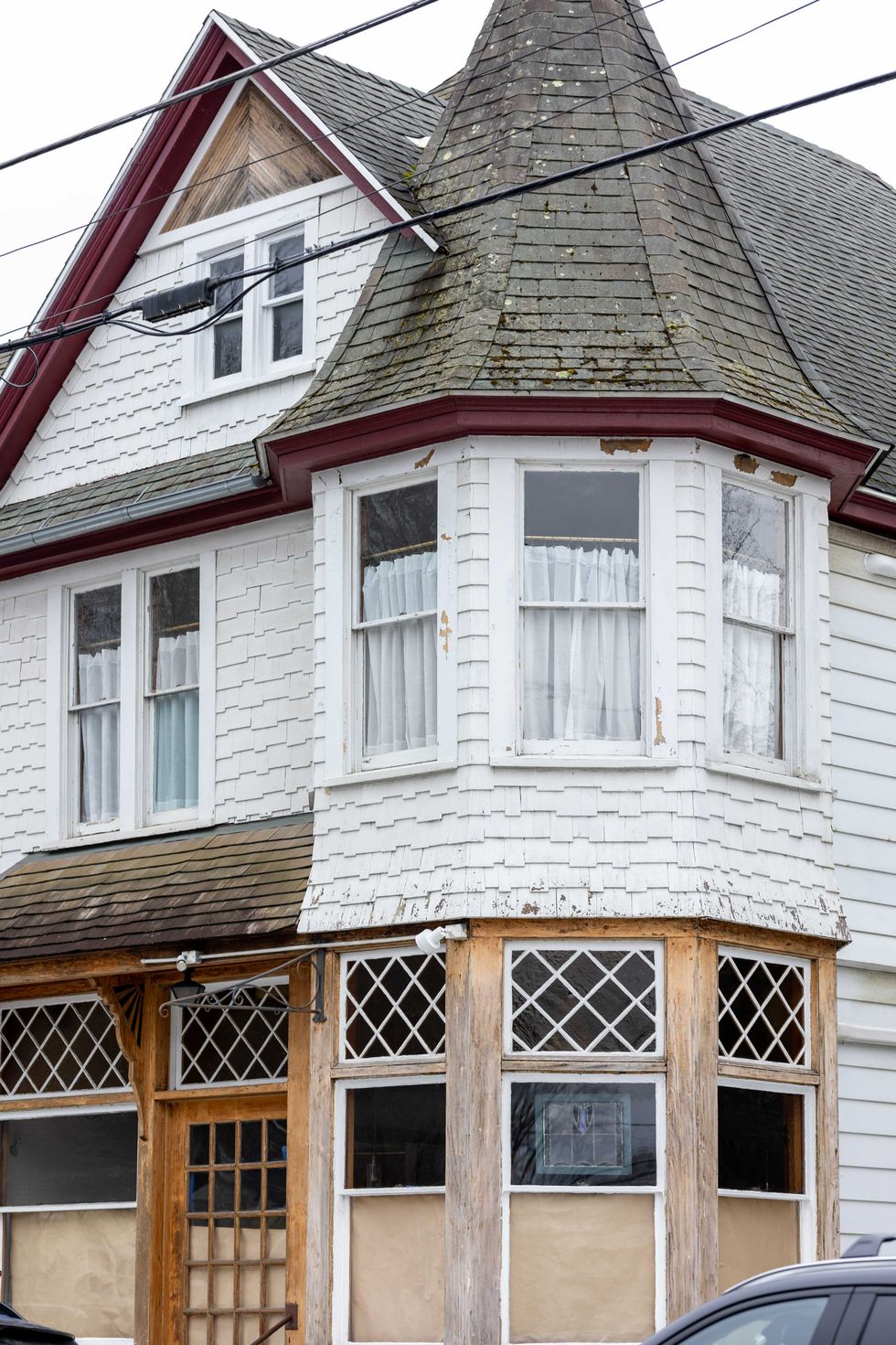 The house at 54 Main St. in Millerton was built in 1891 for the Kisselbrack family and also housed Mary Kisselbrack’s dressmaking business. The building now stands vacant after several years as the restaurant Manna Dew.Photo by Aly Morrissey
Mary Kisselbrack’s early life
Much of what is known about Mary Kisselbrack is found in late 19th and early 20th century issues of The Millerton Telegram, the village’s first newspaper.
Born in Lime Rock, Connecticut, on Dec. 28, 1849, as Mary Hutchinson, the future dressmaker moved to Millerton at the age of four to live with her aunt, Mrs. McAlister, before her parents later relocated to the village as well.
It was under her aunt’s tutelage that Hutchinson learned the art of dressmaking. Like many young women training in the trade during the mid-19th century, she likely began with the fundamentals of hand sewing before advancing to garment construction, embroidery and alterations using fabrics like wool, silk and cotton. She would have also learned millinery skills to make fashionable hats.
Though Paris was largely considered the fashion capital of the world, New York City was quickly becoming the American hub for clothing and textile trends in the mid-1800s, and Hutchinson spent time studying and working there.
After a successful period as a milliner and dressmaker, Hutchinson decided to establish her own business in her hometown of Millerton.
She initially began her business modestly, operating as just a millinery out of several rooms in the Brick Block — a hotel located on top of what was then Hatch’s drug store. She soon expanded the business to include a dressmaking department.
After four years, as business picked up, Hutchinson moved into the Cook building on John Street, where she worked for more than 10 years.
Business boomed, and Hutchinson soon began a new chapter in her personal life. She married train conductor George H. Kisselbrack, and in 1891 he purchased a desirable parcel of land on Main Street where the couple would build their home and a new venue for Mary’s business.
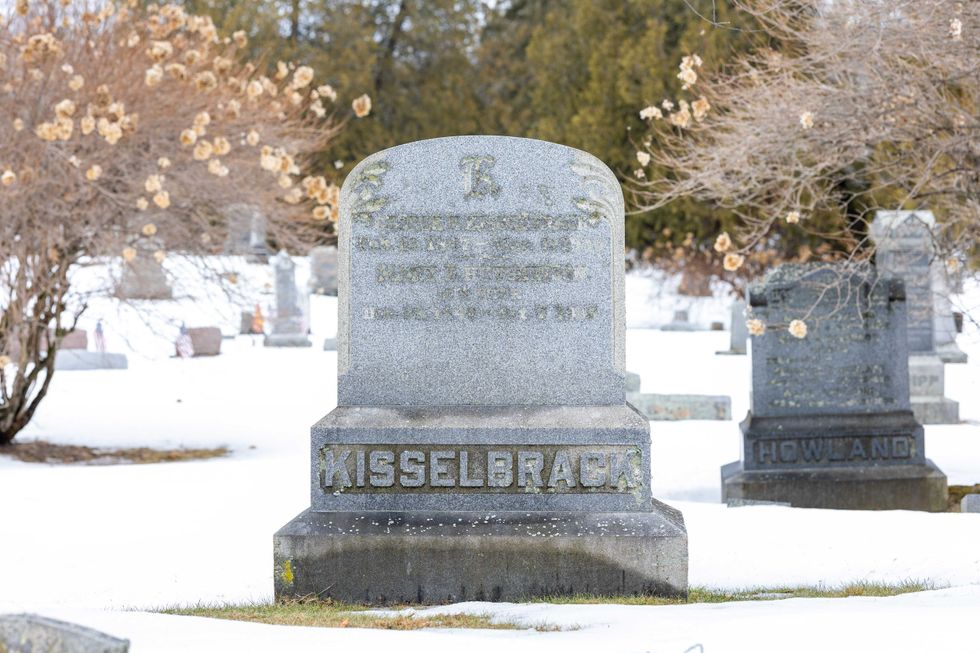 Mary Kisselbrack’s headstone sits in Irondale Cemetery off of Route 44 in Millerton.Photo by Aly Morrissey
Kisselbrack House
According to a property title search for 54 Main St. provided by the North East Historical Society, records dating to November 1875 show that the site where the Kisselbrack House was built was originally a 124-by-232-foot vacant lot that passed through several owners.
After a number of transactions, the land ended up in the hands of John R. Collins and his wife, Matie T. Collins — parents of eventual Hall of Fame baseball player Eddie Collins, who grew up in Millerton and went on to play for the Philadelphia Athletics and Chicago White Sox.
On April 11, 1891, George Kisselbrack purchased the lot from the Collins family and hired locally renowned builders Beers and Trafford to design what would become their home — the west side dedicated to Mary’s business, including a sales room.
In “A Beckon Call to a Village,” a document that compiles articles and information about the early days of Millerton, the house was referred to as “one of the handsomest, architecturally, in the village.” With gables, pointed roof lines and delicate shades of colors on its exterior ornamentation, the document noted that “no stranger passes it without an admiring glance.”
At its time of construction, panes of vibrantly colored glass were used to accent the exterior, features that would have stood out among the village’s commercial architecture. A Millerton Telegram article published shortly after the building was completed described it as “a masterpiece of the modern builders’ and decorators’ art.”
The residence included a kitchen, pantry, dining room, china closet and hall on the first floor, along with a parlor and four large bedrooms on the second floor. The house was designed with closets in every room — an unusual feature for this time. It also included a water heater and hot and cold water throughout the house.
Today, the home still stands and appears to be going through renovations, although no plans have been announced. In recent years, it operated as a restaurant called Manna Dew Café. The ornate exterior details can still be seen.
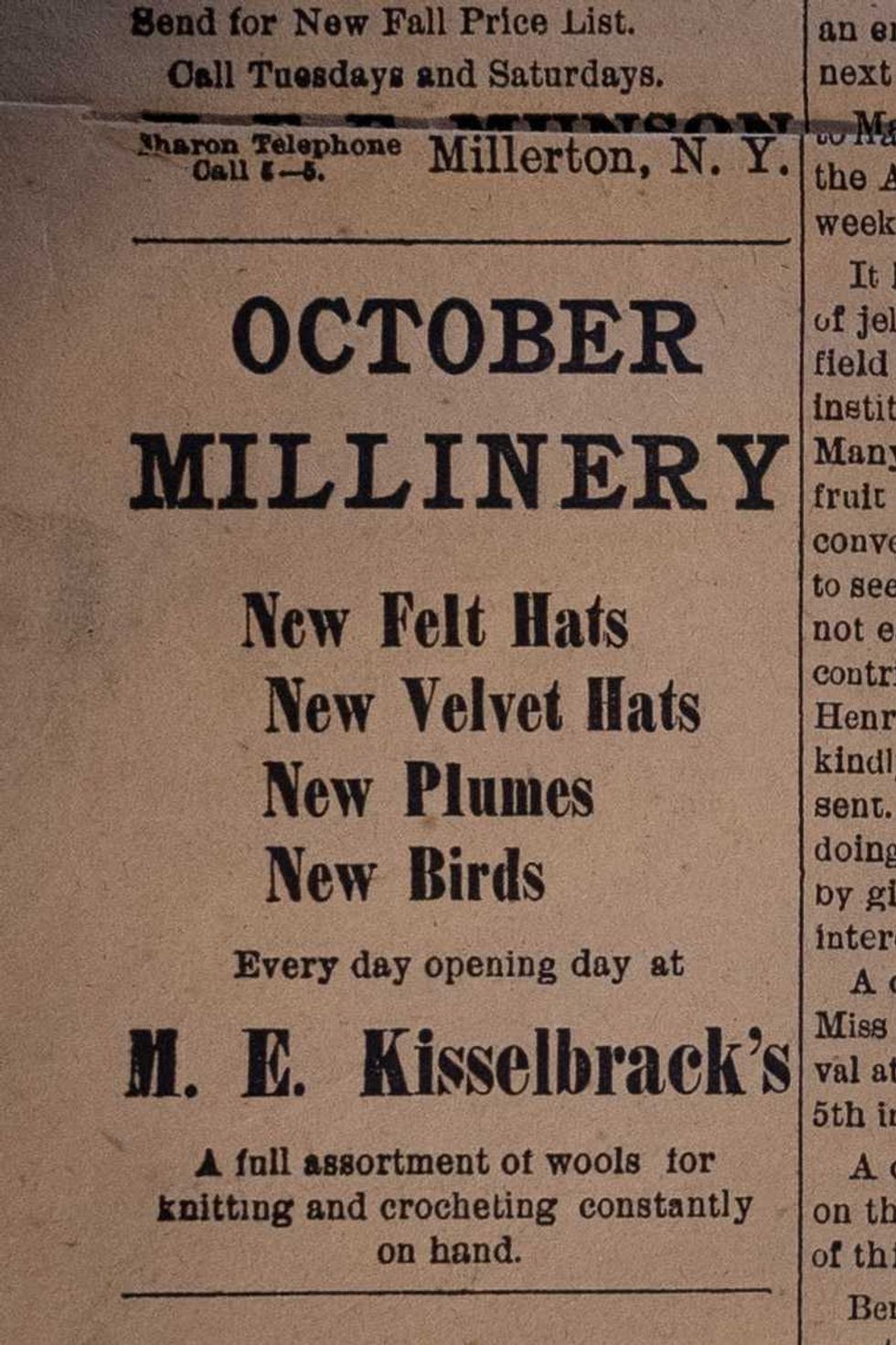 An advertisement in the Oct. 12, 1905, issue of the Millerton Telegram for Mary Kisselbrack’s dressmaking business published alongside her obituary.Photo courtesy North East Historical Society
A well-respected businesswoman gone too soon
Mary Kisselbrack was known for her quality of work, attention to detail and tenacity as a business owner. She frequently traveled to New York City to stay up to date on the latest styles and to purchase high-quality fabrics and materials.
“Mrs. Kisselbrack spares no pains in satisfying her patrons,” an 1890s Telegram article said.
Kisselbrack’s reputation earned her customers from different parts of the country — some as far away as Florida — in addition to regular clients from Salisbury, Lakeville, Sharon, Amenia, Pine Plains, Copake and Hillsdale.
“With a woman of the long experience and exquisite taste of Mrs. Kisselbrack at the head of the millinery and dressmaking business, we may be sure that our wives and daughters will be reasonably supplied with the most stylish bonnets and dresses,” the article said.
On Oct. 5, 1905 — just over two months shy of her 56th birthday — Mary Kisselbrack died following a severe, three-week illness. According to an obituary that appeared in the Millerton Telegram, she suffered a fibrous tumor and peritonitis, which likely would have caused her significant abdominal pain.
“Conditions were so complicated that death seemed inevitable,” the obituary noted.
Kisselbrack was reportedly lucid throughout her illness, and was said to have given instructions and orders up until her very last breath.
“While she was not afraid to die, she lamented leaving home and loved ones,” the obituary said. “She talked of dying and of her funeral arrangements as calmly as if going away on a visit.”
Her obituary said she was surrounded by physicians and her loved ones prior to her death. Her husband, mother and several siblings remained by her side.
Following Kisselbrack’s death, her husband George printed a message in the newspaper expressing gratitude for the many well wishes from neighbors and friends.
“For all the kindness and sympathy shown my departed wife in her illness and to us all in our affliction,” he wrote, “I express sincerest thanks and appreciation.”








 Tiffany Lemelin, shelter manager, brushing Marsala upon arrival.Provided
 Michael DeBarba, certified dog trainer working with Marsala.Jennifer Almquist
 Marsala wins a heart.Jennifer Almquist
 Sadie, center, a Carolina dog, plays with her friend Negra, a terrier mix. Bella Linda, the small poodle, has since been adopted.L. Tomaino
 Wesley, a young, exuberant mix, is looking for an active home.L. Tomaino
 Bonnie and Clyde, an affectionate terrier pair.L. Tomaino