A retired teacher’s ties to Millerton’s founding days

Diane Price holds photographs of her father, Bill Doughty, in her living room on Maple Avenue in Millerton.
Photo By Nathan Miller

Diane Price holds photographs of her father, Bill Doughty, in her living room on Maple Avenue in Millerton.
MILLERTON — A framed portrait of Levi P. Hatch — the village’s first “druggist” and one of Millerton’s founding professionals — hangs on Diane Price’s wall, connecting her to history she didn’t know she had.
The discovery began in 2013, when she read a magazine article on the village’s founders and realized she had a connection to Hatch. He was Price’s great-grandfather.
“He was considered one of the nine founding professionals,” Price said. The discovery came decades after Price first moved to Millerton in 1961, when her father, Bill Doughty, relocated the family there to be closer to his parents, Millerton natives Roy and Mae Doughty.
The discovery, sparked by the article and later expanded through research by local amateur historian Sarah Hermans, cemented Price’s connection to a community that she had been in love with since she was a girl.
Hatch arrived in Millerton by train, according to research completed by Price and Hermans, and settled in the village, where he soon met Lottie Mae Scribner, who lived on nearby Silver Mountain. The two married, though the exact date is unknown, and lived in a house on Elm Avenue — also known today as Route 22. The pair had four children.
Price’s grandmother, Mae Hatch, was the youngest of Levi and Lottie’s four kids. Price describes her as a talented musician who could play piano by ear and never had formal lessons.
“She played for the grange dances,” Price said. Mae married a Poughquag resident named Roy Doughty and the pair also settled down in Millerton.
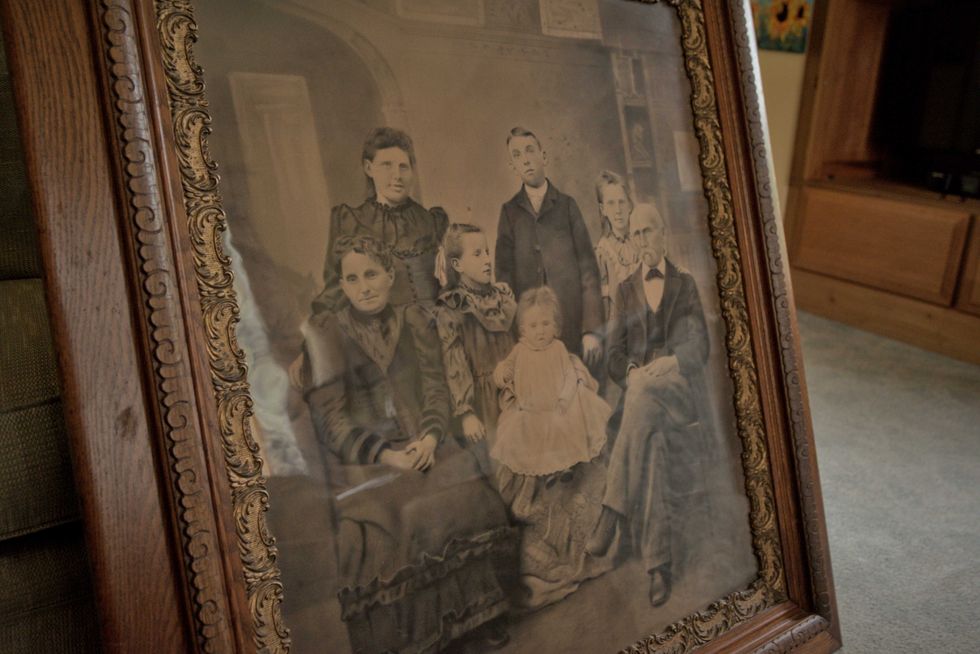
Roy Doughty, Price said, worked at Dutchess Auto in the early days of the automobile industry. But a stroke forced him to take a less-intensive job as a tax collector. Roy and Mae also had four children — Helen, Erma, Richard and Price’s father William “Bill” Doughty.
Bill Doughty graduated from school in Millerton in 1936 and was drafted into World War II in 1941. During the war, Bill served as a first lieutenant in the U.S. Army Corps of Engineers. He moved to Pittsfield, Mass., upon returning to the states and settled down with a resident of that town named Rita Mazur, Price’s mother. The pair married in 1946 and had three children — William Jr., known as “Mike;” Diane, born in 1949; and Patrick.
But quiet suburban life was not necessarily in the cards at the time, as conflict began to brew in the Korean peninsula. Bill was eventually drafted for the second time to serve during the Korean War, and his family moved from Pittsfield to New Smyrna Beach in Florida for about three years, Price said.
After his service ended, the ‘60s had arrived and Price’s grandparents’ health was deteriorating. Prior to the move to Florida, her family regularly made road trips from Pittsfield to Millerton to visit and care for her grandparents. But in 1961, her family moved to Millerton permanently, where her mother and father lived out the rest of their lives.
Price was 13 when her family moved to Millerton permanently. She said she already loved the community, describing it as close-knit, safe and entertaining.
“In 1961, I went to the movies and I met a boy,” Price said. “I sat with that boy and my parents knew about it before I got home.”
At the time, Price had no idea about her great-grandparents — if she’s being honest, Price never knew much about her own grandparents, either.
“I was too stupid to ask back then,” Price said. “I feel bad that I never asked and I never ask my father about his experience in the war. He never talked about it.”
But Price still felt tied to her family and the community she lived in — a bond that has only strengthened over time. After just a few years of living in Millerton, Price went off to college in 1967 and felt so homesick she couldn’t speak to her father on the phone. It took a weekend visit and pep talk from her older brother, Mike, to get her out of the funk.
Upon graduating from college in 1971, Price returned to Millerton and began teaching at Webutuck Elementary School. She lived and worked in the village, raising two daughters, and still lives on Maple Avenue with her husband, Roger Price, who taught math at Webutuck High School.
She said the community has changed dramatically since she moved here in the 1960s. At the time, everybody knew each other. The highlight of the weekend was the Friday night train bringing visitors from New York City. But opportunities in the community declined over the decades, and now many people who grew up in the area feel they have to leave to make a living.
“What industry is there?” Price said. “What reason do we have for children or teenagers or adults to stay here? Where can they work and make a decent living?” Those questions have been on her mind for decades, she said, as she watched her students and her own children grow up and leave Millerton to find work and build their lives.
Despite the anxiety, Price looks back fondly on her upbringing in the village and the community that still exists here. She said she never wanted for anything growing up, and her parents provided ample emotional support as well. The community was full of caring people that looked out for each other, and although neighbors are mostly strangers these days, that thread of safety and looking out for one another still holds.
“Every day is a gift,” Price said. “How can I be anything but grateful for the life that I lived?”

Natalia Zukerman
For many pet owners, animals are family. On Saturday, May 30, that bond will be celebrated in a uniquely practical and heartfelt way when the Blessing of the Animals returns to Third Lutheran Evangelical Church in Rhinebeck alongside a free rabies vaccination clinic hosted by Hudson Valley Animal Rescue & Sanctuary.
The event, scheduled from noon to 4 p.m., is free for Dutchess County residents and open to dogs, cats and domestic ferrets three months and older. While the clinic itself provides an important public health service, organizers say the day has become about much more than vaccinations.
“It’s a very simple afternoon of kindness,” said event curator Rosemary Joyce. “I think of it like a gardener — you go someplace, you learn how to plant seeds and then you take those seeds home and grow them in your own community. Except these are the seeds of kindness.”
The annual blessing is now entering its fourth year, with each event honoring a different theme. This year’s celebration pays tribute to renowned primatologist and animal behaviorist Jane Goodall.
“Most people know her from her work with primates,” Joyce said, “but she also taught us to understand that animals are sentient creatures — they feel like we feel.”
Joyce pointed to recent scientific studies that scanned dogs’ brains using MRI technology.
“When dogs are presented with the scent of the people they love, the part of their brain that lights up is the exact same part of our brain that responds to love,” she said. “So not only do they love us — dogs love the way we love.”
Unlike larger ceremonial blessings often held around the feast of St. Francis, Rhinebeck’s blessing is much more personalized.
“This is not where everyone gathers and gets blessed all at once,” Joyce said. “This is individual and hands-on. You walk up to Pastor Jim Miller, and he talks to you and your animal.”
Past participants have brought everything from dogs and cats to chickens, parrots, reptiles and even an iguana “draped around someone like a scarf,” Joyce recalled.
The event also features more than a dozen rescue and animal welfare groups, each bringing “ambassador animals” for visitors to meet.
Among the most anticipated returning guests is Lazarus, a 9-year-old Eurasian eagle owl with a six-foot wingspan.
“He’s the wow factor,” Joyce said. “I watched a father hustling his two boys to leave last year because they had another appointment. I told him, ‘If you haven’t seen what’s over there, you haven’t seen this event.’ He walked over, looked at Lazarus, and his mouth just dropped open. The little boy came out in him.”
Other participants include rescue horses from the Southlands Foundation, adoptable dogs from Animal Farm Foundation, reptiles from Two by Two Animal Haven, small animals from 4-H and rescued farm animals from Hope Farm Animal Sanctuary, including Rosie, a 200-pound potbellied pig.
Joyce said one of her favorite aspects of the event is watching it create unexpected connections.
“I’m always amazed that people who would never talk to each other on the street are suddenly sitting on the lawn talking like old friends,” she said. “Animals are great catalysts for human connection.”
This year’s rabies clinic, provided by HVARS, adds a critical public service component.
Rabies vaccinations are required by New York state law for all dogs, cats and domestic ferrets by four months of age. Owners who fail to comply can face fines of up to $200.
“A lot of people don’t realize that,” Joyce said. “And they also don’t realize how affordable this clinic makes it.”
Vaccinations are free for Dutchess County residents with proof of residency and $15 per pet for non-residents. Vaccines are valid for three years with proof of prior vaccination, or one year without it.
Microchipping will also be available for $45, and one-year distemper vaccines for $25.
“It’s the size of a grain of rice,” Joyce said of the microchips. “It’s tiny, safe, affordable and permanent. If your pet is lost or stolen, all someone has to do is scan it.”
She noted that the service can be especially important as pet thefts have risen in recent years.
The clinic was made possible through a donation from the Estate of Charles Svatek, whom Joyce described as someone “known for true acts of kindness and a loving desire to make the world better for all living creatures.”
For Joyce, the event reflects a larger message about compassion — for animals and for each other.
“If this event does anything,” she said, “I hope it reminds people that kindness ripples outward.”
Pre-registration is strongly encouraged at hvars.org, though walk-ins will be accepted as space permits. Dogs must be leashed; cats and ferrets must be in carriers. The event will be held rain or shine.

Want more of our stories on Google? Click here to make us a Preferred Source.
Nathan Miller
Sheila Srere, left, and Cathy Fenn plant flowers in a small island at the Harlem Valley Rail Trail’s intersection with Main Street in Millerton on Thursday, May 21.
A band of volunteers planted flowers across downtown Millerton on Thursday, May 21, as part of local group Townscape's annual beautification efforts. Community members from across northeast Dutchess County came together to plant flowers at Millerton's veterans memorial monument in front of the United Methodist Church on Main Street and in planters and flower beds along Main Street down to the intersection with Route 22.
Robin Roraback
Filmmaker Yonah Sadeh on a shoot last year in New York City.
When I was around 12, a family friend showed me how to use my family’s computer...from that point on, it was pretty much all movies. — Yona Sadeh
Filmmaker Yonah Sadeh of Falls Village left May 8 for China, where he will shoot a short documentary.
“I got into a documentary film intensive program where we have two weeks to shoot, edit and screen a 10-minute documentary about a topic of our choosing,” he said.“I’ll be in Changsha, Hunan, making a film about a fifth-generation shadow puppet master.”
It is an exciting opportunity for Sadeh, who has built his own business, Sadeh Studios, by working with small area businesses and nonprofits, “helping to tell their stories through film,” he said.
Some of his projects have included projects for local affordable housing organizations and area nonprofits such as Berkshire Busk, Berkshares, Naturalis Healing, local after-school programs and the Falls Village Fire Department. Current projects are for Berkshire Mountain Bakery and a documentary about Great Barrington’s revitalization in the 1990s.
Sadeh discovered early in life that he wanted to make films and began to develop his process and distinct style.
“It started with puppet shows and musical performances, and then, when I was around 12, a family friend showed me how to use my family’s computer to record and edit short homemade videos using iMovie. From that point on, it was pretty much all movies. I would set up my mom’s computer on a stack of books and record with the webcam.”
An early influence was Wes Anderson’s “Fantastic Mr. Fox,” which, “inspired my Claymation videos when I was 10 and remains one of my favorite films.”
He said getting his first camera made a big difference in his filmmaking.
“I was no longer stuck filming wherever I could set up the laptop. I could move with the camera and be more intentional about how things looked.”
Finding some of the technical aspects challenging, he watched YouTube to learn.
“I would imagine these big scenes, like fight sequences with lighting and effects, and then have to figure out how to actually make them. That process pushed me to learn. I spent a lot of time watching people like Casey Neistat, Film Riot and Corridor Digital, and just trying things out.”
Knowing the path he wanted to take, he pursued his high school education at Bard College at Simon’s Rock in Great Barrington, MA. The school has since relocated to Barrytown, New York.
“Simon’s Rock was not a film school in a traditional sense, but it had incredible faculty that I was able to work with one-on-one throughout my years there,” he said. “It gave me the flexibility and time to make films both in and outside of class, and to start my production business while still in school.”
He was able to take college-level film courses while still in high school.
“It seemed like the perfect opportunity. I loved it so much that I stayed at Simon’s Rock after graduating from the academy for my bachelor’s degree.”

After graduating, he focused full time on his freelance business.
“Most of my professional work is in documentary, where I am a one-man crew overseeing every aspect of the process, from meeting with clients to develop the idea to planning, filming and editing it all together. I love working in this way, with my hands in every part of the project.”
In addition to documentaries, he also works on narrative films.
“The script I am working on now is set over the summer solstice and follows two kids over a short but formative period of time. I feel like this idea of land and place, and the passing of time, is a pretty consistent theme in all of my work, both narrative and documentary.”
Narrative films involve working with a crew, and he said writing and directing have presented different challenges.
“By the time I get to production, I’ve usually been sitting with the story for a while and have a pretty clear picture of how I want each scene to feel. So a lot of directing is about communicating that vision to the actors and crew. It can definitely be stressful, especially with the pressure of being on set. But I’ve been lucky to work with people I really trust and enjoy collaborating with, which makes a big difference.”
The finished film, Sadeh said, “becomes something built by everyone involved.”
Eager to share his love of filmmaking, Sadeh recently took on the role of curator of the VideoWall at the Hunt Library in Falls Village.
“I would love the VideoWall to become a place that showcases the work of local filmmakers, and I hope that other creatives in the area will submit their work to be shown.”
Reflecting on his chosen path, Sadeh said, “I feel really excited and creatively fulfilled to be doing the work I love in the place I grew up.”
Learn more at sadehstudios.com
Natalia Zukerman
Silvano Monasterios thrilled a sold out audience in Cornwall.
Grammy-nominated pianist, composer and producer Silvano Monasterios performed works from his upcoming “Solo in Paris,” his seventh album, on Sunday, May 23 at Cornwall Town Hall to a packed audience. Presented by Music Mountain in partnership with the Cornwall Town Hall and Cornwall Library, the concert showcased Monasterios’ signature fusion of sophisticated jazz harmonies and vibrant Latin rhythms. Throughout the performance, he moved seamlessly between intricate compositions and spontaneous improvisation. The concert built excitement for Music Mountain’s upcoming summer jazz series, which will bring an array of acclaimed performers to the historic venue. For more information, visit musicmountain.org

Want more of our stories on Google? Click here to make us a Preferred Source.

Want more of our stories on Google? Click here to make us a Preferred Source.