Alice Pandaleon lauded as Millbrook’s valedictorian

Alice Pandaleon Photo submitted

MILLBROOK — This year’s Millbrook High School valedictorian, Alice Pandaleon, has been busy and productive throughout her academic career — and she’s loved every moment of it. Her enthusiasm, studiousness and attention to detail will likely keep her just as busy when she attends the University of Virginia this fall as a Rodman Scholar in the School of Engineering.
Alice is rightfully proud of that accomplishment, as only about 5% of the incoming class qualifies for the engineering program. These scholars are leaders with superior academic success who have engaged and made an impact on the world around them. Pretty impressive for a senior in high school.
As a student at Millbrook High School, Alice has always had an impact on those around her, in the sports programs and music programs she participated in, including the Jazz Band, the Pit Orchestra and the Brass Ensemble where she played the trumpet.
She was also a member of the National Honor Society, the Student Council and she participated in the Mock Trial Team.
Like most of this year’s seniors, Alice had curtailed activities over the past year-and-a -half due to COVID-19, but ever an optimist, she stayed as active as possible.
She said she will remember her years in the Millbrook district with fondness and a sense of gratitude. She loved being in a smaller school system, taking many different courses and doing extra-curricula activities. It gave her self-confidence and an academic background that provided her the ability to compete, which she admits she enjoys. It also provided the basis for studying aerospace and problem solving in biomedical engineering.
Alice said she’s looking forward to seeing her college campus in person; she loved the virtual tour and what she heard about the university from others who went there. She’s also looking forward to experiencing life on of a larger campus and meeting other students with like interests.
The idea of being away from home is exciting, but she knows she’ll miss her parents, dad Alec, mom Leslie and older brother Nick. She is grateful for their support, and for the support of the community and the entire Millbrook school system.
After starting her senior year remotely, Alice was glad she could end it in person. She understands the heartbreak of students who graduated last year socially distanced, and is grateful her own graduation will be closer to normal.
Alice is anxious to see graduation caps fly in the air come June 25. In August she’ll depart for college, ready to study aerospace, which, many will point out, is basically rocket science.

Nathan Miller
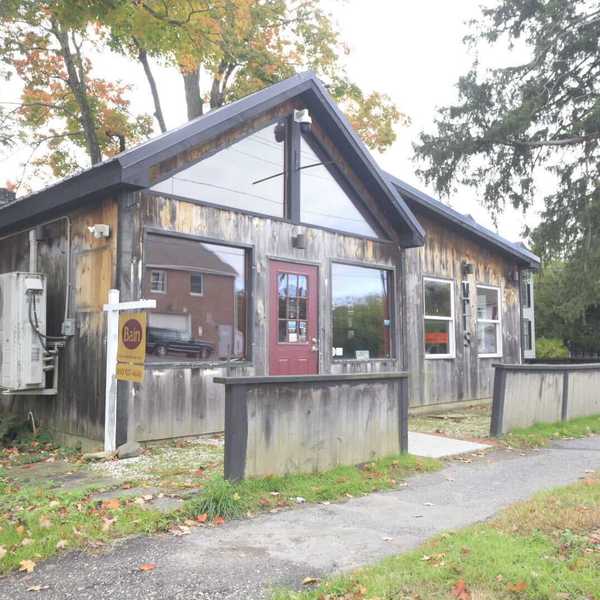
Tim Watson sits in his living room that used to serve as a waiting area for a dentist’s office on Route 44 in Millerton.
MILLERTON — More than three months after a malfunctioning furnace forced the Watson family from their Main Street apartment, Tim Watson said life is finally beginning to stabilize.
The Watsons were tenants of 7-9 Main St. on Jan. 31 when a malfunctioning furnace filled the apartment building with carbon monoxide, forcing emergency responders to evacuate the building. Authorities ruled the building unsafe after the emergency and it has remained vacant since. The Dutchess County Supreme Court granted a foreclosure to US Bancorp for the property in late March.
Watson and his family have found a permanent home in a former office space on Route 44 just outside the Village of Millerton. The office space was originally available for just 30 days, but North East’s recent commercial rezoning now permits residential use on the property. He said the move — made possible through help from relatives, friends and local organizations — has dramatically improved life for his family.
“Our whole life has changed,” Watson said as he sat in his new living room that used to serve as a waiting area for a dentist’s office. He pointed to the space, from the walls to the sofas, as an example of Millerton’s impact.
Family and friends donated furniture to replace what had been ruined at the Watsons’ old apartment. Members of the Millerton Fire Company initially provided a warm place to stay in the firehouse on Century Boulevard in the blistering cold hours following the evacuation. The owner of the family’s new residence on Route 44 — Millerton local Basil Gabriel, owner of local mechanic shop Basil Auto Service — discounted their rent at the beginning of their stay.
Other circumstances have changed for the family, too. Michelle, Tim’s wife of 37 years, recently finished her first round of chemotherapy. She was first diagnosed with pancreatic cancer over a year ago.
Shortly after beginning treatment, Michelle broke her femur and had to start using a wheelchair. She said another benefit of the new space is its accessibility. Michelle and Tim, who also uses a wheelchair after losing both his legs, had to install a stair lift on an exterior staircase to get in and out of 7-9 Main St.
Michelle said the new home will allow her more comfort during her cancer treatments.
“It’s a better place to live,” Michelle said. “This is a blessing.”
Although the evacuation was stressful, Tim said it put his family in a better, more stable place. The long-term viability of the space was under question during the Watson family’s first weeks there. But they were allowed to stay after North East passed its overhaul of zoning regulations that now permits residences and updated commercial zoning along Route 44.
Tim said he wants to stay there indefinitely.
“I think we found our forever home,” Watson said.
Leila Hawken
AMENIA — Housing Board members agreed on three potential uses for remaining grant funds, moving a step toward utilizing the money that was leftover from a Foundation for Community Health grant.
Board members voted on Monday, May 11, to draft a report for FCH detailing three initiatives for the leftover $13,000 aimed at clarifying local housing regulations, defining the board’s responsibilities related to the Housing Trust Fund, and expanding resources for residents seeking to create accessory dwelling units.
The funding will support efforts to simplify land use regulations for homeowners, develop guidance for Housing Board members regarding their oversight responsibilities, and create a step-by-step guide for residents interested in building an accessory dwelling unit, or ADU.
Grant consultant Christina Gast attended the meeting to help guide the discussion and ensure the proposals met both funding requirements and project deadlines. The agreed-upon initiatives closely mirrored ideas discussed at the previous Housing Board meeting on Monday, April 13.
Board members agreed that local housing and zoning regulations can be confusing to residents. They also pointed to a need to draft local legislation to provide a tax exemption for property owners who create an accessory dwelling unit, also known as an accessory apartment unit.
The board estimated that about $3,000 of the grant funding could be used to clarify the Housing Board’s role and responsibilities, particularly regarding oversight of the Housing Trust Fund.
In the coming weeks, the Housing Board will determine passages where the codes are unclear and ask the Planning Board attorney to clarify. The effort would also include preparation of an onboarding handbook for future Housing Board members, outlining the board’s duties and responsibilities.
“A handbook is a good use of a relatively small amount of funds,” Housing Board member Josh Frankel said.
The third initiative, with an estimated cost of $7,000, would see the development of step-by-step instructions about the process that residents need to follow in order to create an approved ADU. The instructions would be a clear guide toward creating a unit, along with a list of available resources.
Since her professional qualifications align with what is needed for the project, Gast offered to take on the work of drafting the materials. However, board members agreed with a suggestion from member Juan Torres that they should seek an additional outside quote for the work. Concerns about the appearance of a potential conflict of interest were first raised by member Shannon Roback.
Nathan Miller
Jacqueline Wikane, right, executive director of Hope Rising Farm and equine therapist, leads Atticus the appaloosa pony out of the barn on Saturday, May 16.
AMENIA — Local equine therapy facility Hope Rising Farm celebrated a special birthday on Saturday, May 16.
People from across Dutchess County and neighboring Connecticut celebrated Atticus the appaloosa pony’s 35th birthday with a party featuring a bouncy castle, a mechanical bull, a petting zoo and live music in the evening.
Jacqueline Wikane, owner and executive director of Hope Rising Farm, said she adopted Atticus about 20 years ago from a former rider. Under her care, he works as a therapy horse in Wikane’s therapeutic riding program at the farm.
The program serves adults and children with intellectual and developmental disabilities. “We teach them all about horses,” Wikane said, adding that interacting with and riding horses has a calming effect on the nervous system.
“It relaxes your blood pressure,” Wikane said. “It makes you calm.”
Although the horse has reached an advanced age, Atticus participates in the therapy program and even takes people for rides. Wikane said the activity is good for therapy clients and the horse. The aging horse needs regular exercise, and slow trail rides are stimulating without being too taxing, she said.
Atticus’s old age requires special care, too. The horse has lost most of his teeth, so Wikane and her volunteers have to feed him a soft mash and fine hay for his meals so he doesn’t have to chew as much. A steamer softens and moistens the hay in the winter, Wikane said, to ensure Atticus gets enough water.
“We do a lot for him,” Wikane said, adding that horses often live into their 40s naturally.
For his birthday, Atticus got a soft cake made of oats, carrots and other treats — all mashed to his liking.
Hope Rising Farm provides semi-private lessons starting at $65 for one hour and private lessons for $85 per hour. More information is available online at www.hoperisingfarm.org

Want more of our stories on Google? Click here to make us a Preferred Source.
Millerton News
One of the things that sets a community newspaper apart is that its readers are participants in the communities it covers. The people who pick up this paper, read us online, or engage with us on social media are the same people making decisions at town hall, running the organizations that support our communities, and living with the consequences of the issues we report on.
“Let’s Hear It …” is a new weekly feature in which we pose a question to our readers and publish a selection of responses. Questions may touch on issues we’re covering, invite readers to share their experiences and expertise, or simply be worth thinking about together. We’ll share each week’s question in print, online, and across our social media channels. Selected responses will appear in this section next week. Send responses to publisher@lakevillejournal.com.
So, let’s hear it …
What is one change you’d make to your town center to make it more welcoming?
Include your name and town in your response.
Peter Riva
The problem with tariffs is that it weakens the political hold on the population, setting up an adversarial relationship as prices rise. Tariffs, in other words price control – for that is in effect what tariffs do – are a governmental restriction to free trade for the population. Even if the goal was to balance import/export trade balance, the real effect is that the government is telling the population that the price of goods is politically controlled by the government. In America this is seen as loss of freedom, loss of getting what you want at a price you could previously afford, and, more than anything, a loss of your individual sovereignty.
America is made of people who demand control over their own lives – even if it’s illusory at times. Americans, spoiled as many foreign cultures seem to think, cannot fathom not being able to do as they damn well please, buy what they darn well want to, and especially want to feel in control of their own happiness.
When you suddenly have to pay 50% more for gasoline or diesel, as an American you do not blame yourself for needing the fuel, you blame “them” for raising the price without your consent. You go to your local gas station and get angry at that supplier. Yesterday I watched a man filling his diesel truck, cursing at the state of affairs as he slammed the nozzle back into the pump. I asked him who he was angry at for the ridiculous diesel price. “We were promised no damn wars, and this is what I get.” The key part of that response is “…what I get.” Personal pronoun. It’s being done to him, taking away his control over his own destiny.
Compare the situation here to China. The same top-down control of prices is put into place but the difference is the Chinese people do not have a feeling of entitlement to happiness, they know their happiness, their personal sovereignty, is controlled by the state. As China moves slowly to a market-oriented economy, or seen another way state-led capitalism, there will come a time when people expect to be able to control their own happiness rather than have it bestowed at the state’s whim. For now, however, that same top-down control in Russia is the very reason there has not been a popular uprising of any effect since the people in Russia are completely devoid of that individualistic desire to be in sole control – or even think they can be in sole control – of their happiness.
Think of tariffs and top-down price control as a stretched rubber band. It can only stretch so far. Pressure is building in America and unlike a true top-down socialist or communist government full control, American political control over tariffs or perhaps the adverse effect of imposed tariffs at an American consumer level, could suddenly cause the rubber band to snap, causing chaos. That could cause a ripple effect across all markets, across the globe, and political upheaval. This pressure, this stress, is always the risk of top-down control of a population’s desires. Unlike socialist countries’ populations, Americans’ desires, American’s happiness quotients, are always tied to the individual, not the state. If the state gets this wrong – and so far they really have -- a repeat rebellion is assured in one form or another.
Peter Riva, a former resident of Amenia Union, New York, now lives in Gila, New Mexico.

Want more of our stories on Google? Click here to make us a Preferred Source.

Want more of our stories on Google? Click here to make us a Preferred Source.