Freedom rings at Eric Sloane Museum

Margaret Gankofskie, the daughter of the late governor John Dempsey, was the first to ring the bell at the ceremony.
Emma Benardete


Margaret Gankofskie, the daughter of the late governor John Dempsey, was the first to ring the bell at the ceremony.
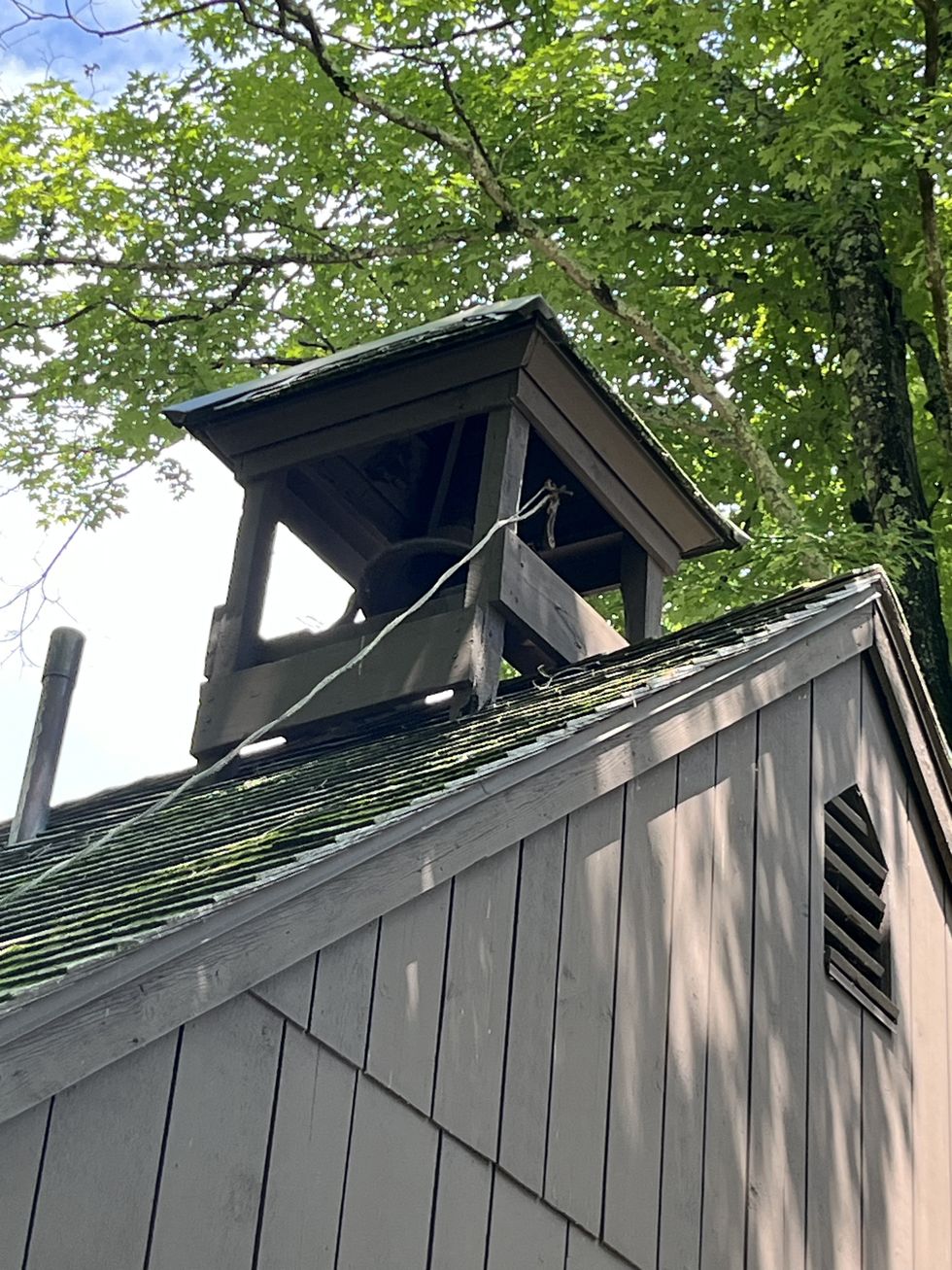
Community members gathered Saturday, July 6 for the Eric Sloane Museum’s annual bell-ringing ceremony in observance of Independence Day.
The Eric Sloane Museum in Kent celebrates the work of the late Eric Sloane, a Connecticut artist and author. In addition to his works, the museum also displays a series of tools which Sloane collected. According to the museum’s page on the State of Connecticut’s official website, “Sloane himself arranged and labeled his extensive collection, telling a fascinating story about bygone times and the great American heritage of craftsmanship.”
Museum Curator and Administrator Andrew Rowand began the ceremony by introducing the history of bell-ringing as an American tradition. He explained that Sloane, along with Connecticut author Eric Hatch, wanted to revive an old American tradition of ringing bells on Independence Day to commemorate the reading of the Declaration of Independence.
“They wanted to get back to the idea that bells were a sound of peace rather than fireworks, which were construed as a sign of war and a sign of violence,” Rowand said.
Sloane and Hatch campaigned to garner official recognition for the tradition. On June 26, 1963, the U.S. Congress passed a resolution encouraging the practice.
“Whereas the tolling of the Liberty Bell at Independence Hall, Philadelphia, Pennsylvania, at 2 o’clock in the afternoon of the 4th day of July, 1776, proclaimed the signing of the Declaration of Independence … Now, therefore be it Resolved … that the anniversary of the signing of the Declaration of Independence should be observed each year by the ringing of bells throughout the United States at the hour of 2 o’clock, eastern daylight time, in the afternoon of the 4th day of July…” the resolution reads. According to Rowand, the museum held a virtual bell-ringing ceremony on July 4 in addition to the one on July 6.
In 1964, Sloane and Hatch continued to display their enthusiasm for bells by publishing a book titled “The Little Book of Bells.” In 1968, Sloane published another bell book titled “The Sound of Bells.”
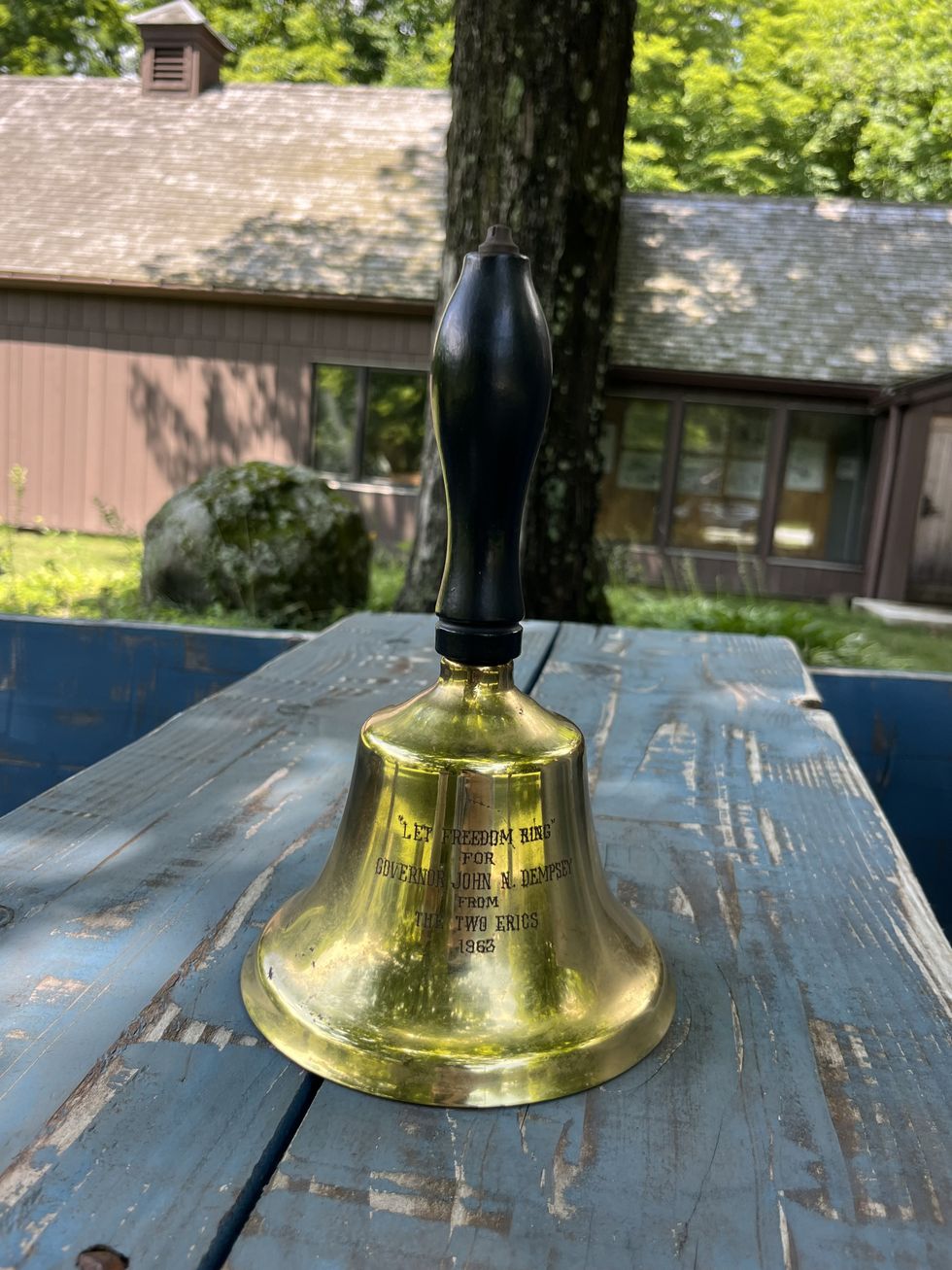
During the July 6 ceremony, after giving his introduction, Rowand read the preamble to the Declaration of Independence. Visitors then took turns ringing the bell outside the museum. The first to ring it was Margaret Gankofskie, the daughter of the late Connecticut governor John Dempsey, who served from 1961 until 1971. In addition to attending the ceremony, Gankofskie donated a bell which she inherited from her parents to the museum. The bell was gifted to Dempsey by Sloane and Hatch in 1963, and is engraved with the phrase “Let Freedom Ring,” as well as the governor’s name, the year and “From the two Erics.”
The museum has more special programming planned for the remainder of the summer, including a blacksmithing workshop July 28 and a spoon-carving workshop Aug. 10. The museum will also host two TradesUp youth programs for participants 10–17, including a plumbing-based workshop and a painting and drywall workshop.

Millerton News
Nathan Miller
The Millerton 175th Anniversary Committee's logo.
MILLERTON — Months of planning will culminate this weekend as Millerton kicks off nine days of events celebrating the village’s 175th anniversary, with festivities running from July 11 through July 19.
Lisa Hermann, a veteran festival organizer who has been leading the planning effort for Millerton 175, said the process intensified this year as the July start date crept closer.
“There’s a lot of moving parts,” Hermann said. “We’re very lucky for the volunteers we had, because we have people who live in such a small community but yet there are people with so many different backgrounds.”
The variety of expertise among Millerton’s 175 committee members lent itself to an expansive list of events spread across the nine days scheduled for the celebration. The celebration brings together local organizations, businesses and volunteers for what organizers say is one of Millerton’s largest community celebrations in years.
The celebration’s first day on Saturday, July 11, will feature the biggest lineup of distinct events. Plans for Saturday include:
Festivities continue with sports tournaments at Eddie Collins Memorial Park on Sunday, July 12. A 3-on-3 basketball tournament is set for 9:30 a.m., with sign-ups beginning at 8 a.m. Each team can register up to five players and registration costs $10 per player.
There will also be a cornhole tournament running at the park beginning at 11 a.m. Registration for that tournament begins at 10 a.m. and will carry a $30 entry fee.
Starting Saturday, July 11, and running all week are the North East Historical Society’s exhibit on Millerton’s history at the Millerton Methodist Church on Main Street. Visitors can peruse the exhibition materials between 10 a.m. and 4 p.m. from Saturday, July 11, to Sunday, July 19.
The night of Monday, July 13, will see a special dinner at the Millerton Inn, set for 4 p.m. to 9 p.m., and a free screening of “Burying the Hatchet: The Tom Quick Story,” followed by discussion at the North East Community Center starting at 6:30 p.m.
Tuesday, July 14, will mark the unveiling of a brand new outdoor classroom on the Harlem Valley Rail Trail. The immersive learning space will include vibrant, educational displays exploring water ecology, natural and social history, birds, insects and other elements of the local landscape.
On Wednesday, July 15, the Millerton Inn will host a party on its front lawn with outdoor cooking, cornhole and fire pits.
Then events start ramping back up with the Millerton Business Alliance’s annual Summer Stroll event, featuring sidewalk sales and pop-ups from local businesses throughout Millerton’s downtown from 1 p.m. to 6 p.m. The North East Historical Society’s exhibit on Millerton’s history will run from 1 p.m. to 7 to coincide with the Summer Stroll.
Festivities on Thursday wrap up with a comedy show in Eddie Collins Memorial Park hosted by local comedian and lifelong Millerton resident Ronnie Reed at 7 p.m.
The nine-day celebration then hits its apex starting Friday, July 17, with the kick-off of the Millerton 175 Fair at Eddie Collins Memorial Park. Carnival rides and games, live music, food and drink will fill the park for three days from July 17 to July 19.
The fair will run from 2 p.m. to 10 on Friday, July 17; from noon to 10 p.m. on Saturday, July 18; and from noon to 6 p.m. on Sunday, July 19.
Bands and musicians from across the Hudson Valley will take the stage to perform free concerts in the park, including Northwest Passage Band, Guilty Pleasure, Jordan Stoner, Hammerhead Horns, The Steve Dunn Trio, Last Good Bender and The Wanda Houston Project.
A children’s stage will also host performances aimed at younger members of the audience, including a musical set from Danny Tieger, onstage clowning from Bee Bee the Clown, the musical talents of Mark Rust, and Jackie the Magician to close out the fair on Sunday.
Hermann said she and the planning committee are eagerly awaiting the start of festivities this Saturday. Looking forward, Hermann said there’s hope around the village that Millerton is starting to rebuild its summer recreation programs.
She said next year’s planned completion of the pool will allow village leadership to fully staff a recreation department again, facilitating more regular community events.
“We just really haven’t had a rec department in so long because we didn’t have the infrastructure,” Hermann said. “I’m very much looking forward to when the park’s done and we have that full rec department back again.”
John Coston
COPAKE — New York State has ruled that a proposed commercial solar farm in Copake cannot move forward until its developer obtains a permit from the town to build in a flood zone.
The ruling affects Hecate Energy LLC’s proposed Shepherd’s Run Solar Farm, a 42-megawatt project that would occupy about 215 acres of a 723-acre site near the intersection of Routes 7 and 23 in Craryville. The Chicago-based company has spent years seeking state approval to build the facility, which has faced sustained opposition from the Town of Copake and local residents.
Approximately 154 acres of the land is classified as regulated wetlands.
“We cannot find... a demonstration of compliance with the applicable State wetlands laws and regulations. We find that the application is deficient insofar as it is based on outdated delineation data from 2019 and 2020,” wrote Maureen F. Leary and Dawn MacKillop-Soller, administrative law judges at the New York State Department of Public Service’s Office of Renewable Energy Siting and Electric Transmission in a ruling on June 25.
The ruling, which is laid out in a 226-page summary, also concluded: “We also find that the application fails to address wetlands of unusual importance and is otherwise not in compliance with the State’s applicable wetlands laws and regulations.”
The company must now go back to town officials in Copake to obtain a permit allowing construction in a flood plain, according to the ruling. The permit process would require extensive study of the proposed construction and site to determine potential and expected impacts to wildlife, wetland habitat and other environmental factors.
“We were granted limited party status,” he added. “It is the first time, as far as I know, that any host community has been granted party status.”
Hecate’s pursuit of a permit from ORES has its origins dating back to 2017. The project, which initially called for a 60-megawatt facility, has been downsized over the years after the company lost control of a parcel of land. Longstanding opposition from state and local officials has buffeted the project, further contributing to delays.
The Town of Copake has opposed the project, and citizen groups have identified a host of issues ranging from impacts to schools, traffic, noise, fire threat and agricultural resources as well as land-use that have been added to the conversation about siting Shepherd’s Run in this farming hamlet.
The Town of Copake received an extension to appeal any portions of the latest ruling until July 10. The administrative law judges set July 27 as a date for ORES staff to respond with a summary of responses to the ruling. A final permit for the project could be issued by Oct. 8, the end of a deadline set to issue a permit.
Three citizen groups commented on the ruling: “After years of bringing up major concerns about wetlands, it is gratifying that the Ruling found the wetland issues raised by the Town of Copake, Craryville Farms, Sensible Solar, and Birch Hill Neighbors Association to be ‘substantive and significant,’” wrote Sara Traberman of Sensible Solar for Rural New York.

Want more of our stories on Google? Click here to make us a Preferred Source.
Aly Morrissey , Alec Linden & Patrick L. Sullivan
An aerial view of the damage in downtown Salisbury, where a tree was uprooted in front of the Scoville Library.
Days after an extreme storm caught the Northwest Corner by surprise after an otherwise sunny Fourth of July, communities are still picking up the pieces as clean-up efforts persist. Blocked roads, downed trees and power lines, and widespread power and water outages continued to affect the region as of Monday, July 6. While more than 1,000 people in Salisbury remained without power Tuesday morning, businesses started to reopen.
Continued rain made clean-up efforts difficult as the week began, and some major roads remained partially blocked.
No tornado, but strongest warning came too late for Northwest Corner
On Saturday evening, the weather took an abrupt turn just after 7 p.m. as hurricane-force winds whipped through the region, with Salisbury and Falls Village in the direct line of the storm before it moved southeast toward Harwinton and Torrington.
The storms forced last-minute cancellations of fireworks and laser light shows in the area and created hazardous travel conditions with hail, heavy rain and strong winds. Emergency crews responded throughout the evening to blocked roads and downed wires.
Residents referred to the scene as “apocalyptic.”
While many believed a tornado was responsible for the extreme damage, meteorologists said there was no evidence to support those claims. Samantha Lankowicz, a meteorologist at the National Weather Service in Albany, said the most likely cause of the damage was strong winds.
“We looked over the radar and we didn’t see anything that would suggest there was a tornado – there were no strong signs of rotation,” Lankowicz said, adding that their radar did pick up strong, straight-line winds up to 60 and 70 miles per hour.
Although thunderstorms were predicted, most residents were not notified about the severity until shortly before the storm struck.
Meteorologist Jack Drake, who covers western Connecticut, said the storm was warned as “severe” about 30 minutes before it reached Salisbury, but it was not upgraded to a “considerable damage” warning until after it had already passed through Falls Village. He attributed the delay in part to limited radar coverage in Litchfield County, making it more difficult to assess the storm’s intensity.
Drake described the storm as a “classic discrete supercell” and one of the strongest to hit the region in recent years, estimating wind gusts may have exceeded 80 mph. He said highly localized summer storms remain difficult to forecast.

Towns declare local states of emergency
The Town of Canaan (Falls Village) declared a local State of Emergency Sunday morning as a result of the storm damage. First Selectman David Barger said the move could help relieve the financial burden of the storm if state or federal funds become available.
On Sunday afternoon, Salisbury, Cornwall, Goshen, Harwinton and Torrington followed suit, each declaring a local State of Emergency.
“We want to be able to utilize all of our resources,” Barger said, adding that town crews have been called in for overtime hours to support the clean-up.
He said he received calls from North Canaan and Kent town officials who offered their support.
“Whether it be with the volunteer fire departments or the department of public works, they stand ready to help us,” he said. “The towns in Region One have really been drawn together with some common problems and common initiatives, and this is one of those things where we’re all working together.”
No injuries reported
As of early Sunday afternoon, state police at Troop B in North Canaan had not received reports of any injuries from the storms.
Sharon Hospital lost power for a short period of time Saturday night but the emergency generators kicked on and services were not interrupted, hospital supervisor Elizabeth Barrows said.
While Barrows could not confirm whether the storm resulted in any injuries, she said the hospital saw a number of visits from patients who were unable to use their portable oxygen concentrators as a result of power loss.
More than 70,000 Eversource customers in Connecticut were without power Sunday morning after the storm. That number dropped to just under 24,000 on Monday, July 6.
Progress was slow in the Northwest Corner. In Salisbury, 93% of customers remained without power as of 1 p.m. Sunday, with 2,792 of 3,006 customers affected. By Monday morning, 80% of Salisbury customers were still without power.

Millerton News
A traffic cone draws attention to a sidewalk hazard along Franklin Avenue in Millbrook on July 4, 2026. The final phase of a sidewalk-improvement project for the north sidewalk on Franklin Avenue is expected to begin by the end of the summer.
MILLBROOK — The final phase of a three year long sidewalk-improvement project on Franklin Avenue is slated to begin later this summer with funding almost in place.
The fourth and final stage covers the north side of Franklin Avenue from Friendly Lane to Front Street. According to Millbrook Mayor Peter Doro, the focal point of the project is to improve safety and compliance with the Americans with Disabilities Act. As of Tuesday morning, July 7, a detailed funding plan for the construction has yet to be announced.
“The focus of the project, and of the grant itself, is ADA accessibility, improving accessibility for the villages, handicapped, senior and other populations that need help,” Doro said.
Dutchess County awarded a grant to partially cover the construction, with local taxpayers likely to cover the rest. The bid was set for discussion at a July 8 Board of Trustees meeting, and officials expect to set the financing structure for outstanding costs shortly after.
“We’re still figuring out how we’re going to structure the rest of the financing that is needed,” Doro said.
As of press time, a clear estimate of outstanding costs was not available as village trustees had not yet approved any bids. The grant award total also had not been announced.
Doro said additional information and questions regarding finances and payment will be discussed at the July 8 meeting.
The sidewalk-improvement project is expected to be complete by the start of winter, although an exact timeline is unclear.
Not every concrete slab of the north sidewalk needs restoration, but cracks and irregular steps will be smoothed out and bricks will be replaced with concrete. Additionally, the project includes the removal of one tree along the avenue and updated, safer crosswalks, including repainting.
Residents on Franklin Avenue on Saturday, July 4, said improving the sidewalks is necessary, although they worry how much taxpayer money will be going toward the project. Some didn’t know the construction was going to be taking place.
Doro refers to Franklin Avenue and the business district as the “lifeblood of the village.” He said businesses along the north sidewalk will remain open and accessible throughout construction.
Graham Corrigan
Community cooling centers opened across Dutchess County last week as temperatures climbed into the upper 90s, prompting officials to warn residents about dangerous heat just days before the powerful July 4 storm swept through the region.
Many libraries, town halls and community facilities offer cooling center services during heatwaves, offering air-conditioned spaces, drinking water and restrooms. Temperatures reached into the triple digits in some areas of the county on Thursday, July 2, and Friday, July 3.
Northeast-Millerton Library, located at 28 Century Blvd., is open and air-conditioned during its normal business hours during heatwaves, offering an air conditioned space and drinking water. The North East Town Hall, at 19 N. Maple Ave., is also available during normal business hours.
The Pine Plains Community Center, located at 7775 S. Main St. above the Pine Plains Free Library, was open 24 hours a day during the last heat wave. The Free Library downstairs is open noon to 6 p.m Friday, and Town Hall, at 3284 Route 199, is open 8 a.m. to 3 p.m. on Wednesday and Thursday.
The Stanford Free Library, located at 6035 Route 82, is open Monday through Friday from 9 a.m. to 7 p.m., and Stanford’s Town Hall at 26 Town Hall Rd is available from 8 a.m. to 1 p.m. on Monday through Friday.
Extreme heat can cause dehydration and heat stroke. The heat wave last week is being blamed for at least 26 deaths across the United States. A recent report found that about 500 New York City residents die each year from heat-related illness. Residents are encouraged to remain in air-conditioned spaces or under shade whenever possible and drink plenty of water.

Want more of our stories on Google? Click here to make us a Preferred Source.

Want more of our stories on Google? Click here to make us a Preferred Source.