AMENIA — The status of two applications and clarification of the next steps to move those applications ahead were topics of lengthy discussion at the regular meeting of the Planning Board on Wednesday, May 22.
The first of the two was an application from Siland to install seasonal athletic domes at the Silo Ridge development. The other application seeks approval of a subdivision application for the Keane Stud Farm property on Depot Hill Road, presently a thoroughbred breeding facility.
Reviewing the history of the Siland athletic dome application, Attorney Diana Kolev of DelBello, Donnellan, Weingarten, Wise and Wiederkehr of White Plains, noted that Siland is re-submitting an application for the domes, although the Planning Board had voted on the special permit for the project two years ago.
“They have some elements that are not shown on the plan,” said Planning Board Engineer John Andrews, reporting on his visit to the site on Friday, May 17, as confirmed in his memo to the Planning Board on Tuesday, May 21. He added that an operations plan has not been fully completed.
“This is a work in progress,” Andrews said.
Still at issue are plans for lighting the fabric domes and implementation of noise reduction, a concern for neighboring residents.
“The question is whether the board is satisfied with the information provided and whether the board wants to receive a current landscaping plan,” Kolev said.
The board’s planning consultant, George Janes, raised the issue of visual impact represented by the domes, and concerns that suggested plantings include species that are not native to the area.
“How can we get a better idea of what the domes will look like at night?” board member Nina Peek asked.
Janes responded that the domes’ interior lights would turn off at 6 p.m. in the winter, and up to 10 p.m. in the summer months, with minimal night lights for safety. He added that the fabric domes are to be opaque. Recreational activities under the domes would include a pool, tennis, pickle ball, paddle tennis and more.
Attending his first meeting as a planning board member, Ken Topolsky asked whether plans might incorporate renewable energy sources as an assist to the environment.
The applicant agreed to assemble information in response to planning board concerns and appear again at the board’s next meeting on Wednesday, June 12.
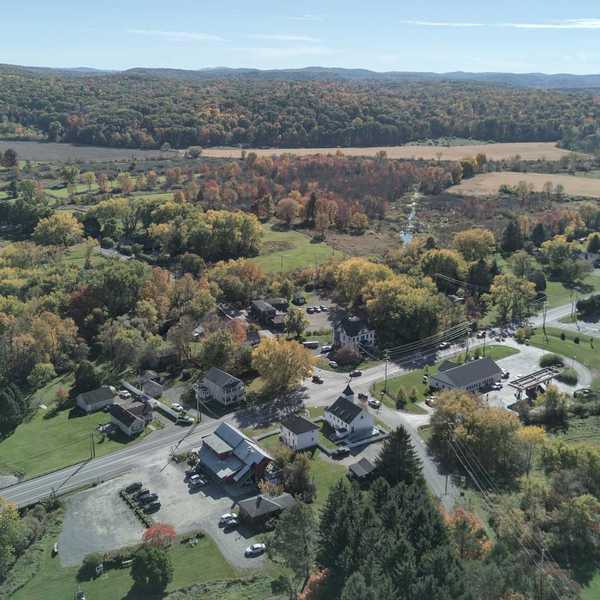
A subdivision application for the 705-acre Keane Stud Farm property on Depot Hill Road that proposes 31 lots, 26 of which are large residential lots was discussed by the developers who sought a review of the project’s status, visual concerns, and definition of next steps.
“The application is for a subdivision approval, not a site plan approval,” Attorney Kolev reminded the board.
Rennia Engineering, represented at the meeting by Rich Rennia, has created the subdivision drawings for review by the planning board.
Planning Board attorney Paul Van Cott instructed the board that it needs to be confident about what the applicant shows in projected home sizes and fencing plans, along with any risk of adverse visual impact. He said that the board needs to look at not only lines on the ground, but what the build-out will look like.
Van Cott said that no provisions of the present code restrict the size of a structure. Only the height of a structure or home is limited.
Andrews reminded the board that the developer’s application concerns subdivision of the land into lots that will be sold to buyers who would then need to approach the board with any plans to build on those lots.
“There are many ways to develop those lots,” Andrews noted.
Janes commented that 80% of each of the projected large-acreage lots would be designated for agricultural uses.
“What is a reasonable footprint of buildings,” Andrews asked.
“It seems like a lot of open land to do what you want,” Topolsky observed, reminding the planning board of the town’s comprehensive plan of 2007, now being updated.
Janes suggested that the developer create a viewshed map to define visual impact, with Peek voicing agreement.
Andrews reiterated that the application is for a subdivision of land, but agreed that the planning board will define deed restrictions for each lot.
In her role as Town Board liaison to the Planning Board, councilmember Rosanna Hamm raised the question of impact of the development on the underlying aquifer (town water source). The response indicated that the impact of 26 wells on a 700-acre property would be negligible.
Newly seated on the Planning Board and attending his first meeting was Jamie Vitiello who asked board attorney Van Cott for clarification of the code that would define home sizes.
Engineer Rennia had indicated that subdivision planning maps generally draw a 5,000 square foot home as an average size for planning purposes.
The Keane Stud developers will return with additional information at the Wednesday, June 26, regular meeting of the Planning Board.





 Pay Bill for Robin Starr’s service in the Continental Army.Courtesy the Alex Breanne Corporation
 John Mills speaking at Quinnipiac University.Courtesy the Alex Breanne Corporation
 Stephanie Saetta,with her rescue dog George and Blue (left), a shepherd mix awaiting his forever home.Madi Long