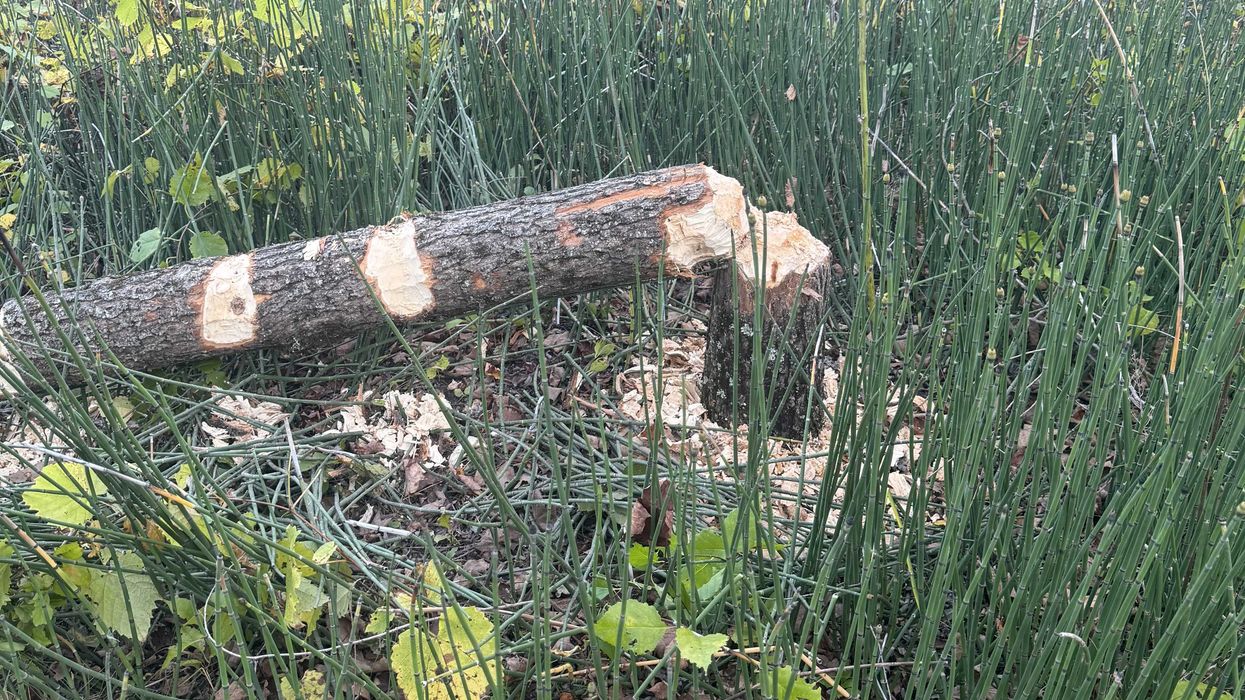
Long before we moved to Litchfield County, there had been a flood on the property caused by the breakup of a beaver dam miles away from the house, near the top of the state forest on Sharon Mountain. There, beavers have a pond whose dam usually slows the run of a stream that journeys down the mountain, under Route 7, through our property and empties into the Housatonic River. Who knows what other damage the water did on its way down from the broken dam, but the resulting flooding left a watermark about knee-high on the inside of our old cottage, now painted over.
What do beavers have to do with ungardening? At its core, ungardening is about restoring native habitats and increasing the diversity of native plants and animals in an ecosystem — aka biodiversity — which we must accomplish because, frankly, our lives depend on it.
For all their practical nuisance to humans, beavers are central to maintaining ecosystems across a large portion of the U.S. They are considered a keystone species: As with the keystone in an arch, an ecosystem will fall apart without its support. In the 18th and 19th centuries, beavers were killed nearly to extinction by trappers who sold their fur. Their return is helping to repair the areas surrounding their habitats. The homes they cleverly engineer filter pollutants, boost plant and animal biodiversity and create resilience to climate change — and they do this quickly.
Most negative human experiences with beavers result from blocked culverts and dammed streams that create the beavers’ ideal pool-like environment. This causes flooding upstream of the blockage and drought downstream.
“We need to find ways to live with beavers,” said Sandy Carlson, a teacher and poet who recently completed the Beaver Institute’s BeaverCorps Wetland Professional training in Southampton, Massachusetts.
“When beavers hear the trickle of water flowing out from a pond or stream, it triggers their instinct to block this release by building a dam. This insight led to a rather low-tech innovation that has allowed beavers and humans to more happily coexist. Cleverly called the Beaver Deceiver, the device lowers the water level of the pond without triggering the beavers’ water-trickle instinct.”
The Beaver Deceiver is a 6-foot-diameter wire mesh cage protecting one open side of a PVC pipe. It is installed in the deepest part of the pond, with the pipe running over the beaver dam — where it can be camouflaged — and into the water on the other side. Water is drawn out of the pond, lowering the water level upstream while maintaining flow downstream.
Carlson has apprenticed with Diane Honer of Beaver & Wildlife Solutions, based in Chester, Connecticut, performing site assessments and installing pond-leveler devices so beavers and humans can coexist. “People are happy because the water level is low, and the beaver thinks the water level is fine,” she said.
Last year, a family of beavers moved in nearby, building a low-profile home against the side of a large tree trunk that had fallen into a relatively deep part of the Housatonic. This created a small, pond-like area on the downriver side of the trunk.
I wasn’t aware of these creatures until one day, while walking along the river, I stopped in my tracks. Like one of those puzzles where you’re meant to spot the differences between two images, something was missing. A weeping willow we had planted a decade earlier, flourishing on the riverbank, had disappeared from view. Up close, the unmistakable V-shape of a beaver-hewn trunk was almost cartoonlike — yet not at all funny. That tree was one of the few nonnative species we planted, and I had imagined it fulfilling the romantic “leaf cascade over the water” look willows do so well.
My son told me beavers seek out willow for its salicylic acid content — the active ingredient in aspirin. I imagine they had a drug-addled willow fest at our expense.
The solution to this particular beaver problem is even more low-tech than the Beaver Deceiver: installing wire mesh or a plastic cage around trees you want to protect from beaver teeth. It also helps to know which woods beavers prefer. Their favorites include aspen, poplar, willow, alder, birch and maple. Protect those first, before hardwoods and conifers.
Let’s welcome the beaver and its ecosystem-restoration superpowers.
Dee Salomon ‘ungardens’ in Litchfield County.



 Pay Bill for Robin Starr’s service in the Continental Army.Courtesy the Alex Breanne Corporation
 John Mills speaking at Quinnipiac University.Courtesy the Alex Breanne Corporation
 Stephanie Saetta,with her rescue dog George and Blue (left), a shepherd mix awaiting his forever home.Madi Long