Latest News
Tri-Corner Real Estate - April 2026
Millerton News
Mar 25, 2026
To mow or not to mow?
Dee Salomon
Mar 25, 2026
A partially mowed meadow in early spring provides habitat for wildlife while helping to keep invasive plants in check.
Dee Salomon
Love it or hate it, there is no denying the several blankets of snow this winter were beautiful, especially as they visually muffled some of the damage they caused in the first place.There appears to be tree damage — some minor and some major — in many places, and now that we can move around, the pre-spring cleanup begins. Here, a heavy snow buildup on our sun porch roof crashed onto the shrubs below, snapping off branches and cleaving a boxwood in half, flattening it.
The other area that has been flattened by the snow is the meadow, now heading into its fourth year of post-lawn alterations. A short recap on its genesis: I simply stopped mowing a half-acre of lawn, planted some flowering plants, spread little bluestem seeds and, far less simply, obsessively pluck out invasive plants such as sheep sorrel and stilt grass. And while it’s not exactly enchanting, it is flourishing, so much so that I cannot bring myself to mow.
I have doubts:If I mow in the spring, would I kill all the overwintering insects? If I mow after the first frost, as suggested in a 2017 paper by the esteemed Kim Stoner, Ph.D., on the Connecticut AgriculturalExperiment Station website, would I lose the seed heads of yarrow, rattlesnake master and black-eyed Susan that birds are supposed to feed on in the winter?Paralyzed by indecision, I have not been able to bring myself to do even a partial cut.
I took a poll at a recent party attended by horticulturalists, environmentalists and garden experts. There was a consensus that early spring is indeed the best time to mow — early, before the ground-nesting birds like woodcock start nesting.I then called Mike Nadeau, whom I consider a meadow master of the Northwest Corner, and he concurred, following the Xerces Society meadow-mowing guidelines: mow in early spring when dandelions are in bloom.
“Xerces Society says this is the time most insects have hatched out of hollow stems and is between bird migrations.”
Nadeau’s experience has borne this out.
“I stress not to mow in fall because a dormant meadow is a haven for winter critters of all ilk.Birds use dormant plants for nesting materials, eat seeds, refuge — not to mention the other mammalian life that benefits from a meadow. An argument that has worked for me to discourage fall mowing is to describe a dormant meadow, with its myriad seed heads and foliage, as kinetic sculpture, especially with snowfall.It’s a beauty all its own.”
Nadeau mows a third to a half of a meadow each year, ideally using a flail mower, which chops vegetation into small pieces, helping foliage to resprout. The unmowed portion is left as a refuge for the animals that get evicted from their homes in the mowed area.
Stoner agrees with Mike to divide up the meadow and mowing different sections at different times. And she validates my mowing trepidation.
“There’s no perfect time. Any time you mow, you will be disturbing the habitat of some creature. If you don’t mow, you will have invasive plants creeping in, and eventually you will have trees,” she said.
“Best thing is to think about what your goals are — what creatures do want to encourage in your meadow? Then set the time of mowing to protect and enhance the habitat for those creatures.”
Additionally, Nadeau suggests that mown paths should be rerouted at least every two years to prevent rhizomatous grasses from establishing, which can grow into meadow edges and look unsightly. And the window is short:
“It’s too late to mow when spring birds arrive in earnest and new meadow growth is taller than 6 inches.”
Lights Out!
One of my favorite meadow benefits are the hundreds of fireflies that emerge in June. I am grateful for the lack of artificial light from neighbors (save for one house across the river with a persistent outside night light), so these creatures can shine brightly — and securely.
The organization DarkSky International relays the effect outdoor lights can have on fireflies: an almost 50% decrease in flashes per minute, which affects courtship behavior and mating success, according to two studies they cite on its website,darksky.org.
There, you can also get the lowdown on the devastating effects even one outdoor light can have on birds, amphibians, insects and mammals.The organization provides educational materials that explain the issue, making it easier to bring it up to neighbors and friends — which I will soon try with the house across the river.
Dee Salomon ungardens in Litchfield County.
Keep ReadingShow less

Want more of our stories on Google? Click here to make us a Preferred Source.
Capitol hosts first-ever staging of Civil War love story
Jack Sheedy
Mar 25, 2026
Playwright Cinzi Lavin, left, poses with Kathleen Kelly, director of ‘A Goodnight Kiss.’
Jack Sheedy
Litchfield County playwright Cinzi Lavin’s “A Goodnight Kiss,” based on letters exchanged between a Civil War soldier and the woman who became his wife, premiered in 2025 to sold-out audiences in Goshen, where the couple once lived. Now the original cast, directed by Goshen resident Kathleen Kelly, will present the play beneath the gold dome of Connecticut’s Capitol in Hartford as part of the state’s America250 commemoration — marking what organizers believe may be the first such performance at the Capitol.
“I don’t believe any live performances of an actual play (at the Capitol) have happened,” said Elizabeth Conroy, administrative assistant at the Office of Legislative Management, who coordinates Capitol events.
When Lavin inquired about staging the production there, “they were very excited about it,” she said.
The performance, to take place April 1, is being sponsored by the Connecticut League of Women Voters. Organizers said the Capitol setting offers a fitting backdrop for a story rooted in American history and civic life.
“A Goodnight Kiss” is a dramatic reading drawn from letters exchanged between Sgt. Maj. Frederick Lucas (David Maccharelli) and Sarah Jane “Jennie” Wadhams (Olivia Wadsworth). Fred wrote from battlefields, while Jennie wrote from the peaceful confines of Goshen. Together, their letters trace a gradually deepening romance and how the couple overcame objections by Jennie’s father, John Marsh Wadhams, and finally married in 1867.
“I just found it adorable that (Jennie’s father) was going to make sure she got the right kind of husband, which is why Fred had such a hard time,” Kelly said.
BroadwayWorld reviewer Sean Fallon called the play “the most romantic love story I have ever seen acted out on stage.”
The letters were first brought to light in the 2002 book “Fred and Jennie: A Civil War Love Story” by the late Ernest B. Barker, a Goshen resident and descendant of both the Lucas and Wadhams families. The Barker family discovered Fred’s letters in the Wadhams homestead and Jennie’s letters in a house once owned by a Lucas family member. The correspondence is now housed at the Connecticut Museum of Culture and History in Hartford.

Kelly said presenting the story through letters poses a challenge because the actors rarely interact onstage. During rehearsals, she had the performers face one another while reading their letters aloud. “It was just like magic happened,” she said.
Lavin said the play “tells the story of what truly makes America great, what made America great then, and what still makes it great, which is devotion to duty, service to others, integrity and treasuring freedom.”
David Maccharelli, who portrays Fred, said, “Charting (Fred’s) course from enthusiastic young recruit gushing with admiration for the new technology of 19th-century warfare to a man crashing into the reality of war is a reminder that even the noblest of causes demand sacrifice, and that sacrifice is often borne by innocents.”
Olivia Wadsworth said of portraying Jennie, “It’s actually a little dizzying to think about. Two people, more than a hundred years ago, sent private letters to one another, and now their love story is being shared in a performance at the state Capitol.”
The performance will take place April 1 at 2 p.m. in Room 310 of the Capitol at 210 Capitol Ave., Hartford. The event is free and open to the public with advance registration at https://bit.ly/4usa9b7. Arrangements for guests with special requirements may be made by emailing Lisa Del Sesto at admin@lwvct.org or calling 203-288-7996. Parking on Capitol grounds is limited, but additional parking is available nearby at the Legislative Office Building, 300 Capitol Ave.
Keep ReadingShow less
Hunt Library launches VideoWall for filmmakers
Robin Roraback
Mar 25, 2026
Yonah Sadeh, Falls Village filmmaker and curator of David M. Hunt Library’s new VideoWall.
Robin Roraback
The David M. Hunt Library in Falls Village, known for promoting local artists with its ArtWall, is debuting a new feature showcasing filmmakers. The VideoWall will premiere Saturday, March 28, at 6 p.m. with a screening of two short films by Brooklyn-based documentary filmmaker and animator Imogen Pranger.
The VideoWall is the idea of Falls Village filmmaker Yonah Sadeh, who also serves as curator. “I would love the VideoWall to become a place that showcases the work of local filmmakers, and I hope that other creatives in the area will submit their work to be shown,” he said.
After the screening of the two films, “Mail Myself to You” and “Circle, Circle Square,” Pranger and Sadeh will discuss filmmaking and answer questions.
Of Pranger, Sadeh said, “She has a strong visual voice as a director, and both of these films are great examples of a blend of documentary and experimental filmmaking.”

Pranger described her approach to filmmaking. “I have always approached the visual arts from an interdisciplinary, multimedia perspective.” This approach was a reason why animation was particularly appealing to Pranger as she began exploring the possibilities of filmmaking.
“I particularly fell in love with the tactility of hand-drawn and painted animation and the ways in which it can be used in tandem with analog 16-millimeter film. Stop-motion animation holds the unique power to bring inanimate objects to life, something that became crucial to my practice of archival documentary filmmaking. I appreciate the sense of play that is encouraged in the medium of animation and find great joy in exploring new avenues and possibilities within the medium,” she continued.
At the core of Pranger’s films, she hopes to capture the joy and intimacy of human connection that blossoms through engagement with material and creative process.
After the opening event, the films will remain available to view at any time on the VideoWall screen in the library stacks. “The screen will always be on and ready for anyone to use,” Sadeh said. The installations will last three to four months.
Sadeh added, “Each installation will begin with a public screening at the library, followed by a talkback with the filmmaker.”
Filmmakers can contact Sadeh at huntartwall@gmail.com for information about submitting films for consideration. Visit huntlibrary.org/art-wall for a schedule of ArtWall and VideoWall events, which are free and open to the public.
Keep ReadingShow less
A bowl full of stars
Cheryl Heller
Mar 25, 2026
A bowl full of stones.
Cheryl Heller
There’s a bowl in my studio where pieces of the planet reside. I bring them home from travels, picking them up not for their beauty or distinction but for their provenance. I choose the ones that speak to me — the ones next to pyramids, along hiking trails, on city sidewalks or volcanic slopes.
I like how stones feel in my hand: weighty, grounding. I don’t mind them making my pockets and suitcase heavier. The bowl is about the size of an average carry-on. It has been years since it was light enough for me to lift.
They’re not specimens. I’m not a scientist comparing igneous with sedimentary, or metamorphic with minerals or meteorites. I don’t know slate from quartzite, or schist from basalt or gabbro. They aren’t memories either, because I can’t tell by looking at them where they’re from. They sit quietly beside me in whatever moment I’m occupying.
They’re not souvenirs from places, like coffee mugs or snow globes. They are the places themselves.
The planet has reorganized itself in my bowl. Melbourne nestles next to the Hebrides. The streets of Roma in Mexico City rub elbows with Vatican City, Rome. Eastern Tibet sits on top of Machu Picchu; New Delhi is now close to Detroit. Cappadocia has finally met Capri. Mustique knows Morocco, and they both lie on the beaches of southern France.
These stones have witnessed the fall of civilizations, the birth and death of infinite beings, tectonic upheavals and the creative destruction of fire and ice.
Who touched them before me? Inca, Maya, Trojans? Warriors, slaves or yaks? Blue-footed boobies in the Galápagos or a slithering Costa Rican fer-de-lance? Was one of them used to stone a blasphemer in ancient Greece?
It’s not as if the place where I live needs more stones. In New England we’ve been blessed with an imposing population of glacial erratics — characters dragged here by the last Ice Age and left to sit silently in the woods for the past 16,000 years. The stones themselves, I’ve learned, are more than a billion years old.
The most ancient rocks known to us are more than four billion years old. Others are practically new, formed continually as tectonic plates shift along seabeds or lava cools along volcanic slopes. And while individual rocks vary wildly in age, the substance of rocks — atoms of silicon, oxygen and iron —is far older than the Earth itself, forged in ancient stars before our Milky Way existed.
Perhaps my bowl is filled with stars.
I recently stood before an exhibit of Aboriginal art called “The Stars We Do Not See.”The artists are descendants of the oldest continuous civilization on Earth, at 350,000 years. Their past is not distant or inaccessible to them; they understand time as a cycle and live in relationship with everything on earth and sky, including stones.
The title of the show was inspired by the late Yolŋu artist Gulumbu Yunupingu, who painted the night sky on bark. She spoke about the “stars behind the stars” — all there is to learn and appreciate beyond what we can see.
Deep in the woods on the hill above our house in Norfolk sits a giant marshmallow-shaped rock, one of the billion-year-old ones. At some point, someone leaned a ladder against it — a standing invitation to a new perspective.
How can we know the things that are invisible, the stars behind the stars? How can we feel connected to what came before us and sits silently around us, too slow for our impatient eyes to see?

Every once in a while, someone leans a ladder against a rock so we can’t miss it. Most of the time, we’re on our own.
I sometimes joke with my younger sister that when I die, she and our nieces can divide up whatever I leave behind, including the handbag she has had her eye on for years. But who will see and care about a bowl of rocks too heavy to lift and too silent about their value to be appreciated?
This is for you, Lynn, Stacey, Katie and Rose.
I hope you keep the planet in my bowl together.
It might be, after all, my small and only lasting intervention in the world.
Cheryl Heller is a designer, educator and business strategist who pioneered the field of social design and founded the first social design MFA program at the School of Visual Arts. She lives in Norfolk.
Keep ReadingShow less

Want more of our stories on Google? Click here to make us a Preferred Source.
loading

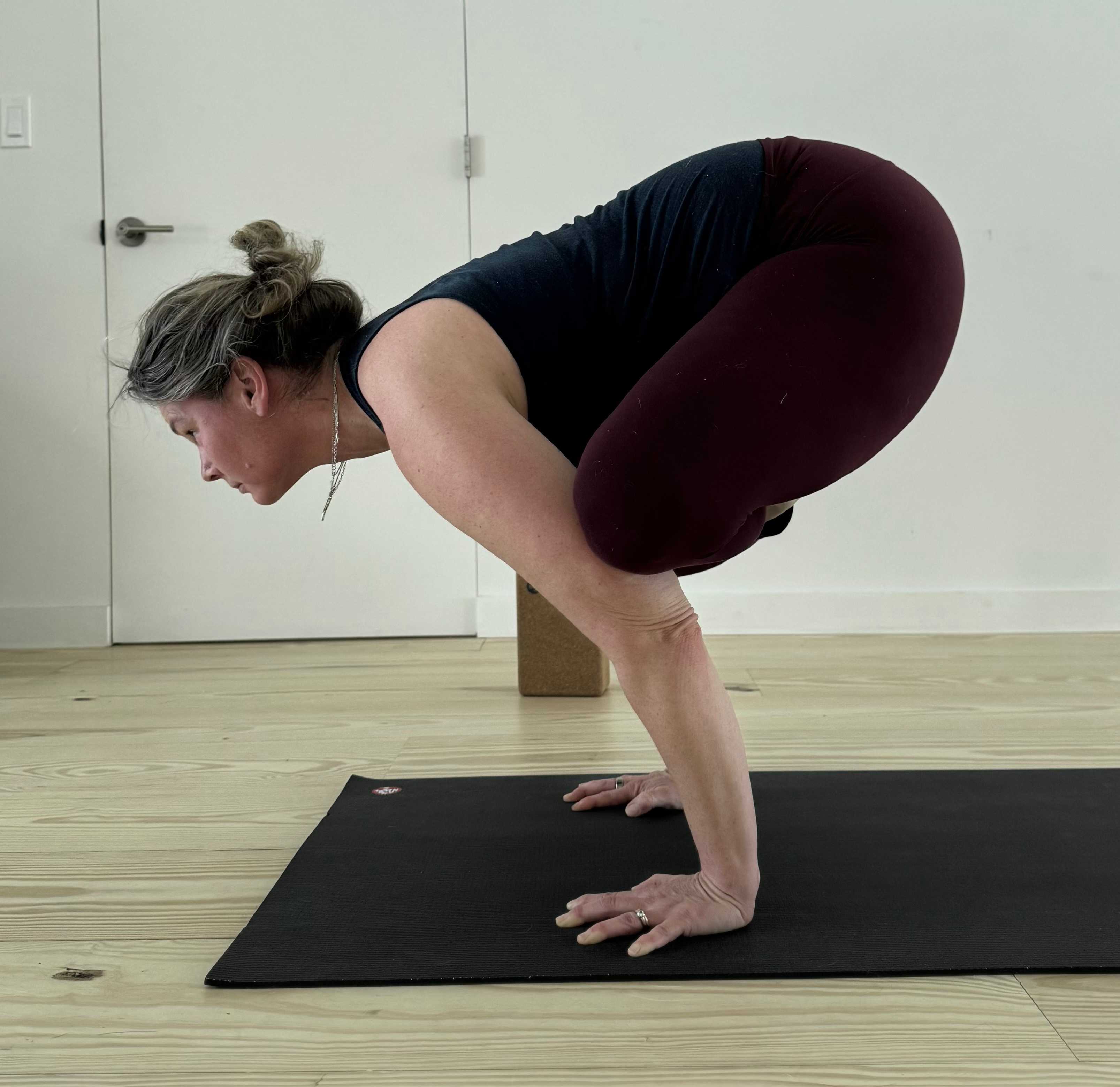
Kathy Reisfeld practicing yoga.Elena Spellman