Everything you know, everything you think you can plan for in the next 10+ years is wrong. Faster than the changes to the backbone of civilization and industry during the ‘70s and ’80 resultant from the Apollo Program (computer chips, MRI, CAT Scans and an endless list — including your cell phone) — what is taking place now will change everything on Earth in the next 10 to 20 years.
Data centers and all communications are moving off Earth. Why? Because computers and data centers (which are only many, many computers in one warehouse) need massive cooling and cooling needs energy. Some data centers now operating use more electricity than the New York City Subway system, hour after hour, day after day. The same data center, in space, in near absolute zero needs only low power for the chips from solar panels. China is building a solar array in space, right now, with a design of over one square mile. Yes, almost 6 football fields in size.
Now, let’s explain something here. Arthur C. Clarke, the sci-fi author, was a brilliant scientist. He calculated a point above the Earth where the gravitational pull of Earth would balance out with a satellite’s inertia to move away from Earth and the satellite would, in effect, rotate over a specific spot on Earth… seemingly stationary above that point. Originally called the Clarke Orbit, it is now called GEO (geostationary orbit). You put your computer and data center at that point and up and down links to Earth are constant and clean.
A scientist recently said, “You control GEO and you control the world’s industry and communication.” When you put Quantum computers at GEO along with the data centers, you can save more than 50% of all — the entire! — electrical consumption now being built and planned for on Earth.
Now you may wonder at news items about a return to the Moon. That same scientist said, “And if you control the Moon, you also control GEO.” Why? Because the moon has all the advantages of low gravity, easy solar arrays, and cool temperatures for these data and computer locations. Oh, and the moon has lava tubes for safe habitation and there’s Helium3 there — a vital cooling chemical for Quantum computers. Why Quantum computers? Quantum computers compared to the fastest current computers are like a F1 race car is to a hula-hoop. One Quantum computer recently performed a calculation that would have taken a Cray Supercomputer 10,000,000,000,000,000,000,000,000 years to perform, it did it in under 5 minutes. Couple that with automation and AI and tasks will be performed you cannot possibly imagine.
Think space exploration is all about satellites and warfare? Medical research in zero gravity accounts for 50% of the greatest breakthroughs in medicine in the last decade—that’s why Russia is staying in the game with another $56,000,000,00 next year to rebuild their own space station. And China? Their space station is growing in size and capability, already 75% of ours.
The Apollo era brought us a 100% change in everything we have, everything we use, everything we know, design, invest in, and invent. This next space era will come quicker and with more fundamental change than you can possibly imagine. So, the message I want to impart here? Space is the future. Buckle up and get involved.
Peter Riva, a former resident of Amenia Union, New York, now lives in Gila, New Mexico.





 Tiffany Lemelin, shelter manager, brushing Marsala upon arrival.Provided
 Michael DeBarba, certified dog trainer working with Marsala.Jennifer Almquist
 Marsala wins a heart.Jennifer Almquist
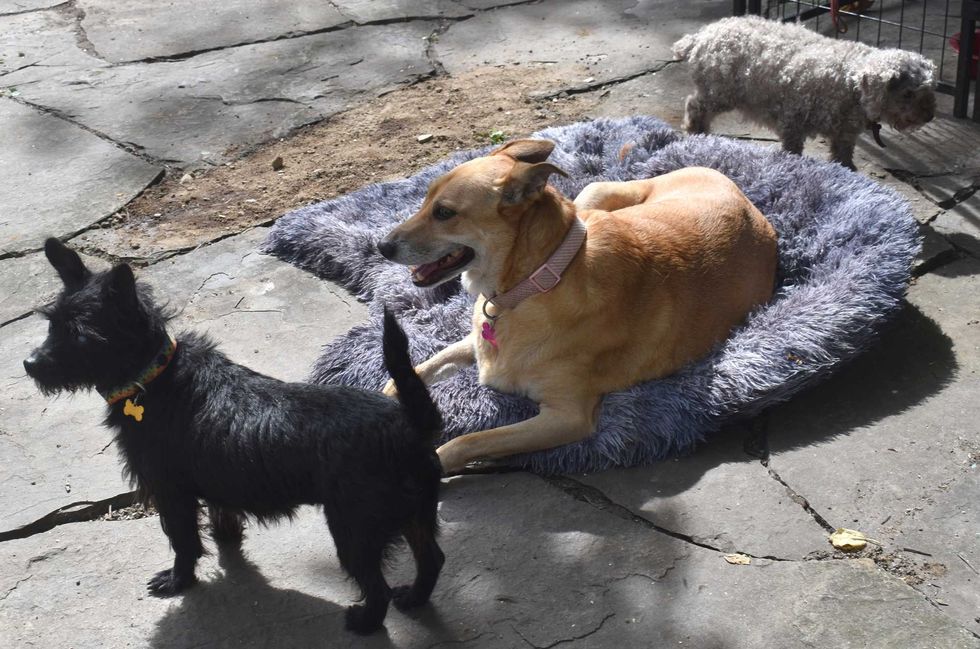 Sadie, center, a Carolina dog, plays with her friend Negra, a terrier mix. Bella Linda, the small poodle, has since been adopted.L. Tomaino
 Wesley, a young, exuberant mix, is looking for an active home.L. Tomaino
 Bonnie and Clyde, an affectionate terrier pair.L. Tomaino