SALISBURY — Those of us who have been following the story from the beginning knew one day it would happen. The trash-to-energy plant of the Materials Innovation and Recycling Authority (MIRA), which at its peak accepted the garbage of some 70 towns, including most in the Northwest Corner, is closing in July.
The question of what to do with our garbage has, therefore, taken on new urgency. Should our towns stay with the quasi-public MIRA and pay much higher fees to ship their garbage to MIRA’s transfer station, where it will be loaded onto other trucks and shipped to farflung states that will accept the smelly cargo?
Or should each town essentially go it alone and contract with private haulers to do the same thing? Either way, the garbage will be shipped out of state and likely be disposed of in landfills or incinerators similar to MIRA’s crippled plant in Hartford.
But before answering that question, it’s worth asking whether the Lamont administration’s refusal to consider the rebuilding of the plant is a wise move. It’s worth considering the cost of spending the $330 million to upgrade the plant versus the cost of trucking all that waste out-of-state over that same period of time.
As yours truly observed in an op-ed last year for CTNewsJunkie, shortly after the Lamont administration announced it was washing its hands of MIRA’s woes, “some of the costs associated with the rebuilding of the MIRA plant could be bonded out over 30 years, with the remainder passed on to member towns.”
There are obvious environmental costs in sending our trash out-of-state to sit in landfills, where it produces methane, as opposed to burning it here and generating electricity. Furthermore, as Thomas Swarr, an ad-hoc member of the MIRA board, wrote in The Hartford Courant, the garbage going to the out-of-state landfills will surely produce methane leaking from containment systems.
Methane, a notorious greenhouse gas, adds 34 times the impact of CO2 emissions to global warming, without the benefit of generating enough electricity to power 150,000 homes, as MIRA’s plant does. And of course, the out-of-state transport plan likely will include a fleet of dirty diesel-powered trucks that will log perhaps thousands of miles per day.
We have yet to see a cost-benefit analysis of the state and 49 towns shelling out hundreds of millions of dollars to bail out the embattled MIRA, versus the transportation and tipping costs associated with the out-of-state shipping plan. Nor have we seen an analysis of the environmental implications of the added truck traffic, and the loss of the MIRA plant’s electricity to the grid.
“We are actually in a waste management crisis — really not only in the state of Connecticut — but in the nation,” Bethel First Selectman Matt Knickerbocker told NBC-CT’s Christine Stuart last year.
So where do we go from here? The Lakeville Journal editorial board — hardly a body given to hyperbole or intemperate rhetoric —agrees with Knickerbocker. The board has correctly pronounced the Northwest Corner’s waste management crisis “dire” and the alternatives “hard to swallow.”
Most Northwest Corner towns have decided to hold their collective noses and stick with MIRA.
As he and his colleagues prepared to sign the agreement with MIRA at a meeting earlier this month, Falls Village Selectman David Barger summed up the feeling of resignation: “I’m hesitant, to say the least, in signing this, but I’ve done my due diligence and don’t see an alternative.”
If, as expected, the MIRA trash-to-energy plant shuts down for good in five months, then it goes without saying that the first step would be for all of us to produce less trash. That means we need to start by upping our game on recycling and throw away fewer biodegradables.
But that’s easier said than done. Many residents and renters don’t have room on the properties to compost, and those who do, don’t want to attract bears and other nuisances by storing garbage in their backyards.
The Salisbury-Sharon Transfer Station has long had one of the best recycling rates in the state. And last year, station manager Brian Bartram and Transfer Station Advisory Committee Chair Barbara Bettigole started a pilot project to direct household food waste from the garbage stream to a commercial composting facility.
This is a much-needed first step, but we all know it won’t be enough because there are some people who are either indifferent or just don’t care. Unless towns want to lose even more money on their transfer stations than they already do, they’ll need to raise the fees for vehicle stickers.
Try as we might to reduce the amount of food waste and recyclables that go into the waste stream, there are some who will resist, either actively or passively. They need an incentive to reduce the volume of refuse they put into the garbage hopper.
“Pay-as-you-throw”
Perhaps the most effective program is the so-called “pay-as-you-throw” (PAYT) system, whereby consumers and commercial haulers pay by the volume of waste they dump. PAYT is still relatively rare in Connecticut (only a “handful” of towns use it, according to the state Department of Energy and Environmental Protection) but it has been a common practice for decades in nearby New York state. In localities where it’s been implemented, the volume of garbage generated has declined significantly and, in some cases, dramatically.
According to DEEP, which has rebranded PAYT as Save Money and Reduce Trash (SMART), the volume of garbage generated per person in Connecticut averages 740 pounds. The town of Coventry, which uses SMART, produces 500 pounds of trash per capita, nearly two-thirds of the state average. The town of Stonington adopted SMART in 1991 and has seen $7 million in savings since then. According to a study by the Northeast Waste Management Officials Association, communities that implement SMART reduce waste by 40% to 55%.
“Pay-as-you-throw has done what the city had hoped,” DEEP quoted the general services director of Concord, N.H. as saying. “Recycling rates are up, trash volume is down and the city is spending fewer tax dollars to get rid of it.”
And there are revenue opportunities that could be explored. Some transfer stations that use SMART are open to other communities that lack facilities. This is true, for example, in the resort community of Lake George, New York, where the Queensbury transfer station is open to all comers who are willing to pay the per-bag fee, which ranges from $3 for a small kitchen bag to $10 for a large 90-gallon bag. The recycling of paper, plastic and glass is free.
Invite other towns?
The per-bag price is slightly higher than the actual cost of disposing of the garbage, so the program is a revenue generator that also helps fund the operations of the transfer station itself.
Back in Salisbury, there is another revenue stream that is ripe for the picking.
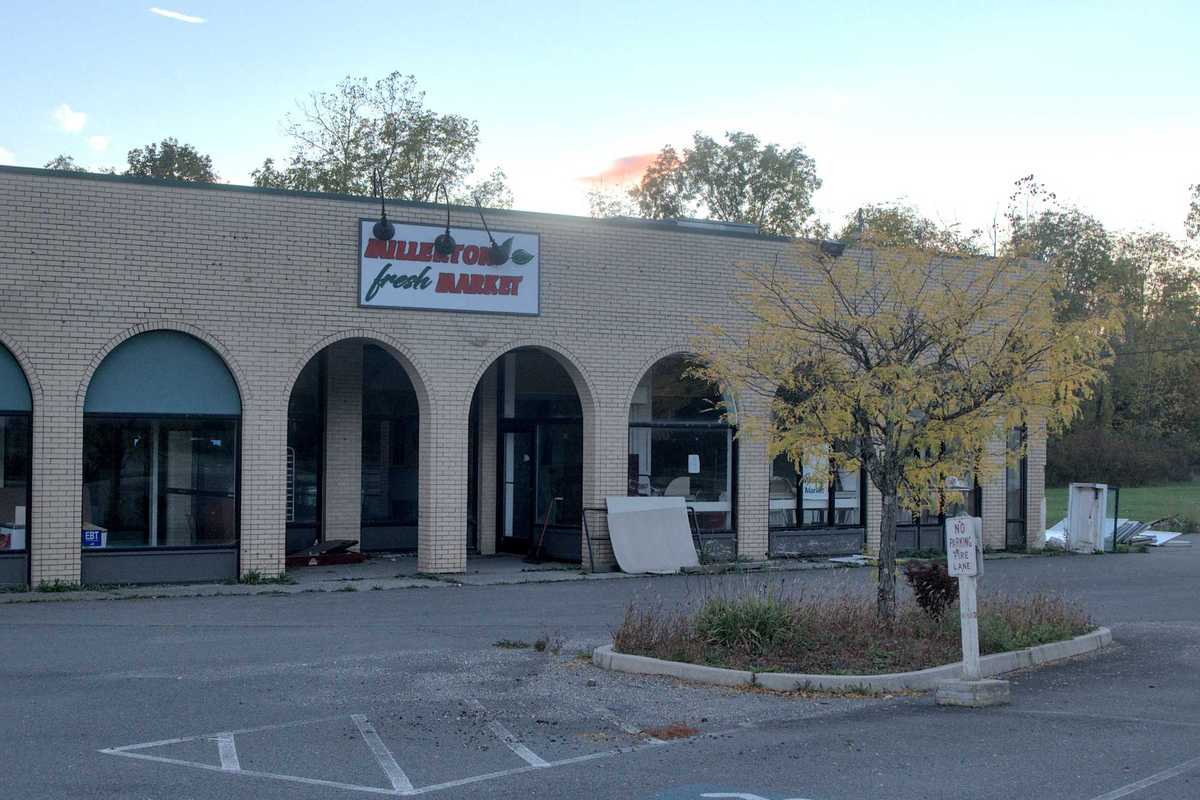
A stone’s throw away from the Salisbury-Sharon Transfer Station lies the village of Millerton and the surrounding town of North East, New York. The town and village have been without a transfer station for decades, so residents must hire private haulers or drive 15 minutes south on Route 22 to Amenia, where a commercial transfer station is operated by Welsh Sanitation.
If the Salisbury-Sharon Transfer Station were to adopt SMART, the station could be open to residents of towns not served by transfer stations, thereby providing an additional revenue stream to help reduce the operational costs to taxpayers in Salisbury and Sharon.
Though many quotations attributed to him are apocryphal, Albert Einstein did, in fact, observe that, “In the midst of every crisis, lies great opportunity.” That maxim applies here. Even those who object to pay-as-you-throw will have to acknowledge that the old way of thinking will no longer suffice.







 Tiffany Lemelin, shelter manager, brushing Marsala upon arrival.Provided
 Michael DeBarba, certified dog trainer working with Marsala.Jennifer Almquist
 Marsala wins a heart.Jennifer Almquist
 Sadie, center, a Carolina dog, plays with her friend Negra, a terrier mix. Bella Linda, the small poodle, has since been adopted.L. Tomaino
 Wesley, a young, exuberant mix, is looking for an active home.L. Tomaino
 Bonnie and Clyde, an affectionate terrier pair.L. Tomaino