Millbrook takes two wins in Webutuck visit

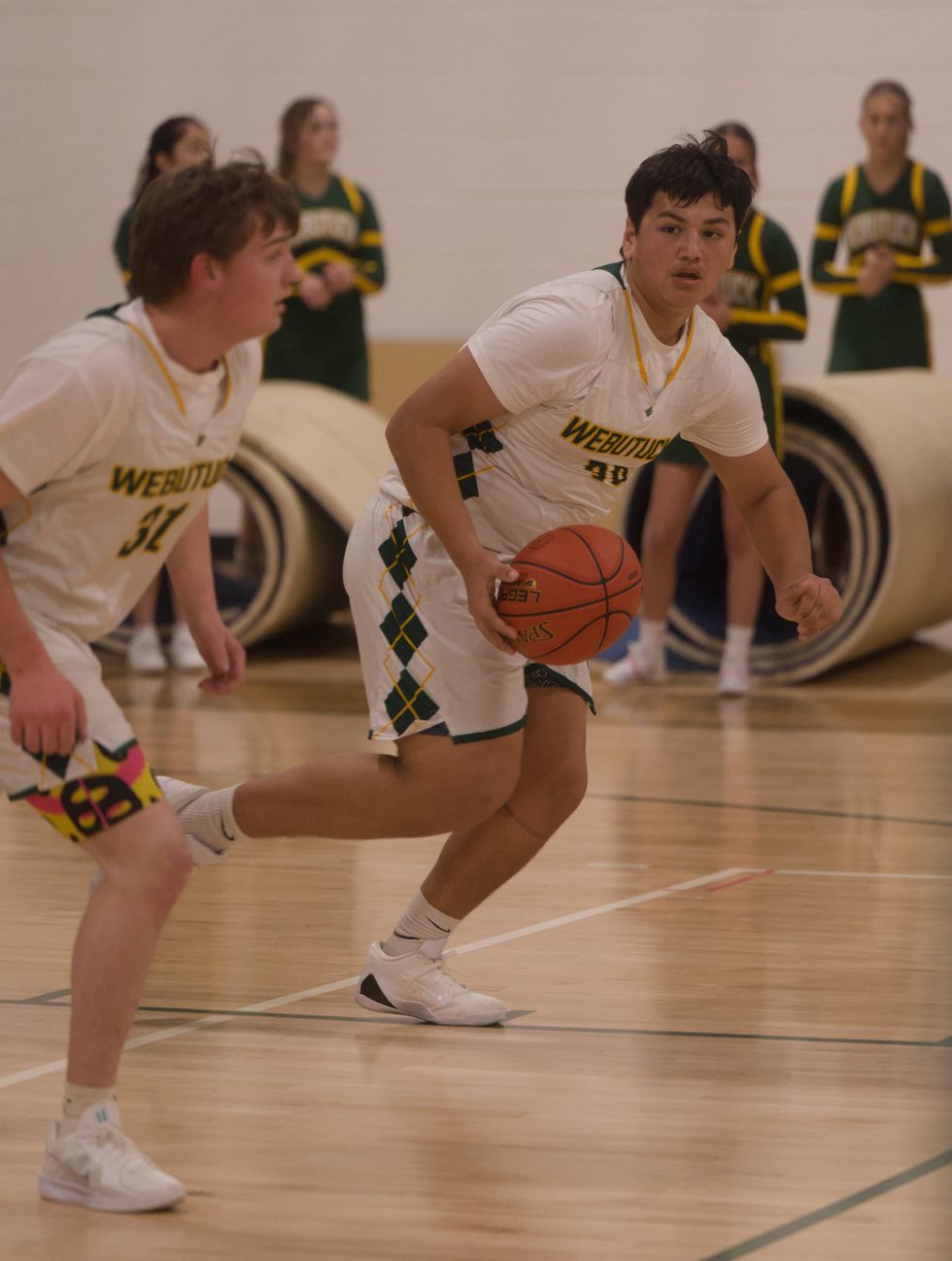
Millbrook won both games at their visit to Webutuck High School Friday, Jan. 24. Millbrook’s junior varsity squad beat Webutuck 55-30 and the varsity squad won 58-34.
Photo by Nathan Miller

Millbrook won both games at their visit to Webutuck High School Friday, Jan. 24. Millbrook’s junior varsity squad beat Webutuck 55-30 and the varsity squad won 58-34.
AMENIA — The Millbrook Blazers travelled to Webutuck High School on Friday, Jan. 24, for a pair of basketball games.
First the junior varsity squads took the court, ending in a 55-30 win for Millbrook.
Then Millbrook’s varsity squad took another win, beating Webutuck’s Wildcats 58-34.
Fans filled the bleachers in Webutuck’s high school gym rooting for both teams and occasionally trying to coach the players.
Webutuck’s biggest struggle in the night was securing rebounds, evidenced by shouts from coaching staff and fans alike to “crash the boards,” and “box out.” The Wildcats’ struggle under the net let Millbrook get more possessions and more attempts at the goal per possession throughout the night. For basketball laymen, the squad which can get more shots up almost always scores more.
By halftime of the varsity game, Millbrook was leading Webutuck by more than 15 points — a lead which would turn out to be insurmountable. Webutuck responded to Millbrook’s performance in the first half by ramping up the heat slightly in the second, but their efforts were in vain. Millbrook matched almost every Webutuck basket.
The Webutuck boys will return to the court on Friday, Jan. 31, when Onteora High School visits for another Friday night game at Webutuck High School.
The Millbrook boys will host Rhinebeck High School Friday, Jan. 31, as well.

Millerton firefighters clean off their trucks at the firehouse garage on Century Boulevard after the annual Santa Run on Saturday, Dec. 6.
MILLERTON — As the holiday season ramps up and the calendar year winds down, the Millerton Fire Company is reflecting on a year with record-high call volume and clear objectives for 2026.
This year, the all-volunteer department surpassed 425 calls — the most the department has seen in at least eight years. Fire officials said the number far exceeds recent annual totals, and there has been a year-over-year increase.
Not only does the department respond to fire emergencies and rescue calls, but it also plays a critical role in emergency medical services, especially in a region grappling with slow ambulance response times, limited support from the county and shifting ownership of private services relied on by the town and village.
With a new leadership lineup, taking effect Jan. 1, both the fire company and district will enter the new year with deep experience across fire, EMS and military backgrounds — and with a renewed focus on training and community outreach.
Fire Chief Keith Roger, who has been a firefighter for 35 years, will continue as chief for the second consecutive year — his third term overall. Roger held the position back in 2005 and 2006.
“I’m looking forward to working with these guys and handing down what I’ve learned,” Roger said, noting that his leadership approach is more about teaching and preparing others to rise through the ranks.
On the less stressful calls, he said he intends to let newer officers take command while he stands close by to guide them. “My focus is now helping them move up the chain.”
Roger will also organize and facilitate training, which occurs on a near-weekly basis.
“Our goal is to ensure everyone’s training is up-to-date and that they receive the best possible training,” Roger said.
Company vice president Chris Reyes, who will also serve as 1st Lieutenant, said Roger’s return provides stability and momentum.
“I’m re-energized having him back as Chief for a second year,” said Reyes, who joined the team in 2020. “It really feels like we’re building off of a fresh foundation.”
The department emphasized the strength of its incoming command staff, which includes career firefighters, veterans with military leadership experience and longtime volunteers who have trained together for years.
Reyes described the fire company as a tight-knit and supportive team — even after a contested captain’s race during the December elections — and called the department a second family.
“When a call comes in, people from every walk of life suddenly come together and speak the same language to protect our community,” said Reyes. “It’s magical.”
In the coming year, leadership expects to maintain its focus on rigorous training, including skills drills, ladder work, air-pack practice, hose advancement, basic life support and CPR refreshers. Nearly all members are New York State-certified in CPR and AED. The company is also anticipating the purchase of a new rescue truck, though delivery is likely 18 months away.
Chocolatier Christophe Armero and his wife, Jennie Baird, handcraft small-batch Mudgetown Chocolate in Millerton. Free tastings will be available at Tri-Corner Feed in Millerton on Saturday, Dec. 13, at noon and 3 p.m.
MILLERTON — There’s wine tasting, beer tasting and even coffee tasting – but Millerton is adding something sweeter to the mix. A craft chocolate tasting event will mark the debut of Mudgetown Chocolate on Saturday, Dec. 13, at Tri-Corner Feed. Two free tastings will be held at noon and 3 p.m.
Mudgetown Chocolate is made in Millerton by Sharon-based chocolatiers using cacao beans sourced from all over the world. Saturday’s event will mark the official launch of the small-batch line at Tri-Corner Feed, one of the only places it will be available.
“Our goal is to delight the community with something special,” said Christophe Armero, chocolatier and founder of Mudgetown Chocolate. He describes his product as a “delicious, locally made chocolate that can’t be purchased anywhere else.”
The business began as a retirement passion project for Armero, who spent 38 years in the sugar industry. After moving full-time to Sharon in 2020 from Riverside, Conn., he and his wife, Jennie Baird, began experimenting with chocolate in their barn in 2022. “I realized quickly that it’s very easy to make mediocre chocolate,” Armero joked.
After becoming more interested in the process, he grew determined to master the craft. In 2024, he landed an internship at Dandelion Chocolate in San Francisco, where he learned the tricks of the trade.
“It was a bit intimidating because I was this older guy and all the other chocolatiers were young and very professional,” he laughed. “But they taught me a lot.”
Today, Armero can speak fluently about each step of the chocolate-making process, from sourcing the bean and fermentation to roasting, cracking and “melanging,” most of which is done right here on South Center Street in Millerton.
Tri-Corner Feed’s incubator kitchen
Tri-Corner Feed has a bustling storefront where community members can find locally sourced produce, nutrient-dense groceries and even a chai latte – all with sliding scale prices. And there is just as much action happening behind-the-scenes in their fully licensed commercial kitchen.
It’s here that entrepreneurs and early-stage businesses like Mudgetown Chocolate can roll up their sleeves and create products in an affordable space without the burden of high startup costs.
Armero uses a small, 1-kilogram roaster in Tri-Corner’s kitchen, followed by a cracking and winnowing setup that uses a shop vac to suck out the shells and leave the nibs behind. Then, nibs spend 48 hours or more in a granite stone melanger, where they break down and release natural cacao butter. During this part of the process, the bitterness softens and new flavors develop.
Locally made, globally sourced
Armero and Baird purchase cacao beans directly from small farms and fermentaries in countries like El Salvador, Colombia and Uganda. The couple even traveled to Ecuador to visit one of their producers, prioritizing direct relationships whenever possible, which sets them apart from other commercial producers.
Armero said he hopes to bring more local partners into his chocolate business for future creations. “We’ve made some fantastic chocolate infused with whiskey,” he said, adding that he also has a vision of creating a chocolate bar with crunchy bread crumbs. His goal is to partner with local distilleries and bakeries to make this a reality.

Commercial chocolate vs. craft chocolate
Armero said the key differences between commercial chocolate and craft chocolate are “scale and objective.” Big-brand names rely on facilities designed to transform commodity beans into large quantities of uniform chocolate designed to meet the brand’s distinct taste.
Unlike these chocolate giants, Mudgetown Chocolate and other craft makers work in small batches, coaxing the best flavors out of beans. You might get a slightly different flavor with each batch. With only two ingredients in their dark chocolate – cacao and sugar – the results are highly dependent on the bean itself.
Armero said, “We’re always trying to get the best out of the beans.”

A sensory experience
Armero and Baird describe their upcoming chocolate tasting as a full sensory experience, explaining that tastes can last from 30 seconds to a minute and evolve in that time.
“You get the top notes first, which are usually floral, lighter notes,” said Baird as she bit a chunk of chocolate. “Then you get the mid-notes which tend to be chocolatey and nutty, and then you get the end notes.”
The couple instruct tasters to crunch first, then let the chocolate melt on your tongue. They recommend breathing in through your mouth and out through your nose for the full effect. And, whatever you taste, Armero and Baird say it’s correct. “Everyone’s different,” Armero said. But everyone is right because it’s entirely subjective.”
The chocolate tastings are free and open to the public. They will take place at Tri-Corner Feed at 56 South Center Street in Millerton.
AMENIA — Revisions to the town regulations outlining the separate roles and structures of the Planning Board and the Zoning Board of Appeals (ZBA) will be considered at public hearings on Thursday, Dec. 18, at Town Hall, beginning at 7 p.m.
Amendments to the local code seek to clarify the structure of both boards, along with the appointment of alternates, training, attendance and the process for removing members. Residents are invited to comment on the proposed regulations during the public hearings or to provide written comments in advance.
The five-member ZBA, whose members serve five-year terms, would be expanded with the addition of two alternate members appointed by the Town Board for one-year terms, should the changes be adopted. If a ZBA member is absent or must recuse due to a conflict of interest on a particular application, the chairman would seat an alternate in their place.
Requirements for four hours of training annually would apply to all members, as well as alternates under the new code.
Under the proposed attendance requirements, ZBA members may not be absent for more than three consecutive meetings or for more than eight meetings within a calendar year.
Under the amended codes, the seven members of the Planning Board would serve for seven-year terms. The Town Board would appoint two alternate members, each for one-year terms. Four hours of training would be required for all members annually. No member would be allowed to be absent for more than three consecutive meetings or a total of five meetings in a calendar year.
Copies of the proposed local laws can be viewed on the town hall website at https://ameniany.gov.
North East Town Hall in Millerton, where officials continue to discuss updates to the town’s zoning code.
MILLERTON — Planning Board members raised a mix of broad and detailed concerns about the Town of North East’s proposed zoning plan during a special meeting on Wednesday, Dec. 3 — their final discussion before the public hearing set for Jan. 8.
The 181-page draft plan represents a rewrite of the town’s decades-old zoning code, updating definitions, commercial use rules, and standards for parking, lighting and design. Town officials say the overhaul is meant to eliminate inconsistencies and give applicants and reviewers a clearer, more functional set of rules.
At Wednesday’s meeting, Planning Board members offered comments that ranged from line-by-line concerns to questions about how cohesively the document functions as a whole.
Planning Board member Dan Sternberg offered the widest critique. “I think as a whole, this draft is not well drafted. I think as a legal document — as a piece of legislation — it’s got a lot of problems. It reads like something drafted by committee.”
Sternberg suggested the document should be considered more holistically, and the language of the proposed draft should be more consistent and clear.
He said lifting examples of codes from other towns likely contributed to the disjointedness of the draft. “The language used in it may not be consistent with some of the language of the rest of our code,” Sternberg said. “I’ve read lots and lots of agreements, lots and lots of legislation over the years, and seeing the drafting process, I can tell that this was kind of stitched together.”
Board members appeared reluctant to scrap the draft outright, arguing that doing so would dismiss several years of work by volunteers and consultants. Instead, they expect to recommend that the Town Board focus on clarifying sections where the language is not clear.
Planning Board member Bill Kish, who served on the Zoning Review Commission that drafted the commercial zoning overhaul, offered a defense of the draft.
Kish emphasized that nothing in the draft was borrowed casually. He said that anything that was borrowed was the subject of at least one full meeting and it was discussed again. “This is about as good as you can get using the process that we had,” Kish said. “That’s all I can say.”
Nevertheless, Planning Board Chair Dale Culver said he agreed with Sternberg's criticism. "I'm never in favor of lifting other towns' codes that are a long ways from our town," Culver said. "Because we tend to get their slant of their view for their code for their town. And our town may be different. It quite often is."
It remained unclear at the close of the meeting whether Sternberg’s broader criticism would be included in the Planning Board’s formal memo to the Town Board. The implications are significant: if the critique is included, it signals that the full board believes the draft needs broader revision. If it is not included, the Town Board receives a narrower set of recommendations, and Sternberg’s concerns will arrive only through his individual memo.
Board members did have consensus on other comments that will be included in the board's memo. Board member Leslie Farhangi requested that the phrase "cage-type poultry" be removed from the draft entirely.
Farhangi also recommended — and the board agreed — that approvals should include an expiration date. Board members noted that a plan could be approved and then remain unbuilt for years, while the town changes.
The Planning Board's memo has not yet been drafted as of press time. Planning Board members were also encouraged to submit individual letters to the Town Board expressing any concerns that the board didn't have consensus on.
"We can't have it be all unanimous consent," Culver said. "Because if that's the case, are we all thinking or are we just listening and agreeing?"