Local group urges Millerton officials to publicly condemn ICE tactics

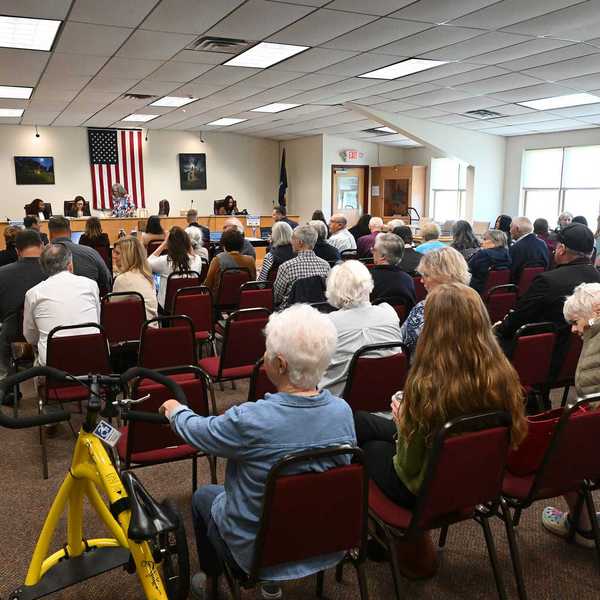
The Millerton Village offices on North Elm Avenue.
Photo by Aly Morrissey


MILLERTON — Immigration enforcement became a central focus of the Village Board of Trustees meeting Tuesday, Jan. 27, which drew a group of residents who called on officials to take a public stance in support of vulnerable community members.
Following routine agenda items, community members used the public comment period to urge the board to publicly oppose Immigration and Customs Enforcement (ICE) activity and affirm protections for local residents. It marked the fourth time in eight months that residents have appeared before the village board to urge action on immigration enforcement, with no action or policy change to date.
Nine residents raised concerns about what they described as increasingly violent and deadly immigration enforcement across the country.
Eliot Ramos, who had previously addressed the village board on the issue, read from prepared remarks, saying she was “extremely distressed and emotional.”
Ramos urged the board and the police department to take action, warning that she was close to losing faith in local elected officials if they did not commit to protecting the human rights and safety of all residents.
“I urge you to be public in showing our community your moral compass,” Ramos said. “Please show us that we have elected people who really do care.”
During the meeting, Trustee Katie Cariello — who is several months into her first term on the board — said she hopes to keep ICE out of Millerton. Other trustees, including Deputy Mayor Matthew Hartzog, Matt Soleau and David Sherman, did not share their views during the meeting and did not respond to requests for comment at the time of publication.
Meanwhile, Mayor Jenn Najdek declined to comment following the meeting and would not say whether the board plans further discussions or next steps.
The village is not required to respond to public comments during their board meetings, but Cariello, Police Chief Joseph Olenik and village attorney Victoria Polidoro engaged in a conversation with attendees and answered several questions about hypothetical scenarios that could play out in Millerton.
“If our police officers are present and another officer — whether federal, state, or sheriff’s department — was breaking the law and abusing somebody against the law, we would have to take action,” Olenik said, though it was unclear whether that action would be through force in the moment or through a report and investigation.
Olenik and Polidoro said it is highly unlikely that ICE would notify the Millerton Police Department of its plans — or ask for assistance — given its part-time status and lack of involvement in immigration enforcement.
Although Olenik previously stated his department was legally obligated to support federal agents — and said in an August 2025 conversation with The News that he would not ask to see a judicial warrant prior to assisting ICE with an arrest — he offered a more conditional response during Tuesday’s meeting, saying he would ask to see documentation and provide support if it was lawful.
“We treat all our people in this community with dignity, respect, and compassion,” Olenik added. “I won’t accept anything less than that from my officers.”
After the meeting, Cariello said she appreciated the group for holding local leaders accountable. “I heard our Police Chief say that he will uphold the law, and I believe that to be true,” she said. “And I heard all of us say that we care about our neighbors and want everyone to feel safe.”
To date, Millerton has not entered into any voluntary agreements with ICE, as some cities and towns have done in states like Florida and Texas. During the meeting, Cariello said she would vote to oppose any such partnership in the future. Najdek and other board members did not state their position when asked.
Other residents put pressure on the board to weigh in. Laura O’Loughlin also read prepared remarks that were co-written by what she described as a large group of Millerton and North East residents.
“We just want to keep naming that immigrants are not outsiders in our village,” O’Loughlin read, adding that they are coworkers, neighbors, business owners and friends who contribute to the strength of the community. “When they are targeted with fear, intimidation, or violence, it harms us all.”
O’Loughlin went on to express concerns about the national pushback on protesters by the Department of Homeland Security (DHS).
“Peaceful protest is a cornerstone of our democracy,” she read. “Responding to it with force, especially against communities that already face disproportionate scrutiny and harm, is unacceptable.”
North East resident Bill Kish spoke to the importance of civic responsibility.
“I feel that if there’s one thing I can do — and that others can do — at this point in time, it’s to speak to power at every level, starting with the people who are here in this room,” Kish said, gesturing toward the board. He urged trustees to recognize that “people are sad and angry and scared,” asking them to carry those concerns up the chain of command.
Kish concluded the final 30 seconds of his allotted time with a moment of silence for the lives that have been lost at the hands of federal officials.
Gov. Kathy Hochul proposes Local Cops, Local Crimes bill
Three days after the village board meeting, Gov. Kathy Hochul proposed a bill that would limit local police departments like Millerton from providing support to ICE.
The legislation would prohibit state and local police from assisting in federal civil immigration enforcement or using taxpayer-funded resources for that purpose. It would also restrict federal agents from using local detention facilities for civil enforcement activities.
Natalia Zukerman
Elyse Deublein Harney (center) celebrates with Keith Harney, Elyse Harney Morris, Paul Harney and Michael Harney after receiving an honorary doctorate from St. Joseph’s University.
On May 19, Elyse Deublein Harney returned to St. Joseph’s University in New York City, her alma mater, where she graduated in 1952. Before the crowd gathered for the university’s 107th commencement ceremony, the Salisbury resident, entrepreneur and community leader received an honorary doctorate and delivered the commencement address to the Class of 2026.
The recognition arrives at a meaningful moment for the Harney family. In February 2027, Elyse Harney Real Estate will celebrate its 40th anniversary, joining Harney & Sons Fine Teas, co-founded by Elyse and her husband, John, in 1983, as one of two enduring family businesses that have shaped both the region and the family’s legacy.
At a moment when many people are expected to reflect on their accomplishments, Harney used her commencement address to talk instead about possibility.
“God has a job for you,” she told the graduates. “Something that you alone can do.”
That line may very well be the organizing principle of a life that has included hotel management, raising five children, launching two businesses, serving on local boards, helping found the Salisbury Volunteer Ambulance Service and, somehow, still finding time to reopen conversations about preserving historic institutions.
One of the most striking parts of Harney’s address centered on beginning again.
When she and her husband were 50 years old, the partners of the White Hart Inn in Salisbury, where John was general manager for many years, decided to sell. Suddenly, the couple needed a new source of income.
John launched what would become Harney & Sons Fine Teas, and Elyse opened a real estate office across the street.
“Simple as that, I did,” she told graduates with characteristic understatement.
Of course, anyone familiar with the growth of Elyse Harney Real Estate knows there was nothing simple about it. What began as a small local office became one of the most respected real estate firms in the region, helping define the market across northwestern Connecticut, the Hudson Valley and the Berkshires.
Her commencement address wandered delightfully through subjects that rarely appear together: Nobel Prize-winning genetic research, French entrepreneurs, Catholic education, self-driving cars, German teachers and divine purpose.
At one point, Harney reflected on the women who educated her at St. Joseph’s.
“They made it very clear we could do whatever we wanted to do, if we were willing to work for it,” she said. “Being a woman was not a handicap.”
For graduates entering a world transformed by artificial intelligence, political upheaval and economic uncertainty, Harney offered neither nostalgia nor easy reassurance.
“AI is here,” she said. “We have to learn to use it and to control it.”
After discussing technology, entrepreneurship and faith, Harney turned to the subject of consciousness. Quoting author Michael Pollan, she shared the final lines from his new book, “A World Appears: A Journey Into Consciousness,” that she said had stayed with her:
“Consciousness is a miracle, truly. It is the most mysterious of things, and yet it can be put in one short sentence: I open my eyes and I see the world.”
Then she offered her final message to the graduates.
“Open your eyes and see the world.”
At 95, Elyse Harney is still opening her eyes and seeing the world. Thankfully, she’s still telling the rest of us what she finds there.

Want more of our stories on Google? Click here to make us a Preferred Source.
Richard Feiner And Annette Stover
Think logically and then break the mold with creativity.
— Pilar Proffitt
Pilar Proffitt is forging a remarkable artistic path grounded in her long history in Northwest Connecticut. Proffitt is a true Renaissance woman with a quirky sense of humor — a visual artist, architect, designer of interiors, furniture and products, and curator of home furnishings.
Her latest grand project is still quite literally under wraps. Large windows obscured by construction paper on a bustling avenue in Manhattan prevent passersby from peeking into the 15-story boutique hotel designed and furnished by Proffitt for an international hotel group, which is nearing completion. The hotel’s lobby, restaurant, common areas and rooms stand out for their attention to design — from the furnishings, colors and fabrics to the mosaic floor tiles, hardware, wrought-iron gates and stairs, selection of antique books, and the art on the walls. The collection includes paintings by Proffitt, photographs by Wassaic Project co-Executive Director Jeff Barnett-Winsby, time-lapse photography by Xan Padron and classics from the Warhol Factory.
Proffitt and her husband and business partner, Robert Bristow, are well-known leaders in the art and architecture communities, and their home, studio and workshop in Lakeville; store and office at 16 Main St. in Salisbury; and gallery space in Norfolk are vibrant hubs for arts and design in the region.
Proffitt has been coming to the area since she was a teenager. Originally from Puerto Rico, her family moved to the New York City area in the 1970’s. Her artist and architect father encouraged her interests in art and design and her deep desire to create. At school, she excelled in math and art and soon realized that this was all she wanted to do. “Think logically and then break the mold with creativity,” she said.
Armed with a degree in visual art from Trinity College, she pursued advanced studies at Berkeley and Pratt before receiving a master’s degree in architecture from Virginia Tech in Blacksburg, Virginia, where she met Bristow. Both landed apprenticeships in Boston and were drawn to the arts community in Norfolk centered around the Yale Summer Arts Program. The area quickly became their personal and family anchor.
They started Poesis, a furniture design and manufacturing studio, with a small loan from her mother. They landed a major house project and soon met a hotelier at a party who hired them on the spot to design a hotel in Washington, D.C.
Proffitt said, “I was hooked because it combined everything I wanted to do creatively: design experiences in the broadest sense with all the supporting pieces of the puzzle — furniture, objects, art. My father felt that architecture was the Renaissance profession: It holds the seeds of art, design, engineering and all the other ingredients. For me, it all starts with art.”

Proffitt is devoted to the area. She and Bristow raised their family in Lakeville. Their daughter Grace, a sculptor, attended Hotchkiss and is pursuing her MFA at University of Pennsylvania. Their daughter Ellis, also a graduate of Hotchkiss and Trinity, is a mathematician and aspiring actress in Los Angeles; and their son Sam attended Salisbury School and is a junior at Trinity, majoring in art history with a minor in architecture. They all are carrying forward the family’s passion for arts, architecture and design.
Proffitt’s interior design work and unique furniture pieces welcome visitors at Hotchkiss’ Art Center, the Scoville Memorial Library, her own wHole hOuse shop in Salisbury and, soon, across the street in the new Jam Food Shop, which is expected to open this fall.
The region’s many museums and galleries include some of Proffitt’s favorites, from Mass MoCA and the Clark to Salisbury’s Geary, Mad Rose in Millerton, Jack Shainman in Kinderhook and Art Omi in Ghent. Proffitt loves the connections and new opportunities brought to the community by the increase in full-time residents, as well as impromptu get-togethers with friends — recently watching a Knicks playoff game at the tavern bar at the White Hart. Moments like that keep her grounded here.
In addition to the White Hart, Proffitt is a fan of area restaurants, including Fern for a quick pasta at the bar; Isabela in Amenia, where Michelin-starred chef Jose Ramirez Ruiz is from Puerto Rico; and Clare de Boer’s Stissing House in Pine Plains.
A perfect day for Proffitt is spent working in her studio overlooking Lake Wononscopomuc, without distractions, rain or shine. It is a quiet and peaceful place that supports her many architecture and design projects. When asked what she would say to a younger version of herself just starting a career, she responded, “Don’t be so shy. As one of my professors told me, ‘Sometimes you just have to crash the party.’ Draw, write, run, play tennis. And travel!”
D.H. Callahan
The set for “Swingtime Canteen” transports the audience to WWII London.
Dateline: 1944. A platoon of our boys are stationed in London, waiting to be sent to the mainland to fight the Axis powers and liberate Europe. While they wait, a group of glamorous gals from Hollywood are sent over to distract them with singing, dancing and a few memories of home.
That’s the scene at “Swingtime Canteen,” the new production now on stage at the Sharon Playhouse.
From the moment you enter the playhouse, the stage takes you right back to another time, with recruitment and War Bonds posters setting the tone alongside soldiers’ footlockers and blankets. When the lights go down, the smiles of the cast light up the room, and the audience is quickly recast as a troupe of American G.I.s.
What follows is a jukebox musical in the truest of sense, bouncing from one 1930s hit to more “contemporary” 1940s tunes and back again, all performed with the kind of polished finish audiences have come to expect from the Sharon Playhouse.
The gals in the band are our entire cast, and they spin yarns in between numbers, throwing the spotlight back and forth between the five singing-and-dancing sensations. But they don’t stop there. Between piano, saxophone, drums and even a banjo, they work with the musicians on stage to create that quintessential ‘30s and ‘40s sound.
“Swingtime Canteen” transports its audience to a time when, unlike today, there was very little division among Americans. The war they were fighting had a 97% initial approval rating from U.S. citizens. In a year when the nation is celebrating its 250th anniversary, the production serves as a reminder of a moment when Americans largely shared a common purpose and a common enemy. Even if the swinging songs of the ‘30s and ‘40s aren’t your thing, the production is a marvelous little escape to a time when life was a little simpler and the lines between good and evil were a little clearer. For showtimes and tickets, visit sharonplayhouse.org
Thomas Jensen
Aerial view of The Shed at Tanglewood.
The Tanglewood classical music schedule is loaded with gems. Here are eight to consider:
Thursday, July 9, 8 p.m., in Ozawa Hall. The dynamic duo of Augustin Hadelich, violin, and Seong-Jin Cho, piano, take on works by Brahms, Janacek, Beach and Prokofiev. Whether you get seats in the hall or sit outside on the lawn, you will not regret getting to this one.
Friday, July 10, 8 p.m., in the Shed. Seong-Jin Cho plays Tchaikovsky’s Piano Concerto No. 1 and excerpts from “Swan Lake.” This special evening features dancers from Boston Ballet and will be wonderful for the ears and the eyes.
Saturday, July 18, 8 p.m., in the Shed. The BSO, with Joe Hisaishi conducting, Jean-Yves Thibaudet on piano and Song Hee Lee, soprano, will perform Hisaishi’s “Adagio for Two Harps and Strings,” Ravel’s Piano Concerto in G, Hisaishi’s “Da-Ma-Shi-E” and Hisaishi’s “Symphonic Suite from Princess Mononoke.” The multitalented Hisaishi will be the most accomplished Japanese artist to grace the grounds since Ozawa’s time. Not to be missed.
Sunday, July 19, 2:30 p.m., in the Shed. The BSO, with Andris Nelsons conducting, Daniil Trifonov on piano and Thomas Rolfs on trumpet, presents a powerful program: Haydn’s Symphony No. 22, “The Philosopher”; Shostakovich’s Piano Concerto No. 1; and Beethoven’s Symphony No. 2. This is quite a lot to take in. Rolfs remains one of the orchestra’s most compelling virtuosos, and his trumpet playing is always worth hearing live. Trifonov, legendary on piano, playing another Russian legend’s finest music; extraordinary. Then, Beethoven. Better get there early.
Friday, July 24, 8 p.m., in the Shed. The BSO, with Andris Nelsons conducting and the brilliant Augustin Hadelich on violin, performs Mozart’s Violin Concerto No. 5 and Tchaikovsky’s Symphony No. 3, “Polish.” Hadelich is worth seeing again and again; the tones he produces are so sweet.
Saturday, July 25, 8 p.m., in the Shed. The BSO, with Andris Nelsons conducting and Paul Lewis on piano. The super-catchy Mozart Piano Concerto No. 27, K. 595, will have Lewis demonstrating his artistic command of tempo and tone while dancing and blending delightfully with the orchestra. Tchaikovsky’s Symphony No. 4 follows after intermission, and you’ll practically float home.
Thursday, July 30, 8 p.m., in Ozawa Hall. The Danish String Quartet, which brings a lot of energy to the stage, performs Stravinsky’s “Suite Italienne,” Beethoven’s String Quartet No. 16 in F, Op. 135, and arrangements of Danish folk songs. Come to hear Frederik, Rune, Asbjørn and Fredrik. Skål!
Friday, July 31, 8 p.m., in the Shed. The BSO, with Esa-Pekka Salonen conducting and Yefim Bronfman on piano. The power of Wagner’s “Prelude and Liebestod” from “Tristan und Isolde,” followed by Sibelius’ Symphony No. 7 and Beethoven’s Piano Concerto No. 5, “Emperor,” will leave you feeling like you are the new emperor.
Other events of note: Friday, July 17, 8 p.m., in the Shed. The BSO performs John Adams’ selections from “Nixon in China.” Also, don’t miss Laurie Anderson’s curated series of events Aug. 13, 15 and 16.
For a full schedule and tickets, visit bso.org/tangle
wood

Want more of our stories on Google? Click here to make us a Preferred Source.

Want more of our stories on Google? Click here to make us a Preferred Source.