“We want a Supreme Court which will do justice under the constitution – not over it. In our courts we want a government of laws, not of men.”
Franklin D. Roosevelt
John Roberts was nominated to replace Sandra Day O’Connor as a justice on the Supreme Court in July 2005 – three days later Rehnquist died and Roberts was nominated for Chief Justice as his replacement. The most vocal Democratic resister to Roberts’ confirmation was the new Senator Barack Obama who contested that though Roberts would be unquestionably qualified for 95 % of Supreme Court cases, he would be lacking for 5% of cases requiring depth and width of empathy – Roberts was for the strong over the weak. Roberts was confirmed 72 – 22. Four years later, January 20, 2009, Roberts bungled the Presidential oath of office at Obama’s inauguration, the oath was redone on January 21. Both men had been president of the Harvard Law Review – Roberts in 1978 and Obama in 1990.
In 2005 the Supreme Court enjoyed approval ratings over 60% - comfortable, respectable. In 2026, their approval rating is 42%, disapproval 57% - nearly a full reversal. The Court has lost the trust of a majority of the nation, 69% are in favor of term limits for Justices versus lifetime appointments. The stability of the law is in question. Many cases have been overturned, some cases have been decided with extraordinary outcomes for money in elections, for immunity from prosecution for the executive.
In 2010, the Supreme Court announced a decision, so contentious that it had to be re-argued, that overturned bans on corporate independent expenditures to favor unlimited corporate expenditures in elections. In 2016, total expenditures on Presidential and Congressional elections was up from $7 billion in 2008 to $18.3 billion boosted by super PACS and dark money whose donors were non-disclosed. Citizens United v. Federal Election Commission has transformed campaigns and impacted election outcomes. The Roberts Court ruled 5-4 with Roberts writing the opinion.
Voting rights have been struck down by three Supreme Court cases: Shelby County v. Holder (2013), Students for Fair Admissions v Harvard (2023) and Louisiana v. Callais (2026). The first decision eliminated requirements that certain states with histories of discrimination obtain federal preclearance before changing their voting laws. The Harvard case bans Affirmative Action for admissions. The final Louisiana decision limits the Voting Rights Act.
Roberts in his opinion in 2013 wrote: “The conditions that originally justified these measures no longer characterize voting in the covered jurisdictions.” The Roberts Court ruled 5-4 then 6-3.
Dobbs V Jackson Women’s Health Organization overturned Roe v Wade reaffirmed by the Supreme Court on four occasions. The Roberts Court ruled 6-3 with a scathing majority opinion written, leaked by Samuel Alito. Abortion is favored by 80% of Americans.
The nation continues to reel as the Supreme Court ruled that all former presidents possess absolute immunity for their core constitutional powers and immune from all official acts. The decision is broadly opposed as it undermines the principle that no one is above the law. The Roberts Court ruled 6-3 with the majority opinion written by Roberts.
Supreme Court overturned decisions have also impacted guns as well as the separation of church and state. An unusually high quantity of case have resulted in “shadow docket” findings which have no vote by the Justices, no explanation, no opinion. Additionally, the Supreme Court has overturned a surprising number of lower courts decisions in favor of the current administration.
The conclusion of the 2025-2026 Supreme Court season is upon us. Expected is another major decision regarding birth right citizenship now guaranteed in Section 1 of the 14th Amendment. Unexpected may be the unfurling of a gigantic Trump poster on the Supreme Court’s 92-foot “greek-temple” on First Avenue in DC. The Trump poster currently on the DOJ is 88 feet long – so a duplicate fits here even though such a Trump image would cover the west facade’s declaration of“ Equal justice under law.” Not all would be bothered or even notice.
“Members of the Supreme Court have lifetime tenure because they’re not suppose to do politics.”
Ben Sasse
Kathy Herald-Marlowe lives in Sharon.




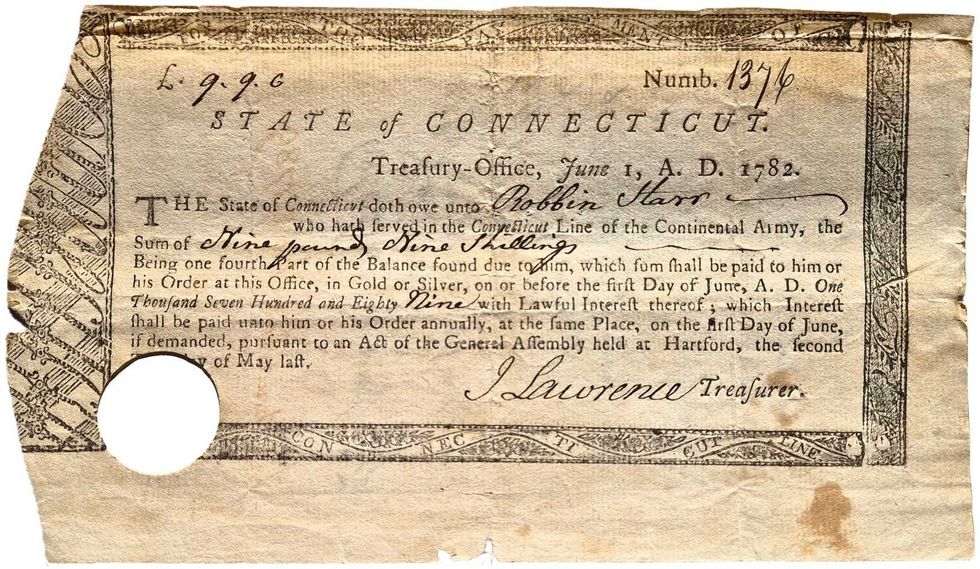 Pay Bill for Robin Starr’s service in the Continental Army.Courtesy the Alex Breanne Corporation
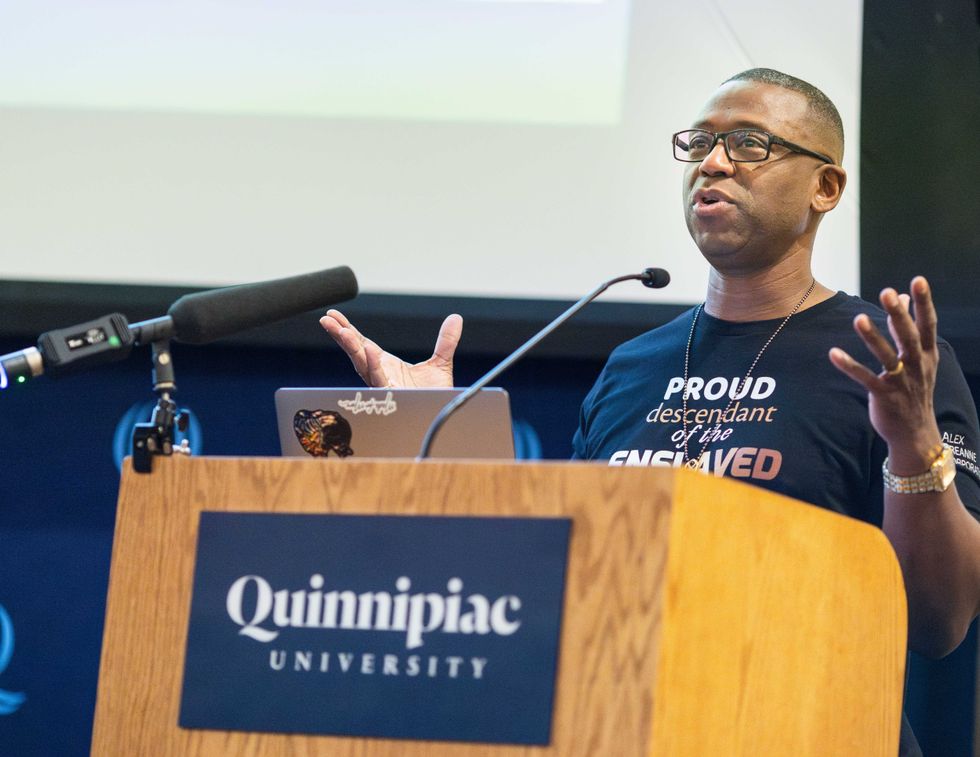 John Mills speaking at Quinnipiac University.Courtesy the Alex Breanne Corporation

 Stephanie Saetta,with her rescue dog George and Blue (left), a shepherd mix awaiting his forever home.Madi Long