They come together, one right after the other: Easter, Mud Season and Spring Vacation. These are all occasions that parents/grandparents either love or dread, when there are multiple children indoors running around together, often with sugar in their bloodstream.
Crafts were invented for just such times as these. In future weeks we will try to do a few projects to help keep families thriving and happy. As they used to say when I was young, the family that plays together stays together.
When I was working as a craft editor for children’s magazines in New York (and simultaneously when I was the mother of a young child), I learned that crafts in magazines are done for visual effect and that most children can’t or won’t do them. What children really like to do is decorate things — and, of course, they like to run around and to hunt for things.
This craft is designed to have something for all ages, and it includes running around and hunting.
I have no problem with children eating sugar, especially as long as those children are not running around in my house. Easter is a notably candy-centric holiday; this craft can be done with or without sugar.
An alternative to egg dye
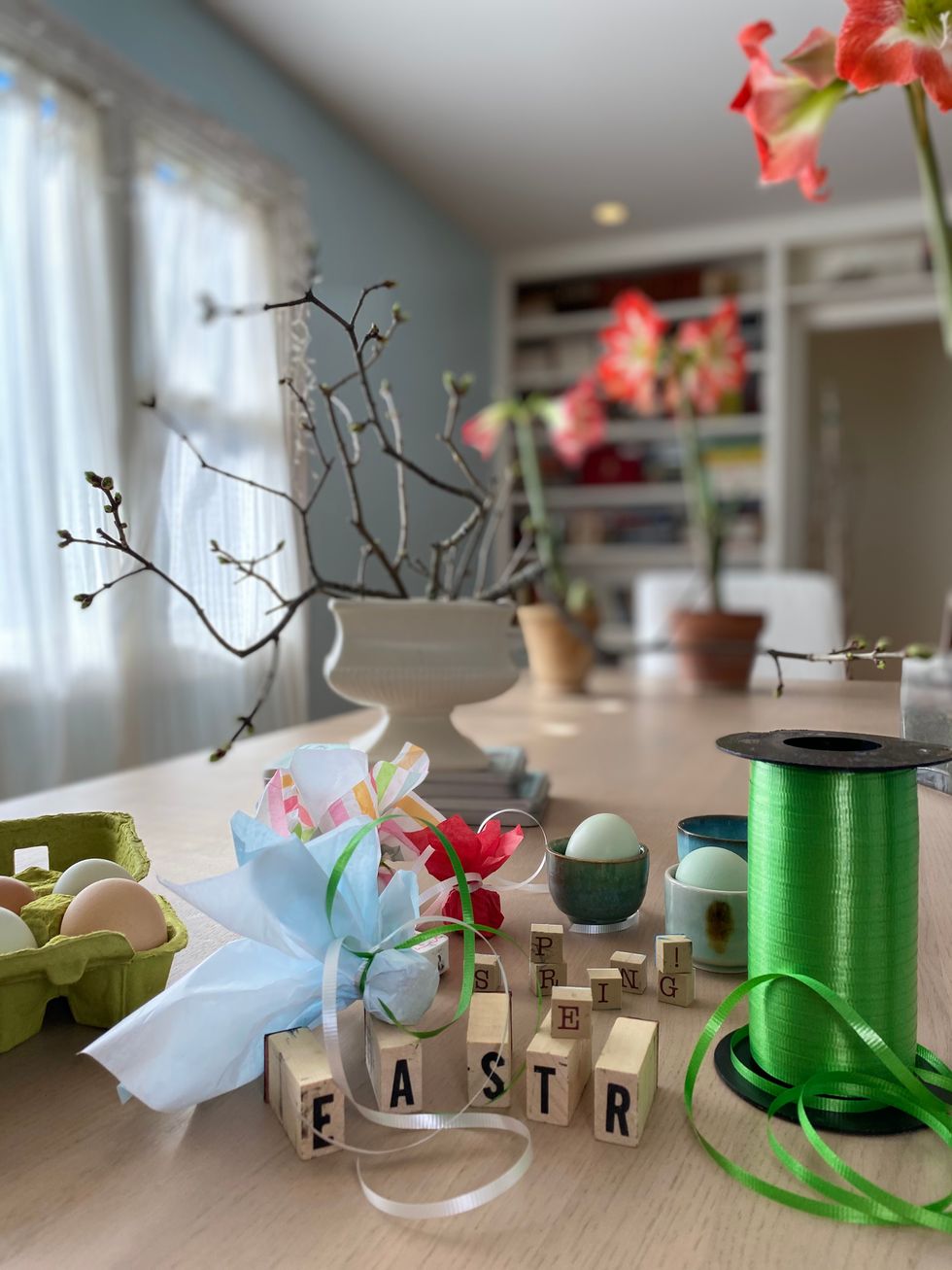
The essence of this project is the creation of gift bundles that can be hidden, and then hunted.
The bundles are easy to make and can be filled with candy — or they can be filled with rubber stamps or decorative stickers. If you put stamps and stickers in them, I promise you that almost all children of any age will quietly spend at least a half hour making pictures and little story scenes on paper.
The stickers can also be used to decorate boiled eggs. Yes, you can do the old-fashioned dying of the eggs but it’s fairly easy in this rural part of the world to find eggs that are naturally colorful (the farmstand on Wells Hill Road in Salisbury will often have blue/green eggs). And you probably know this already but children really hate the smell of vinegar, which you have to use to dye your eggs.
You can avoid the smell by using stickers. You will also avoid all the mess and bother that comes with dying eggs, and I’ll reiterate that children love nothing more than to decorate things.
In addition to stickers, you can get some craft glue such as Elmer’s and have some feathers and glitter on hand (although of course then you have mess; make sure you cover your worktable with old newspapers to make cleanup easier).
The children can decorate pictures on paper, or they can decorate the boiled eggs.
Tissue paper hobo sacks
To create the little bundles, get some tissue paper from any large grocery store or pharmacy (you probably have some left over from the holiday season) and get some inexpensive curling ribbon (again, you probably have some in your basement already).
On a heavy piece of paper or cardboard, measure an 8 inch square and cut it out. This will be your template. Trace the square onto your tissue paper and cut several squares. It’s fun to combine colors of paper in two layers. This is probably a job that’s best done by older children, or by a parent in advance of the craft project.
If you’re using rubber stamps, and the stamps are too big to fit in an 8 by 8 square, make a larger template.
Put your rubber stamp inside the tissue paper, cut about 12 inches of ribbon and then gently pull the edges of the paper up over the top of the rubber stamp to create a little sort of beggars pouch (as they’re called in cooking, or hobo sacks as they used to be called during the Depression). Tie it shut with the ribbon.
Older children can help with making the bundles; very young children probably can not. You’ll know best what your children can do without getting frustrated (or ripping the tissue paper).
Word search and numbers game
For children who are old enough to read, you can buy rubber stamps that spell out seasonal words such as Easter or spring (or mud).
Most stamp kits only have a single letter, so you’ll need to get two or more stamp kits if you want to spell out a word such as Egg or Rabbit (stamps are available at most big box and craft stores; don’t forget to buy ink pads in multiple happy spring colors).
You can count out the number of letters in, for example, Easter and send your child off in search of six little bundles. That’s a counting game. And then when you open the bundles you can have the child put them in the proper order to spell the word.
Older children can help hide the bundles (tissue paper is at its best in dry locations; if you hide the bundles outside and it’s wet or snowy, you can put the tissue paper bundles in plastic bags, which is less cute but more practical).
The oldest children can create a treasure hunt to play with their friends; they can even use the rubber stamps to create small treasure maps, with cryptic instructions and little pirate images. Each map can lead to another map, which leads to another map, which eventually leads to a treasure (candy? a book?).
Have fun and as always on Easter: Try to keep a record of what you’ve hidden and where you’ve hidden it, so you can bring everything indoors before the plants begin to grow again in late spring.




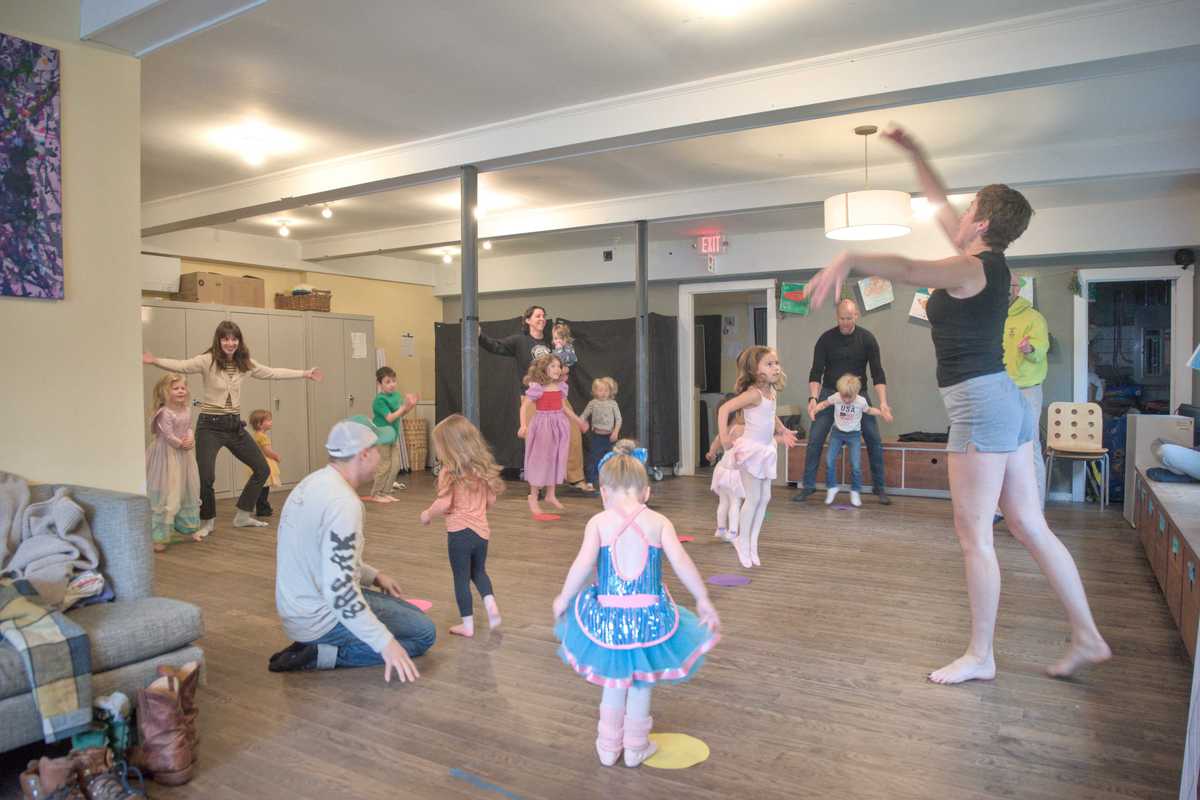
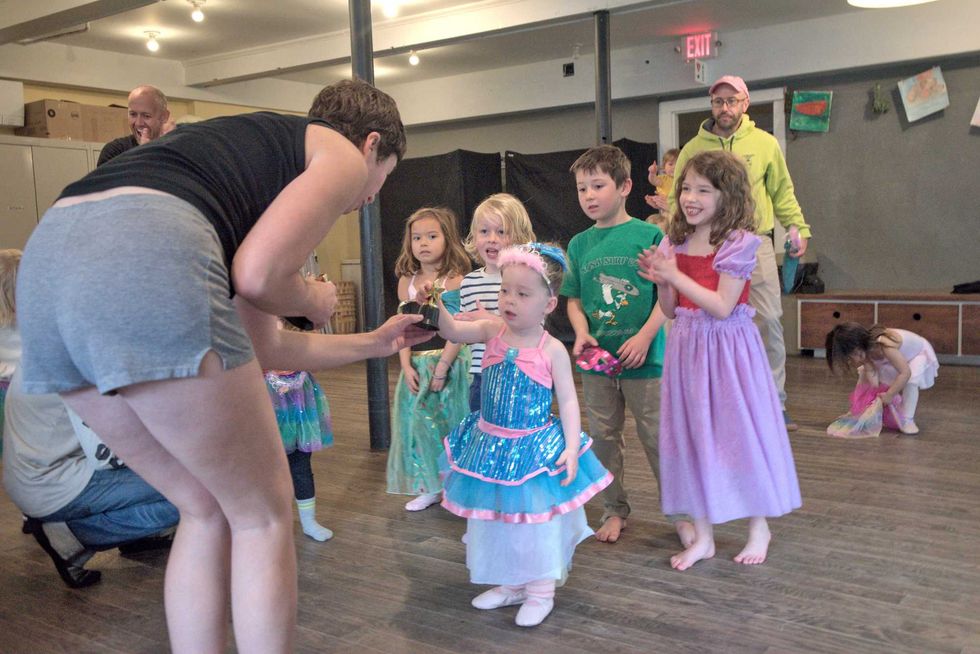 Kim Yarnell supplies all the young dancers with gold star trophies to mark their completion of the six-week pilot program at NECC on Sunday, Oct. 11.Photo by Nathan Miller


 Attendees gather at the Sharon Playhouse Sunday, Oct. 11, for the annual Jubilee gala, celebrating five years of nonprofit ownership of The Lakeville Journal and The Millerton News.Photo by Patrick Stachniak