Latest News
“The Divine Sister” comes to Sharon Playhouse for one-night benefit
Richard Feiner And Annette Stover
Aug 26, 2026
Playwright and performer Charles Busch is “The Divine Sister.”
Provided
Continuing a popular tradition, the Sharon Playhouse will present a one-performance-only staged reading of “The Divine Sister,” another riotous comic romp by the acclaimed playwright and performer Charles Busch, on Friday, Aug. 28 at 7 p.m.
The play is a wild and witty homage to Hollywood films that feature nuns — from “The Song of Bernadette” and “The Bells of St. Mary’s” to “The Singing Nun” and “The Sound of Music.” It is classic Charles Busch: wickedly funny, gloriously over-the-top and overflowing with theatrical joy.
Busch is no stranger to the Playhouse, which has previously produced readings of his Tony-nominated Broadway hit, “The Tale of the Allergist’s Wife” and his hilarious spoof, “Die Mommie Die!” High time indeed to celebrate this irreverently reverent piece of theater.
“The Divine Sister” centers on the Mother Superior of St. Veronica’s Convent and her efforts to save the struggling order and school, which are upended by mysterious visitors, forbidden romance, shocking revelations and increasingly outrageous miracles. In a review of the play’s original production, The New York Times wrote, “‘The Divine Sister’ finds Mr. Busch returned to peak form. This gleefully twisted tale of the secret lives of nuns — in which the playwright doubles as leading lady — is Mr. Busch’s freshest, funniest work in years.”
In addition to Busch, the reading reunites members of the play’s original 2010 Off-Broadway cast: two-time Tony Award nominee Alison Fraser; 2021 Isabelle Stevenson Tony Award recipient Julie Halston; and Sharon Playhouse favorites Jennifer Van Dyck and Jonathan Walker. Completing the cast is Lucy Rhoades, seen earlier this season at Sharon Playhouse in “Swingtime Canteen” and last summer in “Million Dollar Quartet.”
“This is the kind of special event we love to present,” said Sharon Playhouse Artistic Director Carl Andress. “Charles is one of our country’s great comic playwrights and performers, and every time he comes to Sharon it’s a celebration. Whether you’re a longtime fan or discovering his work for the first time, ‘The Divine Sister’ is a wonderful introduction. Reuniting so much of the original Off-Broadway cast for one unforgettable evening makes this a truly special event.”
Busch has been recognized with countless awards for his indelible contributions to American theater. He was inducted into New York’s Theater Hall of Fame in 2024 in honor of his distinctive body of work. He also is the subject of the documentary film, “The Lady in Question is Charles Busch.”
The reading will take place on the Olsen Stage, with all proceeds going to benefit Sharon Playhouse’s productions and educational programs and helping ensure that the Playhouse continues to thrive as a cultural destination for audiences and artists in the region.
“The Divine Sister” is presented by Dugazon and Pete Hathaway, producers, in association with Amy Danis and Mark Johannes, associate producers.
The day before the reading, producer Hathaway will host “A Divine Celebration with Charles Busch,” an exclusive cocktail party on Thursday, Aug. 27, from 5 to 7 p.m. All ticket proceeds from this event will also directly benefit the Sharon Playhouse.
Tickets for both “The Divine Sister” and “A Divine Celebration with Charles Busch” are available at sharonplayhouse.org.
Keep ReadingShow less
KK Kozik sees things differently
Natalia Zukerman
Aug 26, 2026
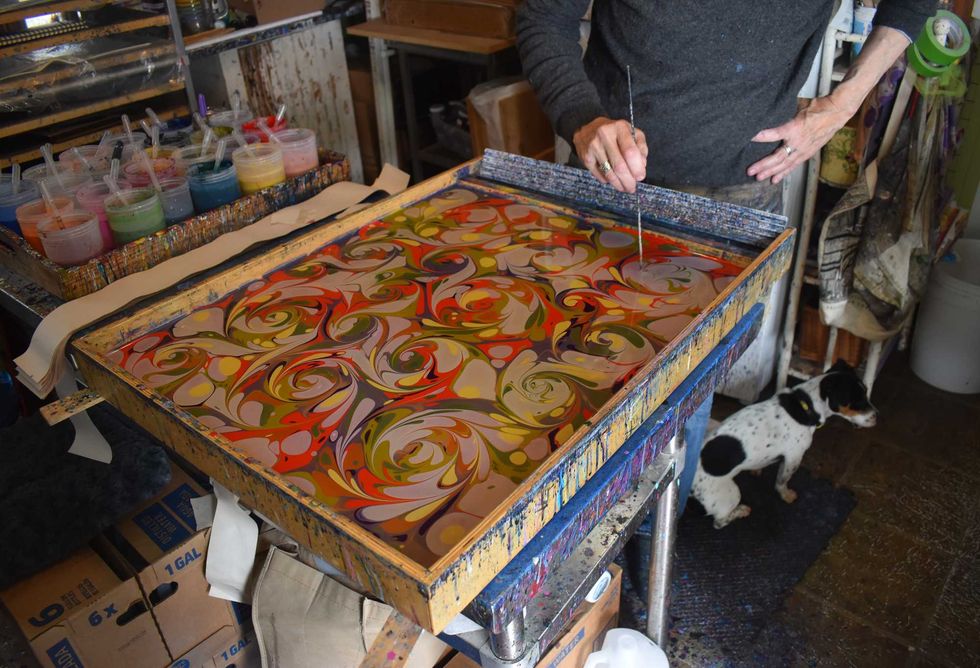
KK Kozik in her studio
Natalia Zukerman
Maybe it takes the ability to interpret what you’re looking at to really see.
— KK Kozik
KK Kozik has a theory about getting older.
“I don’t think you have eyes to see until you have eyes to see,” said the painter. “And maybe it takes the ability to interpret what you’re looking at to really see, and maybe that’s what comes with wisdom.”
It is a particularly fitting philosophy for an artist whose paintings often begin with the world around her but rarely end there. There might be something recognizable — a stone wall, an apple tree, a crow — but then there is something less certain. Something that appears to be one thing becomes another upon inspection. Memory gets involved. So does imagination. So does time.
Since moving from New York City to Sharon, Connecticut in 2006, the landscape around her has become increasingly important to that process.
“I just saw things differently,” Kozik said.
The change was not immediate. She remembers an earlier version of herself driving through Vermont without paying much attention to what was happening beyond the windshield.
“I didn’t have the means to see what was happening around me,” she said. “I just sort of la, la, la, la, la, driving to Vermont.”
But, she said, she started to pay attention differently.
“I became more sensitized as time went on,” she said.
Asked whether that change came with age, she said, “Age and so-called wisdom.”
There’s a sense of loss in her landscapes, but a particular kind of loss that also has a twinge of redemption. Specifically, what happens to a landscape when people leave it?
“When the people go away, the wildlife comes back,” Kozik said.

Kozik’s work has never settled into a single recognizable formula. She has painted landscapes, figures and still lifes, moved toward abstraction and returned to representation. Her subjects change, but the underlying impulse remains: to take what is in front of her and discover what else there might be.
Kozik describes herself as someone who is always trying to figure things out. Her paintings often have the feeling of a thought in progress rather than a conclusion. They have been called “single-line novellas,” a description that makes sense: They can contain the suggestion of an entire story without telling you exactly what happened.
The animals are part of that storytelling.
They arrived partly because of what was disappearing.
“They were like the new redemption in a way,” she said.
There is something almost funny about the way Kozik talks about this — not because the loss itself is funny, but because she refuses to turn it into a grand pronouncement. She observes something, considers it, and lets it complicate the work.
That same sensibility comes through when she talks about her own development as an artist. Her paintings make room for interpretation. They don’t always tell the viewer what an animal symbolizes, or why a landscape has been altered, or where a particular image came from. Instead, they leave enough evidence to make you curious and enough room for your own stories.
The effect is not accidental. Kozik has spent years thinking about how images work, both as paintings and as containers for ideas.
Her work is currently included in “The Naturalist,” a group exhibition on view through Sept. 13 at Kenise Barnes Fine Art in Kent, alongside Richard Klein, Sally Maca, Rick Shaefer and Tricia Wright. The exhibition brings together artists whose work engages with the natural world, including its forms, histories and mysteries.
Kozik is an especially apt fit for the exhibition. She is described by the gallery as a landscape painter, figurative painter and interiors/still-life painter whose work frequently moves toward painterly abstraction. Her practice, the gallery notes, is “fluid and continuous” — always searching for new pictorial problems to solve.
That search has also extended beyond her own studio.
For several years, Kozik ran ICEHOUSE Project Space, an 18th-century icehouse on Sharon’s town green that she transformed into an unusual venue for contemporary art. It opened in 2018 with Dan Devine’s “Inside-Out NASCAR” and went on to host site-specific projects by artists including Mark Dion, Eric Aho, Janet Biggs, Richard Klein, Kristin Jones, Lisa Hoke and Ryan Frank. The projects addressed everything from the decline of winged insects and native and invasive plants to Sharon’s iron industry, its gardens and its history as an ice-producing community.
The space is now closed, but its premise still feels connected to Kozik’s painting practice. Each project responded in some way to the physical location, turning what might otherwise have been a little historic outbuilding into a setting for contemporary art.
Kozik’s own work does something similar with the landscape. She takes a place and lets it become more than a place.
Kozik’s paintings tell us that something happened before we arrived, and that something will happen after we leave.
And then there is the question of what to do with the space in between.
Maybe Kozik’s paintings are less about that space and more about an idea, as she put it, of “which questions to think about.”
Keep ReadingShow less

Want more of our stories on Google? Click here to make us a Preferred Source.
A Vietnamese water puppet musical returns to the quarry where it began
Natalia Zukerman
Aug 26, 2026
“The Magnificent Ms. Pham” combines Vietnamese water puppetry, shadow theater, music and storytelling.
Provided
“The Magnificent Ms. Pham,” the first Vietnamese American water puppet show, is returning to the water where it was born. The perpetual motion puppet show will be at TurnPark Art Space in West Stockbridge, Mass., Aug. 28 and 29, following a sold-out New York City premiere earlier this year. The production was originally developed at TurnPark, where its puppets first danced across the surface of the quarry lake.
Created by Vietnamese American artist Tommy Nguyen and director and designer Doug Fitch, the production tells the story of Nguyen’s mother, Kim Pham, and her journey from Vietnam to the United States. The story moves between memory, Vietnamese history and mythology, and the realities of immigration, following Kim from her childhood in Vietnam through her escape as a “boat person” and eventual life in Houston, Texas.
But this is hardly a conventional historical drama. The story unfolds as a country-western musical, with original music by MUR and additional music by Vietnamese American composer Hao Le. Puppets, shadow theater, songs and water combine to bring figures from Vietnamese history and literature into Kim’s story, including the legendary warrior Lady Trieu and Lady Kieu, the literary heroine who becomes one of Kim’s guides.
The production draws on a Vietnamese theatrical tradition that dates back at least to the 11th century, when water puppetry emerged in the rice-growing communities of the Red River Delta. Traditionally performed on ponds or flooded rice fields, the form uses the water itself as a stage, concealing the mechanisms that allow puppeteers to make wooden figures dance, swim and interact with one another.
For Nguyen and Fitch, the quarry lake adds another dimension to the story. The production was first conceived and developed at TurnPark, including a 2024 workshop and a 2025 festival presentation that featured a giant dragon carrying a Vietnamese village on its back.
The result is a theatrical hybrid: part family history, part mythology, part musical and part visual spectacle. And with the puppets once again moving across TurnPark’s natural quarry lake, the setting is not simply a backdrop — it is part of the show.
“The Magnificent Ms. Pham” will be presented Aug. 28 and 29 at 7 p.m. at TurnPark Art Space, 2 Moscow Road, West Stockbridge, Massachusetts. Tickets and information are available at turnpark.com
Keep ReadingShow less
Barry Blitt draws for the Northwest Connecticut Arts Council
Jennifer Almquist
Aug 26, 2026
Cartoonist Barry Blitt created a design for a limited edition T-shirt for Northwest Connecticut Arts Council fundraiser.
Jennifer Almquist
A drawing by Barry Blitt is recognizable from a distance simply for his line quality and hint of watercolor. Known for his scathing political cartoons, this longtime cover illustrator for the New Yorker has leaned his shoulder in to support the NWCT Arts Council and its Aug. 29 fundraiser at Buck’s Rock Camp in New Milford. Blitt created a design for limited-edition T-shirts that will be available for sale at the event and online at artsnwct.org.
David Remnick, editor of the New Yorker since 1998, called Blitt “One of the greatest political cartoonists of our time.” A native of Canada, Blitt won a Pulitzer Prize for editorial cartooning and has created more than 100 covers for the New Yorker since 1992. Perhaps most memorable is his 2008 iconic fist bump between Barack Obama and Michelle Obama, “The Politics of Fear.” A quarter century of his sketches and drawings are collected in “Blitt: In One Eye and Out the Other,” published by Penguin Putnam. He has created books for children, including “George Washington’s Birthday” and “Once Upon a Time, the End, (Asleep in 60 Seconds).”
When asked about his method, Blitt replied, “You’re trying to get a drawing that looks improvised and fresh, you know? Usually the first drawing I do, I’m not happy with it and I’ll go to a second one or I’ll redraw it several times … But the line becomes labored, so it always really is the first one. It’s probably some kind of Zen thing where you’re not worrying too much or you’re not overthinking it. There’s nothing like an improvised fresh line that’s there the first time you do it. First thought, best thought.”
Given two small prompts by the NWCT Arts Council, Blitt conjured up a fanciful tree in the landscape of the Litchfield Hills, with three artists painting at easels up in the branches. He hand-lettered the banner and reimagined the Arts Council’s logo as hand-painted, with a bit of sky and landscape peeking through. Blitt’s simple depiction of painters in the tree evokes the full spirit of the Council. For 23 years, the NWCT Arts Council has supported artists and creativity in the Northwest Corner of Connecticut. It promotes arts events, maintains an arts calendar, guides individual artists toward grants and funding, housing and studios, and connects the vast network of creative people who live and work in Litchfield County.
Blitt once revealed: “If you’re asking me what I love, it’s that point where I’m just scribbling and trying to make myself laugh and trying to outrage myself.”
Blitt may be best known for skewering politicians and pundits, yet he can also create magic with a child’s eye.
Keep ReadingShow less
Stissing Center brings Frankenstein back to life with live music
D.H. Callahan
Aug 26, 2026
Provided
When the 1931 horror classic “Frankenstein” plays with live musical accompaniment at the Stissing Center on Saturday, Aug. 29, it will open with a warning. A handsomely dressed man will step into the spotlight to warn the audience about the thrilling and horrifying tale to come. Then, it’s off to the graveyard.
“Frankenstein; or, The Modern Prometheus” was written in 1818 by English author Mary Shelley. A summary is comically unnecessary, as the story itself has become one of the most important pieces, not just of horror writing, but of the history of literature. A scientist playing with the finite constraints of life and death, alongside the themes of prejudice, acceptance, and the dangers of mob rule continue to capture generation after generation in ways that seem consistently fresh and relevant.
In 1931, audiences were treated to an early era cinematic masterpiece by director James Whale. The theatrical release was an instant hit, winning praise from the public and critics alike.It would soon spawn sequels, spinoffs, and spoofs including “Abbott and Costello Meet Frankenstein,” “The Bride,” which was released earlier this year, and even Andy Warhol’s attempt, known as “Flesh for Frankenstein.” Notably, Mel Brooks’ comedic reinterpretation,“Young Frankenstein,” has, itself, become a timeless classic of Hollywood history.
Whale was not the first director tapped by Universal Studios to bring Frankenstein to the silver screen. Originally Robert Florey, who was best known for “The Cocoanuts” starring the Marx Brothers, was chosen to direct. His slapstick approach saw Frankenstein as more of a killing machine than the misunderstood portrait of humanity depicted in Shelley’s novel. This may have scared off the original monster, Bella Lugosi, who’d recently killed at the box office for Universal as Dracula. Though the exact reason is still a source of debate, the studio gave the project to Whale, who cast a relatively unknown Boris Karloff to play the monster.
Karloff had played a range of roles in over 80 films before Frankenstein, which would throw him into the public’s collective knowledge and nightmares. His image became an icon itself, still just as relevant today as it was when the film was released. Last October, a painting by Rob Zombie showed at his art show at the Morrison Gallery in Kent, Connecticut focused on Karloff’s face.
The film was released without a soundtrack. For Grammy-nominated composer Michael Shapiro, this provided an exciting challenge. In 2001, thanks to a commission from The Chappaqua Orchestra, Shapiro created a lush, emotional score intended to be played under the original dialogue.
Audiences loved the way the music brought the film to life. While there are multiplearrangements made for a variety of instrumental configurations, the performance at the Stissing Center will be a world premiere for string quartet and piano. The vibrant Argus Quartet, once tapped as the Graduate Resident String Quartet at the Juilliard School, will play the new arrangement with pianist and Steinway Artist Steven Beck. The composer Michael Shapiro himself will be there to conduct the group.
But the musicians won’t be the only ones on stage. In a special appearance for this world premiere, Sara Karloff, Boris’ daughter will be in attendance to participate in an interview before the screening. The Stissing Center asks that audience members leave their pitchforks at home.
For more information and tickets to the performance, visit thestissingcenter.org.
Keep ReadingShow less

Want more of our stories on Google? Click here to make us a Preferred Source.
loading