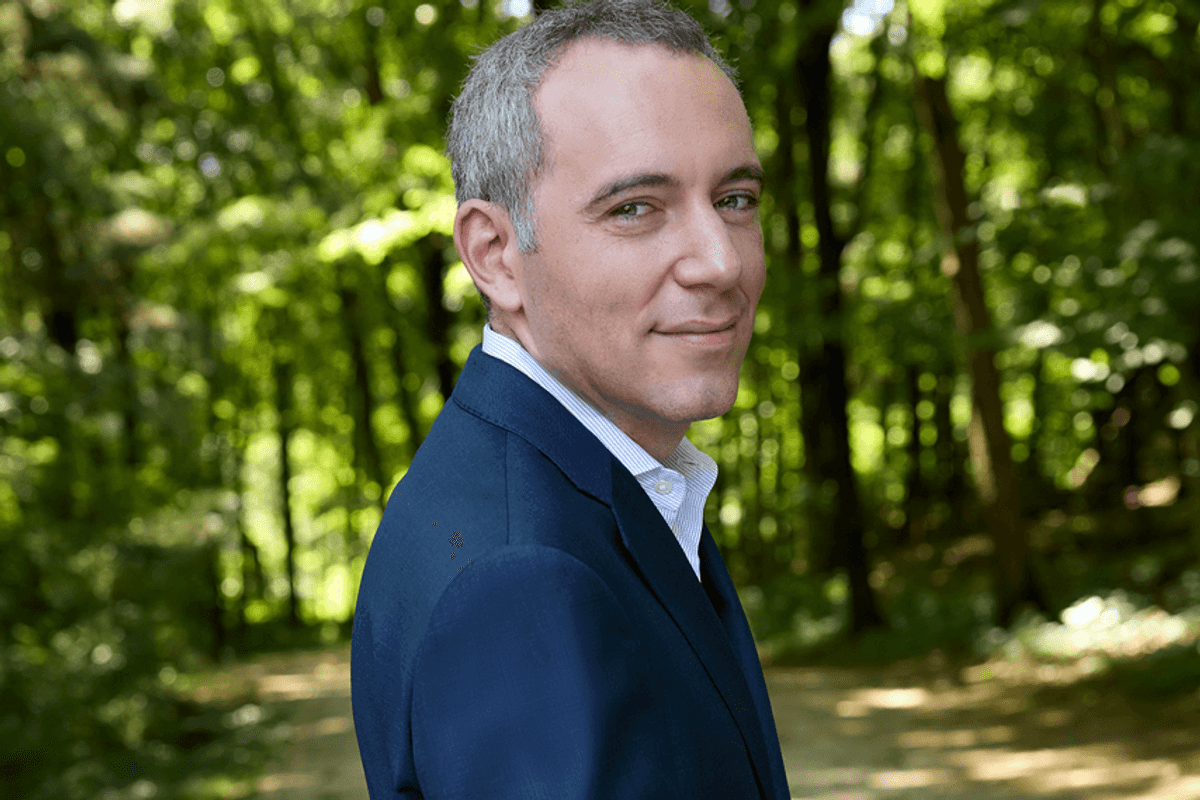
For nearly three decades, Doug Tallamy, a professor at the University of Delaware and co-founder of Homegrown National Park, has studied the intricate relationships between native plants, insects, birds and the ecosystems that sustain them. His books, including “Bringing Nature Home” and “Nature’s Best Hope,” have helped shift the conversation about conservation from something that happens primarily in parks and preserves to something ordinary people can practice on the land around them.
On Sunday, Oct. 4, Tallamy will bring that conversation to Windacre in Millerton for “Work in Progress: Toward Native Fields,” an outdoor gathering exploring both the possibilities and the complications of restoring private land for biodiversity.
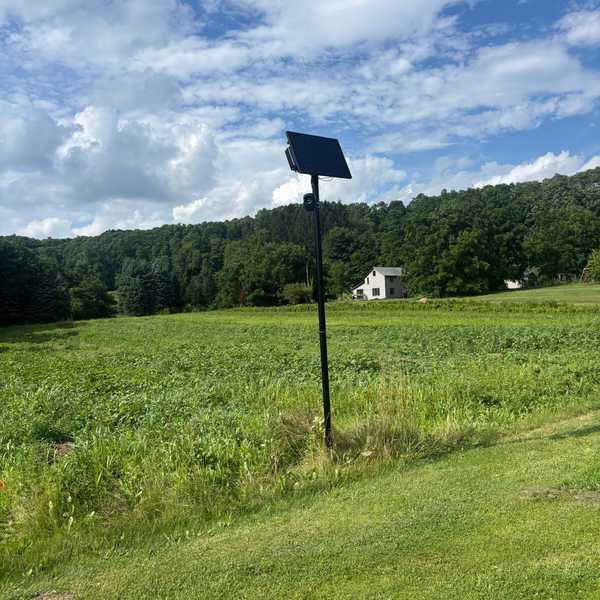
Over the past several years, Windacre owners Amy Chase Gulden and Randy Ramusack have been restoring their 25-acre property on Silver Mountain, confronting many of the questions familiar to anyone who has tried to turn good ecological intentions into reality: What should stay? What should go? Where should a meadow be? How much can one realistically manage? And how perfect does any of it need to be?
“We’re not gonna talk about perfection,” he said in a recent interview. “We do want the majority of the plant biomass on your property to be native. We want them to be the correct species of native.”
By “correct,” Tallamy means plants that are doing ecological work — particularly the “keystone” species that support disproportionate numbers of insects, pollinators and other wildlife.
“I could build a hundred percent native landscape that’s very unproductive just because not all species are productive,” he said. “You wanna favor the ones that are supporting the food web the best, supporting the pollinators the best.”
And then? “Observe,” he said.
“It’s very dynamic. It’s this constant dance,” Tallamy said.
Tallamy knows something about the long game. He and his wife, Cindy, have spent 26 years restoring ecological function to their own 10-acre property in Oxford, Pennsylvania. When they arrived, the land had been mowed for hay and was heavily invaded by nonnative plants.
Today, he can look out his window and see something very different. But he is quick to dispel the idea that restoration eventually reaches a state of completion.
“Our challenge to maintain the ecological productivity that we now have is constant management,” he said. “If we were to go away for five years and come back, it would not look like this.”
That reality is particularly relevant at Windacre, where Tallamy expects invasive plants to be part of the conversation. Bittersweet, for example, might grow among milkweed on a property, creating the kind of dilemma that makes ecological restoration more complicated than simply pulling everything unwanted.
“Timing of the management is really important,” Tallamy said. Milkweed dies back in winter while bittersweet remains, creating an opportunity to target the invasive vine with less risk to the native plants growing alongside it.
Tallamy will be seeing Windacre for the first time at the event, and that, too, is part of the point. Rather than presenting a finished landscape as a model to reproduce, “Work in Progress” offers the property as a living question.
“How much is mowed? I don’t know,” Tallamy said. “Everybody wants to maintain their viewscape. They don’t wanna block anything. But there are ways to do that. You know, where should a meadow be? Where should the forest be?”
He will also look for some of the ecological clues already present: milkweed, fall asters, goldenrods and, especially, oaks.
“Oaks are the most productive woody plant that we have,” he said.
For migrating birds, even one well-chosen tree can matter.
“Even if you have one tree in your yard, migrating birds will stop there if it’s the right tree,” Tallamy said. “It’s the diner. It’s where they stop to eat when they’re migrating.”
That image gets to the heart of Homegrown National Park. The organization asks people to imagine millions of privately controlled pieces of land not as isolated yards, gardens and properties, but as potential pieces of a connected ecological network.
Every restored property, he said, can help fill a blank space between larger parks and preserves. Even isolated efforts can have remarkable results. Before a neighbor joined their efforts, Tallamy and his wife were essentially an ecological island. Yet they documented 62 species of birds breeding on their 10 acres. Tallamy has also photographed 1,388 species of moths there.
“We’re trying to change the culture so that this is not the odd way of landscaping,” Tallamy said. “We want this to become the dominant, the default landscape.”
Right now, he argues, the default is essentially reversed.
“Everybody starts with a dead landscape, and then you have to work hard to change it,” he said. “That’s just backwards.”
Tallamy’s sense of urgency comes from his life as an entomologist. The disappearance of insects and birds is not, in his telling, simply a sad loss of nature around us. Biodiversity is part of the machinery that makes human life possible.
“We’re losing our birds. We’re losing our insects. We’re losing everything,” he said. “And if we do, we’re gonna lose humans too, because those are the organisms that run the ecosystems that generate our life support.”
He offers a deliberately stark analogy.
“If I said we had an oxygen crisis, we were losing oxygen on the planet, people would listen,” he said. “Well, biodiversity is the oxygen of our ecosystems. That’s what keeps us going.”
Yet Tallamy’s prescription is strikingly accessible. A landscape, he said, has four basic ecological jobs: support pollinators, support a food web, sequester carbon and manage the watershed in which it lies.
“You can look at those four things and look at your property and say, ‘What can I do to my property this year to improve each one of those functions?’” he said.
“Even if it’s just one little thing.”
And if that one little thing fails?
Tallamy has a story for that, too. Years ago, he planted an ash tree in the wrong soil. It survived but sat there for 20 years without growing an inch.
“So, I did that wrong. So what?” he said. “I learned that wasn’t the right place to put it, so next time you put it someplace else.”
“Work in Progress: Toward Native Fields” will be held Sunday, Oct. 4, from 11:30 a.m. to 1:30 p.m. at Windacre in Millerton. The event includes a seasonal brunch and an opportunity to explore the property; walking shoes are encouraged. For information, donation and registration, visit bit.ly/4yYkzAP.




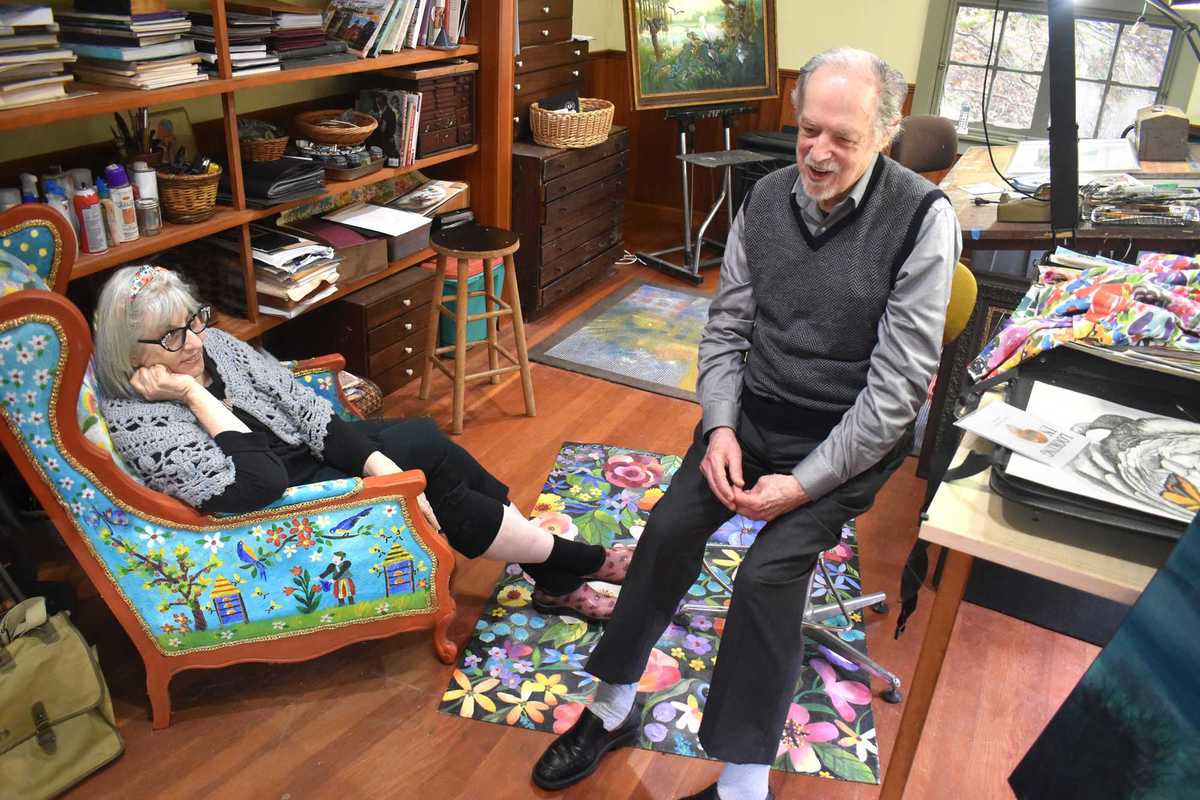
 Justine and Victor Valla in their studio with a painting of Victor’s,”Jonah and the Whale.” Robin Roraback