$6.385 million granted for Millerton’s swimming pool project
An artist’s rendering of the what a swimming pool and poolhouse in Eddie Collins Park in Millerton could look like.
Photo provided
An artist’s rendering of the what a swimming pool and poolhouse in Eddie Collins Park in Millerton could look like.
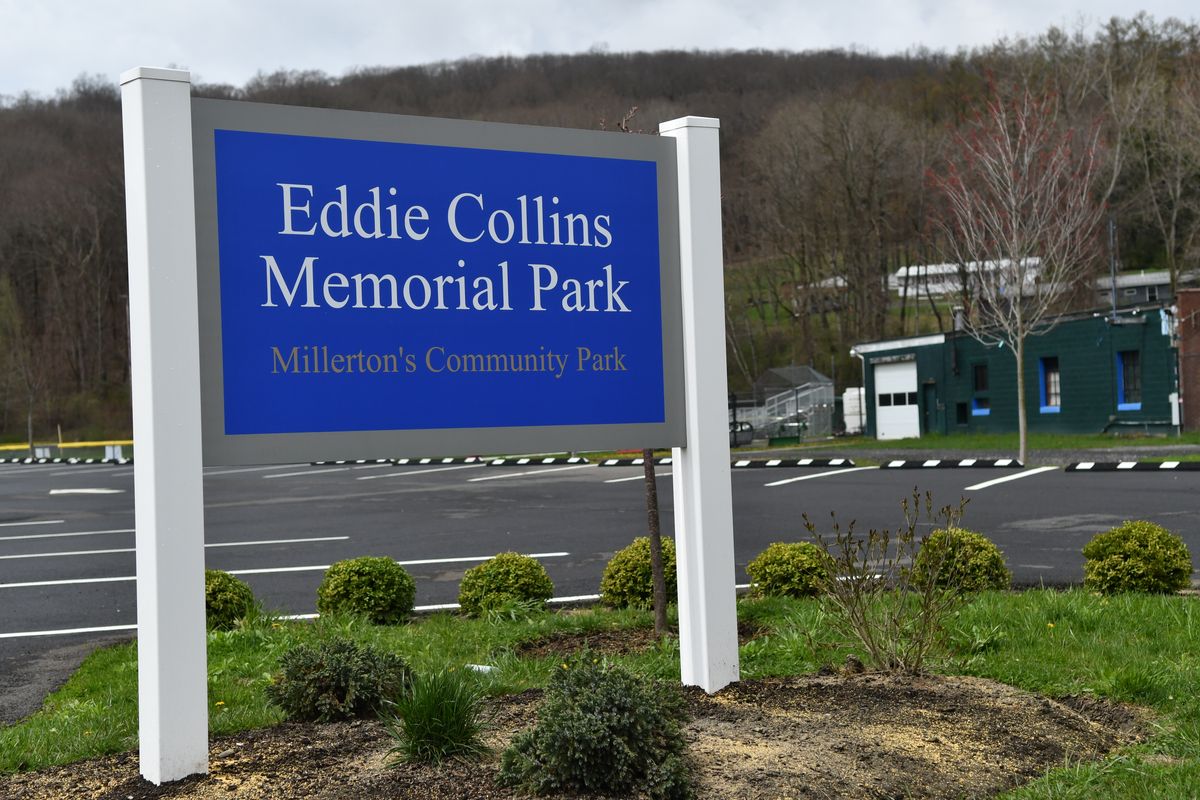
MILLERTON — The NY SWIMS capital grant program awarded $6.385 million to the village to build a community pool, a bathhouse, community room and septic system at Eddie Collins Memorial Park.
The announcement came from Gov. Kathy’s Hochul’s office on the eve of Labor Day, along with $38 million in grants to Dutchess County and towns and cities in the Mid-Hudson region.
“It’s incredible for us to receive this,” Mayor Jenn Najdek said. “To be in the right place at the right time, and to be in good standing with grants.”
The mayor said she hopes that there may be a groundbreaking in the fall of 2025.
“It wouldn’t be possible without the incredible group of volunteers,” Najdek said.
The Eddie Collins Memorial Park Revitalization Committee includes: Stephen Waite, chair, Jeanne Vanecko, vice chair, Edith Greenwood, treasurer, Jennifer Dowley and Greg Swinehart. Mayor Najdek is the village liaison to the committee.
Najdek also thanked Anna Clune, who wrote the grant for the village.
“The grant award is exciting news for Millerton and its residents. Anna did a fabulous job writing the application.
“I spent a lot of time at the old Denney Pool as a kid and made many friends there, some I still keep in contact with.
“The pool served the community well for 50 years until closing in 2016. It’s taken eight long years, but I’m pleased that people will once again be swimming in Millerton in the not-too-distant future.
“I’m grateful for the support from our leaders and donors and extremely proud of the work done by the Committee,” Waite said.
The NY SWIMS grant program was included in the 2025 New York state budget. In May, Village trustees voted to apply for a $6.385 million grant. The first round of applications for municipal swimming facilities were due in July.
The Village also has applied for a $675,000 grant through New York State Parks, Recreation and Historic Preservation and has yet to hear news about that application.
The latest news follows a Millerton visit in late July by Carl Heastie, Speaker of the New York State Assembly, and State Rep. Didi Barrett (D-106) to announce that the Phase 2 renovation of the park will have its funding ensured.
The pool will be ADA-compliant like the rest of the park.
“This will make the entirety of park accessible,” said Mayor Najdek.
Under the NY SWIMS program, grants are offered to “to acquire, design, construct or reconstruct facilities, provide major renovations, improvements, and modernization or rehabilitation of swimming facilities.”
Municipalities are expected to cover 20% of the project cost.
The park’s first swimming pool was installed in 1966 in the rear southwestern corner of the park. Over time, the high water table lifted and cracked the pool. Groundwater infiltration prevented the pool’s water from heating up even on hot summer days. Repairs were attempted but fewer and fewer people came to swim, and Millerton’s summer camp was moved to Rudd Pond in 2015.
Last summer the park’s revitalization committee presented the Phase 2 plans. Construction on Phase 1 — regrading of the park, a new entrance and paved parking areas, a soccer field, accessible playground upgrades, new basketball courts and pavilion improvements—was completed in 2022.
Other big NY SWIMS grants among the 11 announced over Labor Day for the Mid-Huston region include:
Dutchess County — ($10 million) Youth Opportunity Union Aquatic Center: Dutchess County will construct the Youth Opportunity Union Aquatic Center, comprised of an eight-lane lap pool, a two-lane family and therapy pool, and locker rooms.
City of Kingston — ($3,343,345) Kingston Point Beach Swimming Facilities: The City of Kingston will implement a design of multi-tiered raised terraces to connect upland areas on either side of the existing beach to provide flood mitigation and protect the interior of Kingston Point against sea level rise.
City of Newburgh — ($8 million) Delano Hitch Aquatics Center: The City of Newburgh will construct a new aquatic center to replace the pool complex originally constructed in 1920, featuring a fully ADA accessible competition sized pool, new changing rooms and restrooms, new parking area, new concessions stand and a splash pad.

Graham Corrigan
Ryan Courtien disappeared from his Wingdale home at 9:30 a.m. Sunday, July 12, wearing tan pants and a black shirt. New York State Police said he was last spotted exiting a Metro North train at Grand Central Terminal in Manhattan at 12:30 p.m. that same day, and may still be in the New York City area.
DOVER PLAINS — New York State Police said missing former Dover Town Supervisor Ryan Courtien was seen in New York City hours after his reported disappearance on Sunday, July 12.
Investigators said Courtien was observed exiting a Metro-North train at 12:38 p.m., three hours after his reported disappearance. He was seen at Grand Central Terminal, heading toward Madison Avenue and wearing tan pants and a black shirt. Authorities said he may still be in the New York City area.
Courtien — a 49-year-old father of two, Dover Planning Board chair and volunteer firefighter — disappeared from his Waldo Road home in Wingdale shortly after leaving the house at 9:30 a.m. Sunday, July 12.
Police conducted a four-day-long search that largely focused on his home and the surrounding woods. Authorities ended the search on Wednesday, July 15.
Anyone with information is urged to contact Troop K headquarters (845) 677-7300.
Authorities have not provided any additional information about the nature of the investigation into Courtien's disappearance. State Police Public Information Officer Krystal Paolicelli could not be reached for comment immediately following the release's publication.
Graham Corrigan & Nathan Miller
Fire crews douse the smoldering remains of an equipment shed at 357 Hunns Lake Road in Stanford after a fire and propane tank explosions destoryed the structure and farm machinery housed inside on Friday, July 17.
STANFORDVILLE — A fire destroyed a farm equipment shed in Stanford Friday, July 17.
Richie Ahlf, who lives at 357 Hunns Lake Road, was alerted to the blaze on his property when a landscaper working nearby noticed smoke and flames and ran into Ahlf's yard.
Ahlf reported the fire just before 1 p.m. The structure, an equipment shed that housed a tractor, a lawnmower and other farm machinery, was about 50 years old. The fire completely destroyed the shed and equipment stored inside, but caused no injuries.
"Nothing important, compared to a life," Ahlf said of the destruction. "Now I get to see how good my insurance is."
The fire had been brought under control by about 1:30 p.m. Fire crews continued to tamp out latent hot spots into the afternoon.
The mutual aid response drew fire crews from Stanford, Pine Plains, Ancram and North East.
A fire company official with the Stanford Fire Department said propane tanks exploded in the blaze, but was unsure if that was the cause of the fire or a secondary effect.
Nathan Miller
Ryan Courtien disappeared from his Waldo Road home in Wingdale on Sunday morning, July 12. Authorities concluded the search of the landscape surrounding his home after four days of scouring the woods at 4 p.m. Wednesday, July 15.
DOVER PLAINS — The search for former Dover Town Supervisor Ryan Courtien has concluded after four days of scouring the area surrounding his Wingdale home, but authorities say the investigation is ongoing.
New York State Police announced the end of the search for the 49-year-old Wingdale resident and current Dover Planning Board chair at roughly 4:45 p.m. Wednesday, July 15. Courtien disappeared from the yard in front of his Waldo Road home in Wingdale shortly after leaving the house at 9:30 a.m. Sunday, July 12, to work in his yard.
The State Police's Bureau of Criminal Investigation is continuing to investigate the disappearance and pursue additional leads, the statement said.
No further information is available at this time. State Police Public Information Officer Krystal Paolicelli was unavailable for comment immediately following the release's publication.
Courtien has been missing for four days. State Police conducted a search of the area surrounding his Wingdale home assisted by Dutchess County Sheriff's deputies, New York State Fire crews, New York State Forest Rangers and local volunteer fire departments from across northeast Dutchess County and western Connecticut.
Want more of our stories on Google? Click here to make us a Preferred Source.
Aly Morrissey
If you’ve driven down Main Street in Millerton, you’ve passed the former home and shop of one of the village’s earliest female entrepreneurs. At a time when most businesses were owned by men, Mary Kisselbrack made a name for herself in the late 1800s as a well-respected milliner and dressmaker.
On April 11, 1891, train conductor George Kisselbrack purchased a 124-by-232-foot vacant lot at 54 Main St. and hired locally renowned builders Beers and Trafford to design what would become their home and Mary’s business.
In a historical document, “A Beckon Call to a Village,” the house was referred to as “one of the handsomest, architecturally, in the village.” With gables, pointed roof lines and delicate shades of colors on its exterior ornamentation, the document noted that “no stranger passes it without an admiring glance.”
Today, the home still stands, and recently operated as a restaurant called Manna Dew Cafe, which closed its doors in 2023.
Mary Kisselbrack operated her business out of the west side of her home and developed a reputation for her skill, style, and business acumen.
“Mrs. Kisselbrack spares no pains in satisfying her patrons,” an 1890s Telegram article, the village’s newspaper at the time, said.
Kisselbrack’s reputation earned her customers from different parts of the country — some as far away as Florida — in addition to regular clients from Salisbury, Lakeville, Sharon, Amenia, Pine Plains, Copake and Hillsdale.
“With a woman of the long experience and exquisite taste of Mrs. Kisselbrack at the head of the millinery and dressmaking business, we may be sure that our wives and daughters will be reasonably supplied with the most stylish bonnets and dresses,” the article said.
In her 1905 obituary, Kisselbrack was described as a “self-made woman” who possessed “more than ordinary ability.”
On Oct. 5, 1905 — just over two months shy of her 56th birthday — Kisselbrack died following a severe, three-week illness. According to an obituary that appeared in the Millerton Telegram, she suffered a fibrous tumor and peritonitis.
“While she was not afraid to die, she lamented leaving home and loved ones,” the obituary said. “She talked of dying and of her funeral arrangements as calmly as if going away on a visit.”
Nathan Miller
Millerton’s business community will soon see the completion of a public wastewater system, addressing what local officials and business owners have called a major constraint on commercial development in the community for decades.
The $13.8 million project, which is expected to serve the core of the Village of Millerton and a commercial stretch of the Town of North East along U.S. Route 44, represents one of the largest infrastructure investments in the community in decades, and brings an end to calls for a sewer system that stretch back to World War II. Officials say the system will safeguard local waterways while creating a foundation for long-term economic stability.
Millerton trustee Matt Soleau, who has been working closely on the wastewater project and also operates a local full-service custom building firm, said in February that both residents and businesses are constrained by outdated septic systems, particularly on smaller lots where upgrades cannot meet modern health standards.
The proposed wastewater district aims to serve the core of the village, including its business district, as well as the commercial section of the Town of North East along Route 44 extending from Cumberland Farms to the New York-Connecticut border. Properties within the proposed service area currently rely on individual septic systems, including tanks with leach fields, and outdated systems like seepage pits, cesspools and holding tanks.
Village officials said many properties are limited not by zoning alone, but by septic constraints.
“As a result, many homes cannot legally add bedrooms, create accessory dwelling units or convert existing structures,” Soleau said.
Under the proposed system, most properties would retain their existing septic tanks if they are code-compliant and in good working condition. If a tank does not meet current standards, a new one would be installed as part of the project.
The existing tanks will still be used to collect solid waste, but liquid waste will travel through the municipal system to a treatment center. Treated wastewater will then be returned to Webatuck Creek.
Existing leach fields would be taken out of service and left in place, allowing property owners to reclaim that land for landscaping, driveways or ADUs.
For businesses, many commercial properties rely on old septic systems that are already maxed out, which makes it difficult or impossible to open water-heavy businesses like restaurants, cafes, salons or fitness studios.
Officials also emphasize the environmental benefits. A modern, up-to-date wastewater system will protect the natural environment, including the Webatuck Creek that flows right through the village.
Village officials say the construction phase will aim to limit disruption throughout the village and town, proceeding in targeted segments, with defined areas opened for installation, restored, and then closed before crews move on. The goal, Soleau said, is to allow normal activity to continue as much as possible throughout the process.
“Protecting the safety of our residents and visitors, preserving continuity of local businesses, maintaining access, and retaining residents’ quality of life throughout construction are non-negotiable priorities,” Soleau added.
The project hit major milestones this year, with village officials securing needed funding from a congressionally-directed spending grant of just under $4 million announced in February. That additional federal funding represented the last chunk of money needed to move the project forward.
Officials expect to begin construction on the system next year, with a tentative completion date targeting 2028.
Additional reporting provided by Aly Morrissey.
Graham Corrigan
Wooden beams made from tree trunks comprise the load-bearing structure under Millerton’s Moviehouse.
There are a handful of buildings that have stood the test of time over Millerton’s 175-year history. But if there’s one that stands out as a singular representation of the town, it’s the Millerton Moviehouse and its iconic clock tower.
Built in 1903 as a grange hall, it was soon converted into a movie theater with a second-floor ballroom. It was one of a handful of buildings that came to define the town in the following decades, standing tall across the street from the Episcopal Church and Millerton Inn, next to Terni’s, and up the hill from Millerton’s train station.
When a fire destroyed the local department store and other storefronts on the north side of Main Street in 1955, the Moviehouse became a landmark that represented the village’s early history.
It fell into disrepair in the 1970s and was briefly run as an adult theater. Marian and Carr Ferguson bought the theater in 1974, hoping to revive its status as a first-run theater and remove the pornographic element. Their four teenage daughters ran the theater for two years before the Fergusons sold the Moviehouse to Carol and Robert Sadlon in 1978.
“It was a single theater with 300 seats. There was no heat, no air conditioning,” said Carol Sadlon when asked about the state of the theater when she and her husband purchased it.
The Sadlons worked hard to improve the facilities over their nearly 50-year tenure. They added heat, air conditioning, and a second screening room. In 2012, they replaced the 35mm projection systems with a digital system.
But when COVID hit in 2020, the Moviehouse was an early casualty. By November 2020, the property was on the market, and the whole concept of movie theaters was in question.
Vaccines arrived in early 2021 — and a buyer for the Moviehouse followed soon after. The new co-chairs, David Maltby and Chelsea Altman, made the purchase in February 2021 and reopened the theater as a non-profit.
Its new non-profit status allowed the Moviehouse’s operators to seek grant funding. They initiated a massive renovation campaign that included redesigning both floors and adding an elevator. They also replaced the signage, and upgraded the seating this past April.
This past month, the Moviehouse received $99,000 as part of a grant provided by the New York State Council on the Arts that will pay to renovate and stabilize the 120-year-old building.
Looking forward, general manager Jeremy Boviard has big plans for the Moviehouse’s future. “What excites me about the possibilities looking forward is that we continue our positive trajectory as a regional arts center,” Boviard said. “We want to reach a wide variety of demographics, and continue to grow in lockstep with the needs of our community.”
Want more of our stories on Google? Click here to make us a Preferred Source.