Robin Wall Kimmerer urges gratitude, reciprocity in talk at Cary Institute

Robin Wall Kimmerer urges gratitude, reciprocity in talk at Cary Institute

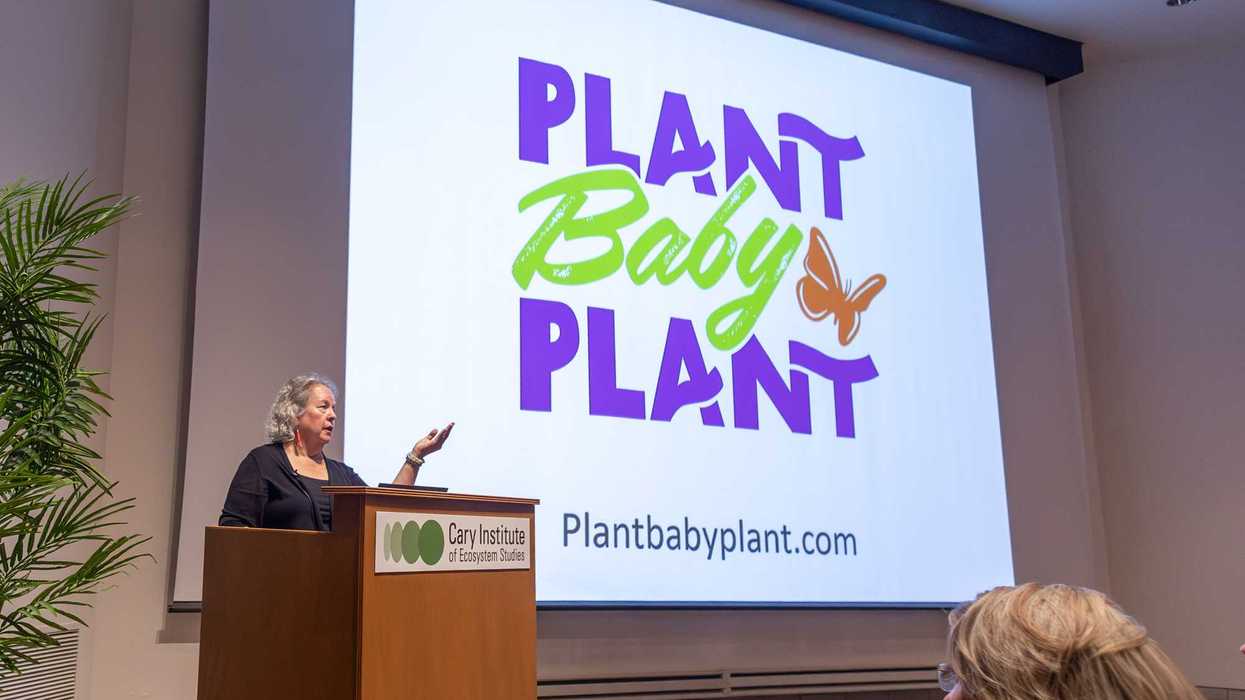
Robin Wall Kimmerer inspired the audience with her grassroots initiative “Plant, Baby, Plant,” encouraging restoration, native planting and care for ecosystems.

Aly Morrissey

Robin Wall Kimmerer, the bestselling author of “Braiding Sweetgrass” and a member of the Citizen Potawatomi Nation, urged a sold-out audience at the Cary Institute of Ecosystem Studies on Friday, March 13, to rethink humanity’s relationship with the natural world through gratitude, reciprocity and responsibility.

Introduced by Cary Institute President Joshua Ginsberg, Kimmerer opened the evening by greeting the audience in Potawatomi, the native language of her ancestors, and grounding the talk in a practice of gratitude.

“Gratitude is the doorway to reciprocity,” Kimmerer said.

Kimmerer, also a mother, botanist and professor, said that Indigenous wisdom does not have to be at odds with Western science, but rather it can help humans reframe the way they understand the Earth.

She also reflected on the personal journey that led to her lifelong commitment to promoting a lens of Indigenous wisdom in Western science. As a young woman entering the field of botany — then largely dominated by men — she said her path in academia was not always welcoming as a female Native scientist.

“It has been a lifelong journey,” she said. “I was born a botanist.”

Throughout the lecture, Kimmerer described how Indigenous ecological knowledge — rooted in observation, experience and ethical responsibility — can complement scientific inquiry and help solve today’s environmental crises.

She pointed to global data showing that about 80 percent of the planet’s remaining biodiversity is found on lands stewarded by Indigenous peoples, many of whom remain under threat from continued colonization and development.

A central theme of the evening was the concept of the “Honorable Harvest,” a code of practical ethics that governs what humans take from the natural world. Its principles include never taking the first one, always asking permission, taking only what is needed, minimizing harm and giving something back.

“Science is a great way to listen for the answer,” Kimmerer said, referring to the practice of asking permission of the natural world and paying attention to ecological limits.

By the end of the talk, Kimmerer turned to the question she said she hears most often: “What can I do?”

Her answer included a call to reciprocity and action. She urged audience members to consider their own “human gifts” and how those gifts might be used in service of the Earth. For example, Kimmerer said she uses her own gift of storytelling to distill complex information and inspire people to think differently about the living world.

“The Earth asks us to change,” she said.

Kimmerer left the audience with a call to action through her latest initiative. In contrast to the slogan “drill, baby, drill,” she said she has helped launch “plant, baby, plant,” a grassroots initiative that encourages people to support the living world through restoration, native planting and care for ecosystems.

Latest News

Officials divided on allowing restaurants along Route 22

The Irondale district, currently known as Highway Business District III, is comprised of just six parcels along Route 22 that are currently occupied by light industrial businesses.

Photo by Nathan Miller

MILLERTON — Though the Irondale District lies just outside of the Village of Millerton, it has become the center of a divisive conversation as the Town of North East continues to review a significant overhaul of its commercial zoning code.

Irondale, officially known as the Highway Business district under current town code, is a small stretch along Route 22 south of the village that some officials and residents believe could support additional businesses, while others argue development there could undermine efforts to boost Millerton’s existing downtown.

Keep ReadingShow less

Melissa Gamwell’s handmade touch

Melissa Gamwell’s handmade touch
Melissa Gamwell, hand lettering with precision and care.
Kevin Greenberg
"There is no better feeling than working through something with your own brain and your own hands." —Melissa Gamwell

In an age of automation, Melissa Gamwell is keeping the human hand alive.

The Cornwall, Connecticut-based calligrapher is practicing an art form that’s been under attack by machines for nearly 400 years, and people are noticing. For proof, look no further than the line leading to her candle-lit table at the Stissing House Craft Feast each winter. In her first year there, she scribed around 1,200 gift tags, cards, and hand drawn ornaments.

Keep ReadingShow less
google preferred source

Want more of our stories on Google? Click here to make us a Preferred Source.

Regional 7 students bring ‘The Addams Family’ to the stage

The cast of “The Addams Family” from Northwest Regional School District No. 7 with Principal Kelly Carroll from Ann Antolini Elementary School in New Hartford at Botelle Elementary in Norfolk.

Monique Jaramillo

Nearly 50 students from across the region are helping bring the delightfully macabre world of “The Addams Family” to life in Northwestern Regional School District No. 7’s upcoming production. The student cast and crew, representing the towns of Barkhamsted, Colebrook, New Hartford and Norfolk, will stage the musical March 27 and 28 at 7 p.m., with a 2 p.m. matinee on March 29 in the school’s auditorium in Winsted.

Based on the iconic characters created by Charles Addams, the musical follows Wednesday Addams, who shocks her famously eccentric family by falling in love with a perfectly “normal” young man. When his parents come to dinner at the Addams’ mansion, two very different families collide, leading to an evening of secrets, surprises and unexpected revelations about love and belonging.

Keep ReadingShow less
‘Quilts of Many Colors’ opens at Hunt Library

Garth Kobel, Art Wall Chair, Mary Randolph, Frank Halden, Ruth Giumarro, Project Chair, Maria Bulson, Barbara Lobdell, Sherry Newman, Elizabeth Frey-Thomas, Donna Heinz around “The Green Man.”

Robin Roraback

In honor of National Quilt Day, a tradition established in 1991, Hunt Library’s second annual quilt show, “Quilts of Many Colors,” will open Saturday, March 21, with a reception from 5 to 7 p.m. The quilts, made by members of the Hunt Library Quilters, will be displayed through April 17. All quilts will be for sale, and a portion of each sale goes to the library.

At the center of the exhibit is a quilt the Hunt Library Quilters collaborated on called the “Quilt of Many Colors,” inspired by Dolly Parton’s song”Coat of Many Colors.” Each member of the Hunt Library Quilters made two to four 10-inch squares for the twin-size quilt, with Gail Allyn embroidering “The Green Man” for the center square. The Green Man, a symbol of rebirth, is also a symbol of the library, seen carved in stone at the library’s entrance. One hundred percent of the sale of this quilt benefits the library.

Keep ReadingShow less
Webutuck students’ films hit the silver screen at filmmaking workshop

Benjamin Sprague, left, Nolan Howard, center, and Holden Slater conduct a Q&A with community members that came to watch their short documentary films after a filmmaking workshop at the Millerton Moviehouse on Thursday, March 12.

Photo by Aly Morrissey

MILLERTON — Students from the Webutuck Central School District screened their five-minute documentaries at The Moviehouse Thursday, March12, showing off their newly acquired skills to an audience of friends, family and community members.

The films — written, directed, shot and edited by the students themselves with guidance from local filmmakers — were the culmination of a two-day student filmmaking bootcamp held earlier this month.

Keep ReadingShow less
google preferred source

Want more of our stories on Google? Click here to make us a Preferred Source.

google preferred source

Want more of our stories on Google? Click here to make us a Preferred Source.