Savoring the schlock, one terrible film at a time

"Mandy"
Produced by SpectreVision

"Mandy"
Since Christmas I have watched about 200 of the worst movies I could find. Thanks to the wonders of streaming, the supply of horrible films is, apparently, inexhaustible.
A note on methodology: I relied heavily on Rifftrax, an outfit that does the hard work of digging up these relics and offers them accompanied by what they call “riffing,” meaning they crack jokes.
The danger here is concentrating on the commentary and not the movies. Here at The Lakeville Journal’s Bad Cinema Desk, we write our own jokes.
So when feasible, I found the straight version of a flick Rifftrax covers.
Free-with-ads services such as Tubi, Freevee, and Plex have vast libraries of cruddy stuff, so it’s not that hard to track these things down.
But sometimes it was just simpler to go with Rifftrax and do my best to avoid swiping their gags.
Here are five awful movies that got my attention, for all the wrong reasons.
“Mandy” (2018): Psychedelic pshocker with the always-entertaining Nicolas Cage doing battle against a cult of weirdos whose leader (Linus Roache) seems to think he’s a cross between Jesus and Charlie Manson, with a little Jon Anderson (of Yes) thrown in for seasoning.
The weirdos are in cahoots with a gang of mutant bikers, and everybody’s drinking down this sludgy LSD specially created for them by the Chemist because, A) he doesn’t like them, and B) he’s got a tiger.
Kung fu with chainsaws, medieval weapons and bare fists. Eyeball-popping. Barbed wire. Hallucinations galore. King Crimson music. Custom vans. About 40 gallons of blood. Dorm room theology. And Cage in his skivvies, for maximum horror.
“Fungicide” (2002): This could be called “outsider cinema.” It could also be called “amateurish dreck.” Both descriptions are correct.
A mad scientist, an ex-military guy with issues, a jort-wearing tough guy from Philly and a real estate dork all show up at a rustic bed and breakfast.
The mad scientist has done something to the mushrooms so the spores are floating around creating killer mushrooms and the world is gonna end. I think that’s the gist of it. It’s hard to tell. The sound is kinda muddy.
What makes this shine are the killer mushrooms. There are three types: Mushrooms with teeth that are about 2 feet tall; man-sized mushrooms (no teeth); and unconvincing computer mushrooms.
Mushroom attack cam. Real estate broker chewed by mushrooms. Excellent stick fights between cast members and the big mushrooms. The slowest martial arts kicks ever captured on someone’s aunt’s camcorder. Mad scientist who would steal the show if there was a show to steal. Fascinating in its way. However, you may lose IQ points by watching this.
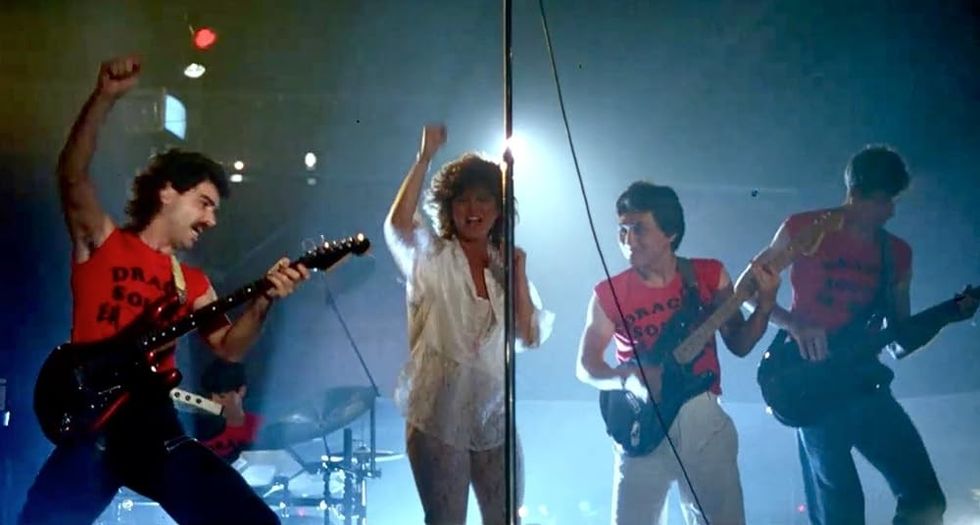
“Miami Connection” (1987): Also outsider cinema, in the sense that it really wants to be inside.
This flick centers around the guys in Dragon Sound, a rock band that made me long for the hard-hitting sounds of Journey or a tape of seals giving birth, whichever is easier to round up.
The Dragon Sound members study tae kwon do with the rhythm guitarist, Mark, and they need it because they get mixed up with a cocaine-dealing bunch of ninja-type bad guys. Also Mark’s not much of a guitarist.
The flick’s got a “Scooby-Doo” or “Archies” feel to it, marred somewhat by the star’s inability to speak English.
The music sequences would be unbelievable…except they are indistinguishable from rock videos of the era. So if the hard work of dozens of professional filmmakers and musicians can be duplicated for about 10 cents on the dollar by a bunch of complete amateurs, that says something. Something profound. And if you give me a minute I’ll remember what it is.
“Radical Jack” (2000): Starring Mr. Achy Breaky his ownself, Billy Ray Cyrus, as Jack, ex-CIA, seeker of justice and proud owner of the most spectacular mullet haircut in world history.
Jack blows into a small Vermont town and gets tangled up in an arms-dealing racket. I know that when I’m in the market for a rocket-propelled grenade launcher or some other handy item, I always think “Vermont.”
Here I must bow in tribute to Rifftrax for the vocal stylings during the sponge bath scene.
Elsewhere, you will be as pleased as I was when the son of the bad guy gets it right in the pleated Dockers. In these lax, postmodern times, crimes against style are so rarely punished in public.

“The Apple” (1980): Saving the absolute worst for last, this is a sci-fi rock musical, written and directed by Menahem Golan.
The story is that something called the BIM is coming, and a whole mob of freaks in shiny underwear have to get ready. Meanwhile this guy Alphie wants to rescue this girl Bibi from the BIM and go live in a field with the hippies.
It’s difficult to describe this adequately, so let’s just go with “bonkers,” which was how Falls Village’s Garth Kobal summed it up in a recent discussion of the trashy and ephemeral.
The high point is a musical number, “Coming.”
I used to think that Donna Summer’s 1975 disco hit “Love to Love You Baby” was the last word in sex songs. I mean, it’s about 20 minutes of moaning over a relentless beat.
But next to “Coming,” Summer’s effort sounds like a Gregorian chant.
The other high point is the end. Well, near the end.
There is an honest-to-God deus ex machina. Literally. A guy in a glowing white suit who gets out of a glowing white Rolls Royce in the sky to lead the hippies to Paradise.
And it’s not John Lennon.
Note: Many Rifftrax flicks (and predecessor “Mystery Science Theater 3000”) are available on the above-mentioned streaming services. For the uninitiated, watching a riffed version is a safe way to enter the world of Bad Cinema. Only advanced viewers should attempt the original versions, due to the very real possibility of irreparable brain damage.

Nathan Miller
Cold Spring Early Learning Center on Homan Road in Stanford. Pine Plains school district officials proposed closing the building last year citing budget constraints and declining enrollment.
STANFORD — Community members gathered on Wednesday, March 4, for a first look at a newly-formed committee that will analyze the impact of closing an elementary school building in the Pine Plains Central School District.
Town Supervisor Julia Descoteaux arranged the Wednesday meeting at Stanford Town Hall to find volunteers to represent the town in the district-wide Building Utilization Advisory Committee. The committee's first district-wide meeting is scheduled for Thursday, March 12.
Pine Plains Board of Education members voted in February to form the committee. That vote came after Stanford residents asked for more details on plans to shutter Cold Spring Early Learning Center on Homan Road in Stanford. Superintendent Brian Timm announced plans to close the building and consolidate students into Seymour Smith Intermediate School in Pine Plains last year, citing declining enrollment district-wide and potential reductions in state aid that threatened the district’s budget.
Descoteaux said the Board of Education asked each of the nine towns in the district to send three representatives, which would result in a committee with at least 27 members. Three people have shown interest in representing Stanford in the multi-town committee — Kyle Odell, Brooke Brown and Abby Knickerbocker, though Knickerbocker was not present at the Wednesday meeting.
Descoteaux said the committee will analyze the impact of closing Cold Spring Elementary and draft a full educational impact statement. Educational impact statements are recommended — but not required — under New York State education law.
The educational impact statement will analyze the closure’s effect on the community, district finances, use of other buildings, staff employment, and school and extracurricular services. The district currently operates three buildings — Cold Spring Early Learning Center in Stanford, and Seymour Smith Intermediate School and Stissing Mountain Jr./Sr. High School in Pine Plains.
Cold Spring Elementary serves roughly 150 students from pre-K to first grade. There are currently just over 750 students enrolled in the district from kindergarten through twelfth grade. Superintendent Timm said enrollment is down nearly 50% in the past twenty years.
Community members in attendance urged Descoteaux to advocate for more Stanford residents on the committee, citing Cold Spring’s location in the town, the town’s contribution to the district’s revenue, and the school’s integral role in the community.
Descoteaux echoed those sentiments. “Our town has a little bit of a different stake in the game,” she said. “I’ve heard from multiple families that — very direct — they wouldn’t have moved here if there wasn’t a school in town.”
Descoteaux said school district officials requested that representatives include a local business leader, a parent or community member and a representative of the Town Board — a request she said she disagreed with. She said Stanford parents have already taken the lead.
“The community’s been driving this process,” Descoteaux said. “The hope coming out of this is it feels like this is a community-driven process.”
Descoteaux credited Stanford parents like Brooke Brown, who she said led the early efforts to press for more information and community involvement in the school’s closure. Brown advocated strongly for her inclusion on the committee.
“I think I just bring slightly more than an average person would because I’ve already done so much research on it,” Brown said.
Kyle Odell, a Stanford parent and financial manager based out of Poughkeepsie, also volunteered for the committee. He said he wants to take a harder look at the budgetary figures that school district officials cited when Cold Spring’s closure was announced.
Odell said he doubted district officials’ claims about budget constraints, citing figures on rising health care and other costs from district presentations that he said added up to less significant losses than administrators claimed.
“They’re looking at it as the price increase for those things but not as to what it is for the overall budget,” Odell said. “I want to be on this committee to actually see the numbers, especially digging in, so we’re actually making an informed decision.”
Patrick L. Sullivan
Publisher James Clark, left, and Executive Editor Christian Murray speak at Scoville Memorial Library March 7.
SALISBURY — What makes or breaks a local newspaper is its reputation, Lakeville Journal Executive Editor Christian Murray said at the Scoville Memorial Library Saturday, March 7.
Murray and publisher James Clark led a discussion at the library that was originally scheduled for January, but the weather intervened.
Karen Vrotsos, the head of adult programming for the library, introduced Clark and Murray, and noted that thousands of American newspapers have closed in recent decades, creating regional “news deserts.”
Clark said the news business is under “tremendous pressure even as local news remains the most trusted source.”
Clark said there are many ideas being discussed for the future of newspapers, including the possibility of going fully digital and eliminating print. He was quick to add that going all digital is not the plan for the Journal and The Millerton News.
“We all enjoy a print product,” Clark said. “But we’re also strongly focused on reaching readers on whatever platform they prefer — particularly online.”
He also noted that while the Connecticut and New York legislatures have introduced bills designed to support news organizations, including funding journalism jobs, they have also considered bills to remove requirements that legal notices be published in local newspapers.
While legal notices are a source of revenue, Clark said they also provide a valuable public service. “All the recent Wake Robin decisions were in our legals section,” which complemented the paper’s reporting.
Clark said long-term success in local news comes down to three essentials: adequate funding, enough reporters and, as he put it, “simply doing the reporting.”
“It’s challenging,” he continued. He said LJMN Media, the organization that publishes the two papers, is in its fifth year as a non-profit.
He thanked the community for the financial support, which has allowed for the hiring of new reporters and editors and expanded coverage.
One of those hires was Murray.
The native New Zealander used to be based in Queens, N.Y. and worked for outlets such as amNewYork, Newsday and Reuters.
When Clark was looking for a new executive editor and sorting through resumes, Murray’s experience with the Queens Post — a local news service he founded that reported on neighborhoods in that borough — caught his attention.
In Queens, Murray had a large urban readership. Here in northwest Connecticut and eastern Dutchess County, the population is markedly different.
“But the nuts and bolts of reporting are the same,” Murray said. “Communities of any size want to know about affordable housing, healthcare, new businesses and public safety.”
In Queens, “the scale is bigger, but it’s the same board meetings. The machinations are pretty much the same.”
Murray, who moved to northwest Connecticut five years ago, said local news is often more meaningful than national news for readers. “I want to know about the restaurant down the street, or the property up the road.”
He said bigger publications are often content rewriting press releases. “Quality journalism is at the local level. Our reporters are out there talking to people.”
Murray said he chatted recently with a friend who works for Fox Digital.
“He’s covering Iran from his apartment in Long Island City!”
Asked about how the two local papers cover national issues, Clark said “We cover how they affect our communities and what they’re doing about it.”
“We’ll continue providing news as we see it and keeping it balanced,” Murray added.
Asked about using Facebook and other social media, Clark said “we see Facebook as one platform of many. We want to get our news to people where they are.”
The questioner followed up, asking how Facebook comments are moderated.
Clark said that “in general we use as light a touch as possible” for comments.
“We’ll delete or hide comments that are simply inflammatory or profane.”
Clark mentioned “HVRHS Today,” the student publication from Housatonic Valley Regional High School that is a collaboration between The Lakeville Journal and the high school.
“That’s their newspaper. They’re not writing for The Lakeville Journal.”
Clark said there are three high schools in The Millerton News’ coverage area, and he hopes to expand the program.
Both Clark and Murray kept reiterating the importance of local newspapers being accurate and fair.
“Reputation matters so much in local news,” Murray said. “We’re much more accountable to our communities” than larger newspapers.
“When we ship the papers, we know we’re going to see the people we’re writing about in the checkout line at LaBonne’s,” said Clark.
“It gives us that little extra ‘oomph’ to get it right.”
Nathan Miller
The Millerton fire crew watches a pump hose carry water from the NorthEast-Millerton Library’s basement on Tuesday, Feb. 10.
MILLERTON — Library officials expect the NorthEast-Millerton Library to be fully open the weekend of March 14-15, a full month after a burst pipe forced librarians to move operations to the annex building on Century Boulevard.
Executive Director Rhiannon Leo-Jameson said the temporary relocation has been stressful, but library patrons have been understanding and using the library to the fullest extent possible.
A pipe in the wall of a private apartment above the library burst on the morning of Tuesday, Feb. 10, sending water into the walls and flooding the basement.
Leo-Jameson reported that at its height, the water settled about five inches above the basement floor. Though the furnace was at risk, the water did not rise high enough to cause damage.
The basement did not contain any stored materials, and damage was contained to the walls surrounding the fireplace in the building’s rear.The leak required the building’s water to be shut off, forcing the library to close until service could be restored.
Leo-Jameson said the plumber is expected to fix the broken pipe on Wednesday, March 11. She said the plumber’s arrival was delayed because the building’s walls, floors and carpet had to be assessed for damage, mold and asbestos.
“Much to the surprise of everybody, it was the original flooring to the building,” Leo-Jameson said. She said current reports indicate the damage was limited to the single burst pipe and the sheetrock adjacent to the burst.
“The force of the water burst through the sheetrock,” Leo-Jameson said.
The library continues to operate during its normal hours of operation from a temporary station in the annex. Patrons can check out requested books and make returns, and daytime programming is ongoing. Leo-Jameson said she was thankful to have the annex after the pipe burst.
“If you’re ever going to have a burst pipe in the library, this was pretty ideal,” Leo-Jameson said.

Want more of our stories on Google? Click here to make us a Preferred Source.
Millerton News
SALISBURY — Alfred Lyon Ivry, a long-time resident of Salisbury, and son of Belle (Malamud) and Morris Ivry, died in Bergen County, New Jersey, on Feb. 12 at the age of 91, surrounded by family members. Born and raised in Brooklyn, he was a graduate ofAbraham Lincoln High School and Brooklyn College, where he earned a B.A. in English literature and Philosophy and served as drama critic for the school paper.
Alfred earned a PhD in Medieval Jewish Philosophy from Brandeis University in Waltham, Massachusetts in 1963 and in 1971 was awarded a D. Phil in Medieval Islamic Philosophy from Oxford University, Linacre College.
He enjoyed a long career as a professor of Jewish and Islamic philosophy, with appointments at Cornell, Ohio State, Brandeis, and New York University. Alfred wrote more than one hundred scholarly articles and book reviews, and was the author or editor of nine books, including Maimonides’ Guide of the Perplexed: A Philosophical Guide, published in 2016.
Alfred and Joann, his wife of 67 years, moved to the Berkshire area in the early 1990s, splitting their time between the Twin Lakes and New York City until their respective retirements. After that, they lived in Salisbury full time, availing themselves of the region’s many cultural offerings. They relocated in late 2020 to Noble Horizons for two years before moving to New Jersey to be closer to their children.
In their many years together, Alfred and Joann traveled regularly, frequenting museums, national parks, and other destinations. Alfred was an avid reader of the newspaper, fiction, and poetry, and possessed both a sharp wit and an estimable sense of humor. Throughout his life, he enjoyed outdoor activities including swimming, camping, hiking, ice skating on Twin Lakes, and tennis. Like many Brooklyn boys of his era, he followed the Dodgers, but happily took his children to Red Sox games at Fenway Park and later his grandchildren to see the Red Sox at Yankee Stadium.
In Salisbury, Alfred became a successful gentleman farmer, and embarked on canoe trips and fishing expeditions on Twin Lakes and beyond.He took up birding, among other hobbies, and with Joann developed and enjoyed the friendships he made in Salisbury and environs, and especially amongst members of the Great Barrington-based Berkshire Minyan, of which they were founding members.
Above all, Alfred was committed to the Jewish tradition and people, and to his family. He is survived by his wife, Joann (nee Saltzman);children, Rebecca and husband Clifford Stein, Jonathan, Sara, and Jessica, grandchildren; Molly and husband Josh Mark, Noah and wife Noa Shapiro, Ben Stein, Talia, Max, Isaiah, and Esther Ivry; great-grandchild, Aaron Mark; and colleagues and friends made throughout his life. He was predeceased by his sister, Grace.
Donations in Alfred’s memory may be made to the Berkshire Minyan and to the Yaakov Goboff Fund at the Yaakov Herzog Institute for Jewish Studies.
Millerton News
LAKEVILLE — Alice Gustafson (née Luchs), 106, of Lakeville, Connecticut, passed away on March 2, 2026. Born in Chicago on Dec. 15, 1919, Alice was raised between New York City, Florida and Lime Rock, where she graduated from Salisbury High School in 1937.
Alice’s career spanned roles at Conover-Mast Publications in New York City, The Lakeville Journal, the Interlaken Inn, and as a secretary to the past president of Smith College. In 1948, she married Herbert “Captain Gus” Gustafson at Trinity Church in Lime Rock.
A devoted community servant, Alice volunteered for twenty years at White Plains Hospital and for over thirty years at Sharon Hospital. She was a passionate supporter of the arts, notably through her involvement with Music Mountain and Crescendo Music Program. She was also an active member of the Salisbury Congregational Church, the Nichi Bei Fujinkai society, and served as a docent at Philipsburg Manor.
Alice is survived by her son, Gordon Gustafson, and his wife Christine, her daughter Elizabeth (DeeDee) Dohan, and her husband Andrew, her grandchildren and great grandchildren. She was preceded in death by her husband, Herbert.
Her celebration of life will take place on Saturday, June 6, at 11:00 a.m. at the Congregational Church of Salisbury.
While flowers are a lovely tribute, those who wish to further honor Alice’s memory may consider a contribution to Music Mountain, Crescendo, or the Congregational Church of Salisbury.
Millerton News
LAKEVILLE — Larry Power passed away peacefully at home on March 9, 2026.
Larry was born at St. Vincent’s Hospital in New York City in 1939.
He had a successful public relations firm for over 35 years in NYC.
After retiring, he chaired the Sharon Land Trust board for many years. He always said one of the most important things he ever did was saving the Twin Oaks Field from development.
He is survived by his husband Lea Davies of 44 years.
Donations in his memory can be sent to East Mountain House in Lakeville in honor of Keavy Bedell or the Sharon Hospital Primary Care Project in honor of Doctor Jonathan Joseph.
The Kenny Funeral Home has care of arrangements.

Want more of our stories on Google? Click here to make us a Preferred Source.

Want more of our stories on Google? Click here to make us a Preferred Source.