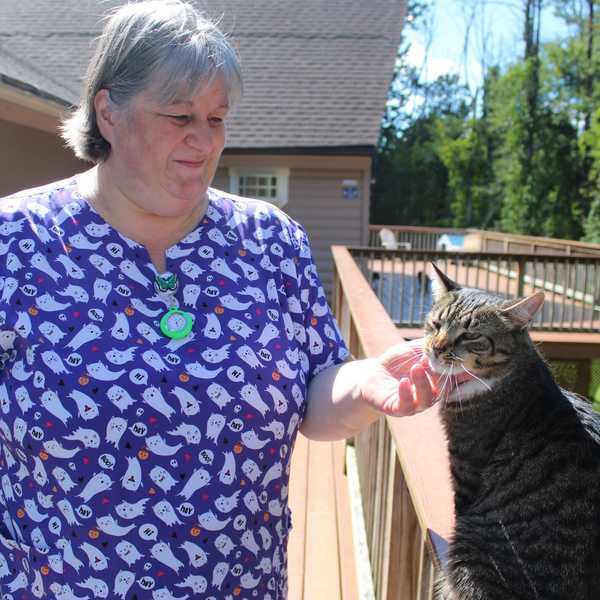
Quellas host Hotchkiss Library of Sharon gala

James and Linda Quella hosted the spring gala at their estate in Sharon.
Alexander Wilburn

James and Linda Quella hosted the spring gala at their estate in Sharon.
The Hotchkiss Library of Sharon held its annual spring gala and auction on Saturday, May 18, at the Sharon home of James and Linda Quella, best known in the area for their family-run poultry farm, Q Farms, where they humanely raise chickens in their pastures.
The spring gala is a major event each year for the library to raise funds for its annual budgeting cost, explained Hotchkiss Library Director Gretchen Hachmeister. “We raise about 65% of our annual operating budget just through fundraising events. We get about 25% from the town and the rest, some grants, and then the rest is fundraising. The general budget supports just opening the doors and helping us do everything we do.”
Silent auction items at the gala included a handcrafted dinnerware set by DBO Home in Sharon — which has provided dining wear to restaurants like ABC Kitchen and Blue Hill at Stone Barns in New York, and Troutbeck in Amenia — as well as art by Patty Mullins and the late Cleve Gray, and a dahlia subscription provided by English Garden Grown in Salisbury. Also notable was a throw woven with wool collected from Hachmeister’s own Shetland sheep she raises.
“We are passionate about community and community is about people and bringing people together,” James Quella said on hosting this year’s library gala. “Mission-driven is a way a community can be brought together. The mission here is that Hotchkiss Library is a community center. It’s a place where the community can gather, learn, educate themselves, educate others, and provide a way station for people who don’t have internet connectivity. A place to reach out to members of the community who may not feel welcome, and we want everyone in our community to feel welcome. [My wife,] Linda is on the library’s board, and her mission to join the board was to create that kind of sense of community. To have everyone here at our house, to get connected, and to believe in the mission of The Hotchkiss Library, it’s ecstasy. It makes us happy. It’s not even a job.”
Hotchkiss Library Board of Directors member Linda Quella cited the sponsorship of Tri-Corner F.E.E.D. (Food, Equity, Education, and Distribution) as a major opportunity in partnering with the library. Founded by James and Linda Quella, Tri-Corner F.E.E.D. connects with farmers in communities experiencing food scarcity and provides resources, as well as allows farms to receive advance payments for their produce in order to secure a reliable flow of income. “Tri-Corner F.E.E.D. is about providing food security and food access for all members of our community. By sponsoring this event we wanted to raise awareness of our farming and agricultural community and make sure that all the food here at the gala is provided by the farmers that are in our community. We want people to understand and start having an awareness of the level of food security in the area. It’s one of the things that we hope to bring to some of the library programs”
For those unable to attend the spring gala but with interest in supporting The Hotchkiss Library of Sharon, Hachmeister said, “We welcome support of all kinds. We’ll be marching in Sharon’s Memorial Day parade, for example, to raise the profile of the library. If anyone would like to participate, they are welcome. Our annual appeal is also ongoing until Sunday, June 30. We welcome everybody at the library. We provide our services free of charge, but it costs us something to do that.”
Millerton Village Hall, where the Zoning Board of Appeals has begun laying the groundwork for a zoning overhaul aimed at modernizing the village’s code.
MILLERTON – The village Zoning Board of Appeals (ZBA) met on Tuesday night to begin laying the groundwork for a long-anticipated update to its zoning code — a process officials say is necessary to replace regulations they repeatedly describe as “outdated.” The discussion comes as the Town of North East faces public scrutiny over its November release of a years-long zoning rewrite of its commercial district.
To better understand the rewrite process — and avoid replicating challenges the town has encountered — ZBA Chair Kelly Kilmer invited two members of the North East Zoning Review Committee (ZRC), Edie Greenwood and David Sherman, to share insight.
Kilmer emphasized that the village has no intention of embarking on a years-long rewrite like North East’s, noting that the town’s zoning update has already stretched over four years. “Some of our terms [in office] will be up by then,” she joked.
Instead, Kilmer said the village intends to begin by zeroing in on the parts of the code that most often appear before the ZBA and Planning Board.
“We need to look at the zoning laws that come up the most when people come to us for variances,” Kilmer said. “The ones that are really holding people up.” She added that she doesn’t want to over-complicate the process.
Parking is one issue that continually comes up at Village Hall. It is already under review and will be discussed at a Dec. 15 public hearing, where a proposed zoning change will be presented. The revision would ease off-street parking requirements in the business district and lower barriers to entry for new businesses.
Greenwood offered two key suggestions for the village’s early stages. First, she recommended becoming fluent in the 2019 Comprehensive Plan, which she said guided the town’s zoning process and served as a blueprint. Second, she urged the village to hire a consultant, pointing out that zoning code is generally “too technical” to interpret and rewrite without professional support.
Greenwood said she pursued a grant through Hudson River Valley Greenway to help the town pay for its consultant. However, the September deadline has already passed for the upcoming year, meaning the village would need to wait until next year to apply
She also advised beginning the process with a clear purpose. “Whether you call it ‘legislative intent’ or ‘purpose,’ that’s the brainstorming of what you want to happen in that district,” Greenwood said.
Village board member and ZRC volunteer David Sherman echoed the sentiment: “Begin with the vision you’d like to see in the district.”
With the help of Greenwood and Sherman, Kilmer outlined four immediate next steps for the village.
Greenwood recommended additional in-person and online training, including programs through Cornell Cooperative Extension (CCE) and the New York Conference of Mayors (NYCOM). While ZBA members are only required to complete four hours of training annually, officials said they intend to do more.
Even as the zoning conversation moves ahead, board members stressed that the village’s long-running wastewater constraints will ultimately shape what any zoning changes can accomplish.
“We can dream all we want,” said ZBA member Delora Brooks, “but if the wastewater doesn’t get addressed, everything else we do will be shaped around that.”
Cathy Fenn, who has served in multiple village and town roles over the decades, questioned why the Planning Board was not at the table, noting that it led the last major zoning change in the village.
The meeting took place as the Village Board weighs whether to consolidate or potentially eliminate the Planning Board in favor of a different structure. Kilmer said there was value in keeping the initial zoning conversations small and focused while the village works through those broader governance questions.
Looking ahead, Kilmer said that transparency will be central to the process, noting that she intends to use the public as a sounding board and help demystify the steps ahead.
The Stone Round Barn at Hancock Shaker Village.
My husband Tom, our friend Jim Jasper and I spent the day at Hancock Shaker Village in Pittsfield, Massachusetts. A cold, blustery wind shook the limbs of an ancient apple tree still clinging to golden fruit. Spitting sleet drove us inside for warmth, and the lusty smells of manure from the goats, sheep, pigs and chickens in the Stone Round Barn filled our senses. We traveled back in time down sparse hallways lined with endless peg racks. The winter light was slightly crooked through the panes of old glass. The quiet life of the Shakers is preserved simply.

Originally founded in England, the Shakers brought their communal religious society to the New World 250 years ago. They sought the perfection of heaven on earth through their values of equality and pacifism. They followed strict protocols of behavior and belief. They were celibate and never married, yet they loved singing and ecstatic dancing, or “shaking,” and often adopted orphans. To achieve their millennialist goal of transcendental rapture, we learned, even their bedclothes had to conform: One must sleep in a bed painted deep green with blue and white coverings.
Shakers believed in gender and racial equality and anointed their visionary founding leader, Mother Ann Lee, an illiterate yet wise woman, as the Second Coming. They embraced sustainability and created practical designs of great utility and beauty, such as the mail-order seed packet, the wood stove, the circular saw, the metal pen, the flat broom and wooden clothespins.
Burning coal smelled acrid as the blacksmith fired up his stove to heat the metal rod he was transforming into a hook. Hammer on anvil is an ancient sound. My husband has blacksmithing skills and once made the strap hinges and thumb latches for a friend’s home.
Shaker chairs and rockers are still made today in the woodworker’s shop. They are well made and functional, with woven cloth or rush seats. In the communal living space, or Brick Dwelling, chairs hang from the Shaker pegs that run the length of the hallways, which once housed more than 100 Shakers.

In 1826, the 95-foot Round Stone Barn was built of limestone quarried from the land of the 3,000-acre Hancock Shaker Village. Its unique design allowed a continuous workflow. Fifty cows could stand in a circle facing one another and be fed more easily. Manure could be shoveled into a pit below and removed by wagon and there was more light and better ventilation.
Shakers called us the “people of the world” and referred to their farm as the City of Peace. We take lessons away with us, yearning somehow for their simplicity and close relationship to nature. One Shaker said, “There’s as much reverence in pulling an onion as there is in singing hallelujah.”
A sense of calm came over me as I looked across the fields to the hills in the distance. A woman like me once stood between these long rows of herbs — summer savory, sage, sweet marjoram and thyme — leaned on her shovel brushing her hair back from her eyes, watching gray snow clouds roll down the Berkshires.
More information at hancockshakervillage.org

Exterior of Lakeville Books & Stationery in Great Barrington.
Fresh off the successful opening of Lakeville Books & Stationery in April 2025, Lakeville residents Darryl and Anne Peck have expanded their business by opening their second store in the former Bookloft space at 63 State St. (Route 7) in Great Barrington.
“We have been part of the community since 1990,” said Darryl Peck. “The addition of Great Barrington, a town I have been visiting since I was a kid, is special. And obviously we are thrilled to ensure that Great Barrington once again has a new bookstore.”
The second Lakeville Books & Stationery is slightly larger than the first store. It offers more than 10,000 books and follows the same model: a general-interest store with a curated mix of current bestsellers, children’s and young readers’ sections; and robust collections for adults ranging from arts and architecture, cooking and gardening, and home design to literature and memoirs. Anne reads more than 150 new titles every year (as many as a Booker Prize judge) and is a great resource to help customers find the perfect pick.
A real-time inventory system helps the store track what’s on hand, and staff can order items that aren’t currently available. There is also a selection of writing and paper goods, including notecards, journals, pens and notebooks, as well as art supplies, board games, jigsaw puzzles and more. The owners scour the stationery trade shows twice a year and, Darryl says, “like to tailor what we offer to suit the interest of our customers in each market.”
The Pecks know what it takes to run a successful local enterprise. Darryl has a 53-year background in retail and has launched several successful businesses. He and Anne owned and operated a bookstore on St. Simons Island, Georgia, from 2019 to 2025. They are tapping into their local roots with both stores. They raised their family in Sharon, and their daughter Alice, a native of the Northwest Corner, manages the Lakeville store.

The family values the role that a retail store plays as a supporting partner in the community, and they prioritize great management in both locations, hiring and training talent from local communities. Their 10 team members across both stores are from the area, and two of the Great Barrington employees previously worked at Bookloft.
Darryl and Anne’s attention to customer service is everywhere apparent and adds to the enjoyable and irreplaceable in-store shopping experience. The books are in pristine condition, eliminating the risk of damage that sometimes occurs during shipping. This is especially important for books that will live on people’s shelves and coffee tables for years.
Darryl says, “People love the in-store discovery — you find books you didn’t know existed, which is very difficult to do on a website. Also, many customers depend on our recommendations when visiting. There is a saying about bookstores versus online ordering: We may not have exactly what you were looking for, but we have what you want.”
Lakeville Books & Stationery’s Great Barrington store is open 7 days a week, Monday-Saturday, 10 a.m. to 6 p.m., and Sunday, 11 a.m. to 5 p.m. Parking is available in the lot behind the building and in the parking lot behind the firehouse. The entrance to the store is accessible from the store parking lot.
For more information, go to lakevillebooks.com., and sign-up for the Lakeville Books newsletter.
Richard Feiner and Annette Stover have worked and taught in the arts, communications, and philanthropy in Berlin, Paris, Tokyo and New York. Passionate supporters of the arts, they live in Salisbury and Greenwich Village.